
The Dictatorship
Americans finally have some details about how ‘TrumpRx’ will work


The Trump administration announced an effort to improve prescription drug prices for the American people, but it is unclear when, or to what extent, Americans will feel relief.
On May 12, Trump signed an executive order titled “Delivering Most-Favored-Nation Prescription Drug Pricing to American Patients,” which directed the administration to work to reduce prescription drug costs by bringing them in line with what other nations pay. Yet the order’s broad strokes had few details about what this would look like.
On May 12, Trump signed an executive order titled “Delivering Most-Favored-Nation Prescription Drug Pricing to American Patients.”
With the unveiling of “ Trumprx” this week, Americans got some answers.
Partnering with Pfizer, beginning in 2026 the federal government will have a website, TrumpRx.gov, through which Pfizer’s prescription drugs can be sold directly to consumers at discounts, without the intermediaries of pharmacy benefit managers such as CVS Health’s Caremark and UnitedHealthcare-owned OptumRx.
To be clear, improving prescription drug affordability is critical. In a 2023 KFF poll, more than 60% of U.S. adults reported taking at least one prescription drug. Almost the same share — 55% — were worried about affording those prescription drugs. Nearly a third said they did not take their drugs as prescribed because of costand such rationing or eschewing of even lifesaving drugs like insulinleads to worse health outcomes.
Americans’ problems affording prescription drugs are attributable in no small part to the fact that we typically pay more for our drugs than other wealthy countries do. Why is that? Some of it is because of access to cutting-edge treatments that come with price tags to develop, but it also comes down to the relatively deregulatory environment of American health care delivery, with the pharmaceutical industry facing limited regulatory constraints on drug pricing.
So, just as the Inflation Reduction Act’s negotiation with insulin manufacturers brought needed relief to Medicare patients dependent on insulin, the cost of which was capped at $35 per monthso, too, would government negotiation with drug manufacturers provide needed relief to Americans of different ages dependent on a broader swath of prescription drugs.
The question is how it will actually work, and there remains ample uncertainty even with Trump’s recent announcement.
At the heart of the White House policy is a concept known as “most-favored-nation” (MFN) drug pricing, which works to bring the cost of prescription drugs in line with what other Organization for Economic Cooperation and Development countries pay.
The White House fact sheet specified that, thanks to the White House’s negotiation with Pfizer, every state Medicaid program would be able to access MFN prices for its prescription drug products via TrumpRx.gov, resulting in “many millions of dollars in savings.”
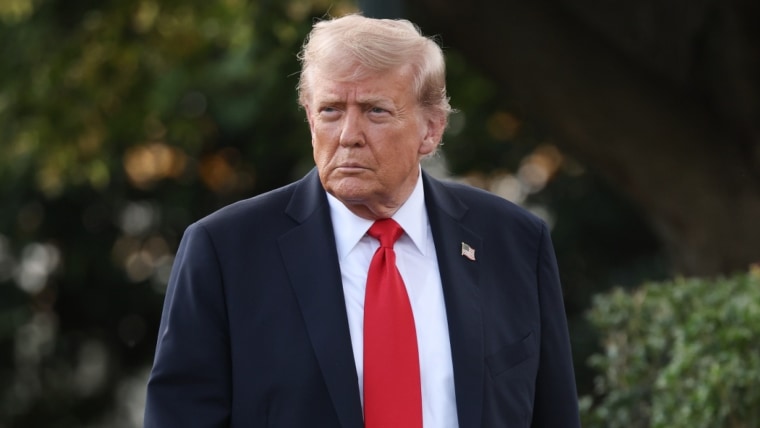
That promise seems a little less grand when you consider that, by the White House’s own admission, “more than 100 million patients are impacted by the diseases Pfizer’s medicines treat.” The fact sheet specifies savings for just three drugs — with Eucrisia, Xeljanz and Zavzpret becoming available at 80%, 40% and 50% discounts, respectively — and other phrases in the order, like “tangible cost savings,” leave the typical savings unclear. All we can say with any confidence is that the White House has pulled back from Trump’s mathematically impossible promise of “1,000%” reduction in prescription drug costs.
And what, if any, benefit will be enjoyed by the millions of patients taking drugs developed by Eli Lilly (which manufactures widely used drugs such as Prozac and Humalog insulin), Johnson & Johnson, AbbVie, Merck, Amgen and others?
What’s more, it is unclear exactly what the benefit will be for Medicaid patients. Their copayments are already capped under federal law at $4 for preferred drugs and $8 for non-preferred drugs — and are often even lower.
It is unclear exactly what the benefit will be for Medicaid patients.
Among the exact drug discounts in the fact sheet, Xeljanz (which used to treat autoimmune conditions) has a list price over $6,000. While privately insured patients’ out-of-pocket prescription drug costs often are difficult to shoulder, reducing a $6,000 list price by 40% still leaves patients with a $3,600 drug in a country where most Americans cannot afford a $1,000 emergency expense. It’s also far above the roughly $1,400 the average American spends on prescription drugs every year (well above what is spent in other high-income countries). The negotiated price of the migraine drug Zavzpret — around $750 per dose, versus a $1,500 list price — is similarly costly, especially when you account for patients taking multiple doses over the course of a year.
Thus, while these are big cost reductions, the cash prices would most likely remain higher than the insured population would face and prohibitively expensive for the uninsured. What’s more, as with private direct-to-consumer platforms like GoodRx, such payments would not count toward insured patients’ deductibles or out-of-pocket maximums. Thus, in some situations they can lead to more health care spending in a year.
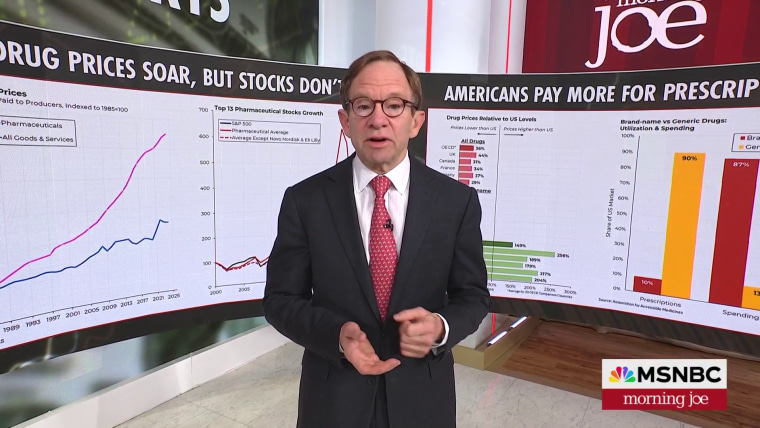
More broadly, there is a fundamental contradiction between TrumpRx’s promise and its namesake’s record. While this is hardly the first time Trump has expressed concern about prescription drug affordability, it is difficult to square that concern with his opposition to the Inflation Reduction Act (which capped insulin at $35 for Medicare patients), his support for cuts to Medicaid and the Affordable Care Act (both of which help ensure health care access) and his recent imposition of 100% tariffs on pharmaceuticals (which increases prescription drug costs).
So does this new policy rollout prioritize cost savings for American patients, or will it largely operate as a means for select pharmaceutical companies to avoid those newly announced tariffs?
For many Americans, a trip to the pharmacy means the stresses of figuring out which drugs are covered or how to afford those drugs at all. Reducing high prescription drug costs is vital in improving health equity and outcomes, and despite threats from this administration, the Inflation Reduction Act and health policies such as Medicaid and the Affordable Care Act have worked to expand access to prescription drugs. TrumpRx advertises dramatic reductions in out-of-pocket costs for many prescription drugs, but the jury is still out on what relief it will bring Americans.
Miranda Yaver
Miranda Yaver is an assistant professor of health policy and management at the University of Pittsburgh and a health care fellow at the Roosevelt Institute.


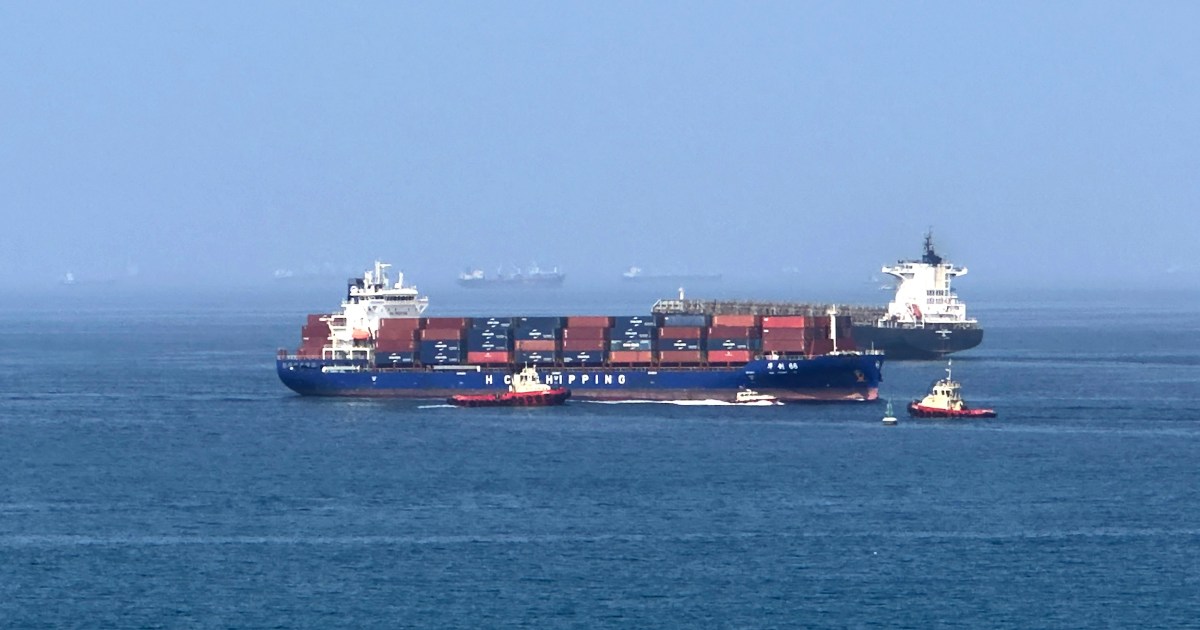
DUBAI, United Arab Emirates (AP) — Iran again launched drone and missile attacks targeting Bahrainand Kuwaiton Sunday following new U.S. airstrikes against the Islamic Republic, and threatened a “complete halt” in negotiations to end the warif Washington continues its attacks.
Efforts to reopen the Strait of Hormuzwithout Iran’s oversight has sparked days of crossfire. A multinational maritime body overseen by the U.S. Navy said Saturday it would expand a route near Omanfor inbound and outbound traffic.
Iranian Foreign Minister Abbas Araghchi on Sunday reiterated the claim that Tehran must govern the strait to the Persian Gulfthat once carried a fifth of the world’s oil and natural gas.
“Any attempt to establish new or separate arrangements from those currently being carried out by the Islamic Republic of Iran will only lead to further complications, delay the reopening of the Strait of Hormuz and increase the level of tension,” Araghchi said.
The strait has long been considered an international waterway despite its location in Iran and Oman’s territorial waters. In recent days, Iran has twice attacked vessels going through a route near the Omani side.
A Pakistani official involved in the technical talks between the U.S. and Iran told MS NOW Sunday that talks between the sides are on hold given the ongoing fighting between the two sides. The source, who did not want to be named to discuss the sensitive matter, said the U.S., Iran, Pakistan and Qatar all have representatives currently in Switzerland to restart discussions when instructed to do so.
But the Trump administration said nothing has been canceled and technical talks are on track for the coming days.
Talks include arrangements around the strait, the removal of a U.S. blockade on Iranian ports and sanctions on Iran, and the future of Iran’s stockpile of highly enriched uranium. The two sides have 60 days from their signing of the memorandum of understanding earlier this month to work out details.
Continued conflict in Lebanon threatens the agreement, which says fighting must end on all fronts before certain issues can be discussed.
Strikes target Gulf states hosting US military
Iran’s paramilitary Revolutionary Guard claimed responsibility for the attacks in Bahrain and Kuwait.
Kuwait, which hosts a major U.S. military base, said air defenses intercepted Iranian drones and two missiles just after the U.S. strikes in Iran. There were no reports of injuries or damage.
Bahrain said the Iranian strikes damaged a residential building near the international airport and no one was killed. Bahrain is home to the U.S. Navy’s 5th Fleet. The damaged building was not near its headquarters.
Bahrain’s Foreign Ministry denounced what it called “a dangerous escalation that reveals that what Tehran is doing is not a passing act, nor an isolated incident, but rather a deliberate approach and a systematic pattern of repeated aggression.”
Later on Sunday, Qatar said a civilian had been killed, and another person was hurt, by shrapnel related to “military operations in the area” after a vessel didn’t return at its scheduled time on Saturday. It did not give details.
Trump accuses Iran of violating ceasefire
The U.S. military said it struck Iranian military “surveillance infrastructure, communication systems, air defense sites, drone storage facilities and minelayer capabilities” following an attack on a ship on Saturday. The Panamanian-flagged tanker Kiku carried crude oil for the state-run energy company of Qatar, another key mediator.
U.S. President Donald Trump on social media accused Iran of violating the deal and warned of a point where the U.S. may “be forced to militarily complete the job.”
“If that happens, the Islamic Republic of Iran will no longer exist!” Trump wrote.
The exchanges of fire began when an Iranian drone struck a merchant vesseloff Oman on Thursday and the U.S. military retaliated.
Ship traffic on the strait had increased over the past 72 hours, “despite the elevated threat environment,” the multinational maritime body overseen by the U.S. Navy said Sunday, adding that “U.S.-assisted commercial transits continued uninterrupted.”
It said 89 such transits had been made, below the historical average of 138 vessels a day.
Iran calls for new ‘conflict control unit’ in Lebanon
Last week, Israel and Lebanon signed a framework agreementto end the latest fighting between Israel and the Iranian-backed Hezbollah militant group, which began two days after the Iran war started when Hezbollah fired at Israel. Israel has responded with an invasion of southern Lebanon and it has said it will not withdraw until Hezbollah is disarmed.
The agreement did not include Iran or Hezbollah, which has criticized itand rejected calls to disarm.
On Sunday, Iran’s foreign minister again said the U.S. must force Israel to halt attacks and withdraw. Israel occupies around 600 square kilometers (231 square miles) in southern Lebanon, which it says it needs as a security buffer.
Sporadic clashes have continued, and Hezbollah’s leader said Saturday that the group would continue fighting until Israel withdraws from Lebanon.
Key Iranian negotiator and parliament Speaker Mohammad Bagher Qalibaf said Sunday that a meeting of a new “conflict control unit” formed among Iran, the United States and Lebanon should meet as soon as possible, Iran’s state broadcaster reported.
Two strikes hit southern Lebanon on Sunday morning — one in Taybeh town and the other in the Nabatiyeh area, according to Lebanon’s National News Agency. There was no immediate word on casualties.
Overnight, Hezbollah militants killed an Israeli soldier in Deir Siryan village in southern Lebanon, according to Israel’s military. Hezbollah did not comment.
Israel targets a village in Syria
Israel’s military targeted Abdin village in southern Syria’s Daraa province with artillery shelling Sunday evening, Syrian state media reported. There was no immediate report of casualties.
State news agency SANA earlier reported that residents had blocked the road into the village with stones to prevent Israeli forces from entering it again after they had entered and withdrawn.
Earlier Sunday, Israel’s military said it had killed several armed men in southern Syria but gave no details. There was no statement from Syrian officials.
Israel seized control of a U.N.-patrolled buffer zone in southern Syria in December 2024 following the ouster of former Syrian President Bashar Assad in an insurgent offensive. Israeli officials initially called the move temporary, but more recently they have said they plan to occupy the zone indefinitely.

New York Mayor Zohran Mamdani has a message for political opponents using him as the new face of the Democratic Party: “Let them.”
Recent primary races in New York turned into a proxy war between progressives, including democratic socialists like Mamdani, and establishment Democratic politicians after candidates endorsed by Mamdani faced off against those endorsed by House Minority Leader Hakeem Jeffries and New York Gov. Kathy Hochul. After all three of Mamdani’s endorsements bore fruit, a national spotlight shone on the mayor as a growing influence in the Democratic Party.
Asked on ABC News’ “This Week” on Sunday how he felt about Republicans making him the “poster child” for the Democratic Party, Mamdani said, “Let them. We don’t have to ask ourselves what life looks like if a socialist wins. I won last November, and over the course of these last six months, what we’ve delivered for working people are the very things we were told were impossible.”
He touted recent campaign promises he delivered on, including freezing rents for nearly one million rent-stabilized apartments, expanding free child care and filling potholes across the city.
“I think we are seeing a hunger that is not just felt by New Yorkers, but frankly by Americans from coast to coast for a new politics, one that puts working people at the heart of it,” Mamdani told ABC.
Mamdani dismissed criticism from Republicans and Democrats alike. Jeffries, who represents parts of Brooklyn and Queens, said last week that he and the mayor “agree to strongly disagree about some of his endorsements, and he’s got work to do in terms of the conversations that he’s going to have with members of Congress moving forward.” Democratic Sen. Richard Blumenthal of Connecticut said, “The effort to nationalize New York is going to fail.”
Mamdani said he’s focused on the three congressional candidates he has already endorsed: Brad LanderDarializa Avila Chevalier and Claire Valdez. But he didn’t rule out future endorsements outside of New York.
“It’s not just New York City where working people are asking themselves ‘why can’t I afford my rent, why can’t I afford my groceries, why can’t I find enough money in my pocket for childcare no matter how hard I work?,’” Mamdani said.
When asked about a recent manifesto penned by a number of moderate House Democrats and Democratic candidates, promoting capitalism over socialism, Mamdani doubled down on his vision for the party.
“I’m not interested in writing a manifesto, or frankly, in reading one,” the mayor said. “I’m interested in delivering.”
Mamdani also criticized Democrats who continue to make antagonizing Trump the center of their politics rather than working people.
“You’ve got to have something that you are not just willing to stand up for, but that you’re also willing to explain how this is relevant to working people,” he said. “And I think this just comes back to the fact that I’m leading a city that’s the wealthiest city in the wealthiest country in the history of the world. I could end the sentence there and say that life is great for 8.5 million people. But it’s also a city where one in four are living in poverty. And for far too many Americans, those contradictions have become their day to day life.”
Erum Salam is a breaking news reporter for MS NOW, with a focus on how global events and foreign policy shape U.S. politics. She previously was a breaking news reporter for The Guardian.

Despite remaining undefeated in the initial round of the World Cupthe Iran national team is going home after failing to secure enough points to advance. But they do not leave quietly.
Iran’s tumultuous journey in the World Cup has been the subject of widespread attention amid the U.S. war with Iran, with the United States being one of three countries hosting matches. The Iranian team captain, Mehdi Taremi, blamed FIFA, saying, “It’s a disaster World Cup. A disaster.”
“I mean, FIFA, they have to solve every problem here but unfortunately they could not solve it since the beginning,” Taremi said at a press conference Friday after his team drew with Egypt, knocking Iran out of the tournament.
He pointed to the team’s biggest obstacle. “We don’t have our logistics people here. They don’t have a visa,” Taremi said, adding, “We always complain about these things but no one helps. No one.”
The Trump administration denied visas to key Iranian staff and severely restricted players’ travel. The team’s base camp was moved from Arizona to Tijuana, Mexico, where it was required to return immediately after each game.
“How is it possible we always have to travel from Tijuana? We love the people in Tijuana. We love Mexico,” the Iran team captain said, but added, “It’s not fair.”
Throughout the tournament, the Football Federation of Iran lamented the number of issues, threatening to lodge a formal complaint against FIFA. Head coach Amir Ghalenoei called his team the “most oppressed” in the tournament. A few days before Iran’s final match against Egypt in Seattle on Friday, the U.S. loosened travel restrictions to allow players to enter the United States two days before the game.
“The Iran team will still be required to leave the day the match ends,” the Department of Homeland Security said ahead of the match. “The overall security measures and protocol are the same. We remain committed to providing the safest tournament possible for players, staff, and fans alike.”
Still, Iran finished Group G in third place with three points earned after drawing in its matches against Belgium, New Zealandand Egypt. Under FIFA’s new 48-team format, the top eight of third-place teams move on to the next round, but Iran narrowly fell short.
The team initially seemed poised to advance when it was tied with the same amount of points as Algeria, which scored a goal in stoppage-time against Austria Saturday night. But moments later, Austria tied the game, guaranteeing Iran’s elimination.
Off the field, tensions with Iran heightened Friday when the U.S. struck Iran despite signing a memorandum of understanding meant to halt hostilities in order to finalize a peace deal.
Erum Salam is a breaking news reporter for MS NOW, with a focus on how global events and foreign policy shape U.S. politics. She previously was a breaking news reporter for The Guardian.
- Coons released from hospital after car crash caused minor injuries
- US, Iran agree to ‘stand down for now,’ resume peace talks: Official

- Trump: Reflecting Pool will be drained after July 4; algae ‘criminally made’

- Capitol agenda: Red, white and GOP hard-liner blues
- Fetterman, McCormick sidestep Shapiro on Pennsylvania’s ‘Great American State Fair’ booth

- AOC calls to ‘break up’ big tech companies amid price hikes
- Renewed Iranian attacks following U.S. strikes threaten to halt talks

- Mamdani embraces GOP making him ‘poster child’ of Democratic Party: ‘Let them’

- Iran soccer team leaves after narrow loss, denouncing ‘disaster World Cup’

- What Ron DeSantis’ closure of ‘Alligator Alcatraz’ reveals about MAGA
-

 Politics1 year ago
Former ‘Squad’ members launching ‘Bowman and Bush’ YouTube show
-

 The Dictatorship1 year ago
Luigi Mangione acknowledges public support in first official statement since arrest
-

 Politics1 year ago
Former Kentucky AG Daniel Cameron launches Senate bid
-
Uncategorized2 years ago
Bob Good to step down as Freedom Caucus chair this week
-

 The Josh Fourrier Show2 years ago
DOOMSDAY: Trump won, now what?
-

 The Dictatorship1 year ago
Pete Hegseth’s tenure at the Pentagon goes from bad to worse
-

 Politics1 year ago
Blue Light News’s Editorial Director Ryan Hutchins speaks at Blue Light News’s 2025 Governors Summit
-

 The Dictatorship10 months ago
Mike Johnson sums up the GOP’s arrogant position on military occupation with two words