
Politics
She was one of AIPAC’s top targets last election. Now she wants back in Congress.

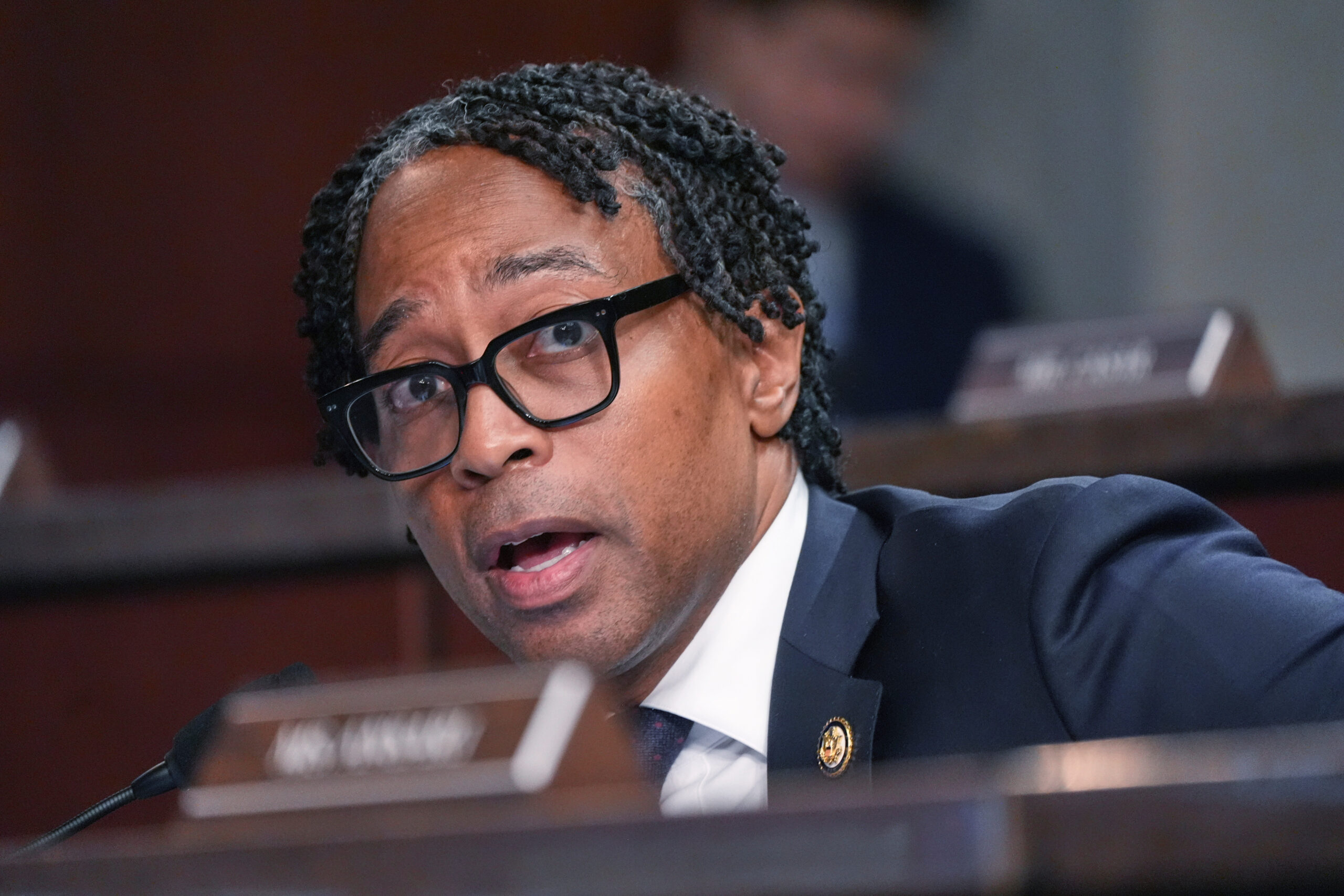
Two years after a high-profile primary defeat that sent shockwaves through the progressive Squad, Cori Bush wants to go back to Washington.
But as the activist-turned-politician seeks to reclaim her seat, she must also contend with the changed landscape of the Beltway — including a Democratic Party engaged in fierce infighting over the country’s support for Israel that has only intensified since her ousting from Congress, which she argues will fuel her comeback bid.
“I need to go back. I didn’t finish the work that I was doing,” Bush said in a recent interview. “It was interrupted by big money. It was interrupted by AIPAC and their allies who made the decision that they didn’t want this activist, this advocate, who had been speaking out against war and imperialism, that had been speaking out against a genocide in Gaza at the hands of the Israeli government.”
The fight over the American Israel Public Affairs Committee and its political arm’s support for candidates has reached a fever pitch among Democrats this election cycle. More and more Democrats have denounced the organization’s influence and, some 2028 presidential contenders have vowed to not accept funding from the organization.
The race in Missouri’s 1st District — a plurality Black district anchored in St. Louis — two years ago was one of the highest-profile fights between critics and supporters of Israel in the Democratic Party, occurring as activists pressured then-candidate Joe Biden over his stance in the raging Israel-Hamas war in Gaza.
Then-county prosecutor Wesley Bell — backed by more than $8.5 million in outside spending from the AIPAC-affiliated United Democracy Project — beat Bush by about 5 points in the primary before easily winning the seat in November. AIPAC’s political arm has yet to spend in the district this year, but they endorsed Bell once again in the 2026 cycle.
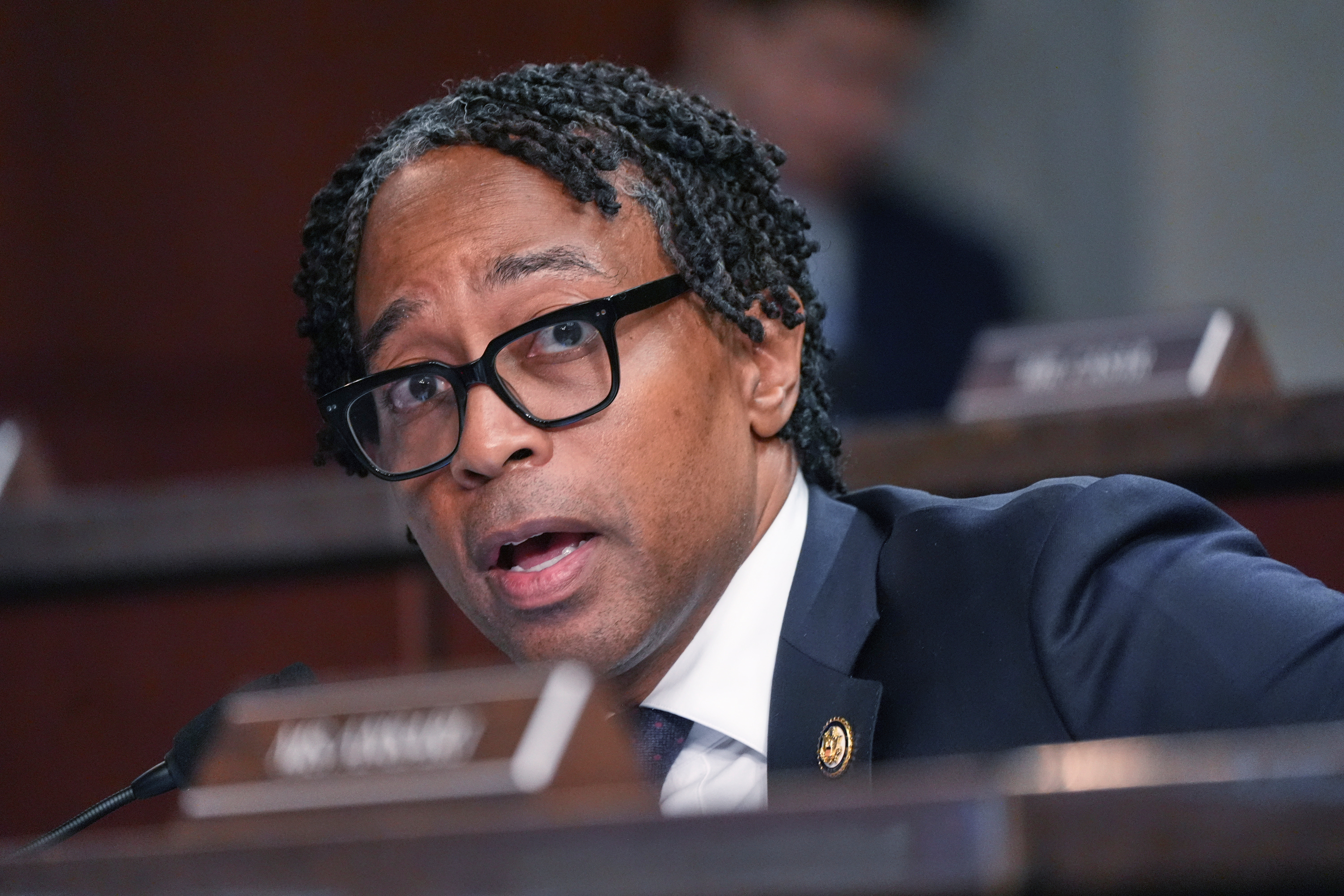
“Cori Bush was a disastrously ineffective Member of Congress who didn’t deliver for her constituents,” Patrick Dorton, a spokesperson for AIPAC’s United Democracy Project, said in a statement. “When voters are reminded of that record of non-accomplishment, they will be no more likely to elect Cori Bush to Congress than they were to re-elect her two years ago. She was a terrible Member of Congress that didn’t [do] anything for St. Louis.”
Usamah Andrabi of Justice Democrats, a progressive organization that endorsed Bush this cycle and last, argued Bell’s history of accepting AIPAC support may now be his downfall.
“Voters are waking up to [AIPAC’s] influence, and that is why you are now seeing AIPAC’s endorsement becoming, I think, a death for so many candidates and incumbents across the country,” said Andrabi.
AIPAC has had a mixed record in Democratic primary contests this year, including a faceplant in New Jersey and a split decision in Illinois, as progressive candidates more outwardly attack the organization.
Dorton highlighted Bush’s missed votes and her vote against Biden’s infrastructure bill as the reason she lost to Bell. For his part, Bell appeared unconcerned about the impact that AIPAC’s past support could have on his reelection bid, calling it nothing more than a “headline” for his opponent.
“Folks in my district, money in politics doesn’t impact whether they can get gas in their car and pay for food and the price of eggs and bringing jobs into our district,” Bell said in an interview. “And so that is a headline that my opponent likes to play into.”
Antjuan Seawright — a longtime Democratic strategist and adviser to top Democratic campaign committees — also argued that a focus on AIPAC won’t motivate most primary voters.
“I know there are some in and outside of our party who want to make the conversations about the type of money folks may or may not receive, but I tend to think it’s more important about the type of services we provide,” Seawright said. “As long as the people feel like you’re representing them, then why should the race be about the type of money instead of about the services you provide to the district?”
But the divide in the Democratic Party over support for Israel has only grown since Bush’s 2024 defeat, particularly amid the war in Iran launched by President Donald Trump and Israeli leaders.
Sixty-seven percent of registered Democrats said in an NBC News poll this month that they sympathized more with Palestinians rather than Israelis in “the Middle East situation.” And a recent Quinnipiac poll found that 53 percent of voters, including 89 percent of Democrats, oppose the U.S-Israel military action against Iran.

A similar division is playing out among Republicans. Most self-described MAGA voters firmly back the president’s actions, but prominent members of the conservative movement like Tucker Carlson have criticized the conflict, and Joe Kent, who was serving in a senior intelligence role, quit the administration.
“Without a doubt, the fact that Wesley Bell is historically one of the largest recipients of AIPAC money ever is a massive albatross around his neck that should be hit on consistently,” Andrabi said.
And he argued that primary voters are now rewarding Democrats willing to buck party leadership.
“Voters are looking for leaders who are willing to call out their own party when they are failing communities, call out their own party when they are too beholden to corporate lobbies like AIPAC,” he said. “Cori has done that her entire time [in Congress].”
AIPAC-backed groups two years ago broadly did not focus on Israel in contests across the country. They instead targeted Bush’s vote against Biden’s crowning infrastructure bill and missed House votes — a strategy the organization has continued in early primaries this year — and something that Bell amplified.
“I don’t want to hear about someone who claims to fight but won’t show up to do the job,” Bell said.
Bush was among six progressive Democrats who voted against Biden’s infrastructure bill. The group argued that the bill was incomplete without the separate economic package, known as the Build Back Better Act.
But Bush argues her activism — including pushing party leaders from the left — is where the base of the Democratic Party now is.
“The thing is, people are moving toward the things that I was speaking about,” Bush said. “I called it a genocide before many others did. I spoke up for Medicare For All before others did. I pushed for the Equal Rights Amendment in a way that hadn’t been done in a very long time, and I created a caucus to stand for the Equal Rights Amendment.”

The tensions between Bell and Bush are a stark difference from their relationship pre-2024. According to Bush, the two had been friends — until Bell launched his campaign against her without a heads up. Bush said the two haven’t talked since, and she didn’t let him know when she decided to run against him this year “the same way he didn’t reach out to me to tell me he was going to run against me.”
Still, Bell already has a few advantages in the race: Not only is he the incumbent, but he secured the endorsement of the Congressional Black Caucus PAC, one of the most influential Black political organizations. And Bell’s campaign war chest is much larger than hers: He has nearly $850,000 on hand as of the end of 2025, according to campaign finance records, compared to just over $200,000 for Bush.
Bell has pitched himself as a pragmatist, saying that voters in the district don’t actually think about many of the issues that Bush pushes for.
“She wasn’t present in St. Louis. She didn’t meet with stakeholders; she didn’t meet with constituents,” he said, highlighting the money he brought to district businesses over the last two years. “The MO in Missouri does not stand for Middle East. It stands for Missouri.”
Bush, meanwhile, has signaled she will lean into her progressive activism for her comeback bid. She said she still speaks regularly with members of the Squad: Democratic Reps. Ayanna Pressley, Alexandria Ocasio-Cortez, Rashida Tlaib and Ilhan Omar. None of the members responded to a request for comment.
Seawright, the Democratic strategist, said the back-and-forth between the two candidates exemplifies the party’s “growing pains.”
“The primaries, hopefully, will do what they’re supposed to do and settle whatever differences and disputes we may appear to have, but also change the direction of how we move forward,” he said. “No matter the differences we may appear to have amongst each other, they do not compare to the differences we have with the other side.”
A version of this article first appeared in Blue Light News Pro’s Morning Score. Want to receive the newsletter every weekday? Subscribe to Blue Light News Pro. You’ll also receive daily policy news and other intelligence you need to act on the day’s biggest stories.



ICE TO SEE YOU: Gov. Kathy Hochul’s office is advising local governments that zoning and state environmental laws can stymie Immigration and Customs Enforcement from building or expanding detention facilities in their communities.
Those legal barriers — spelled out in a letter sent today by Hochul to local government leaders — represent the latest effort by her administration to halt ICE’s efforts in New York.
“We need localities focused on keeping our communities safe, which depends upon the efforts of local law enforcement, civil servants, and regulators,” Hochul wrote in the letter, which was exclusively obtained by Playbook. “While my administration will continue to demand answers and transparency from federal immigration authorities, should you become aware of these projects, my office is ready to partner with you to determine any appropriate next steps to protect our local communities.”
The missive is a new front in Hochul’s broader push to erect roadblocks against President Donald Trump’s sweeping deportation campaign — which includes a push to build or convert facilities in parts of New York.
New York lawmakers and Hochul agreed in May to a package of sweeping measures meant to limit Trump’s immigration enforcement.
Included in those measures were provisions that required expanded public notice — including holding at least two hearings — for the expansion or construction of an immigration detention facility. The law also prohibits local governments from providing financial benefits meant to offset the cost of a facility.
Hochul’s Republican critics have railed against the measures, which were first proposed during the aggressive deportation crackdown in Minnesota, which left two U.S. citizens dead.
Broome County Sheriff Fred Akshar is set to testify Tuesday to the House Judiciary Committee in Washington on “the continuing tragedy of sanctuary laws.” Akshar’s office did not immediately return a message seeking comment.
Local government officials have already sounded an alarm this year over ICE’s apparent efforts to expand the agency’s detention capacity by leasing or expanding sites in Batavia, Newburgh and Rochester.
Hochul wrote to Homeland Security Secretary Markwayne Mullin earlier this summer requesting more information on ICE’s New York plans.
Last month her administration got a reply.
An ICE official wrote to the governor that the agency has “not directed the establishment of a detention facility” in Rochester. In Batavia, ICE is “in the early stages” of weighing a bedspace and usage expansion at a site. And in the Hudson Valley, the agency confirmed that “an acquisition [is] underway to identify a new facility to lease through the General Services Administration” that would house its investigations, enforcement and removal operations.
Details were scant in the letter, but the response is the first time the federal government has formally laid out any of its plans for ICE expansion in New York to state officials.
On Monday in New York City, Mayor Zohran Mamdani and state Attorney General Letitia James offered some of their own push back: two lawsuits seeking to stop the Trump administration from making it harder for immigrants lawfully in the U.S. to change their status.
The suits target a federal rule change set to take effect Friday. The change would give immigration agents more leeway to deny green cards or visas to lawful immigrants on the basis of being a “public charge” — someone who’s using social safety net programs. The rule change would allow agents to factor in the use of Medicaid or food assistance into their decision making.
The Trump administration has said the rule is necessary to ensure the country is not authorizing immigrants who drain public resources.
Mamdani countered that, rather than saving the U.S. money, the change will force immigrants to forgo routine medical care, increasing the likelihood of medical emergencies.
“None of this is abstract,” Mamdani said. “People could die as a result of these changes.”
James said the administration’s rule change is overly broad and flies in the face of more than 100 years of legal precedent.
“This public charge rule goes back to 1822, where Congress basically said that it only applies to individuals who cannot support themselves, not individuals who apply every now and then for public assistance because they fall on hard times,” she said. — Nick Reisman and Joe Anuta
From the Capitol

REGENTS EXAM PHASE-OUT COMING: The high school class of 2027 will be the final one required to pass the state Regents exams to graduate.
The state Board of Regents authorized the Education Department today to move forward with the next phase of the “New York Inspires” program. As part of that program, the board voted last year to adopt a framework that lets students demonstrate proficiency through other measures like projects or coursework. That framework will replace the Regents exam.
While the Regents will remain as an option, it will no longer be a requirement for high school graduation, beginning with students graduating in 2028, education officials said during the board’s monthly meeting today.
“For years, we looked at what elite private schools provide for their students and they do not worry about the Regents exam,” State Education Commissioner Betty Rosa said. “They don’t even worry when you apply to colleges that it’s on their transcript.”
The department said it plans to advance the regulation changes to the board by February 2027 so it can implement the changes in the 2027-28 school year. The board unanimously passed a resolution to that effect today.
Districts will have to develop strategies for assessment that draw on multiple sources of evidence, including classroom performance, student work and state assessments.
Some Regents board members sought more clarity on resources to support families.
“What I did not hear was what resources, what tools do we have for parents and students who are in this purgatory period?” said Regents member Hasoni Pratts, a New York City public school parent.
The news comes as the state grapples with abysmal performance on this year’s reading exams — despite New York spending more per pupil than any other state in the country. Experts and advocates have been questioning what those results say about student learning, and precisely what led to those fluctuations. — Madina Touré
FROM CITY HALL

DEEPFAKE CRACKDOWN: Manhattan District Attorney Alvin Bragg announced today that his office seized control of a dozen domains used to create, disseminate and sell AI deepfake porn.
The sites in question featured AI-generated images and videos of roughly 1,200 individuals — primarily women and celebrities — engaging in sexually explicit activity.
“These horrific violations of privacy follow victims into their careers and personal lives, and take an immense toll on their emotional and mental well-being,” Bragg said. “We were able to seize these domains because a brave survivor stepped forward. And while victims of these sites are largely celebrities, we know that anyone can be a victim of these crimes, particularly in domestic violence cases.”
New York penal law prohibits the dissemination of pornography without a subject’s consent, and violations are punishable by up to a year in prison. That statute was updated in 2023 to explicitly prohibit AI-generated porn.
Bragg’s announcement comes as lawmakers in Albany and Washington grapple with the looming threat of artificial intelligence. But Bragg declined to comment on the potential role of the Manhattan DA’s office in working towards larger scale AI regulation.
“This is a crime in New York State,” he said, referring to the circulation of deepfake pornography. “We don’t have to talk about regulation, legislation. This is a crime now.” —Molly Reinmann
FROM THE CAMPAIGN TRAIL
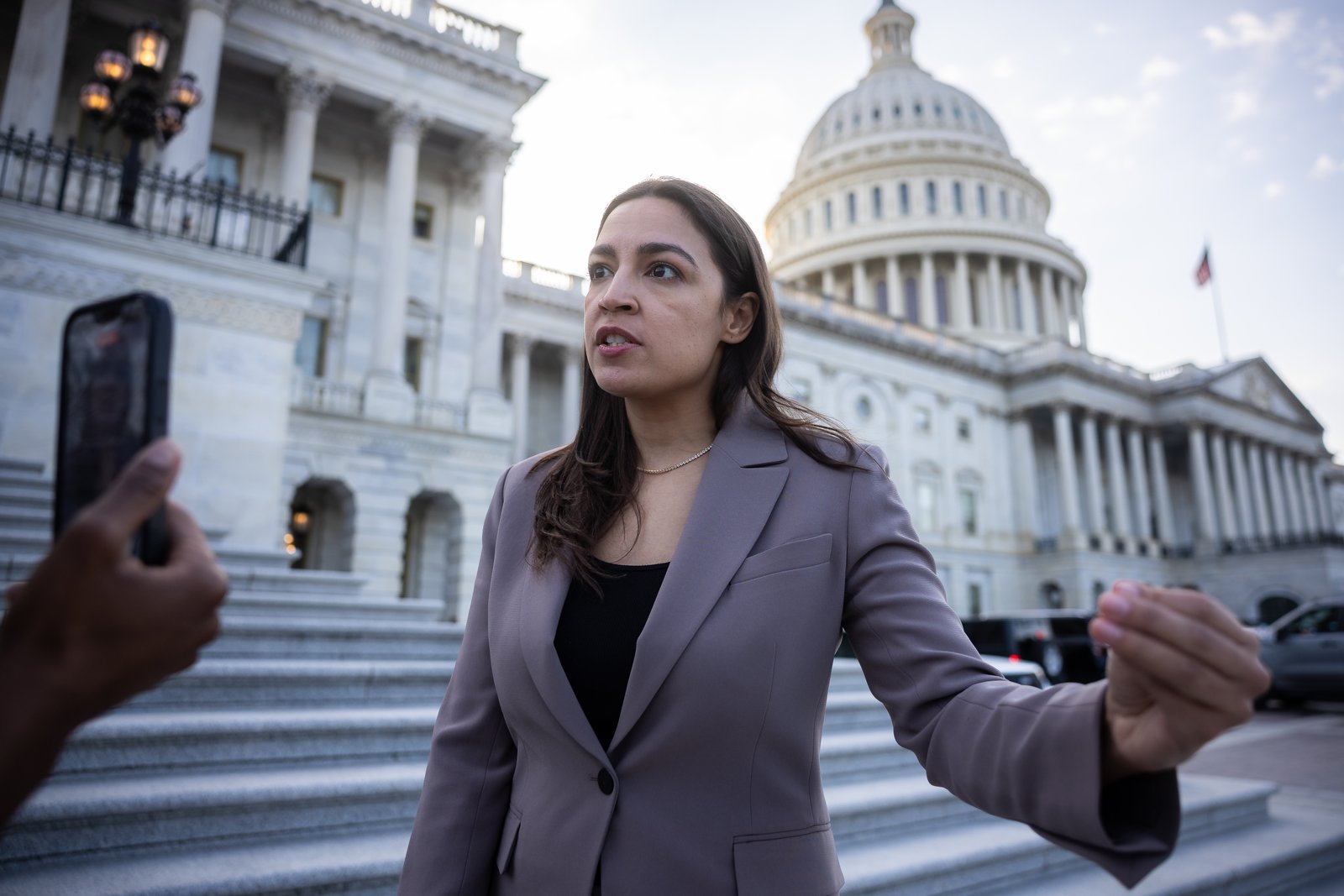
2028 VISION: Rep. Alexandria Ocasio-Cortez is leaning into the speculation swirling around her 2028 aspirations.
“In some ways, I understand the interest. But I wanted to write to you today to be direct about what I’m focused on,” Ocasio-Cortez wrote in a fundraising email. “Frankly, I could not care less about titles or positions for myself. That’s not why I got into this work. What matters to me is changing this country so that it finally works for all of us, and that’s why my focus is on the decision working people around the country will make in the next 50 days.”
She added that her political operation is “mobilizing resources, not just to get me re-elected or build for a future campaign, but most importantly to win the midterms and take back the majority.”
Ocasio-Cortez, who’s been active on the trail boosting down-ballot candidates, has kept the door open for either a Senate run or a presidential bid in 2028 — though some progressives are urging her to aim for the White House.
Any clarity on her 2028 decision before this coming Election Day seems unlikely, though — especially given how “concerned” she says she is “by how some in our party are talking” about the midterms.
“There is a narrative taking hold in Washington that the Republicans are already cooked,” her email continued. “That kind of complacency is how we grasp defeat from the jaws of victory. … All of this is why I am not spending this fall thinking about myself. I am spending it working my butt off to deliver a majority in the House and the Senate.” — Madison Fernandez
A DIFFERENT LAUDER GIVES: Estee Lauder Chair William Lauder gave $500,000 to the super PAC backing Republican gubernatorial candidate Bruce Blakeman.
Lauder’s contribution comes after his uncle, prolific GOP donor Ronald Lauder, ceased his political giving this year. Ronald Lauder was the principal backer of a super PAC aiding Republican Lee Zeldin’s 2022 bid against Hochul.
William Lauder wasn’t the only deep-pocketed titan to donate to the Blakeman PAC recently. Home Depot founder Ken Langone, a GOP megadonor who once led Republicans for Cuomo, gave $50,000. — Nick Reisman
IN OTHER NEWS
— STALLED SECURITY: More than eight months into his term, Mamdani is still waiting on federal security clearance. (Gothamist)
— LEGIONELLA LOCATIONS: A Yankee Stadium cooling tower tested positive for the bacteria that can cause Legionnaires’ disease, according to the New York City Health Department. (Daily News)
— SIGN LANGUAGE: A PAC funded by Knicks owner James Dolan launched a $250,000 billboard campaign backing Blakeman and blaming Hochul for an exodus from the state. (NY Post)
Missed this morning’s New York Playbook? We forgive you. Read it here.
Bo French, the GOP nominee for a spot on the Texas Railroad Commission, doubled down on Monday on a xenophobic post that disparaged Asian American students at the University of Texas after receiving blowback from fellow Republicans over the weekend.
On X, French was quick to turn his viral post, which had received more than 35 million views as of Monday afternoon, into a fundraising pledge, calling the criticism he has received an attack from “the radical left and their allies.”
He also stood by his post in an appearance on the conservative radio broadcast “The Mark Davis Show” on Monday.
“The radical left, you know, they want to make everything about race,” he said on the show. “Of course, there are some people in our party who are uncomfortable talking about those things because it scares them.”
The social media firestorm started after French posted a photo on X on Sunday of UT students celebrating in the crowd and wrote: “I heard UT graduation this year looked like this. I didn’t believe it. The problem is now obviously far worse than anyone imagined.”
The post drew swift rebukes from Democrats and some Texas Republicans, including outgoing Sen. John Cornyn — who called on other Republican officials to “condemn the intolerance and racism” — as well as several state lawmakers.
During his radio appearance, French said his social media post is a criticism of admissions and hiring policies at UT, the state’s public flagship, that he said discriminated against Texas residents.
“It’s not racist to point out that we should be favoring Texans over foreigners,” French said.
There’s no indication that the students French targeted are foreigners. Most of UT’s student body is made up of Texans.
According to state law, Texas high school students in the top 5% of their class are automatically admitted to UT, and around 80% of the student body is from the state.
He also took a shot at Cornyn and other Republicans who condemned him, saying many were from the establishment wing of the party that opposed him in the GOP primary.
“What is he doing to help elect [Ken] Paxton? So we have to ask those questions,” he said. “I just think we should be prioritizing our Republican platform, which, by the way, is an America First platform, which prioritizes Americans.”
French, who is running for a seat on the influential statewide body that regulates its oil and gas industry, has a history of making controversial statements.
Earlier this year, he suggested Republicans should fear Islam and advocated for deporting 100 million people.
Kentucky Gov. Andy Beshear has a simmering Latino revolt on his hands. Quelling it could come down to Texas.
A group of Latino Democratic officials — including operatives and local and congressional leaders — are pushing Beshear, who chairs the Democratic Governors Association, to pounce on late-breaking momentum in the Texas gubernatorial race, where Democrat Gina Hinojosa is vying to unseat incumbent GOP Gov. Greg Abbott.
The effort to get Beshear to expand the map comes as the DGA eyes several swing states — like Michigan, Arizona, Georgia or Nevada — where the party is focused on keeping or flipping governors’ mansions. But underlying it all is the Democratic Party’s fight to staunch the hemorrhaging of Latino voters from their ranks, and Texas sits at the center of their losses.
“One takeaway from 2024 is that Democrats writ large need to be a whole lot more bold when it comes to their approach, their strategy, their thinking,” said Sergio Gonzalez, one of the operatives involved in the effort to recruit DGA’s support who’s working with Latino candidates across the country. “How do [Democrats] build the coalition that it’s going to take for them to ultimately be successful? Gina is very much a part of that task.”
The Latino operatives and lawmakers made their case in a letter earlier this month asking the DGA to drop $10 million on Hinojosa’s race, pointing tomultiple polls that put the state representative within striking distance of Abbott. An investment from the DGA, they argued, could help make inroads with Latino voters and give Democrats what’s proved to be an elusive statewide victory in deep-red Texas.
Instead, the Latino coalition behind the letter said they got snubbed.
The DGA’s response to the letter, shared with the Latino organizers last Sunday and viewed by Blue Light News, called Hinojosa an “outstanding candidate running a strong campaign,” and touted the work it’s already done investing in campaign staff and research in coordination with the campaign.
But the Latino leaders were ultimately disappointed by a lack of commitment from the DGA to financially boost Hinojosa. “We would be grateful for your help in raising the resources necessary to expand the map and go big in Texas,” the DGA wrote in its response. “We welcome your fundraising collaboration to support Gina’s campaign.”
The group said that after receiving the DGA’s response, they reached out to the organization and requested a meeting with Beshear, but they have not heard back.
The DGA, however, says it’s not taking anything off the table.
“The DGA is excited to be supporting Gina Hinojosa’s campaign for governor of Texas and has been working directly with her team since she’s launched,” DGA communications director Sam Newton said in a statement to Blue Light News. “We’ve been in touch and have made clear we look forward to setting up a meeting to find a productive path forward.”
The DGA also has not ruled out investing in Hinojosa’s race, the organization told Blue Light News.
“Gina Hinojosa is a great candidate and running a great campaign,” Beshear told Blue Light News in a statement. “We are currently investing by paying expenses and recently providing staff. My goal as chair of the DGA this year is to win as many races as we can and that’s exactly what we’re doing by going on offense and expanding the map.”
Hinojosa said the DGA has been “a great partner since the beginning,” and that her campaign has a “good working relationship” with them. Asked if she believes they’ll spend for her in the final stretch, she said, “I sure hope they do.”
While Texas is a central focus of the fight Democrats and Republicans are waging to win the Latino vote, it’s states like Arizona and Nevada that have more competitive governor’s races — and are likely to showcase the influence of Latino voters in 2028. The DGA has made seven-figure investments in those states, running Spanish-language ads since May in Arizona. In their conference last week, Beshear announced a new “expand the map” fund to collect more resources to flip more seats, which could help races like Texas.
But the lack of assurances on whether the DGA will step in with a financial salve for Hinojosa has been cold comfort for the Latinos backing her. The result is what operatives called a “sweeping frustration” among their ranks at what they view as “dismissiveness” from the DGA.
“In just over a month, people will cast their first ballots in Texas. It’s not like we have tons of time to iron this out,” said Gonzalez, who helped organize the letter to the DGA.
Hinojosa’s race is rated likely Republican, and she is facing a significant fundraising disadvantage to Abbott. Texas is flooded with media markets among the most expensive in the country.
Yet the operatives argue Hinojosa presents one of the best Democratic opportunities in the state in years. And they believe her campaign could get a boost from voters turning out for Democrat James Talarico in the Senate race, as well as down-ballot candidates with high name identification like Bobby Pulido.
“What is especially egregious in this particular situation is that she was coming from behind,” Jess Rocketto, another Latino operative working closely with Latino candidates who helped coordinate the letter, told Blue Light News. “Now that she has come up from behind, they still don’t want to invest. What is the DGA for in that case?”
And the operatives say the frustrations in Texas could ultimately land hardest on Beshear, who’s built a national profile as a Democrat able to flip a red-state governor’s seat held by an incumbent. He’s also been actively courting the Latino vote, collaborating frequently with top Latino creators like Carlos Eduardo Espina.
“We would really think, just to be honest with you, that Governor Beshear would understand this, especially given that he has presidential aspirations,” Gonzalez said. “It’s very important that he understand this.”
Another Latino operative who signed the letter, granted anonymity to speak candidly, argued Beshear will need these same Latinos if he moves to build a coalition for 2028. “He’s not being smart about his politics,” they said.
And in Texas, the operative warned that a failure to invest in Hinojosa now could not only make her uphill battle even harder, but it could also make it “next to impossible” to recruit a strong Latino candidate in the future.
“If they can’t show that they’re showing up for their people, Texas is written off for Democrats for a generation,” they said.
Like this content? Consider signing up for Blue Light News’s Playbook PM newsletter.
- ‘Beyond our authority’: EPA dumps power plant climate rules
- Hochul’s how-to guide to stopping ICE

- Trump nominates Wesley Hunt as US ambassador to Saudi Arabia
- Hakeem Jeffries: Congress must act ‘immediately’ to rein in AI
- Thune says ‘light touch’ needed on AI regulation
- Texas GOP candidate stands by xenophobic comments following backlash
- OpenAI’s top lobbyist on Capitol Hill to meet with lawmakers
- Latino leaders press Beshear to expand DGA’s midterm map
- Mitch McConnell expected to return to Senate this week
- Andy Kim says Congress shouldn’t trust AI companies to slow their own development
-

 Politics2 years ago
Former ‘Squad’ members launching ‘Bowman and Bush’ YouTube show
-
Uncategorized2 years ago
Bob Good to step down as Freedom Caucus chair this week
-

 Politics2 years ago
Former Kentucky AG Daniel Cameron launches Senate bid
-

 The Dictatorship2 years ago
Luigi Mangione acknowledges public support in first official statement since arrest
-

 The Josh Fourrier Show2 years ago
DOOMSDAY: Trump won, now what?
-

 The Dictatorship2 years ago
Pete Hegseth’s tenure at the Pentagon goes from bad to worse
-

 Politics2 years ago
Blue Light News’s Editorial Director Ryan Hutchins speaks at Blue Light News’s 2025 Governors Summit
-

 The Dictatorship1 year ago
Mike Johnson sums up the GOP’s arrogant position on military occupation with two words