
Congress
Trump thrashes European leaders in wide-ranging interview: ‘I think they’re weak’

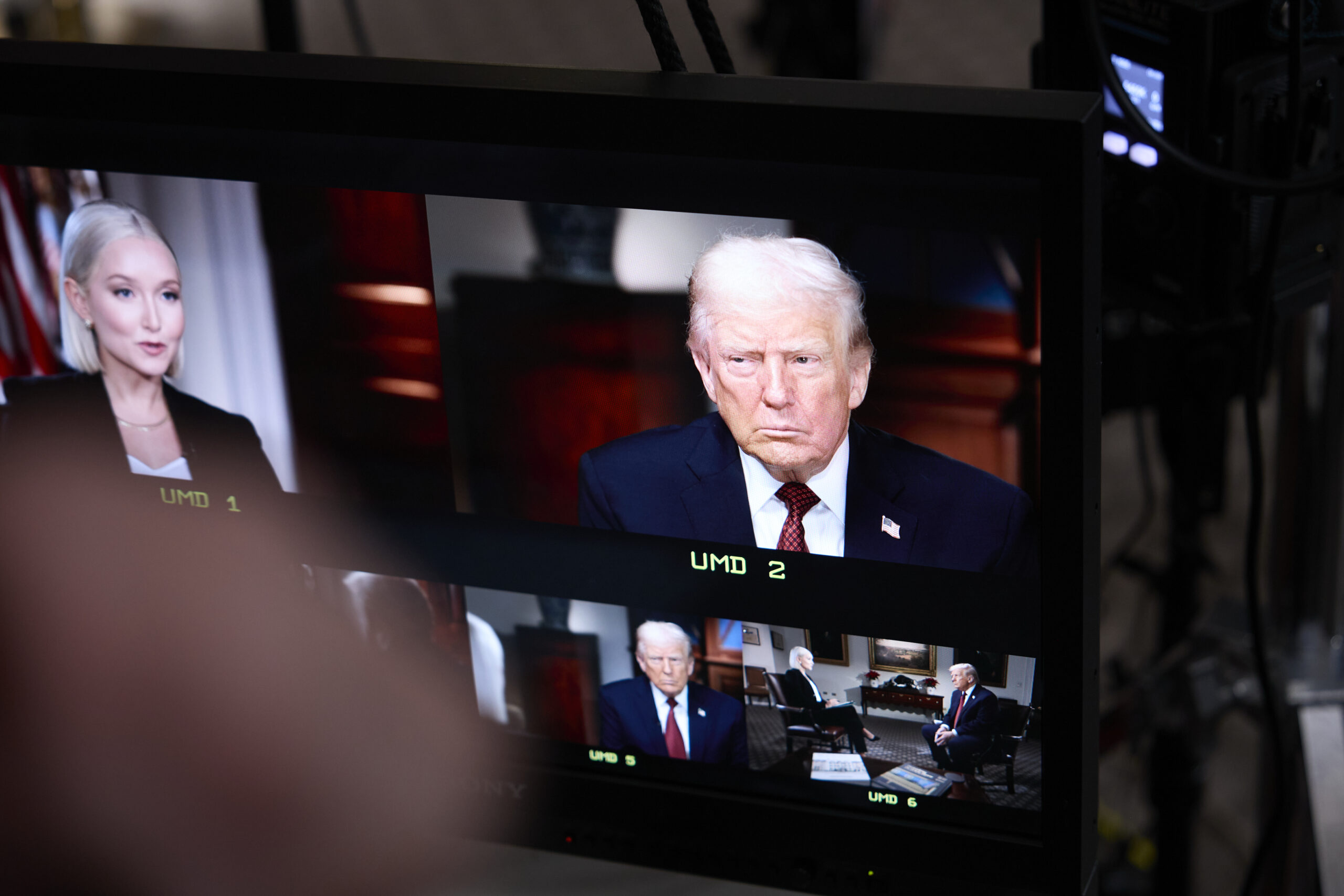
President Donald Trump denounced Europe as a “decaying” group of nations led by “weak” people in an interview with Blue Light News, belittling the traditional U.S. allies for failing to control migration and end the Russia-Ukraine war, and signaling that he would endorse European political candidates aligned with his own vision for the continent.
The broadside attack against European political leadership represents the president’s most virulent denunciation to date of these Western democracies, threatening a decisive rupture with countries like France and Germany that already have deeply strained relations with the Trump administration.
“I think they’re weak,” Trump said of Europe’s political leaders. “But I also think that they want to be so politically correct.”
“I think they don’t know what to do,” he added. “Europe doesn’t know what to do.”
Trump matched that blunt, even abrasive, candor on European affairs with a sequence of stark pronouncements on matters closer to home: He said he would make support for immediately slashing interest rates a litmus test in his choice of a new Federal Reserve chair. He said he could extend anti-drug military operations to Mexico and Colombia. And Trump urged conservative Supreme Court Justices Samuel Alito and Clarence Thomas, both in their 70s, to stay on the bench.
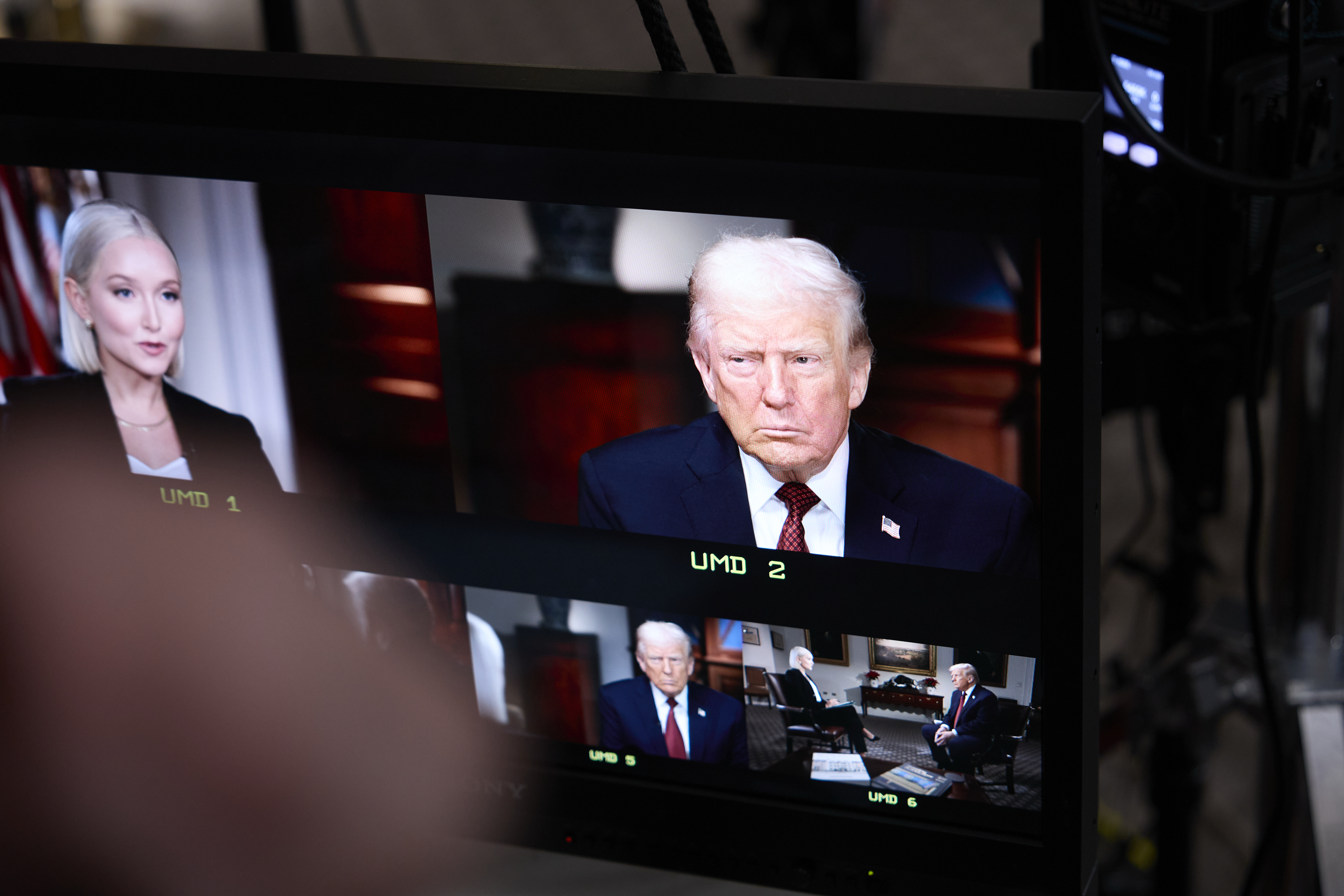
Trump’s comments about Europe come at an especially precarious moment in the negotiations to end Russia’s war in Ukraine, as European leaders express intensifying alarm that Trump may abandon Ukraine and its continental allies to Russian aggression. In the interview, Trump offered no reassurance to Europeans on that score and declared that Russia was obviously in a stronger position than Ukraine.
Trump spoke on Monday at the White House with Blue Light News’s Dasha Burns for a special episode of The Conversation. Blue Light News on Tuesday named Trump the most influential figure shaping European politics in the year ahead, a recognition previously conferred on leaders including Ukrainian President Volodymyr Zelenskyy, Italian Prime Minister Giorgia Meloni and Hungarian Prime Minister Viktor Orbán.
Trump’s confident commentary on Europe presented a sharp contrast with some of his remarks on domestic matters in the interview. The president and his party have faced a series of electoral setbacks and spiraling dysfunction in Congress this fall as voters rebel against the high cost of living. Trump has struggled to deliver a message to meet that new reality: In the interview, he graded the economy’s performance as an “A-plus-plus-plus-plus-plus,” insisted that prices were falling across the board and declined to outline a specific remedy for imminent spikes in health care premiums.
Even amid growing turbulence at home, however, Trump remains a singular figure in international politics.
In recent days, European capitals have shuddered with dismay at the release of Trump’s new National Security Strategy, a highly provocative manifesto that cast the Trump administration in opposition to the mainstream European political establishment and vowed to “cultivate resistance” to the European status quo on immigration and other politically volatile issues.
In the interview, Trump amplified that worldview, describing cities like London and Paris as creaking under the burden of migration from the Middle East and Africa. Without a change in border policy, Trump said, some European states “will not be viable countries any longer.”
Using highly incendiary language, Trump singled out London’s left-wing mayor, Sadiq Khan, the son of Pakistani immigrants and the city’s first Muslim mayor, as a “disaster” and blamed his election on immigration: “He gets elected because so many people have come in. They vote for him now.”
The president of the European Council, António Costa, on Monday rebuked the Trump administration for the national security document and urged the White House to respect Europe’s sovereignty and right to self-government.
“Allies do not threaten to interfere in the democratic life or the domestic political choices of these allies,” Costa said. “They respect them.”
Speaking with Blue Light News, Trump flouted those boundaries and said he would continue to back favorite candidates in European elections, even at the risk of offending local sensitivities.
“I’d endorse,” Trump said. “I’ve endorsed people, but I’ve endorsed people that a lot of Europeans don’t like. I’ve endorsed Viktor Orbán,” the hard-right Hungarian prime minister Trump said he admired for his border-control policies.
It was the Russia-Ukraine war, rather than electoral politics, that Trump appeared most immediately focused on. He claimed on Monday that he had offered a new draft of a peace plan that some Ukrainian officials liked, but that Zelenskyy himself had not reviewed yet. “It would be nice if he would read it,” Trump said.
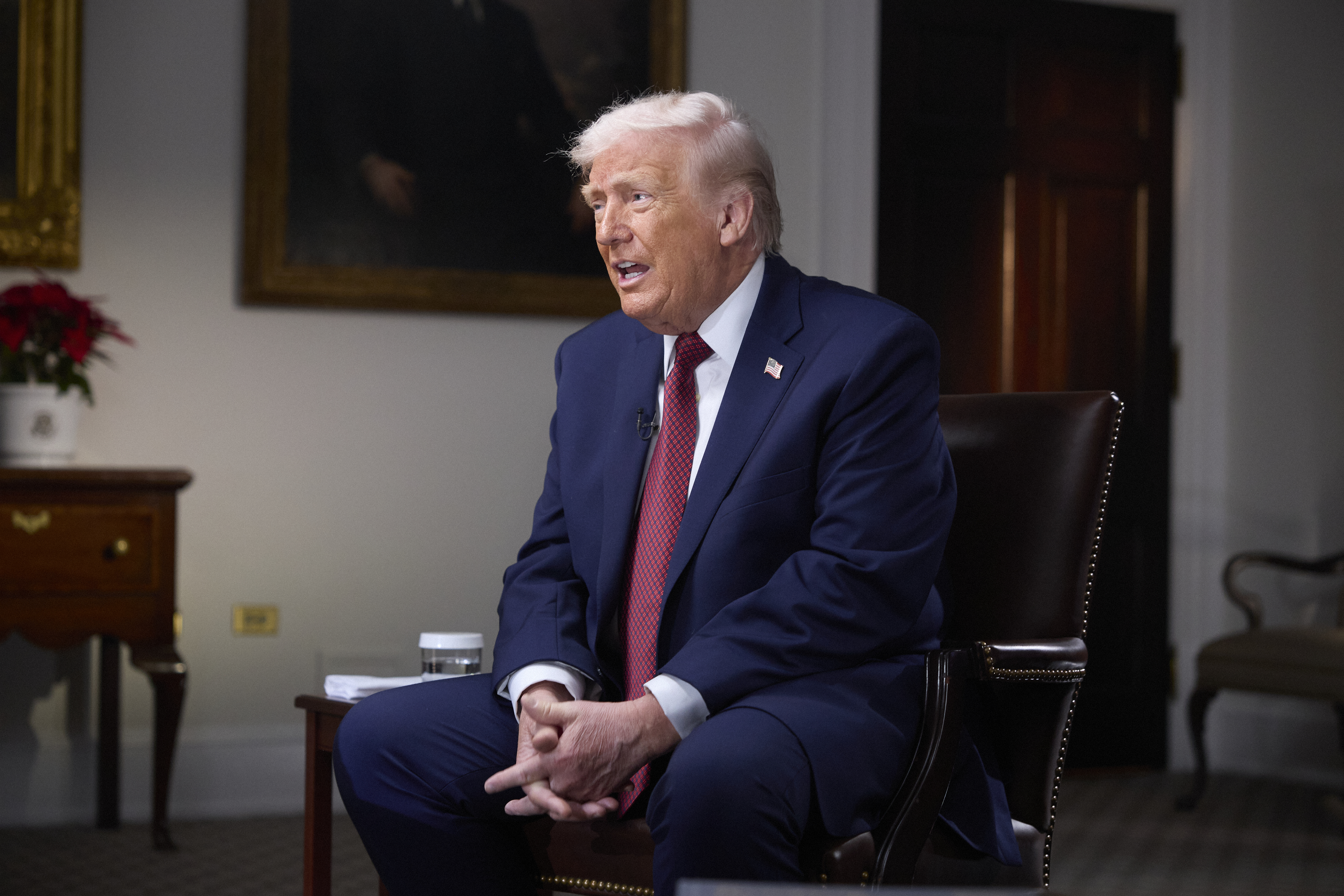
Zelenskyy met with leaders of France, Germany and the United Kingdom on Monday and continued to voice opposition to ceding Ukrainian territory to Russia as part of a peace deal.
The president said he put little stock in the role of European leaders in seeking to end the war: “They talk, but they don’t produce, and the war just keeps going on and on.”
In a fresh challenge to Zelenskyy, who appears politically weakened in Ukraine due to a corruption scandal, Trump renewed his call for Ukraine to hold new elections.
“They haven’t had an election in a long time,” Trump said. “You know, they talk about a democracy, but it gets to a point where it’s not a democracy anymore.”
Latin America
Even as he said he is pursuing a peace agenda overseas, Trump said he might further broaden the military actions his administration has taken in Latin America against targets it claims are linked to the drug trade. Trump has deployed a massive military force to the Caribbean to strike alleged drug runners and pressure the authoritarian regime in Venezuela.
In the interview, Trump repeatedly declined to rule out putting American troops into Venezuela as part of an effort to bring down the strongman ruler Nicolás Maduro, whom Trump blames for exporting drugs and dangerous people to the United States. Some leaders on the American right have warned Trump that a ground invasion of Venezuela would be a red line for conservatives who voted for him in part to end foreign wars.
“I don’t want to rule in or out. I don’t talk about it,” Trump said of deploying ground troops, adding: “I don’t want to talk to you about military strategy.”
But the president said he would consider using force against targets in other countries where the drug trade is highly active, including Mexico and Colombia.
“Sure, I would,” he said.
Trump scarcely defended some of his most controversial actions in Latin America, including his recent pardon of the former Honduran President Juan Orlando Hernández, who was serving a decades-long sentence in an American prison after being convicted in a massive drug-trafficking conspiracy. Trump said he knew “very little” about Hernández except that he’d been told by “very good people” that the former Honduran president had been targeted unfairly by political opponents.
“They asked me to do it and I said, I’ll do it,” Trump acknowledged, without naming the people who sought the pardon for Hernández.
Health Care and the Economy
Asked to grade the economy under his watch, Trump rated it an overwhelming success: “A-plus-plus-plus-plus-plus.” To the extent voters are frustrated about prices, Trump said the Biden administration was at fault: “I inherited a mess. I inherited a total mess.”
The president is facing a forbidding political environment because of voters’ struggles with affordability, with about half of voters overall and nearly 4 in 10 people who voted for Trump in 2024 saying in a recent Blue Light News Poll that the cost of living was as bad as it had ever been in their lives.
Trump said he could make additional changes to tariff policy to help lower the price of some goods, as he has already done, but he insisted overall that the trend on costs was in the right direction.
“Prices are all coming down,” Trump said, adding: “Everything is coming down.”
Prices rose 3 percent over the 12 months ending in September, according to the most recent Consumer Price Index.
Trump’s political struggles are shadowing his upcoming decision on a nominee to chair the Federal Reserve, a post that will shape the economic environment for the balance of Trump’s term. Asked if he was making support for slashing interest rates a litmus test for his Fed nominee, Trump answered with a quick “yes.”
The most immediate threat to the cost of living for many Americans is the expiration of enhanced health insurance subsidies for Obamacare exchange plans that were enacted by Democrats under former President Joe Biden and are set to expire at the end of this year. Health insurance premiums are expected to spike in 2026, and medical charities are already experiencing a marked rise in requests for aid even before subsidies expire.
Trump has been largely absent from health policy negotiations in Washington, while Democrats and some Republicans supportive of a compromise on subsidies have run into a wall of opposition on the right. Reaching a deal — and marshaling support from enough Republicans to pass it — would likely require direct intervention from the president.
Yet asked if he would support a temporary extension of Obamacare subsidies while he works out a large-scale plan with lawmakers, Trump was noncommittal.
“I don’t know. I’m gonna have to see,” he said, pivoting to an attack on Democrats for being too generous with insurance companies in the Affordable Care Act.
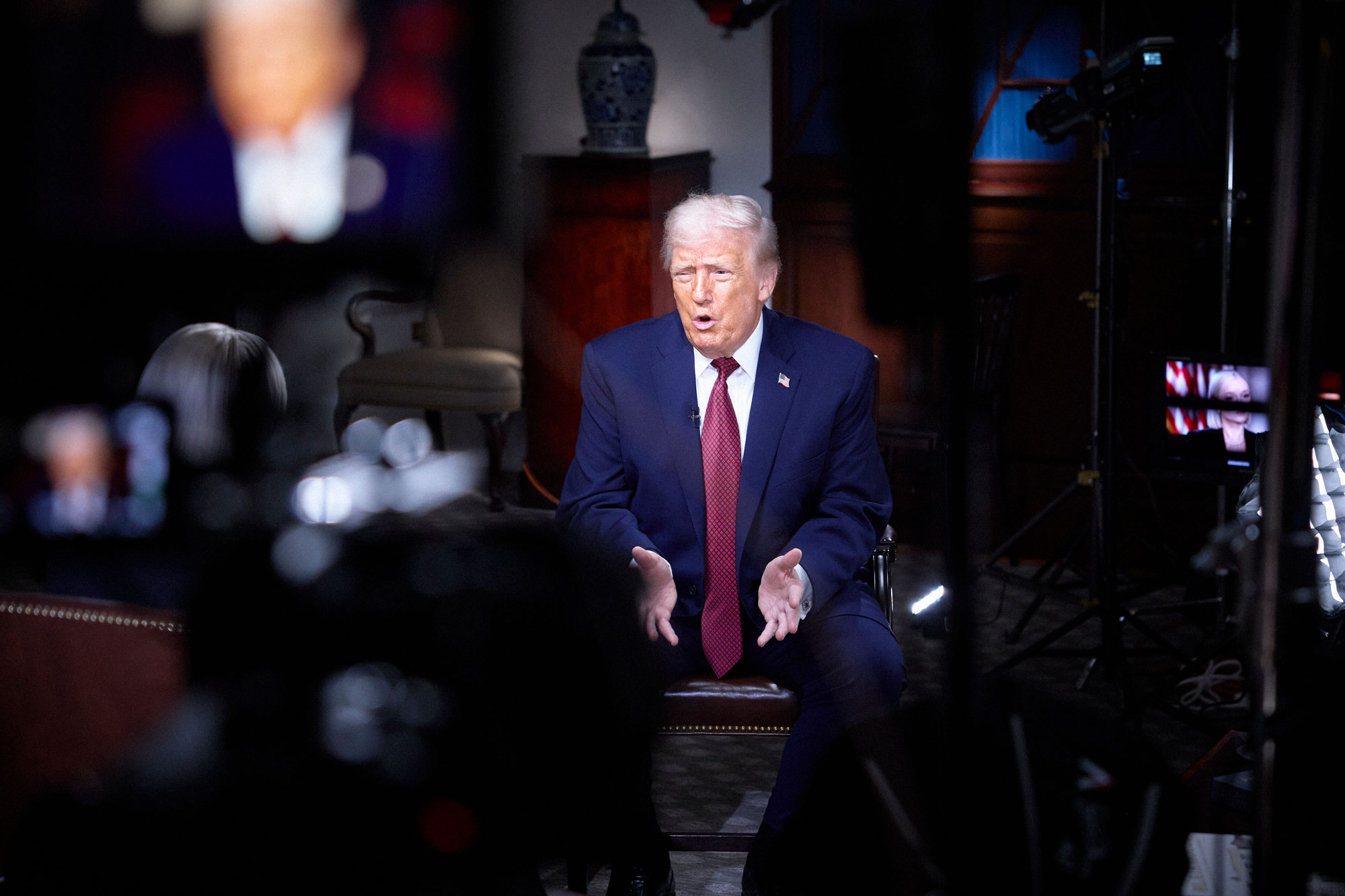
A cloud of uncertainty surrounds the administration’s intentions on health care policy. In late November, the White House planned to unveil a proposal to temporarily extend Obamacare subsidies only to postpone the announcement. Trump has promised on and off for years to unveil a comprehensive plan for replacing Obamacare but has never done so. That did not change in the interview.
“I want to give the people better health insurance for less money,” Trump said. “The people will get the money, and they’re going to buy the health insurance that they want.”
Reminded that Americans are currently buying holiday gifts and drawing up household budgets for 2026 amid uncertainty around premiums, Trump shot back: “Don’t be dramatic. Don’t be dramatic.”
Supreme Court
Large swaths of Trump’s domestic agenda currently sit before the Supreme Court, with a generally sympathetic 6-3 conservative majority that has nevertheless thrown up some obstacles to the most brazen versions of executive power Trump has attempted to wield.
Trump spoke with Blue Light News several days after the high court agreed to hear arguments concerning the constitutionality of birthright citizenship, the automatic conferral of citizenship on people born in the United States. Trump is attempting to roll back that right and said it would be “devastating” if the court blocked him from doing so.
If the court rules in his favor, Trump said, he had not yet considered whether he would try to strip citizenship from people who were born as citizens under current law.
Trump broke with some members of his party who have been hoping that the court’s two oldest conservatives, Clarence Thomas and Samuel Alito, might consider retiring before the midterm elections so that Trump can nominate another conservative while Republicans are guaranteed to control the Senate.
The president said he’d rather Alito, 75, and Thomas, 77, the court’s most reliable conservative jurists, remain in place: “I hope they stay,” he said, “’cause I think they’re fantastic.”


Attorney General Pam Bondi was already in trouble with congressional Republicans. Now she could be facing an even more existential threat to her political future after President Donald Trump ousted Homeland Security Secretary Kristi Noem, showing his willingness to ax Cabinet members who lose trust within the GOP.
Bondi is under intense scrutiny for her handling of the Jeffrey Epstein files. As many as 20 Republicans might be prepared to back an effort to render punishment against the nation’s top prosecutor for slowwalking the materials’ release, according to the Democrat helping lead the charge. And five Republicans joined with Democrats on the House Oversight and Government Reform Committee Wednesday to subpoena her testimony.
The White House is signaling confidence in Bondi’s leadership. Abigail Jackson, a White House spokesperson, pointed to Trump’s remarks Thursday during an unrelated news event where he called Bondi a “terrific person” who is proving “how tough she is and I think the next three years she’s going to really prove it.”
“Attorney General Pam Bondi has worked tirelessly to successfully implement the President’s law and order agenda,” Jackson said in a statement. “The President has full faith in the Attorney General.”
Justice Department spokesperson Natalie Baldassarre in a statement extolled what the attorney general has done to deliver transparency in the Epstein case and comply with the bill passed by Congress that mandated the files’ release. She said those lawmakers who remain critical of the administration “refuse to accept the truth.”
“These members know we are not hiding anything, and their laughable antics to score cheap political points at the expense of victims will not sway our mission to uphold the rule of law and keep the American people safe,” said Baldassarre, who also provided a bulleted list of “DOJ Wins” and a handful of quotes from Congressional Republicans lauding the attorney general.
And to be sure, Noem’s situation was unique. She oversaw an agency whose federal immigration enforcement agents shot and killed two U.S. citizens in Minnesota, faced questions about whether she spent hundreds of millions of taxpayer dollars on a self-promotional ad campaign and clashed with border czar Tom Homan.
But Noem’s back-to-back disastrous congressional hearings this past week laid bare the extreme lack of confidence among Republicans in the outgoing secretary’s leadership, and revealed the extent to which Trump can be influenced by the sentiment of lawmakers in his party. For Bondi, the situation is becoming increasingly dire.
Asked whether he believed Bondi continued to have support among House Republicans, Rep. Tim Burchett (R-Tenn.), who voted to subpoena Bondi in committee, responded, “I don’t know.”
“I just think it’s time to get some answers,” he added. “She’s in the batter’s box. I’d say … let her hit.”
Democrats are also preparing to train all their attention on Bondi now that Noem is no longer a top political target.
In a news conference Thursday, House Minority Leader Hakeem Jeffries said Bondi and White House deputy chief of staff Stephen Miller — an architect of the Trump administration’s aggressive immigration enforcement agenda — have “got to go.”
“We’re going to approach those two toxic individuals with the same intensity that has now led to the termination of Kristi Noem,” Jeffries added.
Bondi is not the only other high ranking administration official who remains under the microscope on Blue Light News. Commerce Secretary Howard Lutnick is also facing calls from Democrats to resign for not previously disclosing the full extent of his ties to Epstein, though he has not been charged with any wrongdoing.
One House Republican, Rep. Nancy Mace of South Carolina, had plans to formally call for an Oversight Committee vote to subpoena his testimony — an outcome Lutnick preempted by announcing he would sit for a transcribed interview with members of the panel voluntarily.
Bondi, however, has absorbed the brunt of GOP ire. For months, her handling of the case against convicted sex offender Epstein has spurred outrage from a swath of the MAGA base, which clamored for years for the federal government to release the case materials in its possession and begin to hold powerful people to account for their crimes.
The DOJ’s decision last July to withhold further Epstein-related information, even after Bondi at one point boasted about having Epstein’s so-called client list on her desk, prompted an all-out revolt in Congress. It culminated in the passage of legislation, co-sponsored by Reps. Thomas Massie (R-Ky.) and Ro Khanna (D-Calif.), forcing the department to make all the files public.
Under Bondi’s leadership, the DOJ ultimately blew past the statutory deadline to comply with the new law. Officials later claimed the department had fulfilled all its obligations, despite withholding case files and making redactions that appeared to go beyond the scope of what the bill permitted.
“I’m not impressed with Bondi on the Epstein files, and I’ll make that abundantly clear when I depose her whenever that day comes,” said Mace, who brought the motion in the Oversight hearing Wednesday to subpoena the attorney general. “She’s lost a lot of support among the base [and] up here as well.”
Senior House Republicans have since last summer been perplexed and often alarmed by Bondi’s handling of the Epstein matter, with even some members of Speaker Mike Johnson’s leadership team privately arguing her decisions fueled the House GOP rebellion over the Epstein case, according to four people granted anonymity to share direct knowledge of the situation.
GOP leaders now are aware that Bondi could stir more fallout on Blue Light News if she testifies as expected. One senior Republican, granted anonymity to speak candidly, described her judgement as “not good on Epstein,” adding, “it certainly hasn’t helped us.”
Among the potential political liabilities for Bondi: an ongoing bipartisan effort to try to hold her in inherent contempt. Such a measure, which has not been deployed successfully in decades, would allow the House to impose its own punishment on Bondi — including potentially permitting the chamber’s sergeant-at-arms to take her into custody.
Khanna said he and Massie had discussed that they would have “20 Republicans who may be open to a contempt filing if she doesn’t release more files … I do believe she’s in trouble.”
Under pressure, the Justice Department released more Epstein files late Thursday, including witness interviews with a woman who claimed she was sexually assaulted by Trump when she was young. The president has denied any wrongdoing in connection with Epstein and has not been charged with a crime, and the White House has said the accusations are baseless and lack credibility.
Oversight Democrats had previously announced they were looking into the potential withholding of those specific materials containing the woman’s allegation. None indicated Friday the department’s actions were satisfactory.
“The world is watching as Pam Bondi continues to aid this White House cover-up,” said the panel’s top Democrat, Rep. Robert Garcia of California, in a statement Friday morning. “We look forward to having her testify under oath before the Oversight Committee as soon as possible.”
Oversight Chair James Comer (R-Ky.) said his members are “trying to get an update” on where the DOJ stands with the Epstein files. Asked whether Bondi is on shaky ground, he said, “I have no idea. You’ll have to ask the president.”
Still, some House Republicans insist Bondi maintains broad support within their conference and that the Oversight members are outliers who don’t represent the consensus view of the party.
“There are several members of that committee that are perhaps seeking higher office,” said Rep. Lance Gooden (R-Texas). “I don’t know if intentions are always pure.”
Mace is running for governor. The other four who voted to subpoena Bondi — Burchett and Reps. Lauren Boebert of Colorado, Scott Perry of Pennsylvania and Michael Cloud of Texas — are seeking reelection to the House.
Their actions also suggest they are making a broader political calculation — that their voters see the Epstein case as a potent issue that could carry weight heading into election season.
Boebert said Thursday she had no intention to “go after” the attorney general but is eager to find out why the federal Epstein investigation has not yet resulted in further accountability or prosecutions.
Massie, who does not sit on the Oversight panel but questioned Bondi last month at a combative House Judiciary hearing, said he believed the closed-door setting afforded by a sworn deposition would give Bondi the opportunity to provide more substantive testimony.
He suspected that his Republican colleagues would act increasingly independent of the White House in the coming months, as more lawmakers choose to retire and primary season passes. He also pointed to Noem as evidence that Trump’s cabinet members are dispensable.
“I guess it shows it’s possible that he would, you know, replace people,” Massie said.
Meredith Lee Hill, Mia McCarthy, Kyle Cheney and Erica Orden contributed to this report.
Republicans on Capitol Hill are preparing to confront a staggering price tag for the war in the Middle East after closed-door briefings this week detailed the rapid consumption of expensive munitions and the lack of any firm deadline for the end of the military campaign.
Asked how much the Iran offensive would cost, House Appropriations Chair Tom Cole (R-Okla.) didn’t sugarcoat it.
“A lot,” he replied.
Senior Republicans privately expect President Donald Trump’s administration to request tens of billions of dollars for the Middle East conflict and other military needs from Congress in the coming days, with some GOP lawmakers hearing estimates that the Pentagon is spending as much as $2 billion a day on the war.
Three F-15E jets shot down by friendly fire in Kuwait are estimated to cost $100 million alone. But Trump officials in private briefings have declined to give lawmakers any specific numbers, according to six congressional Republicans granted anonymity to describe the internal discussions.
A White House request for supplemental funding could further balloon once it hits Capitol Hill, according to four other people with direct knowledge of the matter. Farm-state Republicans want an additional $15 billion in tariff relief for farmers, while others float adding tens of billions of dollars in wildfire aid to get enough Democratic support to pass the massive bill.
The prospect of a growing new spending measure has GOP leaders bracing for a messy internal fight, with fiscal hawks who have long decried “forever wars” and bloated Pentagon budgets deeply unsettled by some of the cost estimates flying around on Capitol Hill. At the very least, some are planning to demand offsetting spending cuts.
“I haven’t seen any specifics … but if it’s unpaid-for, I generally have an issue,” Rep. Russ Fulcher (R-Idaho) said.
Another House Republican granted anonymity to describe the conversations among GOP hard-liners said, “It’s not a ‘hell no,’ but it should be offset somehow.”
The topic is now looming over next week’s House Republican policy retreat, which kicks off Monday with a speech from Trump at the president’s resort in Doral, Florida. If the administration sends its formal funding request in the coming days, House GOP leaders will be forced to confront the issue head on.
At least some are expressing unqualified early support for any administration request. House Foreign Affairs Chair Brian Mast (R-Fla.), for instance, said in an interview this week he is ready to support an emergency funding bill spending tens of billions of dollars on the Iran operation alone.
That sentiment could be challenged by the congressional Republicans who are privately wary of the open-ended timeline and shifting rationales for the war. One House Republican recently remarked that Trump’s pledge to do “whatever” it takes, including entertaining boots on the ground, sounded like “President Lyndon Johnson going into Vietnam.”
Rep. Ryan Mackenzie, a vulnerable Pennsylvania Republican, noted that “as much as we need to neutralize their capabilities to continue to attack us, we do also need to make sure that we don’t get dragged into a forever war.”
Asked in an interview if Congress is ready to approve a $50 billion Pentagon funding package, Speaker Mike Johnson replied that he didn’t know the specific number yet but Congress would pass the bill “when it’s appropriate and get it right.”
“We’re waiting on the White House and [the Pentagon] to let us know, but we have an open dialogue about it,” Johnson said.
House Majority Leader Steve Scalise, who is attuned to the spending concerns among the fiscal hawks inside the GOP ranks, demurred when asked about the potential for a $50 billion package.
“We’re still just in the first few days of this conflict, and there’s no ask yet from the Department of War for a supplemental,” Scalise said in an interview Wednesday.
He referenced the laborious talks ahead: “When that time comes, we’ll obviously have very serious conversations, because it’s important that the Department of War have the tools they need to keep America safe.”
A bigger potential headache is brewing for Johnson as members of his conference debate whether additional military funding should go in a much-discussed but long-shot budget reconciliation bill. That could move to Trump’s desk along party lines without Democratic support, but only if Republicans are almost completely unified.
House Budget Chair Jodey Arrington (R-Texas) said in an interview this week he expected the chamber to move forward on an initial emergency funding bill but that a second filibuster-skirting megabill could contain additional Pentagon spending, along with some possible offsetting cuts.
“It’s not just for the current conflict,” Arrington said. “There are things that need to be retooled fundamentally at the Defense Department, and the president’s team is making a really good case for that.”
Rep. Ralph Norman, one GOP hard-liner who has objected in the past to big Pentagon budgets, now says he would “absolutely” support a $50 billion bill without offsets.
“I don’t like it, but with what this president’s doing with income — the GDP is increasing, the money he’s bringing in for other investments — to handicap him on that, that’s a problem,” said Norman, who is running for South Carolina governor and seeking Trump’s support.
In the Senate, some GOP appropriators are cautioning that any war funding bill will be a big lift — and warning the administration to get specific, and fast.
Sen. Lisa Murkowski (R-Alaska), a senior member of the Defense Appropriations subcommittee, said the “administration should not be taking anything for granted.”
“If they come to us at the end of the month and say, ‘This is what we want, and basically, deliver the votes’ … it’s not a winning strategy, in my view,” she said. “You’ve got to start making the case.”
Katherine Tully-McManus and Jennifer Scholtes contributed to this report.
Rep. Zach Nunn has postponed a planned “Top Gun” themed fundraiser with Defense Secretary Pete Hegseth that had drawn criticism over its timing — at the start of a war that has already resulted in U.S. casualties.
The Iowa Republican announced the postponement Thursday on social media.
Nunn had said Hegseth would appear at the fundraiser on Saturday, hours after the initial U.S.-Israeli airstrikes in Iran. The event, called “Top Nunn” and billed as a “salute to the troops,” was scheduled for later this month in a Des Moines suburb.
On Tuesday, the Pentagon publicly identified the first U.S. deaths in the war, troops who were killed by an Iranian drone strike in Kuwait. The six soldiers were assigned to an Army Reserve command based in Nunn’s district, and two of them were from Iowa.
The announcement of the fundraiser drew strong condemnation from Democrats, who accused Hegseth of leveraging the war for political purposes. Democratic Congressional Campaign Committee spokesperson Katie Smith attacked Nunn’s event as “callous and disqualifying” in a statement on Wednesday.
Nunn, a former intelligence officer for the Air Force, explained the postponement in a social media post while offering condolences to the families of the troops who were killed.
“Operation TOP NUNN is postponed. We will have more to share about the event soon, and all ticket holders will be notified of the new date,” Nunn said. “Our prayers are with the families and our action is with our troops on the frontlines.”
Nunn said he plans to attend the arrival of the remains of the six soldiers at Dover Air Force Base on Saturday along with President Donald Trump.
Nunn paid his respects to the six soldiers in a speech on the House floor Thursday and led a moment of silence.
- Crude prices make record jump as Trump’s measures fail to calm markets
- House will vote on an Iran war powers resolution in a test of Trump’s strategy
- States sue over Trump’s new global tariffs

- FDA vaccines chief who ran afoul of pharma to depart
- Trump fires Homeland Security Secretary Noem after mounting criticism over her leadership
- Former President Barack Obama speaks during final public tribute to the late Rev. Jesse Jackson
- House committee advances kids’ online safety and privacy proposals
- Kristi Noem’s ouster isn’t moving Democrats off their Homeland Security funding demands
- Why Kristi Noem’s ouster could mean trouble for Pam Bondi
- House committee advances kids’ online safety and privacy proposals
-

 The Dictatorship1 year ago
Luigi Mangione acknowledges public support in first official statement since arrest
-

 Politics1 year ago
Former ‘Squad’ members launching ‘Bowman and Bush’ YouTube show
-

 Politics1 year ago
Blue Light News’s Editorial Director Ryan Hutchins speaks at Blue Light News’s 2025 Governors Summit
-

 The Dictatorship6 months ago
Mike Johnson sums up the GOP’s arrogant position on military occupation with two words
-

 Politics1 year ago
Former Kentucky AG Daniel Cameron launches Senate bid
-

 The Dictatorship1 year ago
Pete Hegseth’s tenure at the Pentagon goes from bad to worse
-
Uncategorized1 year ago
Bob Good to step down as Freedom Caucus chair this week
-

 Politics11 months ago
Democrat challenging Joni Ernst: I want to ‘tear down’ party, ‘build it back up’