
Congress
Trump thrashes European leaders in wide-ranging interview: ‘I think they’re weak’

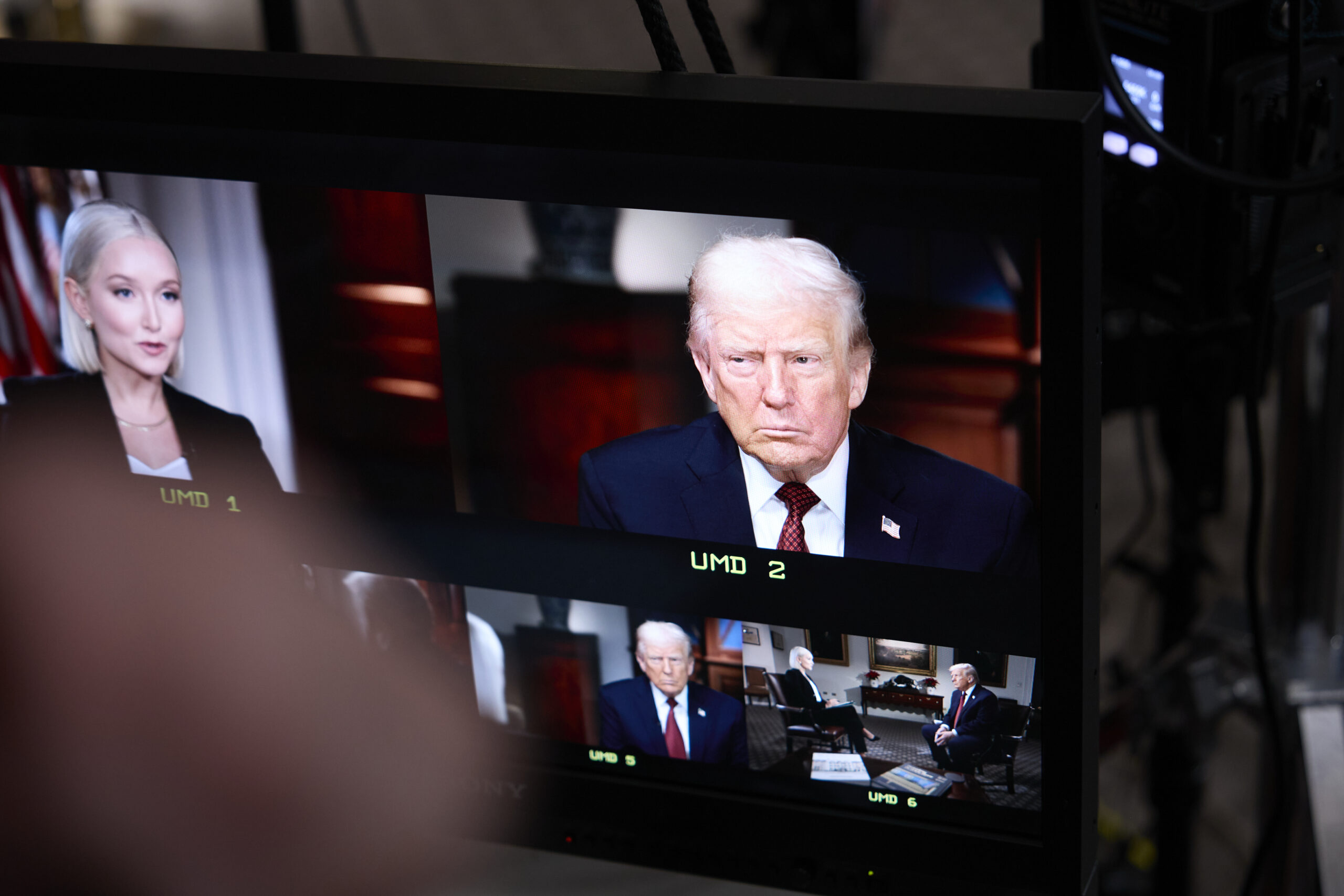
President Donald Trump denounced Europe as a “decaying” group of nations led by “weak” people in an interview with Blue Light News, belittling the traditional U.S. allies for failing to control migration and end the Russia-Ukraine war, and signaling that he would endorse European political candidates aligned with his own vision for the continent.
The broadside attack against European political leadership represents the president’s most virulent denunciation to date of these Western democracies, threatening a decisive rupture with countries like France and Germany that already have deeply strained relations with the Trump administration.
“I think they’re weak,” Trump said of Europe’s political leaders. “But I also think that they want to be so politically correct.”
“I think they don’t know what to do,” he added. “Europe doesn’t know what to do.”
Trump matched that blunt, even abrasive, candor on European affairs with a sequence of stark pronouncements on matters closer to home: He said he would make support for immediately slashing interest rates a litmus test in his choice of a new Federal Reserve chair. He said he could extend anti-drug military operations to Mexico and Colombia. And Trump urged conservative Supreme Court Justices Samuel Alito and Clarence Thomas, both in their 70s, to stay on the bench.
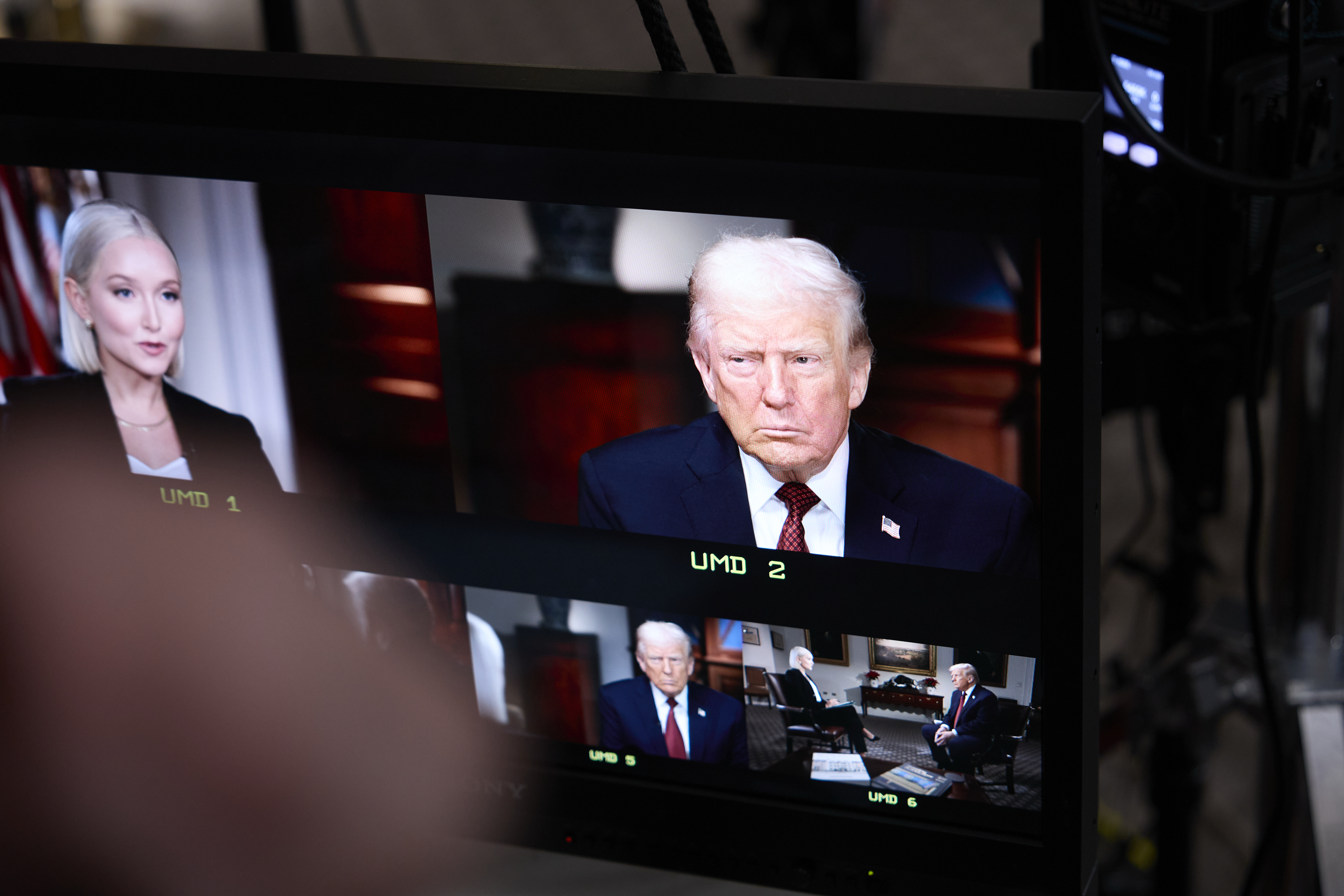
Trump’s comments about Europe come at an especially precarious moment in the negotiations to end Russia’s war in Ukraine, as European leaders express intensifying alarm that Trump may abandon Ukraine and its continental allies to Russian aggression. In the interview, Trump offered no reassurance to Europeans on that score and declared that Russia was obviously in a stronger position than Ukraine.
Trump spoke on Monday at the White House with Blue Light News’s Dasha Burns for a special episode of The Conversation. Blue Light News on Tuesday named Trump the most influential figure shaping European politics in the year ahead, a recognition previously conferred on leaders including Ukrainian President Volodymyr Zelenskyy, Italian Prime Minister Giorgia Meloni and Hungarian Prime Minister Viktor Orbán.
Trump’s confident commentary on Europe presented a sharp contrast with some of his remarks on domestic matters in the interview. The president and his party have faced a series of electoral setbacks and spiraling dysfunction in Congress this fall as voters rebel against the high cost of living. Trump has struggled to deliver a message to meet that new reality: In the interview, he graded the economy’s performance as an “A-plus-plus-plus-plus-plus,” insisted that prices were falling across the board and declined to outline a specific remedy for imminent spikes in health care premiums.
Even amid growing turbulence at home, however, Trump remains a singular figure in international politics.
In recent days, European capitals have shuddered with dismay at the release of Trump’s new National Security Strategy, a highly provocative manifesto that cast the Trump administration in opposition to the mainstream European political establishment and vowed to “cultivate resistance” to the European status quo on immigration and other politically volatile issues.
In the interview, Trump amplified that worldview, describing cities like London and Paris as creaking under the burden of migration from the Middle East and Africa. Without a change in border policy, Trump said, some European states “will not be viable countries any longer.”
Using highly incendiary language, Trump singled out London’s left-wing mayor, Sadiq Khan, the son of Pakistani immigrants and the city’s first Muslim mayor, as a “disaster” and blamed his election on immigration: “He gets elected because so many people have come in. They vote for him now.”
The president of the European Council, António Costa, on Monday rebuked the Trump administration for the national security document and urged the White House to respect Europe’s sovereignty and right to self-government.
“Allies do not threaten to interfere in the democratic life or the domestic political choices of these allies,” Costa said. “They respect them.”
Speaking with Blue Light News, Trump flouted those boundaries and said he would continue to back favorite candidates in European elections, even at the risk of offending local sensitivities.
“I’d endorse,” Trump said. “I’ve endorsed people, but I’ve endorsed people that a lot of Europeans don’t like. I’ve endorsed Viktor Orbán,” the hard-right Hungarian prime minister Trump said he admired for his border-control policies.
It was the Russia-Ukraine war, rather than electoral politics, that Trump appeared most immediately focused on. He claimed on Monday that he had offered a new draft of a peace plan that some Ukrainian officials liked, but that Zelenskyy himself had not reviewed yet. “It would be nice if he would read it,” Trump said.
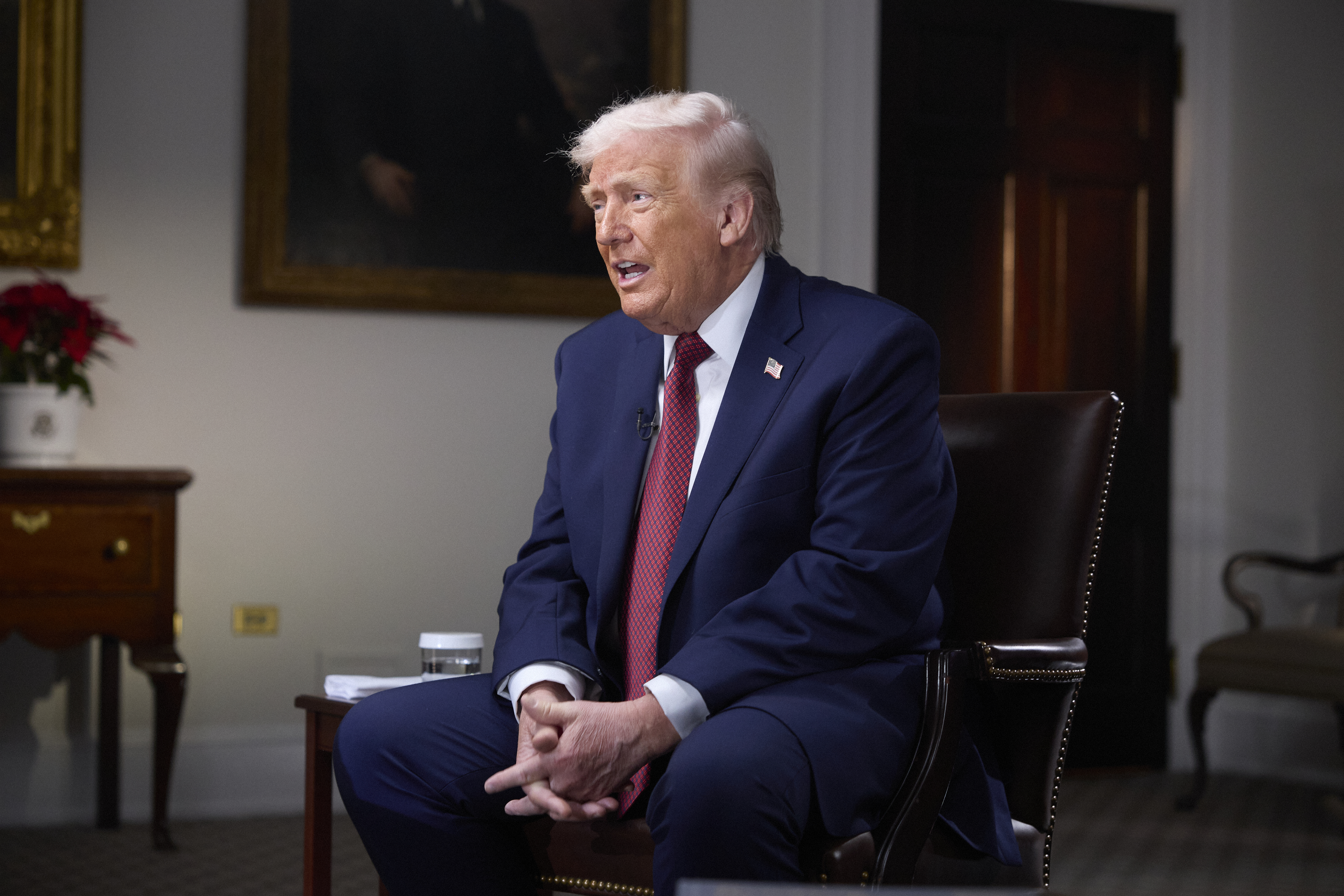
Zelenskyy met with leaders of France, Germany and the United Kingdom on Monday and continued to voice opposition to ceding Ukrainian territory to Russia as part of a peace deal.
The president said he put little stock in the role of European leaders in seeking to end the war: “They talk, but they don’t produce, and the war just keeps going on and on.”
In a fresh challenge to Zelenskyy, who appears politically weakened in Ukraine due to a corruption scandal, Trump renewed his call for Ukraine to hold new elections.
“They haven’t had an election in a long time,” Trump said. “You know, they talk about a democracy, but it gets to a point where it’s not a democracy anymore.”
Latin America
Even as he said he is pursuing a peace agenda overseas, Trump said he might further broaden the military actions his administration has taken in Latin America against targets it claims are linked to the drug trade. Trump has deployed a massive military force to the Caribbean to strike alleged drug runners and pressure the authoritarian regime in Venezuela.
In the interview, Trump repeatedly declined to rule out putting American troops into Venezuela as part of an effort to bring down the strongman ruler Nicolás Maduro, whom Trump blames for exporting drugs and dangerous people to the United States. Some leaders on the American right have warned Trump that a ground invasion of Venezuela would be a red line for conservatives who voted for him in part to end foreign wars.
“I don’t want to rule in or out. I don’t talk about it,” Trump said of deploying ground troops, adding: “I don’t want to talk to you about military strategy.”
But the president said he would consider using force against targets in other countries where the drug trade is highly active, including Mexico and Colombia.
“Sure, I would,” he said.
Trump scarcely defended some of his most controversial actions in Latin America, including his recent pardon of the former Honduran President Juan Orlando Hernández, who was serving a decades-long sentence in an American prison after being convicted in a massive drug-trafficking conspiracy. Trump said he knew “very little” about Hernández except that he’d been told by “very good people” that the former Honduran president had been targeted unfairly by political opponents.
“They asked me to do it and I said, I’ll do it,” Trump acknowledged, without naming the people who sought the pardon for Hernández.
Health Care and the Economy
Asked to grade the economy under his watch, Trump rated it an overwhelming success: “A-plus-plus-plus-plus-plus.” To the extent voters are frustrated about prices, Trump said the Biden administration was at fault: “I inherited a mess. I inherited a total mess.”
The president is facing a forbidding political environment because of voters’ struggles with affordability, with about half of voters overall and nearly 4 in 10 people who voted for Trump in 2024 saying in a recent Blue Light News Poll that the cost of living was as bad as it had ever been in their lives.
Trump said he could make additional changes to tariff policy to help lower the price of some goods, as he has already done, but he insisted overall that the trend on costs was in the right direction.
“Prices are all coming down,” Trump said, adding: “Everything is coming down.”
Prices rose 3 percent over the 12 months ending in September, according to the most recent Consumer Price Index.
Trump’s political struggles are shadowing his upcoming decision on a nominee to chair the Federal Reserve, a post that will shape the economic environment for the balance of Trump’s term. Asked if he was making support for slashing interest rates a litmus test for his Fed nominee, Trump answered with a quick “yes.”
The most immediate threat to the cost of living for many Americans is the expiration of enhanced health insurance subsidies for Obamacare exchange plans that were enacted by Democrats under former President Joe Biden and are set to expire at the end of this year. Health insurance premiums are expected to spike in 2026, and medical charities are already experiencing a marked rise in requests for aid even before subsidies expire.
Trump has been largely absent from health policy negotiations in Washington, while Democrats and some Republicans supportive of a compromise on subsidies have run into a wall of opposition on the right. Reaching a deal — and marshaling support from enough Republicans to pass it — would likely require direct intervention from the president.
Yet asked if he would support a temporary extension of Obamacare subsidies while he works out a large-scale plan with lawmakers, Trump was noncommittal.
“I don’t know. I’m gonna have to see,” he said, pivoting to an attack on Democrats for being too generous with insurance companies in the Affordable Care Act.
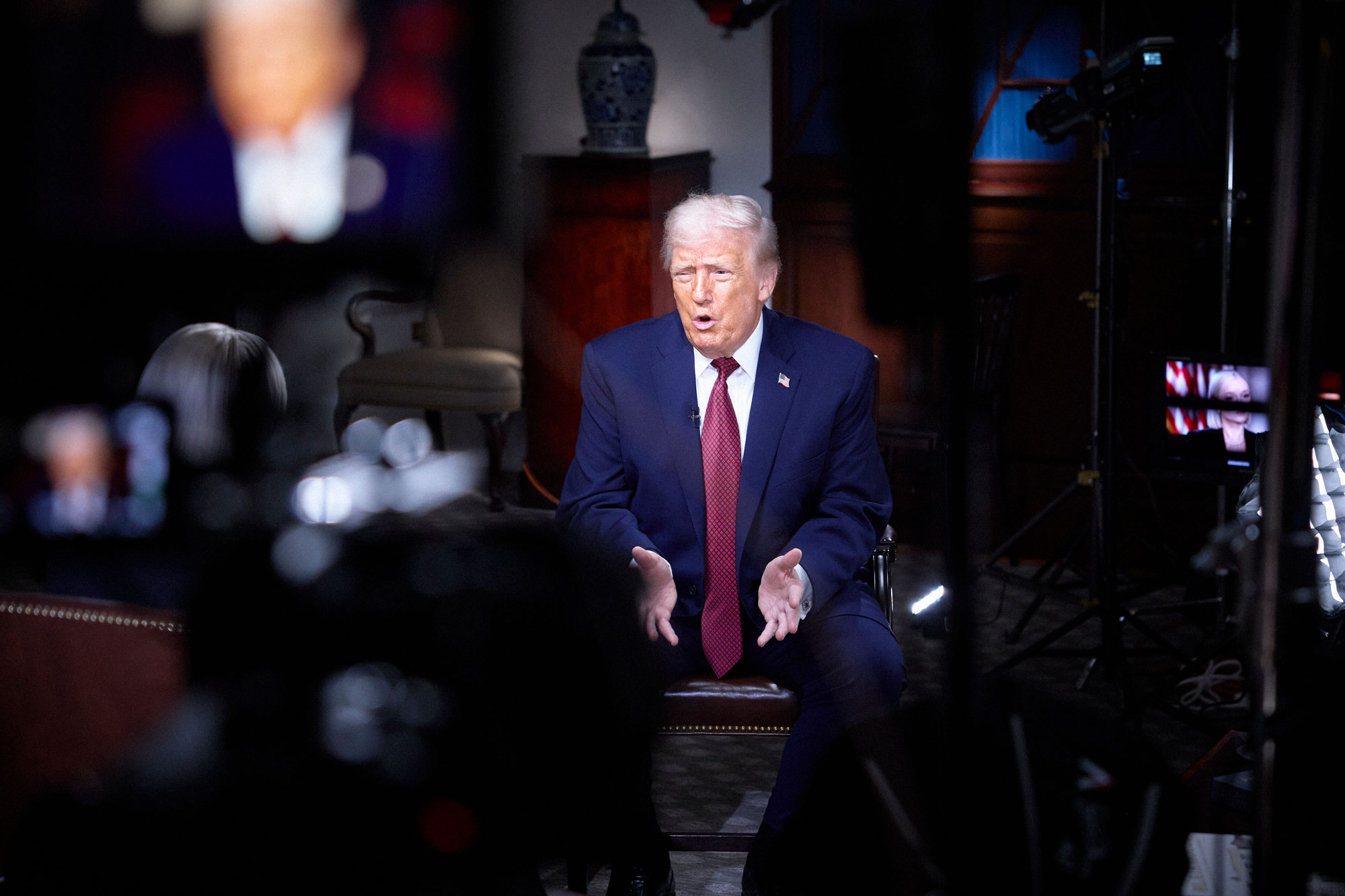
A cloud of uncertainty surrounds the administration’s intentions on health care policy. In late November, the White House planned to unveil a proposal to temporarily extend Obamacare subsidies only to postpone the announcement. Trump has promised on and off for years to unveil a comprehensive plan for replacing Obamacare but has never done so. That did not change in the interview.
“I want to give the people better health insurance for less money,” Trump said. “The people will get the money, and they’re going to buy the health insurance that they want.”
Reminded that Americans are currently buying holiday gifts and drawing up household budgets for 2026 amid uncertainty around premiums, Trump shot back: “Don’t be dramatic. Don’t be dramatic.”
Supreme Court
Large swaths of Trump’s domestic agenda currently sit before the Supreme Court, with a generally sympathetic 6-3 conservative majority that has nevertheless thrown up some obstacles to the most brazen versions of executive power Trump has attempted to wield.
Trump spoke with Blue Light News several days after the high court agreed to hear arguments concerning the constitutionality of birthright citizenship, the automatic conferral of citizenship on people born in the United States. Trump is attempting to roll back that right and said it would be “devastating” if the court blocked him from doing so.
If the court rules in his favor, Trump said, he had not yet considered whether he would try to strip citizenship from people who were born as citizens under current law.
Trump broke with some members of his party who have been hoping that the court’s two oldest conservatives, Clarence Thomas and Samuel Alito, might consider retiring before the midterm elections so that Trump can nominate another conservative while Republicans are guaranteed to control the Senate.
The president said he’d rather Alito, 75, and Thomas, 77, the court’s most reliable conservative jurists, remain in place: “I hope they stay,” he said, “’cause I think they’re fantastic.”


A top priority for Democrats if they get more power in Congress in November: Forcing the Trump administration’s controversial and unpopular immigration crackdown back in the headlines.
And one of the people they plan to go after hard is Homeland Security Secretary Markwayne Mullin — the former lawmaker who was brought into the role in part because he was seen as someone who could play well with Congress, unlike former DHS Secretary Kristi Noem.
A House Democratic aide said that committees plan to look at how DHS under Mullin has failed to deploy body cameras to many immigration agents, allowed dismal conditions at immigration facilities and failed to cooperate with the department’s Inspector General.
“He owns that,” the aide emphasized. They were granted anonymity to speak freely about evolving legislative preparations ahead of November.
Other Democrats plan to take him to task over the Oct. 12 ICE raid on the D.C. residence of Rep. Ilhan Omar (D-Minn.).
Even if Democrats are only able to issue subpoenas and produce reports, that could be enough to force DHS back into the headlines — undermining a major goal of Mullin’s: Keeping unpopular immigration enforcement operations away from public attention.
That would likely worsen the political pains the White House is experiencing on immigration. Voters in both parties have soured on the president’s ambitious immigration crackdown after a series of controversies, including the deaths of several American citizens following encounters with immigration officers.
“We will investigate the administration weaponizing DHS against Americans, its out-of-control immigration policies, and its blatantly corrupt self-dealing. The American people expect nothing less, and we will deliver,” said Rep. Bennie Thompson (D-Miss.), who is poised to chair the House Homeland Security Committee in the next Congress.
While Democrats want to investigate the full breadth of the Trump administration’s immigration policies, including changes to immigration courts and efforts to throttle legal immigration to the United States, multiple aides and lawmakers told Blue Light News that much of the action on Capitol Hill will center around deportations that appear to have happened without due process, aggressive practices in arrests and conditions at detentions facilities.
Democrats also plan to review how DHS has spent a historic influx of funds from a series of reconciliation bills — including controversial purchases of jets for use by Noem, warehouses intended to operate as detention facilities and other department acquisitions that may have benefitted administration allies.
As part of this push, they plan to also pull in a raft of lower-level and former officials for testimony.
At a Monday press conference in Long Beach, California, Rep. Robert Garcia (D-Calif.), the top Democrat on the House Oversight Committee, stressed that investigations into “abuses of ICE and DHS” will rank high among committee priorities — alongside investigations into the Trump family’s business dealings, disgraced deceased sex trafficker Jeffrey Epstein and “corporate corruption.”
“What has been happening is horrific,” Garcia said. “But folks like Stephen MIller, Donald Trump and the horrific people they have in power to do this harm think they can get away with frankly these crimes and this inhumanity … you will be held accountable, you will be held investigated.”
“There is no moving forward without justice,” he added.
Other potential House committee chairs are also homing in on immigration enforcement as a top area for immediate congressional oversight after the midterms. The Senate Homeland Security and Governmental Affairs Committee, as well as the House and Senate Judiciary committees also have jurisdiction over immigration operations. Aides say the incoming chairs of all of these committees are planning on working together to conduct oversight of DHS.
“This is a team sport,” said the House Democratic aide. “One of the Democratic campaign’s overwhelming themes has been accountability, and committees have an appetite to do more oversight work. So this is going to be a multicommittee effort.”
That said, the number of committees that are planning immigration investigations could result in a morass of similar probes if House Democratic leadership fails to manage committee chairs with differing priorities and personal styles. Republicans already experienced this during the Biden administration, when the chairs of the House Judiciary and Oversight committees did not clearly coordinate in their oversight of immigration policy and often held similar hearings with limited results.
Much of Democrats’ final approach will depend on the outcome of the midterm elections. While it is expected that Democrats will retake control of the House, if they also take back the Senate they could exert even more pressure on the administration by throttling the confirmation of nominees and leverage more resources for investigations.
But even just Democratic control of the House, which is seen in Washington as an all but certain outcome, would give Democratic committee chairs the ability to issue subpoenas for administration officials to testify before their committees and produce documents of import for committee investigations. The House could also always move to impeach the president and other top officials, though Democrats across the party’s ideological divides have for now ruled out a third impeachment of Trump, since it would likely fail to secure enough Republican Senate votes to result in his removal from office.
In a statement, the Department of Homeland Security said that “political attacks will not deter DHS from carrying out its lawful mission.”
“Congressional oversight should not be used as a vehicle to obstruct the department’s ability to secure the border, remove dangerous criminal aliens, disrupt transnational criminal organizations, and defend the homeland,” DHS added.
House Democrats also plan to focus on Noem’s tenure. Garcia confirmed in an interview on MS Now last week that his committee will be scrutinizing her tenure, even though she and former DHS adviser Corey Lewandowski have both left the department.
But many Democratic lawmakers are incensed about actions taken under Mullin’s tenure, including the raid on Omar’s residence.
“We are going to drag Markwayne Mullin into the Judiciary committee and give him the full Jack Smith treatment as a result of these raids,” Rep. Sydney Kamlager-Dove (D-Calif.), a member of the House Judiciary Committee, said in an interview earlier this month on MSNow, referring to the former special counsel who led federal prosecutions against Trump.
Her comments indicate that some Democratic lawmakers want to make a spectacle out of Mullin. Republicans regularly dragged Smith to testify before congressional committees as they sought to tar investigations into the president’s alleged criminal conduct.
Democrats are also eager to use their subpoena and investigative powers to compel testimony from White House deputy chief of staff Stephen Miller, who wields considerable influence over the administration’s immigration policy, and border czar Tom Homan, who is accused of taking a cash bribe from a major government contractor.
White House spokesperson Lauren Bis said in a statement that “Democrats have no agenda to improve the lives of Americans — their only agenda is to continue to demonize ICE law enforcement and continue their decade long witch hunt against President Trump and his administration.”
Homan has repeatedly denied any wrongdoing.
Oversight work is a hallmark of divided government, especially since the party in control of Congress is often unlikely to secure presidential support for major pieces of messaging legislation. But parties have at times squandered those opportunities.
Committees are trying to put resources in place ahead of the elections to speed up this work, since investigations inherently take time as staff interview witnesses and pursue relevant documents and records. As the midterm elections approach, Democrats poised to lead committees with relevant jurisdiction over the Department of Homeland Security have begun staffing up in anticipation of a change in control of Congress.
New Hampshire Democrat Sen. Maggie Hassan, is poised to take the gavel of the Senate Homeland Security and Governmental Affairs Committee should her party prevail in November. Hassan, who already began probing contracting decisions at DHS from her more limited perch as the top Democratic senator on the Joint Economic Commission, is hiring staff and preparing to continue her oversight work atop the Senate Homeland Security panel in the next Congress.
For now, House Democrats — mainly Garcia and Rep. Jamie Raskin of Maryland, who is poised to take over the Judiciary Committee — are vowing they will coordinate their efforts and work together.
“We view this as a responsibility that belongs to every committee and every member of congress … this is just an overwhelming mountain of corruption and authoritarianism that we face,” Raskin said.
Senate Majority Whip John Barrasso will campaign with Ken Paxton next week in Texas as Republicans work overtime to try to hold onto the endangered seat.
Barrasso said in an interview that he plans to join a bus tour with Paxton, who is locked in a tossup battle with Democrat James Talarico despite Donald Trump carrying Texas by roughly 14 percentage points two years ago.
The No. 2 leader, Barrasso is the most senior Senate Republican to hit the trail in Texas in the general election. Senate Majority Leader John Thune has held fundraisers with Paxton but has not publicly campaigned with him.
Barrasso also plans to campaign with former Rep. Mike Rogers in Michigan and Rep. Andy Barr in Kentucky. He was also in South Carolina this week with Trump and said he had made stops in Iowa, Ohio and Kansas — all home to battleground Senate races.
Republicans are navigating steep headwinds as they try to fend off Democratic momentum and voter dissatisfaction to keep their majority. But Barrasso said he was “very optimistic” that the party would keep control of the Senate.
“There’s a lot of energy at every event I’ve gone to, and of course there are eight, 10 races now, a number for sure, that are within the margin of error,” Barrasso said. “So there’s a lot at stake in the next week and a half, and nothing’s going to be left on the field.”
He said races for Democratic-held seats in Michigan, Minnesota and New Hampshire are still within the GOP’s grasp. But Republicans are also on defense in states like Kansas, Iowa and Texas where Trump won easily in 2024.
Republicans have poured hundreds of millions of dollars into Texas to boost Paxton, even as some in the party lament some of the campaign decisions he’s made.
“I mean, I hope Ken Paxton wins. … But you know, Ken Paxton also has some responsibility here to be a better candidate and to raise some of his own money and to not be a drain on the system,” Sen. Kevin Cramer (R-N.D.) said in an interview Thursday. “Having said all that, I hope he’s a senator.”
Democrats are now pushing into even deeper red territory, including South Carolina and Mississippi. Barrasso, in the interview, said that he was “very confident” that Republicans would hold both states, which have seen an influx of late spending.
“You know the president has really opened up his campaign coffers, and he’s fully invested time as well as money,” Barrasso said. “Every candidate wishes there were more resources, every candidate, so there’s no surprise there, but we feel we’re fully resourced to get … the message out.”
National Democrats finally went into Mississippi this week, putting over $1 million behind Scott Colom‘s campaign to unseat Sen. Cindy Hyde-Smith.
To the state’s most prominent Democrat, it was welcome — but too late.
“Anything is appreciated, and I don’t want to seem like people here are not appreciative. But you know, we’ve been singing this song for almost a year,” Rep. Bennie Thompson said in an interview. “Scott is a quality candidate and he could’ve benefited from early recognition from the Senate Majority PAC and others.”
Thompson’s sentiments reflect ongoing frustration among some Democrats who have been beating the drum for more national investment in Black candidates in races once seen as long shots that are now anything but.
“Mississippi people are ready for a new direction. They’re ready to fire Cindy Hyde-Smith. They want somebody that’s going to actually look out for our state, and it’s great that the country is starting to realize that,” Colom said in an interview.
The sentiments were also echoed by Florida Democrat Angie Nixon, who is on her own quest to defeat incumbent GOP Sen. Ashley Moody.
Nixon, referring more broadly to national Democratic donors, said the party needs to do more in her state, and stat.
“I can win. I’m going to win. We just need people to really lean into this moment right now,” she told Dasha Burns in the latest episode of The Conversation.
Neither the Democratic Senatorial Campaign Committee nor Senate Majority PAC has publicly announced a Florida television buy on her behalf, but Nixon was clear that the DSCC has been “very helpful” recently, opening up doors to connect her with donors and having her participate in fundraisers with DSCC head Sen. Kirsten Gillibrand and Minority Leader Chuck Schumer.
“They are now seeing that this seat is actually winnable,” Nixon said.
Colom has also been a part of DSCC fundraisers and Schumer has directed donors to him.
The Senate Majority PAC declined to comment. DSCC spokesperson Maeve Coyle said Nixon and Colom are running “inspiring and energetic campaigns” and that her group is “committed to expanding the map as much as possible” despite limited resources and a flood of Republican money.
But Thompson argued that party leaders need to move much faster in the future to invest early in strong candidates who can mobilize the large populations of Black voters in Southern states that others deem unwinnable.
“The South in general is ripe for Democrats, but it has to be a sustained investment,” he said. “Given the loyalty that the African American population gives to the Democratic Party, it is just an ideal opportunity to grow the party and ultimately get some Democrats elected.”
“But,” he added, “that engagement can’t come two weeks or less before the general election.”
What else we’re watching:
— DEMOCRATS’ LOOMING TRADE BATTLE: Cracks in Democrats’ trade policy are starting to emerge within the party, even as candidates are presenting a united front on repealing Trump’s tariffs on the campaign trail. The simmering debate over how far to reject Trump’s trade agenda cuts across geography and ideology. It’s likely to bubble into public view in the coming months as Democrats prepare to assume more power in Congress and jump into the wide-open upcoming presidential primary.
— DEMS WANT MULLIN IN HOTSEAT: A top priority for Democrats if they get more power in Congress in November: Forcing the Trump administration’s controversial and unpopular immigration crackdown back in the headlines. And one of the people they plan to go after hard is Homeland Security Secretary Markwayne Mullin — the former lawmaker who was brought into the role in part because he was seen as someone who could play well with Congress, unlike former DHS Secretary Kristi Noem. A House Democratic aide said that committees plan to look at how DHS under Mullin has failed to deploy body cameras to many immigration agents, allowed dismal conditions at immigration facilities and failed to cooperate with the department’s Inspector General.
Adam Wren, Daniel Desrochers and Eric Bazail-Eimil contributed to this report.
- Democrats want Mullin in the hotseat in the next Congress
- John Barrasso to campaign with Ken Paxton
- Capitol agenda: Bennie Thompson warns about Dems’ late bet
- Poll: Trump wants the midterms to be about him. That could backfire.
- Can Angie Nixon prove Democrats can win in Florida?

- Elon Musk pours another $76 million into boosting Republicans
- Senate Democrats’ campaign arm takes out $15M loan
- Democrats’ top Senate super PAC has raised $354M this year
- Biotech investment is the new front in the U.S.-China trade fight
- A final farewell to NYC’s horse carriage industry

-

 Politics2 years ago
Former ‘Squad’ members launching ‘Bowman and Bush’ YouTube show
-
Uncategorized2 years ago
Bob Good to step down as Freedom Caucus chair this week
-

 The Josh Fourrier Show2 years ago
DOOMSDAY: Trump won, now what?
-

 The Dictatorship2 years ago
Pete Hegseth’s tenure at the Pentagon goes from bad to worse
-

 Politics2 years ago
Former Kentucky AG Daniel Cameron launches Senate bid
-

 The Dictatorship2 years ago
Luigi Mangione acknowledges public support in first official statement since arrest
-

 Politics2 years ago
Blue Light News’s Editorial Director Ryan Hutchins speaks at Blue Light News’s 2025 Governors Summit
-

 Politics1 year ago
John Legend advises Trump to drop the ‘dictator s‑‑‑’ if he wants Nobel Peace Prize