
Politics
The false narrative at the heart of Trump’s victory over Harris

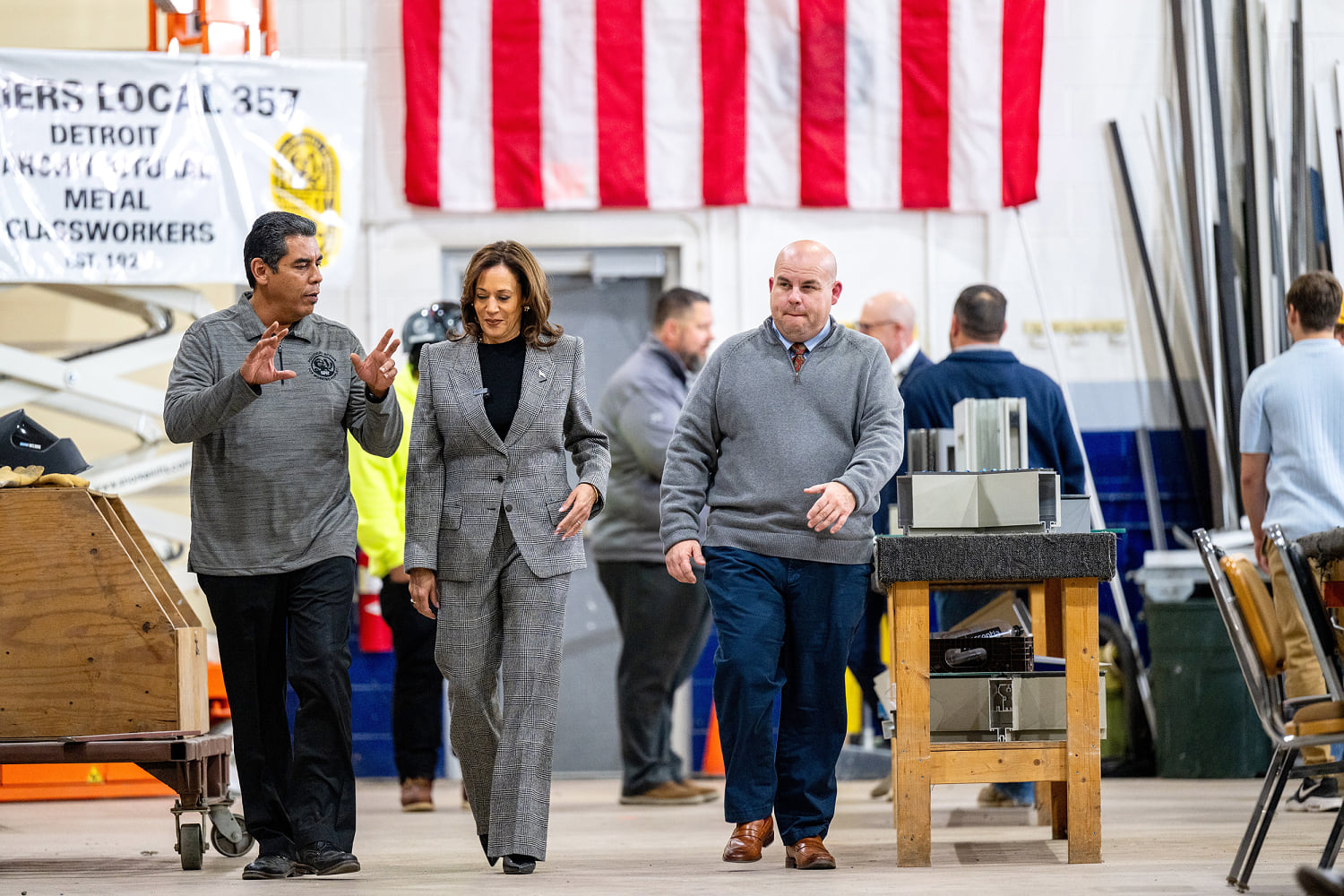
Since Tuesday night’s election results were tallied, there has been a recurrent refrain as to why Democrats lost so badly — they ignored the working class, both white and nonwhite.
In what amounted to the proverbial act of coming down to the battlefield and shooting the survivors, Sen. Bernie Sanders, I-Vt., labeled the Kamala Harris campaign “disastrous” and said Democrats should not be surprised that “a Democratic Party which has abandoned working class people would find that the working class has abandoned them.”
There are a couple of problems with Sanders’ argument. The most obvious and glaring is that it simply isn’t true that Democrats abandoned the working class.
It simply isn’t true that Democrats abandoned the working class.
During his nearly four years in office, President Joe Biden was arguably the most pro-union president since FDR. He literally walked a picket line, supported union organizing efforts, increased funding for the National Labor Relations Board. He infused $36 billion into the Teamsters Union pension plan (an act that Sanders praised).
Biden’s attention to the working class went far beyond the symbolic. The Inflation Reduction Act, the bipartisan infrastructure bill and the CHIPS Act all led to a fertile job creation environment — and a significant increase in manufacturing jobs, which declined during Donald Trump’s presidency. (It bears noting that all of this legislation passed in the U.S. Senate with the support of the senior senator from Vermont, Bernie Sanders.)
Indeed, since Biden took office, the U.S. economy has added more than 16 million jobs — which starkly contrasts Trump’s negative job growth rate. As for wages, the working class saw a higher increase in their pay than any other group of Americans, so much so that it undid one-third of the growth in wage inequality since 1980.
During Biden’s administration, subsidies for Obamacare grew. He forgave billions in student loan debt, much of which went to community college students. His Department of Labor changed overtime eligibility rules, boosting wages for more than 4 million workers and also increased pay for construction workers on federal projects.
Critics like Sanders would likely argue that these successes weren’t messaged properly to working-class Americans. That’s not true either. As the New Republic’s Greg Sargent pointed out earlier this week, the Harris campaign poured $200 million into ads that focused on her economic message. In fact, she outspent the Trump campaign by around $70 million on ads about the economy.
What was the content of these ads? Calls to end corporate price gouging, lower housing costs, cut middle-class taxes and protect Social Security and Medicare. Other Harris ads accused Trump of only looking out for his billionaire pals and corporations and attacked him for enacting tax cuts that were primarily directed at the wealthiest Americans.
This is the definition of an economic populist message.
Critics like Sanders would likely argue that these successes weren’t messaged properly to working-class Americans. That’s not true either.
Yet, Biden’s record and the disparity in the two candidates’ economic messages didn’t increase the party’s support among working-class voters (which are defined here as those without a college degree). Arguably, it improved Harris’ margins in swing states where these ads predominately ran, but according to preliminary exit polls, Trump won them by 14 percentage points over Harris (56%-42%), a 6-point improvement over his performance in 2020.
Harris only did one point worse than Biden among white working-class voters, but she was still mired in the low 30s with them. Instead, her losses came among the nonwhite working class, a group with which she did 16 points worse than Biden — and 26 points worse than Hillary Clinton.
In short, under Biden, Democrats adopted one of the most pro-working class policy agendas in recent political memory, enacted much of it — and accrued no electoral benefit.
As for Trump, his main economic agenda item was a pledge to increase tariffs, which by increasing costs on imported items, would have disproportionately harmed low-wage workers. Did he have a plan for lowering housing or dealing with health care? What about lowering inflation?
What Trump essentially offered the working class were attacks on undocumented immigrants, which his campaign blamed for much of the nation’s ills.
As in 2016, Trump served as a political voice channeling the fears, cultural grievances and resentments of working-class Americans — and, as has been the case for much of the past 60 years for Republicans, it worked.
Of course, it’s not just Trump. The GOP’s attention to the white working class is overwhelmingly symbolic. They offer nothing substantive on policy. They oppose expanding health care access or raising the minimum wage.
During Trump’s tenure in office, his major legislative accomplishments were a tax cut for the wealthy and the further tilting of the economic playing field in favor of corporations and not workers. While some working-class voters drifted away from him in 2020, he easily won them back in 2024 (and of course, won the majority of such voters in both elections). None of his policy positions mattered much at all.
During Trump’s tenure in office, his major accomplishments were a tax cut for the wealthy and further tilting the economic playing field in favor of corporations, not workers.
Take, for example, what happened in Missouri on Election Day. Voters in the Show Me State didn’t just narrowly support a referendum enshrining a right to abortion in the state constitution by a 58%-42% margin, they backed a ballot measure raising the minimum wage and requiring employers to provide paid sick leave. Yet, at the same time, only 40% of the state’s voters cast a ballot for Harris, who, unlike Trump, supports both policy initiatives.
Democrats are a party of “doing stuff” with an electorate utterly indifferent to the stuff they do.
As Larry Mishel, former president of Economic Policy institute, who has written extensively on politics and the working class, said, there is a glaring lack of connection between material reality, even material gains, and recognition or appreciation for such gains. “Partisanship shapes perceptions. There is simply a disconnect between policy, outcomes, and political rewards.”
Is there a path for Democrats to reverse their declining support with the working class? The short and depressing answer is that they likely can’t.
Appeals to the working class might have worked for Democrats when the Republican presidential nominee was a blue blood like Mitt Romney or even a creature of Washington like George H.W. Bush or Bob Dole. But when facing off against a racist demagogue like Trump, it’s a nearly insurmountable challenge.
Moreover, the Democrats’ political coalition is liberal and overwhelmingly Black (even with the inroads Trump made on Tuesday), which only compounds the challenge. The party can’t run against undocumented immigrants or retreat on cultural issues like guns, LGBTQ and civil rights, or abortion, which are such powerful political drivers among the working class.
In 1992, Bill Clinton could get away with naked appeals to white voters, like when he attacked the rapper Sister Souljah. Back then, the Democratic Party was around 80 percent white. Today, the number is closer to 56 percent.
Quite simply, the Democratic coalition as presently constructed doesn’t allow for the kind of political appeal that might (but probably wouldn’t) win back the working class.
Indeed, when I recently asked a red state Democrat what the national party would need to do to win over working-class Republicans, he joked, “Firebomb an abortion clinic.” The cultural divide is so intense — and Republicans are so hostile toward the left — that it’s hard to see any reasonable way for Democrats to bridge it.
If there is any path for Democrats to return to national power, it might be in doubling down on what produced such significant political gains for the party in 2018, 2020 and 2022 — college-educated suburban voters. At the same time, they need to find ways to arrest their slide with minority voters. Or considering the fact that the last four presidential elections have gone Democrat, Republican, Democrat, Republican —which hasn’t happened in America since the late 19th century — maybe they should just wait for an inevitable anti-Trump backlash.
But if Democrats think they can win back the loyalty of the working class, they likely should think again.

Michael A. Cohen is a columnist for BLN and a Senior Fellow and co-director of the Afghanistan Assumptions Project at the Center for Strategic Studies at the Fletcher School, Tufts University. He writes the political newsletter Truth and Consequences. He has been a columnist at The Boston Globe, The Guardian and Foreign Policy, and he is the author of three books, the most recent being “Clear and Present Safety: The World Has Never Been Better and Why That Matters to Americans.”


Sen. Ted Cruz fired back at JD Vance for suggesting he’s already focused on a 2028 presidential bid, calling the vice president “insecure” while insisting he’s focused on the 2026 midterms.
“In my experience, people engage in political bomb-throwing when they’re feeling insecure,” Cruz said in a phone interview Saturday. “So he’s welcome to make whatever comments he likes. I’m going to keep focusing on the midterms and helping us win on Election Day in the next 30 days.”
Cruz’s comments came in response to an NBC News interview Thursday with Vance in which the vice president suggested Cruz was prematurely eyeing a White House run.
“It is really obvious to me that, at this very moment, Ted Cruz is running for president,” Vance said. “At this moment, I’m not. I’m trying to help elect Republicans. That’s what I’m going to keep on doing.”
Vance is widely viewed as the frontrunner for the Republican presidential nomination, but Cruz has said he doesn’t believe Vance is the sure-fire nominee and suggested he might throw his own hat in the ring. “I’ll certainly be part of the discussion,” he told MS NOW in August.
On Saturday, Cruz told Blue Light News he is dedicated to helping Republicans maintain control of both chambers of Congress. He pointed to his travel this cycle to campaign with candidates in Georgia, Iowa, Nebraska, South Carolina as well as in his home state of Texas as proof. He also said he has trips planned this month to campaign with Republicans in Alaska, Florida, North Carolina and South Carolina.
“Over the last 10 years, there’s no Republican in the country who has campaigned for more Senate candidates, more House candidates, more gubernatorial candidates than I have, and this year will be no exception,” he said.
Cruz rattled off a list of a dozen GOP candidates he’s helped bolster in past years, including former Virginia Gov. Glenn Youngkin, Sen. Thom Tillis of North Carolina, U.S. House candidate Karoline Leavitt — and the vice president.
“Indeed, ironically, I spent a full day on the road with JD Vance, campaigning with him when he was running for Senate in Ohio [in 2022],” Cruz said. “I was very glad he won that race. I was very glad to help him.”
A spokesperson for Vance did not immediately respond to Cruz’s latest comments.
Vance campaigned in Texas and Florida this week and will hold a rally in Alaska on Monday.
Republicans have tried to find a new boogeyman this year as they rail against Democratic socialism and the “radical” left: Zohran Mamdani. Alexandria Ocasio-Cortez. Bernie Sanders.
Still more mentioned than all of them, at least in campaign ads: former President Joe Biden.
A Blue Light News review of hundreds of ads running in battleground House and Senate races in recent months shows Republicans largely haven’t seized on progressive icons in paid media. Instead, Biden is the Democrat most likely to be mentioned in GOP ads this cycle, coming up across dozens of races.
President Donald Trump has frequently sought to blame Biden for high prices and other challenges that his administration has faced. Even so, the former president has become a far less useful punching bag for Republicans since leaving office and remaining largely out of the spotlight: At this time in the 2024 cycle, Biden had been mentioned in more than 1,000 Republican House and Senate ads, according to AdImpact data.
The data illustrates how Republicans have been unable to land on a clear villain as they seek to convince voters that Democratic control of Congress would be worse than keeping the GOP in charge. Their warnings about old establishment figures like Biden and former Speaker Nancy Pelosi don’t land like they once did. But they also haven’t been able to seize on emerging democratic socialists like they had hoped to.
Democrats’ foil, meanwhile, has never been more obvious, with Trump’s approval rating in the mid-thirties amid continued high prices and the Iran war.
“No one will match the level of Pelosi for Republicans, in part because the Obamacare vote was such a touchstone moment. And the ‘we have to pass it to find out what’s in it,’” said Doug Heye, a longtime Republican operative who noted he still has “Fire Pelosi” swag from the Republicans’ successful 2010 midterm rout. The then-speaker was central to the GOP’s campaign message that year.
Part of the challenge for Republicans comes from Democrats’ lack of a clear leader. Pelosi stepped down from Democratic leadership at the start of 2023, and her successor, House Minority Leader Hakeem Jeffries (D-N.Y.) does not elicit the same animus from Republicans. In the 2022 cycle, her last term as Democratic leader, Pelosi was invoked in more than 80 GOP ads, Blue Light News’s analysis found. Now, she’s mentioned just a handful of times, while Jeffries hasn’t been mentioned in any battleground TV ads this year, according to the Blue Light News review of transcripts.
Biden was an easy target for the GOP in 2022 and 2024, when Republicans blamed him for high inflation and the cost of living. Now, poll after poll shows that voters are more likely to hold Trump — not Biden — responsible for the current state of the U.S. economy, even as Trump tries to redirect the blame.
Even Kamala Harris, the most recent Democratic standard-bearer as their 2024 nominee, is named less often in paid media this cycle than Biden. And among other potential future Democratic presidential candidates, only California Gov. Gavin Newsom and Ocasio-Cortez appear as Republican foils — and not as often as Harris or Biden.
Ocasio-Cortez is often mentioned by Republicans in the same sentence as Sanders, especially when the GOP seeks to tie Democrats in battleground races to the party’s progressive wing. In Michigan’s hotly contested Senate race, former public health official Abdul El-Sayed was endorsed by both — something his opponent Mike Rogers and GOP outside groups have seized on.
“El Sayed is endorsed by extreme liberals like AOC, Elizabeth Warren, and Bernie Sanders,” one recent ad from the conservative super PAC Sentinel Action Fund says.
Some Republicans have sought to run against the progressives even when there are no such ties: One ad that ran earlier this year from Texas Gov. Greg Abbott and the state’s GOP comptroller promised to stand up to Ocasio-Cortez, Sanders and the “new radical left.” Neither Sanders nor Ocasio-Cortez have endorsed in either race.
Most often, the GOP has run ads seeking to tie Democratic candidates to socialism or communism — the concepts themselves — in dozens of House battleground races and nearly every major Senate race. Just this week, the Trump administration launched a national $20 million DHS-funded campaign-style ad spree that features Trump lambasting “communism, socialism, and Marxism.”
But when it comes to specific political figures — like Mamdani, New York City’s mayor — it gets complicated. Republicans once salivated at the prospect of Mamdani as a foil when he was first elected last year. But his first year in office has largely boosted his standing with voters, complicating efforts to turn his tenure into a negative for Democrats.
Trump’s surprising continued embrace of the New York City mayor — just last week, the president stood by Mamdani and said he hoped he would “be a great mayor” — has further complicated GOP efforts to paint him as a villain.
In a handful of swingy New York congressional districts, Republicans have still attempted to tie their opponents to Mamdani, while Democrats have pushed back on the connection. In New York’s 21st District, which Trump won by more than 20 points two years ago, Democratic dairy farmer Blake Gendebien ran an ad arguing that his Republican opponent wants voters to think he’s “running against Zohran Mamdani” but “that’s a load of bull.”
The GOP has characterized prominent Democrats as socialist for decades. As progressives won a series of contested primaries this year, some Democrats worried the rise of figures with ties to the Democratic Socialists of America would give Republicans easy ammunition for the general election.
But being called a “socialist” may not have the same shock value it once did.
“I don’t think just calling a candidate ‘socialist’ works that well for Republicans, particularly this late in the game,” said Matt Towery, a longtime GOP pollster. “If a candidate focuses on parts of the DSA’s platform and can authentically pin it on their opponent, that might work. But Republicans just assume people have a bad reaction to the term socialist, and the term doesn’t elicit the same reaction it used to.”
Politics
‘A slow-moving car crash:’ Republicans are wary of the $200 million-plus price tag to save Ken Paxton

Republicans know they have to spend big to save Ken Paxton. They’re increasingly worried MAGA Inc. won’t throw down in time.
In private conversations over recent weeks, senior Hill Republicans and GOP officials have nudged President Donald Trump’s team to start spending more on the Texas Senate race before it’s too late, according to three people with direct knowledge of those conversations, who were granted anonymity to discuss them.
Those fears escalated after audio leaked of Paxton privately trashing Trump’s midterm convention, with some worrying it could impact whether MAGA Inc. continues spending after a current wave of GOP ad bookings run out Oct. 12.
A Trump operative told Blue Light News that MAGA Inc. and its affiliates are expected to spend near $45 million on direct mail, TV, and digital advertising in Texas through Oct. 12, an increase from its previous $20 million to boost Paxton. But they said the team is still assessing how much more money to send in the final weeks, in consultation with Senate Republicans and their top super PAC, the Senate Leadership Fund.
The Trump operative, who like others in this article was granted anonymity to speak candidly, would not commit to any plans when asked by Blue Light News.
With national Democrats starting to finally spend for their Senate nominee, James Talarico, after months of holding off, and as polling of the race tightens, Republicans expect the cost of salvaging Paxton’s campaign will only skyrocket. And, they’ve started to panic.
“It’s a five-alarm fire, no doubt,” one GOP senator said. “Can we put it out? I hope so.”
“This is a slow-moving car crash that we’re witnessing right now,” a Republican strategist in the state said. “And there’s a 75% chance that the ultimate result here will be catastrophic from a GOP Senate majority standpoint.”
A fourth Republican, a national operative, spoke to the urgency factor: “While it’s money we shouldn’t have needed to spend, it needs to be spent now,” said a national GOP operative, describing the state as more winnable than North Carolina, Georgia and potentially Ohio.
Even with a massive war chest, Texas is turning into a huge money sink for the GOP that senators worry could hurt them in other tight races as they work to defend deep-red states and try to flip blue seats in Michigan and New Hampshire.
Trump himself nodded to some of the concerns at a rally just across the Texas border in Oklahoma Thursday night, saying those voters aren’t the ones he’s concerned about.
“We’re worried about Michigan. We’re worried about Texas,” he told the crowd. “We’re worried about a few states.”The president is scheduled to visit Texas again next week for a rally in San Antonio next Wednesday.
SLF poured another $60 million into Texas on Wednesday, bringing its total expenditure there to a record-breaking $131 million. With the MAGA Inc. money and additional GOP ad reservations, the race is already on track to top $200 million from outside Republican groups hoping to save Paxton. Paxton’s own campaign recently announced a $20 million ad buy — one of the largest single media investments in a Texas Senate race.
Some Republicans want MAGA Inc. to take over spending for Paxton in Texas in the final few weeks, so SLF can focus its resources elsewhere. MAGA Inc. could also funnel money into SLF’s recently established Texas PAC. But, according to two people with direct knowledge of that matter, that hasn’t happened.
“At some point I think the people spending that money are going to have to make hard choices and figure out where the money can have the biggest impact, and certainly Texas is the most expensive,” Sen. John Cornyn, who lost to Trump-backed Paxton in the primary, recently told POLITICO.
SLF Executive Director Alex Latcham indicated to Blue Light News the group will keep spending in Texas: “Senate Leadership Fund’s investment through Texas PAC affirms our commitment to maintaining the Republican majority and defeating Far-Left liberals like James Talarico.”
But Republicans’ money concerns have been complicated by Paxton himself. A growing number of GOP senators and top operatives have been stunned by what they described as unforced errors by the Texas Senate nominee. For example, he crossed one of the brightest red lines with Trump, telling a group of donors that “everybody’s numbers dropped” after the president’s GOP convention in Dallas last month, according to the audio leak reported by The New York Times.
“There seems to be very little strategy there,” said another Republican senator, granted anonymity to candidly discuss the race. “Sometimes, I think [Paxton] wants to lose.”
The White House did not respond to a request for comment.
Trump, while on his way to Texas to tour a motor facility on Thursday, told reporters he hadn’t talked to Paxton about his convention comments. Later, he told a crowd in Texas that “Ken Paxton was at my side more than anybody, and I have to always remember that because he can be a pain in the ass sometimes. I’ll be honest.”
Sen. Ted Cruz (R-Texas) told reporters this week that he hadn’t seen the audio of Paxton trashing Trump’s convention. He acknowledged the stakes in his home state were high — and that the influx of cash is key.
“The reason that it is a serious race and a close race right now is that for several months the Democrats were massively outspending us,” he said, “and I am glad now that we are seeing money invested in communicating with the voters.”
The White House has attempted to reassure concerned senators, with chief of staff Susie Wiles telling Senate Republicans this week that there will be enough money available for competitive races in the final stretch, according to two people with knowledge of the meeting.
GOP operatives in both Michigan and New Hampshire said they feel that some of the cash being shoveled toward Texas should be going to their states instead. Most polls show Republicans running narrowly behind or neck and neck in both states, even though they hold a spending advantage on the airwaves there.
“We’re focusing so much on ‘we’ve got to put this money into Texas.’ Why? We’ve never had a problem in Texas. Let’s focus on taking back a seat we haven’t had in years,” said an ally of former Sen. John E. Sununu, who’s in a tight race against Democratic Rep. Chris Pappas. “There are real chances in Michigan and New Hampshire,” said the person, who was granted anonymity to speak candidly about the dynamics.
Sununu’s campaign did not respond to a request for comment.
Latcham, who heads SLF, said that “Texas PAC is a dedicated effort that will not take resources from our other ongoing investments across the Senate map.”
Recent polling still shows the Texas Senate race with a razor-thin margin. Most public polling over the past two months shows Talarico with an edge, though Paxton’s campaign released an internal poll Tuesday that shows Paxton leading by three points among likely voters, 48% to 45%.
“I don’t think the needle has moved in the last month,” said one Texas Republican elected official, granted anonymity to speak frankly. “Unless it’s the worst polling that’s ever been done in political history, all this spend hasn’t changed anything, and I think people have made their mind up.”
Lisa Kashinsky, Samuel Benson, Alex Gangitano and Kelsey Brugger contributed to this report.
- Ted Cruz blasts JD Vance as ‘insecure,’ says he’s focused on helping GOP win midterms
- Republicans don’t have a clear boogeyman for this year’s midterms
- Republicans tried to punt health care cuts until after the midterms. It didn’t work.
- Trump apparently shares Tom Cotton’s phone number in push to make Daylight Saving Time permanent
- ‘A slow-moving car crash:’ Republicans are wary of the $200 million-plus price tag to save Ken Paxton
- Trump rules out diesel export ban after Europe agrees to tap stockpiles
- Sanders to rally for Troy Jackson in Maine
- Hill: Trump’s ‘lack of favorability’ creating challenging politics
- Hochul eyes changes to state’s rape law amid Cornell crisis

- Kansas becomes a surprise Senate battleground
-

 Politics2 years ago
Former ‘Squad’ members launching ‘Bowman and Bush’ YouTube show
-
Uncategorized2 years ago
Bob Good to step down as Freedom Caucus chair this week
-

 The Josh Fourrier Show2 years ago
DOOMSDAY: Trump won, now what?
-

 The Dictatorship2 years ago
Pete Hegseth’s tenure at the Pentagon goes from bad to worse
-

 Politics2 years ago
Former Kentucky AG Daniel Cameron launches Senate bid
-

 The Dictatorship2 years ago
Luigi Mangione acknowledges public support in first official statement since arrest
-

 Politics2 years ago
Blue Light News’s Editorial Director Ryan Hutchins speaks at Blue Light News’s 2025 Governors Summit
-

 The Dictatorship1 year ago
Mike Johnson sums up the GOP’s arrogant position on military occupation with two words