
The Dictatorship
Republicans are suddenly having some regrets over the redistricting war

Ten months after President Donald Trump pressed Texas Republicans to redraw their congressional map to help secure more GOP seats in the midterm elections, the nationwide redistricting war could end up yielding either a small GOP advantage or, as it stands now, a small Democratic gain.
With Virginia voters opting to redraw their map Tuesday, Democrats are on course to pick up four seats in the commonwealth, as long as the map survives legal challenges. A circuit judge on Wednesday blocked the state from certifying the congressional map, ruling that the voter referendum was unconstitutional.
Virginia’s Democratic Attorney General Jay Jones has already vowed to file an appeal.

While the new map will have to survive legal challenges, Democrats may have mitigated the impact of GOP gains in other states that redrew their maps, such as Texas, North Carolina and Ohio, when you add in Democratic pickups in California from its new map.
The whole exercise raises an important question: Was this push to redraw maps in the middle of the decennial process really worth it?
When MS NOW asked Rep. Richard Hudson, R-N.C., chair of the House GOP’s campaign arm, that question, he did not exactly offer a ringing endorsement of the redistricting war.
“Not for me to decide that,” Hudson said. “Wasn’t my decision.”
Other Republicans were decidedly more blunt, with some suggesting they wished Republicans had not started this fight.
Rep. Pete Sessions, R-Texas, the former head of the National Republican Congressional Committee, made it clear he was not thrilled to see his state shake up its map, telling MS NOW, “No one cared to listen to the delegation.”
Asked if he wished the president had not requested that Texas redraw its map given what followed, Sessions left it at, “The president will live with the results.”
And Rep. Jay Obernolte, R-Calif., told Politico on Wednesday, “It was a mistake to go down this road.”
“The problem is, at the end of the day, whatever party wins, we all have to govern,” he said. “It’s harder to do when we’ve eroded our constituents’ trust in our democracy and the fairness of our elections — which is what mid-cycle redistricting does.”
The national redistricting fight began last summer, when Trump demanded Republicans in the Texas Statehouse redraw their congressional lines to help pick up an additional five seats in the House — in a pinkish state where the map was already gerrymandered in the GOP’s favor, 25-13. Republicans in Texas eventually complied with the president’s demands, drawing a map where the intended breakdown is 30-8, in a state where former Vice President Kamala Harris won 42% of the vote in 2024.

California, where the map was already gerrymandered in Democrats’ favor, 43-9, decided to retaliate. After putting the question to voters, the state voted to redraw the map further in Democrats’ favor, with the intention of picking up another five seats. Soon after, other states got into the game, looking to undo the effect of California’s redistricting effort. But on Tuesday, Virginia Democrats succeeded in passing a voter referendum to redraw its lines, with the intended breakdown being 10 Democratic House seats and one Republican.
While Florida may still get in on the battle and functionally give Republicans a slight advantage on the mid-decade redistricting battle, Democrats appear to be winning the gerrymandering game — at least for the moment. And that fact has vulnerable Republicans wondering whether either party should have gone down this road.
Rep. Mike Lawler, R-N.Y., told MS NOW he does not believe “this tit-for-tat is especially beneficial to anybody in the end.”
“When everything is said and done, it’ll probably be a net wash,” he said.
Rep. Brian Fitzpatrick, R-Pa., argued the math of which party comes out ahead is “irrelevant,” because mid-decade redistricting like this is “terrible policy.”
“We should be un-gerrymandering every district, not gerrymandering every district in America,” he said. “It’s crazy.”
And Senate Minority Leader John Thune, R-S.D., said these are the “kinds of outcomes you’re going to run into” when “you go down the path of starting to do these things mid-decade.”
“States are, depending on who’s in power, going to try and work the maps to their advantage,” he said.
Some Republicans shied away from casting any blame on the president for setting this gerrymandering battle in motion.
Instead, many accused Democrats of starting this fight — specifically pointing to a previous redistricting feud in New York during the 2022 and 2024 elections cycles.
Rep. John McGuire, R-Va., who called the results of Tuesday’s election in Virginia “illegal and unconstitutional,” told MS NOW, “It did not start in Texas. It started in New York, by Democrats.”
Lawler echoed that sentiment, arguing that because the 2022 congressional map in New York “wasn’t good enough” for Democratic leaders, “they filed a lawsuit, came back, and won four seats as a result” in 2024.

Many of the lessons either party will learn from this exercise will depend on Florida, where state lawmakers are set to meet next week to consider their potential new map. But illustrating the unease among Republicans about redistricting, not all GOP lawmakers in the Florida delegation are cheering on an effort to squeeze out more Republican seats, which could weaken a number of their districts and leave many susceptible to a Democratic challenger — particularly in a wave election.
Rep. Maria Salazar, R-Fla., who represents parts of Miami, said she likes her current district as it is.
“I think I’m doing well,” she said. “I’m representing them well, I think.”
But she remained deferential to Gov. Ron DeSantis, R-Fla.
“If the governor of the state of Florida and the legislature believes differently, who am I to say?” she said.
Still, in an interview with Politico last month, Rep. Greg Steube, R-Fla., urged caution.
“I think the legislature needs to be very cognizant of the fact that if they get too aggressive,” he said, “you could put incumbent members at risk.”
Earlier this week, Rep. Darrell Issa, R-Calif., was asked by known what he thought of the redistricting war. Issa, a longtime Republican who decided not to run in 2018 as a blue wave gathered over the midterms during Trump’s first term, came back to Congress in 2021.
With his purple-ish district turned blue during this latest redistricting, Issa is one of the GOP casualties of the gerrymandering war. He looked at running in Texas, in one of the new districts Republicans had drawn, but ultimately decided he would not seek another term in Congress.
“There’s the obvious question of, is it ever a mistake to start a war?” Issa said Tuesday before the Virginia vote. “I don’t know.”
For their part, Congressional Democrats have dismissed Republican complaints that the 10 to 1 map in Virginia is unfair — even as some grapple with their own disdain for gerrymandering.
Rep. James Walkinshaw, D-Va., who backed the creation of a bipartisan redistricting commission in Virginia in 2020told MS NOW he has reached the conclusion that the GOP is “only going to join us in supporting non-partisan redistricting when they learn that — best case — they’re going to fight to a draw.”
So far, Walkinshaw said, Republicans have concluded that “gerrymandering is in their interest politically, that’s why they oppose our national ban on partisan gerrymandering. We’ve got to show them that it’s no longer in their interest.”
And Rep. Alexandria Ocasio-Cortez’s, D-N.Y., reaction to the GOP complaints was to mimic a baby.
“Wah wah wah,” she said.
“Democrats have attempted and asked Republicans for 10 years to ban partisan gerrymandering, and for 10 years, Republicans have said no,” Ocasio-Cortez said. “Republicans have fought for partisan gerrymanders across the United States of America, and these are the rules that they have set.”
Jack Fitzpatrick and Nora McKee contributed to this report.
Kevin Frey is a congressional reporter for MS NOW.


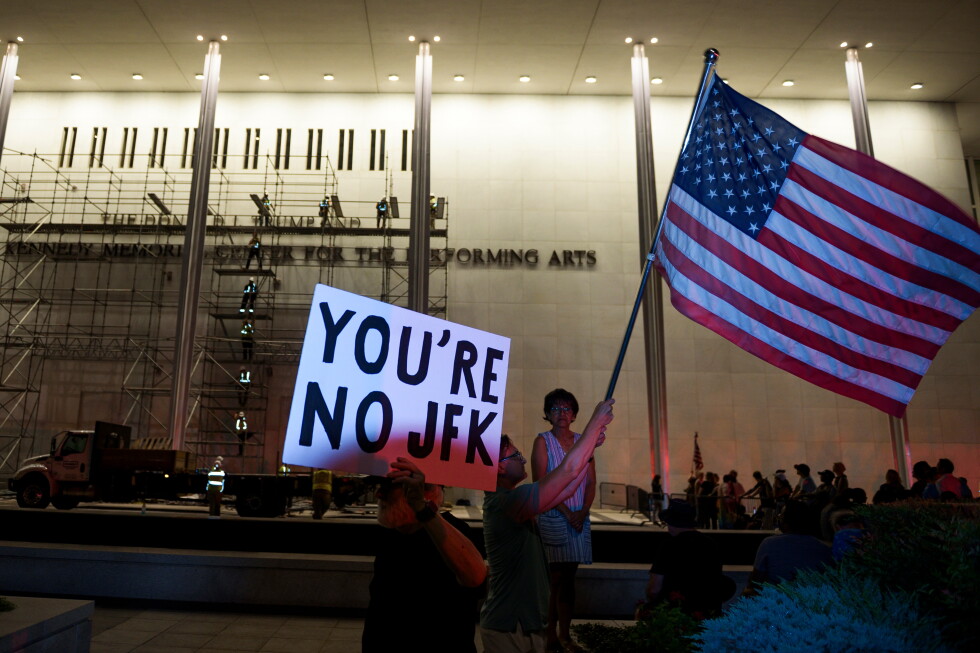
WASHINGTON (AP) — The curtain may have come down for President Donald Trump at the Kennedy Center but the tarp stays up for now.
Matt Floca, executive director and chief operating officer of the performing arts venue, told a federal court Saturday that the institution had complied with an order to remove Trump’s name from the facade. In a filing, Floca said the board of trustees and the center had removed “all physical signage on the Kennedy Center building and grounds, including the front portico, that purports to rename the Kennedy Center after President Trump.”
But for onlookers who have gathered on the plaza in front of the center over the past day hoping to witness a dramatic moment symbolizing the limits of Trump’s power, it was virtually impossible to see whether the signage was gone. A tarp hung over the scaffolding constructed for workers to perform that task. It was unclear when the tarp might be removed to reveal the original lettering that had endured for decades: “The John F. Kennedy Memorial Center for the Performing Arts.”
A reporter was able to peer through a slight opening in the tarp, which was pulled tightly against the wall, and saw that the letters for Trump’s name were no longer affixed to the building.

A worker constructs scaffolding in front of the John F. Kennedy Center for the Performing Arts sign in Washington, Friday, June 12, 2026. (AP Photo/Cliff Owen)
A worker constructs scaffolding in front of the John F. Kennedy Center for the Performing Arts sign in Washington, Friday, June 12, 2026. (AP Photo/Cliff Owen)
By the end, the Kennedy Center’s leadership had dug in against a federal judge’s order to erase Trump’s name from the building. Two courts rejected the institution’s last-minute request to retain Trump’s name pending an appeal. After severe thunderstorms raked Washington on Friday evening, the Kennedy Center sought one more extension before complying with a noon Saturday deadline.
AP AUDIO: Trump’s name is gone from the Kennedy Center’s facade, according to a top official at the arts venue
AP correspondent Julie Walker reports Trump’s name is gone from the Kennedy Center’s facade, official says.
Those who pushed for the scrubbing of Trump’s name were in a celebratory mood. Rep. Joyce BeattyD-Ohio, an ex officio member of the board who sued to remove references to the president from the building and the center’s operations, was spotted in the plaza late Friday and Saturday morning. She posted a video to social media that purported to show her performing the “Trump dance” in one of the Kennedy Center’s great halls.
“Today’s victory is the beginning of returning the Kennedy Center to the American people,” Beatty said in a statement. “The rule of law prevailed, and that is worth celebrating.”

Women take a selfie as the wall of the John F. Kennedy Center for the Performing Arts is covered in tarp as work continues on the removal of President Donald Trump’s name, Saturday, June 13, 2026 in Washington. (AP Photo/Rahmat Gul)
Women take a selfie as the wall of the John F. Kennedy Center for the Performing Arts is covered in tarp as work continues on the removal of President Donald Trump’s name, Saturday, June 13, 2026 in Washington. (AP Photo/Rahmat Gul)
Leo Bartholomaus, a recent graduate of Syracuse University who lives in Virginia, said he was walking by the Kennedy Center on Friday afternoon after visiting the National Mall to see events related to this weekend’s UFC match at the White House. He said he was not happy that Trump added his name to the building.
“My grandmother had a big love of the arts,” he said. “I’ve been here to see ‘The Lion King.’ I wasn’t a fan of Donald Trump putting his name on it. I thought it was better as the Kennedy Center.”
Closing an unusual chapter
The removal of Trump’s name closes one of the more unusual chapters in the history of the Kennedy Center, which began construction in 1964 and was dedicated to the memory of the slain president, Democrat John F. Kennedy. At what is typically one of the few relatively nonpartisan spaces in Washington, Trump has wielded tremendous influence over the venue during his second term.
Though he rarely discussed the Kennedy Center during his 2024 campaign, Trump moved quickly to oust the institution’s leadership when he returned to office in January 2025 and replaced it with a board of trustees that named him chairman. His name was quickly added to the building.
While the removal of his name marks a setback for Trump, he is moving forward with plans to reshape the physical landscape of the nation’s capital in ways that have few modern parallels.
He demolished the East Wing of the White House and is building a controversial ballroom in its place. He remodeled the Lincoln Memorial Reflecting Pool and plans extensive renovations of a golf course in East Potomac Parkmoves that could significantly reduce the public’s access to running and biking paths. He is also moving forward with a triumphal arch that will sit near Arlington National Cemetery across the Potomac River in Virginia.
Indeed as Trump’s name was being removed from the Kennedy Center, the South Lawn of the White House has been transformed into a venue for a UFC match intended to celebrate the 250th anniversary of American independence but also coinciding with Trump’s birthday on Sunday.

The arena for the UFC Freedom 250 fights on the South Lawn of the White House is photographed Thursday, June 11, 2026, in Washington. (AP Photo/Alex Brandon)
The arena for the UFC Freedom 250 fights on the South Lawn of the White House is photographed Thursday, June 11, 2026, in Washington. (AP Photo/Alex Brandon)
Questions linger about the Kennedy Center’s future
Back at the Kennedy Center, there are many questions about the institution’s future. The same May court decision that ordered Trump’s name to be removed from the building also blocked a planned two-year closure for renovations that was set to begin next month.
The Kennedy Center’s calendar for the weeks ahead include performances of “Moulin Rouge! The Musical” and “Bluey’s Big Play.” Comedian Bill Maher is to be awarded the Mark Twain Award for American Humor during a ceremony on June 28.
But little is scheduled for the stages beyond that and, after substantially reducing staff, it is unclear how quickly the Kennedy Center could build out a robust performance list. Trump, angered by the court’s order to remove his name, has said he would turn the Kennedy Center over to Congress and has suggested it might simply shutter because of public safety concerns.
In its unsuccessful appeal on Friday seeking a pause on the order removing Trump’s name, the Kennedy Center’s leadership argued, in terms that seemed similar to the president’s speech patterns, that the lower court was interfering with needed renovations.
Workers construct scaffolding below the sign for the John F. Kennedy Center for the Performing Arts, Friday, June 12, 2026, in Washington. (AP Photo/Rahmat Gul)
Workers construct scaffolding below the sign for the John F. Kennedy Center for the Performing Arts, Friday, June 12, 2026, in Washington. (AP Photo/Rahmat Gul)
“The District Court is not allowing us to close in order to properly fix up and repair the Building, including potentially life threatening structural damage like beams and parking garage ceilings that are rusted, and in serious danger of falling onto people below,” according to the appeal. “Indeed, total collapse!”
The institution also suggested that the president’s name could return to the building if the Kennedy Center later wins its appeal.
If the court denied the venue’s request for a pause, the Kennedy Center argued it would “be forced to squander time and money — by both removing the signage and then potentially returning it after appeal.”
___
Associated Press journalist Emily Wang contributed to this report.

WASHINGTON (AP) — AI giant Anthropic said Friday it has taken its latest artificial intelligence models, known as Fable 5 and Mythos 5, offline to comply with a directive from the Trump administration to prevent their use by foreign nationals.
The export controls mark the U.S. government’s most significant step to date to restrict access to the most advanced AI models. Anthropic released Fable widely this week. That model is a limited version of the even more advanced Mythos, to which the company has tightly limited access due to cybersecurity fears.
In a statement, Anthropic said it disagrees with the government’s handling of the matter, saying it received the directive from the U.S. government Friday afternoon and it did not specify the national security concerns. “We believe the government should have the ability to block unsafe deployments, as part of a statutory process that is transparent, fair, clear, and grounded in technical facts,” the company said. “This action does not adhere to those principles.”
Anthropic called it a “misunderstanding” and said it hopes to restore access to the models “as soon as possible.”
The Commerce Department did not immediately respond to a request for comment.
The action comes 10 days after President Donald Trump signed an executive order to establish a framework for the federal government to vet the national security risks of the most advanced AI systems for up to a month before their public release. Participation by AI developers would be voluntary, the order said.
When the New York Knicks qualified for the NBA playoffs in 2021, after an eight-year drought, the New York Post reported on that team’s sole postseason victory with the headline“Wild crowd of Knicks fans take over streets after playoff win.”
A friend of mine visiting the city at the time picked up on the palpable Knicks fever, though he was a bit flummoxed at the level of giddiness for a team that won just one game before being bounced from the tournament by the Atlanta Hawks. “This is a basketball town,” I said, “If the Knicks ever actually make a real run at the title, this place will go absolutely insane.”
Now the New York Knickerbockers are NBA champions for the first time since 1973, having defeated the San Antonio Spurs in a five-game series that featured the greatest comeback in NBA finals history. And New York fans are indeed back in the streets, this time in even greater abundance, exploding with joy.
Now the New York Knickerbockers are NBA champions for the first time since 1973, having defeated the San Antonio Spurs in a five-game series that featured the greatest comeback in NBA finals history.
Will Leitch aptly explained why Game 4, when the Knicks rallied from a 29-point deficit at Madison Square Garden, was a microcosm for this squad’s improbable, inspiring, record-breaking playoff run: “For whatever reason, the Knicks spent most of this season toggling themselves on and off, like a circuit breaker. They just toggled themselves off and back on again. But this wasn’t a toggle: This was the smashing of a plunger that blew the roof off an entire building.”
There were doubts that first-year coach Mike Brown would be able to build off the success of his predecessor Tom Thibodeau, whose five-year run ended with the Knicks’ loss in the 2025 Eastern Conference finals, but made the Knicks legitimate title contenders for the first time since Bill Clinton was president. While this team has a lot of talent, it is hardly made of superstars.
Team captain Jalen Brunson made this year’s All-NBA Second Team, but none of the other Knicks made even the third team. Instead, their special sauce is chemistryas Brunson is joined by two of his NCAA Championship-winning Villanova teammates, Josh Hart and Mikal Bridges; New Jersey native Karl-Anthony Towns has won hearts with both his play and candor about personal tragedies he’s endured in recent years; OG Anunoby brings a quiet grittiness and clutch efforts on both sides of the court; and rotation players coming off the bench each knew their role and played with confidence when called on to play.
A Knicks fan went viral this month with the chant, “My mayor’s Muslim / My bagel’s Jewish / My Christian’s Dior / Knicks in four!” The Knicks didn’t win the title in four, but the sentiment captures the atypical warm and fuzzies engendered by the team’s championship run — and the magical, fleeting moments that won’t be forgotten by anyone lucky enough to experience them.
New York, famously not the friendliest of cities, has been tangibly united behind the Knicks. Thousands of people watching the games on a screen outside MSG on Seventh Avenue. Intrepid New Yorkers projecting the ABC broadcasts onto handball walls and the sides of buildings for their neighbors. Staten Island hip-hop legends Wu-Tang Clan rallying the moribund Garden crowd at halftime in Game 4, when the Knicks trailed by 27 points.

Anyone who has been in this city since April, whether they’re a lifelong fan, a late-coming bandwagoneer or a grimacing hater of all things New York sports, has experienced a communal, euphoric, even egalitarian vibe (though it didn’t extend to ticket prices at the Garden). As Alex Kirshner wrote in Slate“What’s happening here is some kind of confluence, one that a lot of people are desperate to bottle up but that might not come around again.”
John Turturro, the veteran actor and native New Yorker, said “one of the joys of being alive” is riding the subway with other fans after a Knicks win. “I’m in this city that no one ever looks at each other and everyone’s talking to each other,” he told CNN.
To be sure, there have been some terrible “fan” moments during the finals — when a creep threw an egg at Spurs star Victor Wembanyama on the sidewalk or when a mob viciously assaulted a Spurs fan outside the Garden after Game 3. And as The Athletic put it with regard to the clout-chasing viral video wannabes doing stupid, dangerous stunts for the clicks, “Attention-seeking knuckleheads are the lone blight on these amazing NBA Finals.” Here’s hoping said knuckleheads don’t spoil the Knicks’ victory parade down the Canyon of Heroes for the rest of us.
Yes, there are longer-suffering fanbases. Yes, New York City’s smug self-regard and disproportionate national media attention will always generate a certain level of resentment. But few fanbases have cared this much, for this long — selling out the Garden nearly every game night, even when the team’s play was abominable and the organization was better known for its toxic environment and comical mismanagement.
New York might be the financial capital of the U.S. and a prime destination for an oligarch’s pied a terre (or two), but most of the 8.5 million of us in this city will never sniff that kind of privilege. This city is prohibitively expensive, it is perpetually dirty and its infrastructure only occasionally functions properly. It is, frankly, often such an exasperating pain that rational adults have been known to regularly question their life choices for still being here.
But the Knicks are champions for the first time in more than a half-century. And these particular Knicks — humble, hard-working, overachievers with personality — reflect a New York we’d all like to believe in. They’ve briefly made us forget our troubles, and allowed us to (mostly) leave politics at the door for a few hours a night.
This victory, by this team of players, has unleashed an unbridled ecstasy from denizens of a place that prides itself on world-weary cynicism — even if that merely conceals a hopeless romanticism just beneath the surface. Go New York, go New York, go!
Anthony L. Fisher is a senior editor and opinion columnist for MS NOW.
- Ukraine is winning the drone war. Now it needs to win over Trump.
- Workers begin removing Trump’s name from the Kennedy Center
- Anthropic says it has taken its latest AI models offline

- The Knicks are NBA champs — and New Yorkers share a moment to last a lifetime
- How U.S.-Iran draft agreement fails to meet Trump’s war goals

- Trump’s name removed from Kennedy Center after losing court fight

- How Washington got ready for a UFC fight, in photos

- Workers begin removing Trump’s name from Kennedy Center after last-minute bid to fight ruling

- Bowser reinstates limited youth curfew in DC
- Karen Bass’s brother joins lawsuit against Los Angeles over Palisades fire
-

 Politics1 year ago
Former ‘Squad’ members launching ‘Bowman and Bush’ YouTube show
-

 The Dictatorship1 year ago
Luigi Mangione acknowledges public support in first official statement since arrest
-

 Politics1 year ago
Former Kentucky AG Daniel Cameron launches Senate bid
-
Uncategorized2 years ago
Bob Good to step down as Freedom Caucus chair this week
-

 The Dictatorship1 year ago
Pete Hegseth’s tenure at the Pentagon goes from bad to worse
-

 The Josh Fourrier Show2 years ago
DOOMSDAY: Trump won, now what?
-

 Politics1 year ago
Blue Light News’s Editorial Director Ryan Hutchins speaks at Blue Light News’s 2025 Governors Summit
-

 The Dictatorship9 months ago
Mike Johnson sums up the GOP’s arrogant position on military occupation with two words