
Politics
PR fail: Mamdani’s Boricua bungle


DEPARTMENT OF UNFORCED ERRORS: Mayor Zohran Mamdani held an annual Puerto Rican heritage event today at Gracie Mansion that underscored a growing tiff.
The afternoon celebration was pared-down. Prominent leaders never received an invite or declined to attend. And Nuyoricans were initially told it wasn’t going to happen at all.
Roughly 200 people milled about the ornate entertaining room in the mayor’s official residence on the Upper East Side. A smattering of elected officials past and present were there, among them state Sens. Gustavo Rivera and Kristen Gonzalez and former Council members Rafael Salamanca and Carlina Rivera.
“New York City government has not done its part to serve Puerto Rican New Yorkers. Our City Hall is determined to change that,” Mamdani told the crowd, citing his administration’s plan to build municipal grocery stores in East Harlem and the Bronx.
The vibe, however, was a bit off.
In a matter of weeks, the mayor’s office has turned what’s normally a routine and low-stakes way of keeping in good stead with the Puerto Rican community into a self-inflicted political wound that comes as the democratic socialist tries more broadly to sweep out an old guard of Latino elected officials.
“There are people who are still upset about this,” said Erica González, former executive editor of El Diario La Prensa, the oldest, largest Spanish-language daily newspaper in the country. “It’s begging the question about what the treatment of the Puerto Rican community is going to be.”
Upon taking office, Mamdani created an outreach division called the Mayor’s Office of Mass Engagement, which seeks to replicate the success of the volunteer army that helped propel him to victory (and in the process provide a taxpayer-funded boost to Mamdani’s reelection campaign). As POLITICO previously reported, the office also absorbed — and de-prioritized — several longstanding outreach divisions that help plan and execute events like today’s Gracie Mansion fiesta.
Earlier this month, a mass engagement representative told Puerto Rican leaders the annual event was not happening.
“In an effort to celebrate the National Puerto Rican Day in the company of as many working-class New Yorkers as possible, Mayor Mamdani and our administration are prioritizing his attendance at the 5th Ave Parade and the Knickerbocker Parade on June 14th instead of hosting an invitation-only reception,” Álvaro López, a former campaign staffer and DSA organizer who now works in the Office of Mass Engagement, wrote in an email.
Outrage inevitably followed. The mayor’s office quickly disavowed the email and said a reception was indeed in the works.
But at least some invitations didn’t go out until last week. Several prominent people weren’t contacted at all, and notable Puerto Rican political figures in the city — like former City Council Speaker Melissa Mark-Viverito — were no-shows. On top of that, today’s midday event didn’t keep with the tradition of throwing a large-scale, invite-only evening bash ahead of Sunday’s annual Puerto Rican Day Parade in Midtown. (The mayor’s office said heritage events will no longer feature a large tent in Gracie Mansion’s backyard). Some community leaders upset about the Mamdani snub held an alternative event Thursday evening in Brooklyn.
“It concerns me there is someone in the administration that thinks there’s some mythical, Downton Abbey class of Puerto Ricans that shows up to Gracie,” González said.
López, the Mass Engagement staffer whose email triggered much of the backlash, was on hand for Friday’s Gracie reception, tasked with checking in media at the front entrance. When a Playbook reporter arrived, López questioned why Blue Light News should be allowed in. When asked why, López said he was only joking.
The dustup over the reception doesn’t seem to have affected Mamdani’s poll numbers with Latino voters. In a Data for Progress survey of New York City voters conducted May 20-26, nearly 60 percent of Latino respondents viewed the mayor either somewhat or very favorably.
The mayor is creating rifts elsewhere as well, though.
Mamdani endorsed a democratic socialist challenger to Rep. Adriano Espaillat in upper Manhattan and the Bronx, touching off a generational battle between older Dominican voters and younger, more affluent supporters of Darializa Avila Chevalier. And in Assemblymember Claire Valdez, Mamdani is betting against the chosen successor to Rep. Nydia Velázquez, one of the city’s most prominent Puerto Rican figures.
Velázquez was among those who skipped Mamdani’s Friday afternoon event, vaguely telling Playbook she had “too many things” to do. But in a sign of her irritation with Mamdani, she questioned why he threw a FIFA soccer event in Gracie’s backyard Thursday evening, saying it seemed like the same sort of private party his office is saying they want to move away from.
“We have to be clear about what is the policy going forward,” she said. “Because otherwise people will feel: Why them and not us?” — Chris Sommerfeldt and Joe Anuta
FROM CITY HALL

ZOMBIE DISASSEMBLING: Yet another member of former Mayor Eric Adams’ legally dubious Charter Revision Commission has resigned — putting the zombie-like panel on the brink of extinction.
Ismael Claudio, a Brooklyn pastor who acted as a faith adviser to Adams while he was still mayor, resigned from the commission Monday, according to a person with direct knowledge of the matter who was granted anonymity to discuss the issue.
Kayla Mamelak, Adams’ former press secretary who also sits on the commission, wouldn’t comment on Claudio’s resignation. Claudio couldn’t be reached for comment.
Charter revision commissions, which are convened by mayors to propose ballot referendum questions for local elections, can only legally operate if they have at least nine members. With Claudio out, Adams’ panel only has nine members — the bare minimum to live on.
Three other members, Robert Tucker, Fernando Mateo and Shams DaBaron, also resigned in the past few weeks. Another two appointees, Martin Connor and Alfred Curtis, never filed the requisite paperwork to join the commission in the first place.
At least one additional member, retired labor leader Denis Hughes, hasn’t shown up to any of the commission’s public hearings. Mamelak insisted he is still a member of the commission, though. Hughes couldn’t be reached for comment.
Ultimately, resignations may be the smallest problem for the panel, which Adams launched on his final day in office.
Mamdani ordered Adams’ commission disbanded in late May, using a new authority granted him by the state. Mamdani also launched his own Charter Revision Commission and tasked it with advancing ballot questions for November related to improving government efficiency.
Randy Mastro, Adams’ former first deputy mayor and the counsel for Adams’ commission, has insisted Mamdani’s nullification order wasn’t lawful and is forging ahead.
On the same day Mamdani ordered Adams’ commission disbanded, the panel voted to advance a November ballot question that would, if approved by voters, establish an open primary system in local elections. Under such a system, it would likely be harder for democratic socialists like Mamdani to be elected, as the pool of primary voters would be expanded to include more conservative voters — a wrinkle that has reinforced many observers’ belief that Adams created his commission to deliberately stymie his successor.
In addition to voting to advance that referendum question, Adams’ commission has continued to hold public hearings to consider more questions for the November ballot. Among the additional proposals they’re looking at is a ballot question to create new, unspecified initiatives aimed at combating antisemitism in New York.
It’s unclear how the Adams commission’s actions — including those already taken — would be impacted if enough members resign for the panel to be nullified by default.
Mamdani’s administration has maintained that nothing the Adams commission is doing holds legal relevance since the mayor killed it weeks ago. — Chris Sommerfeldt
FROM THE CAMPAIGN TRAIL

PAC IT UP, PART I: A shadowy super PAC war has descended upon the Democratic primary to take on Rep. Mike Lawler.
Progressive Champions PAC, a group that filed with the Federal Election Commission last month and has yet to disclose its donors, has placed close to $1 million on a TV advertising buy attacking Democratic candidate Cait Conley in the final days of the campaign.
Democrats were quick to accuse the group of being backed by GOP interests, pointing to a bank it shares with another PAC with ties to Republicans that spent in other Democratic primaries across the country.
It’s not unheard of for the opposite party to get involved in a primary across the aisle in an attempt to elevate candidates they think will be easier to defeat in the general election.
The ad hits Conley, an Army veteran who has drawn the support of national groups, over Immigration and Customs Enforcement. The narrator states that she is “bankrolled by firms partnered with a major ICE contractor targeting immigrants” — a reference to reporting that firms she consulted for aided immigration enforcement. She has repeatedly denied this claim.
“True activists fought ICE’s atrocities, but Conley kept collecting,” the ad continues. “That’s not progressive, that’s profiteering.”
In a statement, Conley said that “Republicans are seriously underestimating NY-17 Democrats who will see through their political lies and deceit.”
The PAC didn’t respond to Playbook’s request for comment. Its site states that its mission is to “elect bold, progressive candidates up and down the ballot who will fight for working families, protect our democracy, and build a future that works for everyone.”
Conley is one of five candidates running for the Democratic nod. Her two most high-profile challengers are Rockland County Legislator Beth Davidson, who like Conley is running as a moderate, and Tarrytown Trustee Effie Phillips-Staley, who has sought to claim the progressive lane. Some Democrats worry that a far-left candidate would make flipping the battleground seat more difficult in November.
Conley also placed some blame for the PAC attack on Davidson, who has public messaging on her site echoing a similar sentiment as the ad. Davidson also ran a spot hitting Conley on the immigration issue.
In response, Davidson in a statement said “Mike Lawler and Republican dark money groups have no place meddling in our Democratic primary. Full stop.” (Phillips-Staley also condemned the spending.)
Lawler hasn’t shied away from hitting his potential Democratic opponents throughout the primary. But on Friday, his campaign insisted it couldn’t be bothered by the messiness across the aisle.
“Frankly, we don’t care who survives this clown car primary because every single one of them supports raising taxes on working people, making New York a Sanctuary State, and doesn’t have an independent or bipartisan bone in their body,” Lawler campaign manager Ciro Riccardi said in a statement. — Madison Fernandez
PAC IT UP, PART II: There’s yet another super PAC in the high-dollar Democratic primary to succeed retiring Rep. Jerry Nadler.
Guardrails Alliance, a super PAC that registered with the FEC last month, has made a six-figure ad buy in the race, according to the ad tracker AdImpact. Public filings with the Federal Communications Commission show that the ad will refer to Assemblymember Alex Bores and focus on artificial intelligence — making it the latest AI-related PAC in the race.
Bores’ work on landmark AI regulation in the state Legislature has attracted millions of dollars both in support of and against him amid his congressional bid. Think Big — a super PAC backed by leaders at OpenAI and the venture capital firm Andreessen Horowitz, among others who claim such regulation stifles innovation — has targeted Bores with more than $6 million in spending, according to FEC filings. A handful of other PACs, many of which have ties to those in the tech industry who are friendlier to AI guardrails, have spent $8 million supporting him, per the FEC.
Super PAC spending has been a sore spot in the race. In the closing days of the campaign, Bores’ opponents have expressed frustration with the heavy super PAC spending in support of him. — Madison Fernandez
BERNIE COMES TO TOWN: Bernie Sanders, Vermont senator and democratic socialist forefather, is coming to New York on Thursday in a last-minute push to boost progressive congressional candidates.
The New York Times first reported the event is set to feature Assemblymember Claire Valdez, who is running in the open race to succeed Velázquez; Darializa Avila Chevalier, who’s challenging Democratic Rep. Adriano Espaillat; and former city Comptroller Brad Lander, who’s looking to unseat Rep. Dan Goldman. All three are endorsed by Mamdani, who is also expected to join the rally.
Sanders’ team confirmed the event to Playbook.
Sanders, who is wildly popular in New York, previously endorsed Valdez and Lander. Both Valdez and Avila Chevalier are members of the Democratic Socialists of America and are backed by the city chapter in their bids; the two cross-endorsed each other.
But Lander has tried to keep some distance, despite appearing in a joint advertisement with Mamdani’s congressional slate. When asked at a press conference earlier this week why he would appear in that ad with Avila Chevalier, who attended a pro-Palestinian rally the day after Hamas’ Oct. 7 attack in 2023 — the same rally Lander said he left the DSA over — he said it was an “opportunity to show New Yorkers that politics can be a team sport.” He also clarified that he has not endorsed candidates in any other congressional primaries.
Avila Chevalier told reporters last week that she went to that rally to “stand against” Israel engaging in “a response that is often disproportionate and creates a greater loss of life.” She added that she has “condemned Hamas” and does “not believe that celebrating the loss of anybody’s life is OK.”
Avila Chevalier’s profile has been heightened in recent weeks, following Mamdani’s endorsement. But with that has also come more scrutiny — particularly of her social media activity from the beginning of the decade. One such post criticized what she called Sanders’ “liberal Zionism.” But Avila Chevalier has repeatedly said that she has changed in the years since she made those posts and has accused Espaillat of relitigating old posts to distract from other issues in the race. — Jason Beeferman and Madison Fernandez
WORLD CUP WATCH

MOHAWK VALLEY MADNESS: When Bosnian refugees started arriving in Utica in the mid-1990s, it was a down-on-its-heels upstate Rust Belt city that had seen its population crater by roughly a third from a midcentury peak of just over 100,000 residents.
“I thought I came to another war zone when I came here,” said Hanka Grabovica, who arrived in the Mohawk Valley city in 2001 when she was 16 years old, citing the prevalence of boarded-up buildings and garbage on the streets. “Utica was pretty bad back then.”
Grabovica was part of a wave of Bosnian refugees who settled in Utica after fleeing the brutal war in their native country — and its messy aftermath — that followed the breakup of Yugoslavia. Exact figures are tough to pin down, but it’s believed that about 6,000 Bosnians now live in Utica — or nearly 10 percent of the total population.
The city’s unlikely emergence as an epicenter of Bosnian American culture will probably never be more prominently on display than this afternoon when Bosnia and Herzegovina faces Canada on the second day of the World Cup. It’s just the second time Bosnia has qualified for the tournament since it became an independent country in 1992.
The dramatic and unlikely way that the country punched its ticket to North America — knocking off four-time World Cup champion Italy via penalty kicks in a one-match playoff — has heightened the delirium among Bosnians from Sarajevo to St. Louis (the largest enclave of Bosnians in the U.S.) to Utica.
“Seeing this national team progress to the World Cup is definitely something amazing,” said Sandro Sehic, secretary of the Bosnian American Community Association of Utica, noting that many ethnic Serbians and Croatians who live in the country still refuse to play for the national team owing to lingering tensions from the war. “Bosnia is still struggling politically, socially. There are still so many problems that are still affecting the country.” Read more from Paul Demko in Blue Light News
IN OTHER NEWS
— GROCERY EXPANSION: City Council member Jennifer Gutiérrez introduced a bill to expand Mamdani’s city-owned grocery story plan and make it a permanent part of city government. (The City Reporter)
— WHO CALLS THE SHOTS: GOP gubernatorial candidate Bruce Blakeman called Gov. Kathy Hochul’s newly passed bill that requires children to be vaccinated for summer camp “un-American.” (Gothamist)
— BUG INVASION: Tick season is in full swing with a rare case of Lyme disease being detected in the Empire State for the first time. (CBS News)
Missed this morning’s New York Playbook? We forgive you. Read it here.


CHICAGO — JB Pritzker is pouring tens of millions of dollars of his own money into boosting Black and Hispanic candidates this cycle. That could help him win over critical voters in 2028.
The billionaire Illinois governor — who’s also considered a potential presidential contender — is investing at least $38 million in battleground races, according to a person familiar with the governor’s political strategy granted anonymity to discuss details.
Much of that spending has gone to candidates of color, some of whom haven’t drawn much other investment from national Democrats. Pritzker is also investing in races in all six early states on the Democratic presidential nominating calendar, which was rearranged earlier this year to give prize spots to five states with significant Black or Hispanic communities: South Carolina, Nevada, New Mexico, Virginia and Michigan.
Asked by Blue Light News about how his midterms spending could lay the groundwork for a presidential campaign, Pritzker said he’s “focused on winning in 2026.”
But some of those receiving major infusions from Pritzker say it should earn him a serious look in 2028.
“Governor Pritzker is playing a very important role” in the party, said Rep. Shomari Figures, a Black Democrat facing an uphill fight in Alabama who has gotten an assist from Pritzker’s newly-formed super PAC, Ready for the Fight. “He actually cares and is… willing to invest in districts where minority candidates have a good shot if they have the right type of support. I think that’s an important element of any leadership.”
Pritzker said Ready for the Fight’s strategy focuses on GOP-leaning districts that would normally be “out of sight for Democrats” but have become competitive in a favorable midterm environment.
Figures is fighting for reelection in a district Republicans redrew to make it harder for a Democrat to win by decreasing the Black population, after the Supreme Court gutted the Voting Rights Act this past spring.
When that court decision came down, Figures said Pritzker was one of the first people to call him to offer help.
“The fact that he reached out and engaged us through that lens with that level of knowledge about what was happening in Alabama meant a lot to us,” Figures said.
Pritzker is spending $1.6 million for Figures, $1.9 million to boost Tennessee state Rep. Justin Pearson, another Black candidate running in a newly gerrymandered district that includes part of Memphis, and has put $1.3 million behind Arkansas Democrat Chris Jones in his race against Rep. French Hill (R-Ark.) in Little Rock, making him the largest Democratic spender besides the Democratic Congressional Campaign Committee in all three districts.
Pritzker is also the largest individual donor to Texas Democrat Gina Hinojosa’s gubernatorial campaign, personally contributing $200,000 before committing another $1 million earlier this month. The latter donation came with a matching contribution from the Democratic Governors Association. Hispanic officials and lawmakers have been ramping up the pressure on the group’s chair, fellow 2028 hopeful Kentucky Gov. Andy Beshear, to invest more in Texas.
Pritzker called Hinojosa an “outstanding person.”
“The opportunity for her to win and for Democrats to win as a result of her winning is tremendous,” Pritzker told Blue Light News at a Thursday press conference. “From my perspective, we all ought to be helping somebody like that to overcome the odds.”
And while he declined to criticize national Democrats’ strategic decisions not to spend for some candidates in tough races facing a deluge of GOP outside money, he made clear he was looking to make up for that lack of funding.
“If I were running in one of those districts, and I’m not getting dollars that I see going to other districts, I would feel frustrated,” Pritzker said. “There’s only so much you can do when you’re being outspent three to one or four to one nationally, and so I’m trying to do my best to fill in some of that wherever I can.”
Pritzker is not the only potential 2028er looking to woo politically powerful Black and Hispanic communities, and his day job and his own reelection bid keeps him away from the national trail — unlike some of the other senators and governors who’ve been criss-crossing the country for months. But what he lacks in time, he makes up for in money.
His spending strategy is catching the attention of senior Black Democratic leaders.
“People tend to take notice of the people who take notice of them,” said South Carolina Rep. Jim Clyburn.
Clyburn said he takes Pritzker “seriously” as a potential presidential candidate, but cautioned that Black voters and organizers in his home state, where Pritzker recently addressed the state NAACP’s annual convention, likely won’t be swayed by campaign contributions alone.
“We are going to take measure of candidates, not based upon how deep their pockets are, but we’re going to take measure of how deep their commitments are to those things deemed important in the African American community,” he said.
Still, the donations are helping the billionaire longtime Democratic donor and two-term governor forge new allies in key communities that could provide a boost come primary season.
“I appreciate Governor Pritzker’s willingness to invest in places others have written off,” said Jones, who also thanked the DCCC for recently adding him to their list of targeted races. “Convincing people a race is worth investing in has often been an insurmountable barrier for Black candidates.”
Pritzker’s PAC spent $2.8 million for New Mexico Democratic Rep. Gabe Vasquez and the governor made a $400,000 personal contribution into a super PAC backing Nevada gubernatorial candidate Aaron Ford, a Black candidate running in a heavily Hispanic early-voting state.
But his biggest investment of the cycle was to boost Illinois Lieutenant Governor Julianna Stratton, who he picked as his 2018 running mate when she was a little-known state representative, then invested $10 million to help her win her U.S. Senate primary this spring.
The move created some tensions: Pritzker’s endorsement of Stratton helped lift her 2026 Senate campaign significantly over two other candidates — including Rep. Robin Kelly (D-Ill.), another Black woman who has had a strained relationship with Pritzker over the years. That frustrated several members of the Congressional Black Caucus, though he’s sought to mend fences since. Clyburn, who endorsed and campaigned for Kelly, said that race won’t “dictate future relationships when it comes to putting our party in the best position to win the elections in 2028.”
And ultimately, Stratton’s ascendance is a significant step in his outreach to Black voters nationally. He will be credited with helping send just the sixth Black woman ever to the U.S. Senate after her likely victory in November. She could be a key 2028 surrogate should he run for president.
“He really does have a platform to raise awareness of critical races that people might not otherwise pay attention to,” Stratton said. “I’m really grateful for that.”
Democrats are salivating over, and Republicans are bracing for, a potentially massive blue wave. One GOP pollster is urging everyone to calm down.
Patrick Ruffini, a founding partner at Echelon Insights, has been loudly throwing cold water on Democrats’ hopes of sweeping the red state Senate seats that have become battlegrounds in a worsening national environment for Republicans.
“The polls are, I think, intentionally inflating the size of the battleground,” Ruffini told Blue Light News.
Democrats are pushing to flip Senate seats in Iowa, Texas, Ohio and Alaska — all states that President Donald Trump won by at least 11 points in 2024 — with dreams of going even deeper into the map Kansas, South Carolina and even Mississippi. Sensing a potential disaster, Republicans have significantly curtailed their investments in North Carolina and Georgia to direct resources elsewhere.
Ruffini, who isn’t polling for candidates or party committees in any federal races, said he’s skeptical of Democrats flipping some of those seats, particularly in the Midwest, and gives the GOP a coin flip’s chance at keeping control of the Senate.
If a blue wave were to come, he said it would defy the ingrained partisanship in deep-red states that has mirrored growing political polarization around the country.
“I think it would be somewhat of a historic shift if that were to happen,” he said.
Here’s more from Blue Light News’s chat with Ruffini, edited for length and clarity. A more condensed version of this interview ran in Blue Light News’s Morning Score campaign newsletter.
You’ve been pretty publicly skeptical of polling that indicates a big tsunami for Democrats in November. Why is that?
I think we can read the environment right, but the map wrong.
The pretty large shift towards Democrats that we’re seeing on the generic ballot and in a lot of individual races, I’m not saying that’s not going to materialize. What I am more skeptical of is… the ability of any major party in this polarized era that we’re in to rack up significant gains in states that went double digits for the other side.
I’m not ruling out — I think there will be some [examples]. I think Alaska is one where it’s both an idiosyncratic state, and [Democratic nominee Mary] Peltola has shown some specific candidate-centered strength. Nor would it shock me if [Democrat] James Talarico wins, despite the history in Texas. That would not surprise me, just given the candidate quality disparity, particularly on the Ken Paxton side.
Where I get more skeptical is when you move into the Midwest, where there has historically been pretty large polling errors [overstating Democrats’ chances] in states like Iowa, Ohio. And I think you can extend that to the Democratic enthusiasm around Kansas.
Is your skepticism coming more from the quality of the individual polls that you’re seeing that are showing massive Democratic surges in the Midwest, or is it the history of these states that you’re betting will ultimately win out?
I think fundamentals are going to play an important role, particularly in states where there was a solid Trump advantage. We’re not talking about a state like North Carolina or Georgia that’s only for Trump narrowly, where Democrats, at least in the Senate races, are clearly favored.
Historically the presumption is that states tend to converge on their base partisanship in the closing days of an election, but especially that’s been the pattern in the Midwest.
Specifically as it relates to the polls this year, I think any pollster you would talk to, including myself, is experiencing significant non-response bias favoring Democrats.
When you’re seeing high-propensity Democrats [responding to polls] at twice the rate of high-propensity Republicans, when we know that the turnout on both sides would be roughly evenly paired, that’s a warning sign for polling in this cycle.
It seems like there’s some GOP internal polling saying that Republicans are worried about these states, because they are moving money around to triage certain races. I’m curious if you feel like they’re wrong to be making those decisions?
Absolutely not. They’re not wrong. You do have to take the polls somewhat seriously in the sense of, if you do get a poll that’s within the margin of error, I think you’re duty-bound to spend money in those places and not to ignore what could be a potential signal.
I think that control of the Senate comes down to Texas, so they’re right to be spending money there. If you just look at the amount of money being spent in Texas versus Kansas, obviously it’s a much, much bigger state, and you need to spend much more money.
But it’s not something along the lines of ‘the battleground has shifted. It’s a foregone conclusion. Democrats are going to win the Senate,’ and then the battleground entirely shifts to a state like Kansas or to Iowa, right? I don’t think we’re seeing that.
It sounds like the issue you have is how the broader public is interpreting these polls rather than the polls themselves?
The polls are, I think, intentionally inflating the size of the battleground. And to some extent it’s happening both ways. The polls showing a margin-of- error race in Minnesota is possible, right? I’m not as concerned about a polling error in Minnesota as I am in Kansas.
But because of the number of Democratic internals and because of the incentive of Democratic internals to show close races across the battleground, what you generally tend to see is more of an inflated sense of how big the battleground actually is. A lot of these races just break a certain way.
We’ve reported that Republicans are privately conceding that the House is lost. Is that your reading of the data too?
That’s the best reading of the data. That said, if there’s a three-point polling error or something, then I think it gets very, very tight and anything can happen. But I think that’s the most likely outcome.
What is your prediction for the number of Senate seats Republicans will have?
My prediction for both the probability and the seat count is 50-50. There’s a 50-50 chance Republicans hold the Senate. I think if they do, it’s with 50 seats, probably. But obviously, that can tilt very easily.
Which of these states do you think are going to flip for Democrats?
Alaska is clearly favored. I mean, I don’t know if it’s clearly favored, but I think it’s at least still Democrat. I think Texas is going to be very, very close. I just think the partisanship of the state is — people forget it’s a little bit more Republican than it was back in 2018. I think Republicans are probably being underestimated in Ohio because of the past Midwestern polling error.
At the same time, I would say it’s still uphill in Maine and Michigan to some degree. I think Susan Collins has really been the lone bright spot, at least in terms of the conventional wisdom, the narrative in the Senate for Republicans. I think she has a fighting chance, but I think Republicans are still probably under a 50% chance in both Michigan and Maine, just due to the nature of their partisan lean.
If at the end of all of this it is a real blue wave in the Senate, what will have happened to have made you wrong?
If that happens, we will have seen a level of depolarization in the electorate that we haven’t seen since around 2012. You really have to go back in history for a state like Kansas to flip.That would be pretty unique historically, where it’s a flip where you have an incumbent losing.
That’s the kind of thing that used to happen in Senate races a lot, and then things, starting with Trump, got a lot more polarized. So what that would mean is, maybe this is the start of a new political era. But I think it would be somewhat of a historic shift if that were to happen.
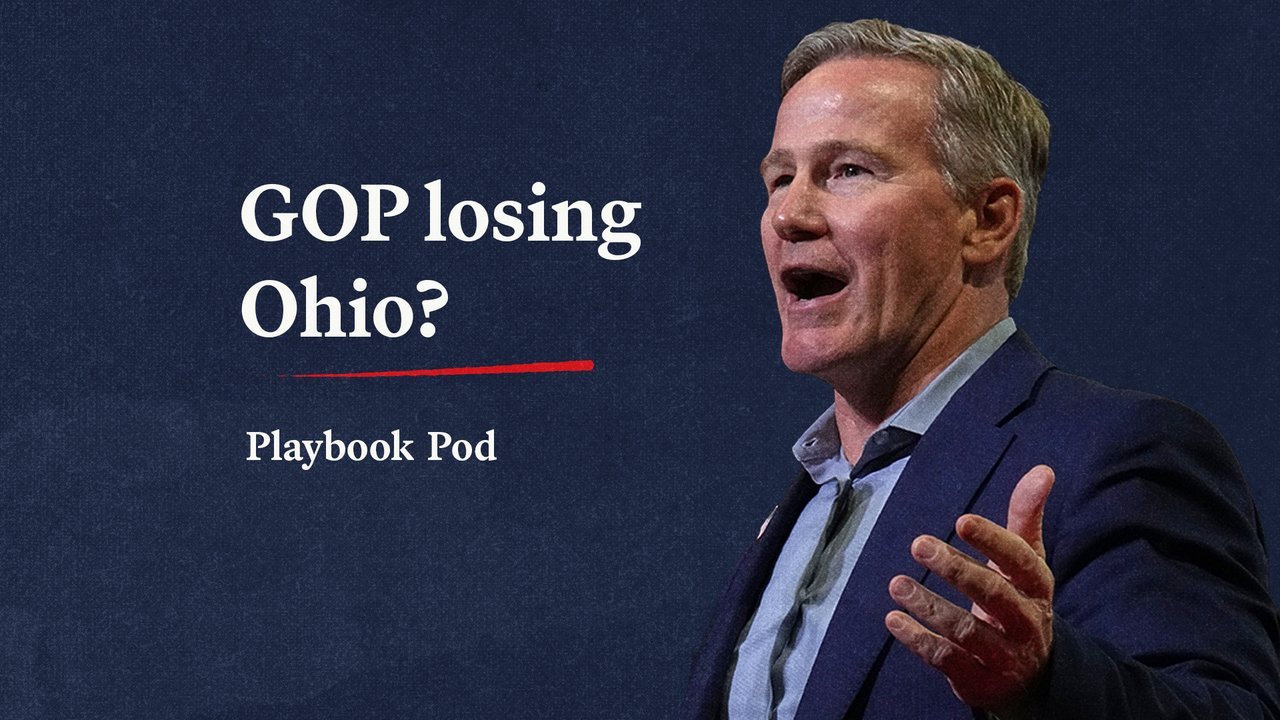
Ohio returns as a bellwether
lead image
-

 Politics2 years ago
Former ‘Squad’ members launching ‘Bowman and Bush’ YouTube show
-
Uncategorized2 years ago
Bob Good to step down as Freedom Caucus chair this week
-

 The Josh Fourrier Show2 years ago
DOOMSDAY: Trump won, now what?
-

 The Dictatorship2 years ago
Pete Hegseth’s tenure at the Pentagon goes from bad to worse
-

 Politics2 years ago
Former Kentucky AG Daniel Cameron launches Senate bid
-

 The Dictatorship2 years ago
Luigi Mangione acknowledges public support in first official statement since arrest
-

 Politics2 years ago
Blue Light News’s Editorial Director Ryan Hutchins speaks at Blue Light News’s 2025 Governors Summit
-

 Politics1 year ago
John Legend advises Trump to drop the ‘dictator s‑‑‑’ if he wants Nobel Peace Prize