
The Dictatorship
Mike Johnson sums up the GOP’s arrogant position on military occupation with two words

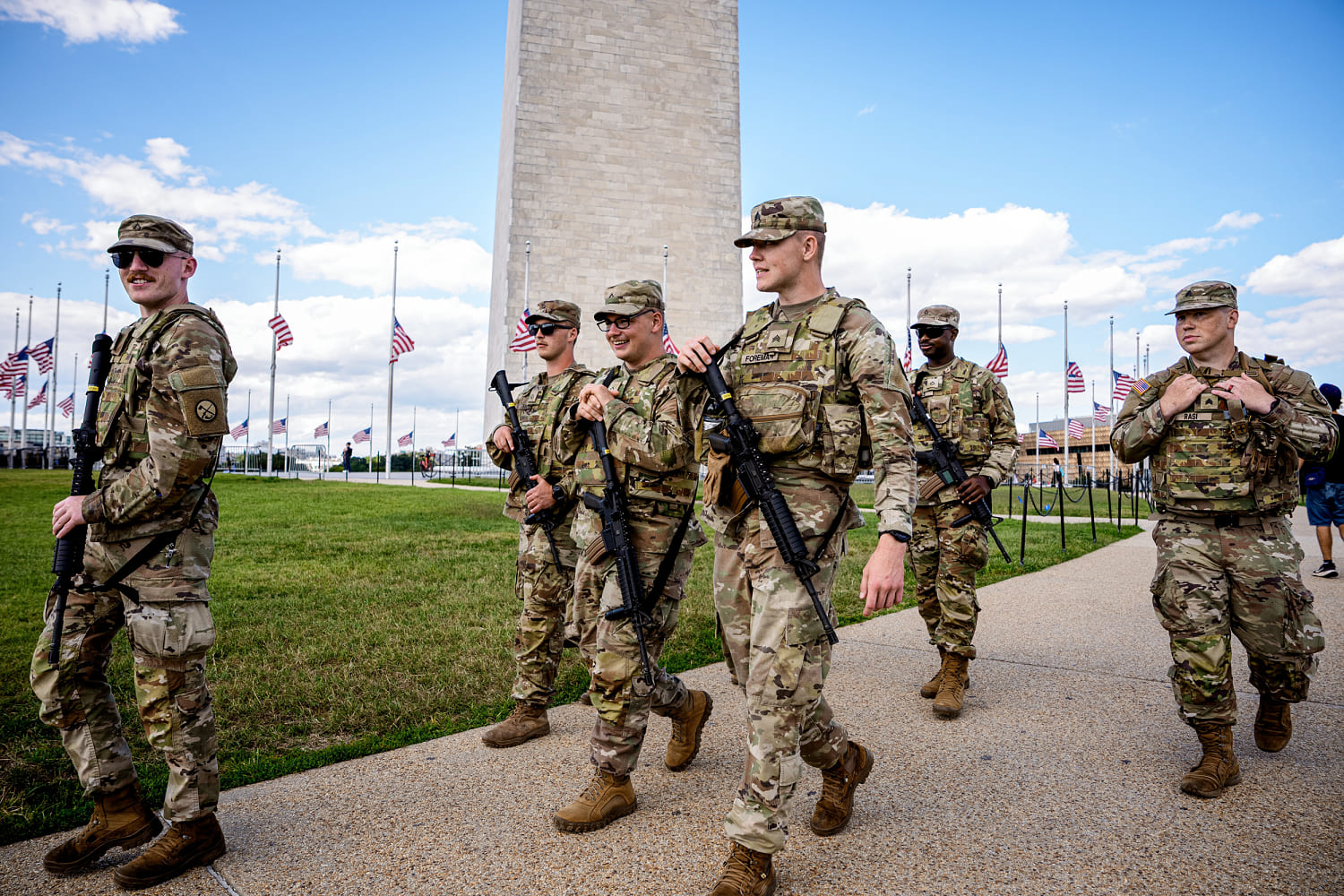
House Speaker Mike Johnson said Tuesday that Democratic mayors who run the cities President Donald Trump is threatening with troops should stop resisting. “Yield, man,” said JohnsonR-La. “Let the troops come into your city and show how crime can be reduced. It’s a morale boost for the country, and it’s safe and right for everybody involved.”
Not since Vice President Dick Cheney told us that U.S. troops invading Iraq in 2003 would be “greeted as liberators” have we heard a Republican make the preposterous claim that a people — in this case Americans! — would welcome a U.S. military occupation. And, to be clear, an occupation is what Trump has been promising. As a characteristically tasteless social media post from Trump over the weekend put it, Chicago is “about to find out why it’s called the Department of WAR.”
Not since Dick Cheney told us troops would be “greeted as liberators” have we heard a Republican claim that people would welcome a U.S. military occupation.
If Speaker Johnson believes that Chicago Mayor Brandon Johnson — or Chicagoans in general — should bend the knee to a president promising such aggression, then he’s telling us that he doesn’t believe that they are fully American, that he doesn’t believe they’re rightful heirs to the Declaration of Independence, the U.S. Constitution and the traditional American ideas of freedom. Land of the free for us, but not for y’all is not an argument a white Southern Republican should expect Black Democrats farther north to accept.
It’s not surprising that a Trump loyalist like Johnson is supporting the president’s military occupation plans, but even former Ohio Gov. John Kasich — a Republican Never Trumper — suggested last month that Democrats should be less opposed to Trump’s unprecedented power play.
Referring to parts of the Windy City, Kasich told MSNBC’s Alex Witt“I just got a text from a from somebody that says, ‘Englewood, West Garfield Park, South Chicago, their kids are dying. Research has shown many don’t expect to grow up. Shame on city’s leaders for not taking all the help they can get.’”
Kasich then conceded, “Look, we don’t want to have to see the military barge in into these cities.” But, he said, if you’re a mayor, “why not go down to the White House and why not to admit we have a problem with crime … and say to the president the United States, ‘Look, you have a lot of resources, and we’ve got a lot of needs’?”
The former governor makes several assumptions. One, that Democrats who lead cities with high crime rates haven’t admitted to such, nor made it a priority to address the problem. Two, that Democrats haven’t asked the federal government (including the White House) for help. And three: that Trump is genuinely interested in reducing crime and that his chief goal isn’t humiliating Democrats and expanding executive power.
Speaker Johnson’s statement suggests that only cities led by Democrats have crime problems.
Speaker Johnson’s statement suggests that only cities led by Democrats have crime problems. But a Republican leads his hometown of Shreveport, Louisiana, (Johnson still lives in the metro area) and the murder rate there is higher than it is in Washington — and higher than it is in Chicago. Louisiana Gov. Jeff Landry, a Republican, has said he’d welcome Trump’s assistance against crime “from New Orleans to Shreveport.” But that welcome was extended only after criticism emergence that Republicans seemed more obsessed with taking down Democrats than crime. So we can be forgiven for doubting the governor’s sincerity.
Last week, in the midst of threatening America cities with military occupations, a Trump-affiliated political action committee sent out a fundraising email with the subject line: “Do not tread on our safety.” That email called out the California judge who correctly ruled Trump had illegally used the military in a domestic law enforcement capacity.
It’s the height of irony and absurdity for that PAC — Never Surrender Inc. — to allude to the “DONT TREAD ON ME” Gadsden flag that small-government devotees love to wave even as Trump is trampling on the wishes of Americans and their elected officials.
Many Americans, including conservatives, are fond of quoting Ben Franklin’s remark “Those who would give up essential Liberty, to purchase a little temporary Safety, deserve neither Liberty nor Safety.” The argument from those who generally use that phrase is that, in the United States, liberty is paramount.
And yet, the Republican speaker of the House is telling his fellow Americans to surrender to their own government, to accept less than their due as citizens and to treat the troops Trump might send in as their liberators. Johnson says he’s just asking for “common sense.”
No, he’s asking for capitulation.

Jarvis DeBerry is an opinion editor for BLN Daily. He was previously editor-in-chief at the Louisiana Illuminator and a columnist and deputy opinion editor at The Times-Picayune.


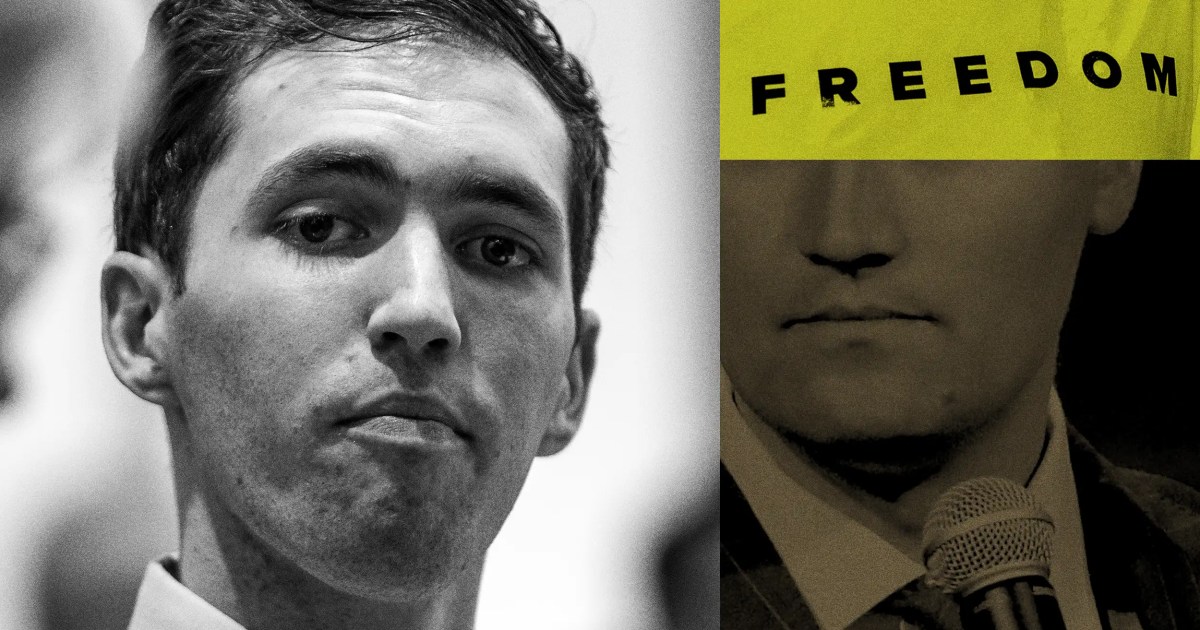
PROVO, Utah — There were three of them that first day, milling about outside Utah’s Fourth District Courthouse, after failing to secure one of the 14 seats reserved inside for the public. I had taken to calling them the Freedom Ladies; named for their shirts and other merch emblazoned with the word freedom, like the one conservative activist Charlie Kirk had been wearing when he was killed last September at a debate event.
We agreed to stick to first names as they didn’t trust the mainstream media and said they didn’t know how I’d spin what they would tell me. The Freedom Ladies — Brandy, Jamie, and Hayley, Utahns in their 40s — had each been in the crowd at Utah Valley University, watching Kirk speak when he was shot.
“We’re trauma sisters,” Brandy told me, wrapping her arm around Jamie.
They had driven to Provo this week for the preliminary hearing of Tyler Robinson, the 23-year-old the state has charged with Kirk’s murder. They were there, Jamie told me, looking for answers. The government’s story just didn’t sit right with them: that Robinson found Kirk’s right-wing politics hateful, and so drove 250 miles with his grandfather’s WWII-era rifle and a bunch of bullets etched with internet memes, climbed onto a campus rooftop and shot Kirk in the neck.
Prosecutors would spend the week laying out that case in a small fourth-floor courtroom, using DNA evidence, surveillance video, and several confessions the state alleges Robinson made, to ask a judge to send the case to trial. Robinson has yet to enter a plea.
Outside, the Freedom Ladies — part of a small, passionate crowd of lookie-loos, true-crime junkies, Charlie Kirk fans, and conspiracist creators — were weighing alternative narratives, assembled mostly online, that were unfounded yet felt to them somehowmore true: that Robinson had been set up, a patsy in conspiracist speak; or that Kirk’s own organization, Turning Point USA, was involved in his death; or that Israel, perhaps, was pulling the strings. The one thing nearly everyone I spoke to seemed to agree on was that Erika Kirk, Charlie’s widow, was somehow involved — suspect at best.
“She’s evil,” Jamie said of Charlie Kirk’s widow.
Rarely do I get to spend a week around people who traffic in conspiracy theories as they’re shown, up close, evidence that flies in the face of their beliefs. While the state made its early case against Robinson, I watched from the jury box, alongside a dozen other reporters who’d landed media seats. And when I wasn’t in the courtroom, I was with the believers: waiting out in the middle of the night beside people camped in the public linetalking during breaks to the members of the public who’d made it inside, trailing conspiracist creators as they lingered in the parking lot after court. I was also searching for an answer to a question of my own: What would change someone’s mind?
***
Almost immediately following Charlie Kirk’s killing, the conspiracy theories began. Since the 2012 massacre of school children at Sandy Hook Elementary School, it’s become expected in the face of mass tragedy or high profile shootings that a cadre of fabulists will deny the event outright and spin up a narrative to counter the official ones. But Kirk’s killing widened the audience of people who were willing to believe such things well beyond the usual fringe, to elected officialspopular right-wing influencers, and Kirk’s closest friends and allies.
Candace Owens, a former Turning Point employee and friend of Kirk, has since led the conspiratorial charge. Less than a week after his death — days after Robinson turned himself in and was arrested for the murder, authorities said — Owens branded herself an investigative journalist and set out on her next crusade: finding out who really killed Charlie Kirk.
As difficult as these last few days have been, it brings our family comfort to know that the world has witnessed the overwhelming evidence of what occurred to Charlie that day.”
statement from the family of charlie kirk
Early episodes of her popular online show included “Charlie Kirk Shooting Suspect Charged. Something Isn’t Right…” and “Who Ordered The Hit On Charlie Kirk?”
Owens had been clawing her way back to the spotlight after she was fired by The Daily Wire for veering from culture-war podcasting into open antisemitism and conspiracist content, including a ham-fisted deep dive into the debunked theory that the first lady of France is secretly a man. With the Kirk investigation, Owens’ YouTube audience grew fourfold overnight; her channel now has over six million followers.
Since September, Owens’ theories about Kirk’s death have expanded, and she and much of her rabid audience have decided that the case against Robinson is rigged. Across thousands of podcast episodes and online posts, a network of conspiracist creators — with Owens at the top — has implicated state prosecutors, federal agencies, foreign governments, and TPUSA in a plot against Robinson.
“I know this is controversial,” Brooke Johnson, an Orem native and Utah Valley University graduate, told me around 2 a.m. as she waited in the overnight line for one of the 14 public courtroom seats, “but there are certain questions that Candace has asked that need to be answered.”
Owens dismissed the court proceedings before they began.
“Today the Tyler Robinson show trial begins,” she posted.
But a preliminary hearing is not a trial. It exists to determine whether the state has enough evidence to move a case forward to trial. And for five days, prosecutors tried to prove it, one exhibit and witness at a time. I watched them from two perspectives: one focused on the evidence and another on what the far-out internet, led by Owens, would make of it.
The state’s first witness was a campus police officer who had been working an overtime shift on the day Kirk spoke. Officer Christopher Bagley said he saw Kirk being shot, recognized the sound of a rifle, and climbed to the roof of a building with a clean line of sight down onto the stage, where he found a screwdriver and a disturbance in the gravel: the distinct impression, he said, of someone laid out flat, in “sniper position.”
Prosecutors showed video from campus surveillance cameras they said tracked Robinson — a young man with a slim build and a baseball cap pulled far down onto his brow — as he moved across campus four separate times that day: in his car, arriving in a maroon shirt and shorts, leaving and then returning on foot in different clothes, walking with a heavy limp to conceal a long gun. In the footage the state played in court, a young man climbs a stairwell, crosses a walkway, rolls over a railing onto the roof, drops into position, and, after the shot that killed Kirk, runs back across the roof and disappears off campus and into the trees.
Online conspiracists claim the videos showed nothing; they were too blurry, shot too far away. They had been doctored by authorities, some said. Others posited that the videos had been engineered on purpose, using decoys who looked just enough like Robinson to frame him.
“This is a psyop for the general public,” wrote Jose “Chille” DeCastro under his X account Project Constitutiona self-described YouTube cop watcher turned Kirk conspiracist creator who has been cited by Owens on her show. “The feds and their media lapdogs are trying to convince people this blurry, unidentifiable footage proves Tyler did it.”
Sgt. Jennifer Faumuina of the Utah Department of Public Safety testified that she oversaw the securing of the crime scene and the evidence. Prosecutors showed photos of a rifle wrapped in a towel and stuffed behind a tree near campus, and a spent .30-06 cartridge case — the brass from a fired round — alongside three unfired bullets, each engraved with a message. They showed photos of the same kind of ammunition recovered in a search of Robinson’s home, along with paper targets and a round from his bedroom etched with the words “test shot.” And they showed results of DNA testing that linked Robinson to the screwdriver found on the roof, the towel, the rifle and to a tool prosecutors say Robinson used to scratch the messages into the bullets.
I feel so bad if it really does turn out that Tyler Robinson did this. I’ll feel like such an asshole.”
Brooke johnson, Utah Valley University graduate
Some online conspiracists have pushed an unfounded theory and framed the rifle as a distraction from the real murder weapon: Kirk’s microphone.
“We don’t know what Robinson’s actual role was, but Charlie was taken out by an exploding lav mic,” offered Stew Peters, a well-known antisemitic conspiracy theorist.
Then there were the alleged confessions. The state presented evidence – text messages, a group chat, a physical note, and testimony – that they claim shows Robinson repeatedly confessing to the killing.
“I had the opportunity to take out Charlie Kirk and I’m going to take it,” Robinson allegedly wrote in a note to his boyfriend and roommate, Lance Twiggs.
“I had enough of his hatred,” Robinson allegedly texted to Twiggs. “Some hate can’t be negotiated out.”
In a recorded interview played in court, Twiggs told prosecutors that Robinson confessed in person the day after Kirk’s killing.
“He started crying a little bit and said he wishes he hadn’t done it,” Twiggs said in the video.
Baron Coleman, an attorney turned YouTuber, who Owens describes as the “after party” to her show, suggested on X that the note hadn’t been written by Robinson because it lacked commas.
***
Resting the state’s case, Chief Deputy Utah County Attorney Chad Grunander said, “the evidence is overwhelming. It’s devastating.”
Owens’ response was predictable.
“The ‘evidence is overwhelming’ campaign has begun!” Owens posted on X Friday. “This is all so pathetic. And obvious. And [sic] utter disaster of a non-existent case.”
The people I spent the last week with were a little harder to read.

One court-watcher who declined to be named had arrived certain that Robinson was being framed, and that Twiggs was in on it. But she told me the evidence presented in court had gotten to her. Watching Twiggs on the screen, she’d started to believe him. He was a kid, she said, “without a fully formed brain” who was in over his head. Kirk’s killing was starting to look less like a conspiracy and more like a tragedy, she said.
Johnson, who told me on Monday that Erika Kirk seemed “suspect,” had softened by Friday. She still saw holes in the case, but said she was hesitant now to cast blame — on Erika Kirk especially, whom she’d been seated behind on the last day of court, and had watched as the widow and her mother-in-law embraced and cried while prosecutors showed surveillance video of the man they say was Robinson crouching on a roof before shooting Charlie Kirk.
“You never want false accusations,” Johnson said. “I feel so bad if it really does turn out that Tyler Robinson did this. I’ll feel like such an asshole.”
The Freedom Ladies didn’t come back into court to watch the defense try to poke holes in the state’s forensic science and cast doubt on the completeness of the state’s investigation.
Jamie told me she’d changed her m ind about Erika Kirk, too — but she wouldn’t come back to court. Another person in their group had made national news for a moment of sympathy shown toward Erika Kirk, and Candace Owens had called her outsuggesting she’d be the next target of her show. Jamie didn’t want to be next.
The Kirk family released a statement on Friday.
“As difficult as these last few days have been, it brings our family comfort to know that the world has witnessed the overwhelming evidence of what occurred to Charlie that day,” it read. “Nothing will ever undo the loss of our beloved Charlie. As this case moves into its next phase, we pray that truth will continue to be heard through a process that is fair, transparent, and grounded in the facts.”
One conspiracist creator, popular within Owens’ network, told me after court on Thursday she was having second thoughts about the case. On camera and on social media, she leaned into the narratives being pushed by her colleagues online. But in private — and asking me not to use her name —she conceded that the state’s case was strong. She might even step back from the conspiracy world, she said, “but not yet.”
“I gotta do it slowly,” she told me. “I don’t want to make people mad.”
Brandy Zadrozny is a senior enterprise reporter for MS NOW. She was a previously a senior enterprise reporter for NBC News, based in New York.
ByMichael Steele
It should have been an occasion for a great patriotic speech.
Instead, the short address said America faced “enemies from within,” casting routine political disagreements as an existential crisis of Christianity against communism and calling for the “twisted warped thinkers” of the opposition to be swept from the national scene.
The year was 1950. The politician was Sen. Joe McCarthy. And the occasion was a dinner marking Abraham Lincoln’s birthday.
That speech has become infamous for helping launch the Red Scare, long considered a stain on American history. But as President Donald Trump stood at Mount Rushmore on the eve of the nation’s 250th anniversary, he matched it beat for beat in remarks that preyed on his base’s religious devotion to falsely paint Democrats as communists:
These are not mere political disagreements, like differences over taxes or regulations. Communism is a mortal threat to American liberty. … The godless communist morality states that anything is justified to bring about inhuman visions. … They don’t want good, they don’t love God, and they don’t want God.
Trump’s speech comes at a very different time than McCarthy’s, however. The West won the Cold War decades ago; the remaining communist countries, such as China and Vietnam, have mixed economies, and even Cuba has adopted some market reforms. The “communists” Trump is attacking are democratic socialists who want to do things like expand Medicare and start city-run grocery stores in needy areas, not seize the means of production.
The times are also different. The month before McCarthy delivered that 1950 speech, personal income was $6.5 billion higher than the year before. The prior decade saw homeownership grow by a staggering 55%, according to the 1950 Census. The ensuing decade would see the median wage grow by 62%.

Americans within the sound of McCarthy’s voice that night in Wheeling had a reason to be optimistic about their economic futures and to see capitalism as a system worth protecting. The senator preyed on that vigilance.
Trump doesn’t have that luxury of optimism. A YouGov poll from late last month found that 71% of Americans rate the economy as “fair” or “poor.” A Gallup poll from this past April found only that 25% of non-homeowners expect to buy a home in the next five years, and 67% said it was a bad time to buy a home — even as Trump still hasn’t signed a bipartisan housing reform bill overwhelmingly passed by Congress.
That shouldn’t come as a surprise, because time and time again, Trump has blocked Congress from making Americans’ lives easier. Instead, he’s attempted to strong-arm the economy like it’s a Republican incumbent seeking his endorsementusing the same government intervention that his party — my party — once stood against.
In fact, if anyone is trying to create a government-run economy, it’s not the democratic socialists; it’s Trump himself.
The president has imposed illegal tariffs and is now subsidizing farmers suffering under those tariffs to the tune of $44 billion by the end of this year. He spearheaded partial state ownership of private companies. As recently as this week, the administration even announced so-called “Freedom Fuel” centers to offset uncertainty at the pump caused by Trump’s war with Iran, which he entered without congressional approval.
All the while, Trump has not only insulated his own riches from the disastrous economic policies he’s implemented, but he’s multiplied them.
Even more sinister, the president has embraced the same authoritarian tactics associated with actual communist leaders. Since Day One of his second term, his administration has worked overtime to purge the federal workforce of anyone he suspects of disloyalty. His Homeland Security Department has detained people for writing op-eds and flooded cities with masked federal agents. His Justice Department has targeted perceived enemies with the full might of the U.S. criminal justice system.
The communists didn’t do it. He did; and that’s exactly why Trump won’t be able to sell a new Red Scare any better than he was able to sell red meat.

It’s not just because fearmongering about communism only reminds Americans that the man is 80 years old and mentored by the biggest architect of McCarthyismRoy Cohn.
It’s not just because half of Americans weren’t even alive when the Soviet Union was still an existential threat to the United States.
It’s because they’re fed up with politicians performing one moral code in public while living a diametrically opposite one in private. They’re tired of a politics that says it’s communist to feed the poor and Christian to starve them. They’re sick of confronting a real red scare every time they check their bank balance while an octogenarian yelling about communism gets billions of dollars richer.
America deserves a debate about the proper role of government in a free society. We deserve an honest discussion about capitalism, markets, regulation, public investment and individual liberty. Those conversations become impossible when every dissenting voice is derided as a communist.
History is complicated. Political philosophy is nuanced. Reasonable people can and likely will disagree. But democracy is strengthened when our leaders negotiate those differences rather than exploiting them.
That night in Wheeling, McCarthy did say one thing that holds up now, though probably not the way he intended:
It has not been the less fortunate or members of minority groups who have been selling this Nation out, but rather those who have had all the benefits that the wealthiest nation on earth has had to offer — the finest homes, the finest college education, and the finest jobs in Government we can give.
For a living example of that, stop by 1600 Pennsylvania Ave. Look for the man in the red hat.
For more thought-provoking insights from Michael Steele, Symone Sanders Townsend and Luke Russert, watch“The Weeknight”every Monday-Friday at 7 p.m. ET on MS NOW.

Michael Steele
Michael Steele is a co-host of “The Weeknight,” which airs Monday through Friday at 7 p.m. ET on MS NOW.
ByRoey Hadar
The quarterfinals of the FIFA Men’s World Cup are underway. And the tournament’s most consequential actor has not been a star player, like Argentina’s Lionel Messi, or even President Donald Trump. No, the most important figure has been the post of video assistant referee, or VAR.
The premise is simple: Should the referee on the field make a “clear and obvious error,” or if there is a “serious missed incident,” another referee sitting off-site in a room with myriad camera feeds can help the in-stadium ref review and correct the mistake.
Nowadays, nearly every burst of joy from a goal is tempered for several minutes by a lengthy wait, either for referees to decide whether they will review it or by the review itself.
It’s a great idea on paper. But the perfect has become the enemy of the good. Instead, even as VAR has been increasingly used in soccer over the past decade, it has become a byword for long reviews and questionable officiating. And its use at this World Cup has felt arbitrary, at best a minimal improvement over human judgment.
At least three dramatic moments in this tournament were altered by VAR.
Croatia’s dramatic last-second equalizer in its round of 32 match against Portugal was called back after VAR used sound-wave technology inside the ball to decide that the goal scorer was offside due to a nearly invisible touch of the ball from a teammate.
The day before, in the round of 32 game between the U.S. and Bosnia and Herzegovina, VAR’s input led to the on-field referee showing U.S. player Folarin Balogun a red card, resulting in an automatic ban. The fallout was compounded when FIFA suspended the ban after Trump called FIFA President Gianni Infantino.
Remarkably, an even greater VAR-related controversy emerged in the round of 16. When Egypt took a 2-0 lead over Argentina, the goal was nullified after review for a foul committed at the other end of the field. Egypt would score again minutes later, only for Argentina to win 3-2 — with the go-ahead goal coming after what Egypt believed was a foul. Afterward, Egyptian soccer’s governing body released a statement criticizing the VAR process for raising “profound questions about the consistency and fairness of decisions.”

Soccer is a game that builds to just a handful of dramatic, emotionally explosive moments. But nowadays, nearly every burst of joy from a goal is tempered for several minutes by a lengthy wait, either for referees to decide whether they will review it or by the review itself.
The waits alter the momentum of the game, seemingly more sometimes than the goals themselves.
It’s one thing when VAR corrects a mistake, even a small one like Croatia’s goal. It is an annoying decision, but it is the correct one.
But was Balogun’s tackle a “clear and obvious” red card? That seems hard to argue, especially since the review process may have incorrectly used slow-motion replays to determine the forcefulness of Balogun’s foul.
In the NFL, replay reviews have left fans baffled, as players, broadcasters and officials seem to never be in agreement over what constitutes a catch.
And was Egypt’s would-be goal obviously given in error, when the supposed foul took place more than 15 seconds beforehand? I again would say no, particularly when VAR did not even ask the on-field referee to review a similar sequence of events in the run-up to Argentina’s winner.
Soccer isn’t the only sport struggling to implement video review technology. The final minutes of NBA games have always been exhausting, full of timeouts, fouls and other pauses. But the prospect of several multi-minute reviews can sap any remaining late-game drama. In the NFL, replay reviews have left fans baffled, as players, broadcasters and officials seem to never be in agreement over what constitutes a catch.
Sometimes these systems can be both effective and quick. Pro tennis has, for almost two decades, used technology to provide a near-immediate computerized review of whether a ball lands inside or outside the lines on the court. The NFL already adopted the same technology for first-down markers before the 2025 seasonand many soccer competitions (including the World Cup) use it to judge whether a ball crossed the goal line.

This year, Major League Baseball has also added similar technology to allow for quick, efficient challenges of an umpire’s initial call of a ball or strike. They have also put tight limits on the number of challenges and how long players have to initiate the process. It has created a system that fans and players alike have generally welcomed.
These systems increase the accuracy of calls without disrupting the game, and a better VAR system would reflect that. My proposal: The VAR process must conclude in a set short amount of time. From the first stoppage of play, the video referee gets 30 seconds to determine whether the on-field referee should look at the footage; the latter then gets another 30 seconds to make the final call. If the error is visible in that time, it meets the criteria of “clear and obvious.” If not, then it’s too inconclusive to change. Just keep the game moving.
When referees, officials and umpires have the technology to quickly review calls and correct obvious errors, that should always be welcome. VAR, however, has been arbitrary, inconsistent and anything but quick. Continuing with the current system is a clear and obvious error.

Roey Hadar
Roey Hadar is a TV news producer with experience at MS NOW, Scripps News, PBS, and ABC News, and author of “I’m Curious,” a newsletter on sports and more.
- How ICE melted from view at the World Cup
- The Trump ally looking for a Messi miracle
- Change my mind: Searching for reality in Charlie Kirk’s murder case
- Trump is trying to start a new Red Scare
- Video review has become the story of the World Cup for all the wrong reasons
- Will Trump’s Justice Department rescue Messi’s Argentina?
- After another broken ceasefire with U.S., Iran talks with Gulf leaders
- Khamenei vows to ‘avenge’ his father, Trump threatens to ‘decimate’ Iran

- Not everyone wants a day off
- The host city is doing all of the hosting, none of the headlining
-

 Politics1 year ago
Former ‘Squad’ members launching ‘Bowman and Bush’ YouTube show
-

 The Dictatorship1 year ago
Luigi Mangione acknowledges public support in first official statement since arrest
-

 The Josh Fourrier Show2 years ago
DOOMSDAY: Trump won, now what?
-

 Politics1 year ago
Former Kentucky AG Daniel Cameron launches Senate bid
-
Uncategorized2 years ago
Bob Good to step down as Freedom Caucus chair this week
-

 The Dictatorship1 year ago
Pete Hegseth’s tenure at the Pentagon goes from bad to worse
-

 Politics1 year ago
Blue Light News’s Editorial Director Ryan Hutchins speaks at Blue Light News’s 2025 Governors Summit
-

 Politics1 year ago
Democrat challenging Joni Ernst: I want to ‘tear down’ party, ‘build it back up’