
Congress
Mass firing threats don’t faze Democrats

President Donald Trump said Monday he’s on the verge of enacting mass firings of federal workers. But Democrats say it won’t make them budge in the increasingly rancorous shutdown standoff.
The mass layoffs, dreamed up by White House budget director Russ Vought, would be the most significant pressure point yet as the shutdown enters a seventh day Tuesday — if Trump follows through. Already he has blown past Vought’s own prediction that firings would start by the end of last week, and no action was taken in the immediate aftermath of a fifth failed Senate vote Monday to reopen the government.
But ahead of that vote, Democrats projected defiance and argued the White House threats are hollow — not because they don’t believe the administration won’t follow through, but because they think it would be swinging the meat-axe regardless.
“They were firing people right and left before the government shutdown,” said Sen. Dick Durbin of Illinois, the No. 2 Senate Democrat, when asked about the threats.
Proceeding with “reductions in force,” as Vought has threatened, would go well beyond the typical shutdown furloughs, where federal workers are hired back once the government reopens. But they would be in keeping with the Trump administration’s sledgehammer approach to the federal bureaucracy since January.
Trump officials have made no secret they are using the threats as a cudgel in the shutdown fight: One of his top economic advisers, Kevin Hassett, said Sunday the administration was closely watching how Democrats voted Monday night — in effect, daring them to risk their own constituents’ livelihoods.
More than 20 percent of the federal workforce resides in the District of Columbia, Maryland and Virginia. But even Democrats representing the capital’s suburbs shrugged off the threat.
“[Federal workers] know that he’s going to move forward with firing as many federal government employees as he possibly can,” Rep. Glenn Ivey (D-Md.) told reporters. “And this is a threat that they don’t think is any different from what he’s been doing before, and I think they’re right.”
Sen. Chris Van Hollen (D-Md.) was more direct in a gaggle with reporters last week, calling Trump’s plans “Mafia-style threats and blackmail.”
They have backing from federal worker unions, who have generally encouraged Democrats to keep up their fight against Trump as lawmakers urge Republicans to come to the negotiating table on health care. Democrats also believe that the threat of a steep premium hike for Affordable Care Act insurance plans will resonate with voters in the midterms.
Two of the biggest unions, the American Federation of Government Employees and the American Federation of State, County and Municipal Employees, filed a federal lawsuit last week seeking to block Vought from proceeding with any layoffs during a shutdown — arguing that mass firings are among the nonessential activities that must be curtailed during an appropriations lapse.
Asked about the threats Monday, Trump said if the shutdown continues, “It could, at some point it will” trigger layoffs
The firings aren’t the only pressure point bearing down on lawmakers and the administration. Most civilian federal workers will miss their first payback Friday, while active duty military members could go without pay starting Oct. 15.
Durbin acknowledged that there might be a “tripping point” where the fallout from a shutdown forces a resolution but could not say what it might be.
Senate Minority Leader Chuck Schumer told reporters shortly after Monday night’s vote that if there are layoffs “it falls on Donald Trump’s shoulders.”
“He’s doing it, not Democrats,” the New York Democrat said. “And the American people know that.”
Democrats have been buoyed by polling that shows voters holding Trump and Republicans more responsible for the shutdown than Democrats — for now. That has given Democrats confidence in their positions, with some saying they have been emboldened by the mass-firing threats.
“Having been in many budget negotiations, I know that the person to make the first threat is usually the one with the least leverage,” said Rep. Sarah Elfreth (D-Md.).
Trump suggested Monday he was already in talks with Democrats about their health care demands, but top Democratic leaders quickly batted down that claim while emphasizing that they stand ready to negotiate.
“I do not know of any Democrats who have spoken to President Trump or members of his administration on this issue of reopening the government, enacting a bipartisan spending agreement, and addressing the Republican health care crisis,” House Minority Leader Hakeem Jeffries told reporters Monday, while Schumer similarly told reporters that it was his “understanding” that Trump had not spoken to any Democrats.
Some Republicans, like Alabama Sen. Tommy Tuberville, have defended Trump and Vought’s threats, saying layoffs are necessary to address a “bloated” federal bureaucracy. “We’ve got to find some way to cut back on the debt we have,” Tuberville added.
But others have reacted to the mass firing threats with unease. They worry that the Trump administration’s bald attempts to focus political pain on Democrats and their constituencies muddles their attempt to keep the shutdown blame game focused solely on Schumer and Senate Democrats — and makes a solution to the standoff harder to find.
“I think that digs us a deeper hole,” Sen. Thom Tillis (R-N.C.) said last week in reference to Vought’s campaign targeting blue states. “I think if you do that, you’re going to create a bad faith environment.”
Jennifer Scholtes contributed to this report.


Congress
‘I think we win’: Schumer sets the tone as Senate Democrats grow more confident about November
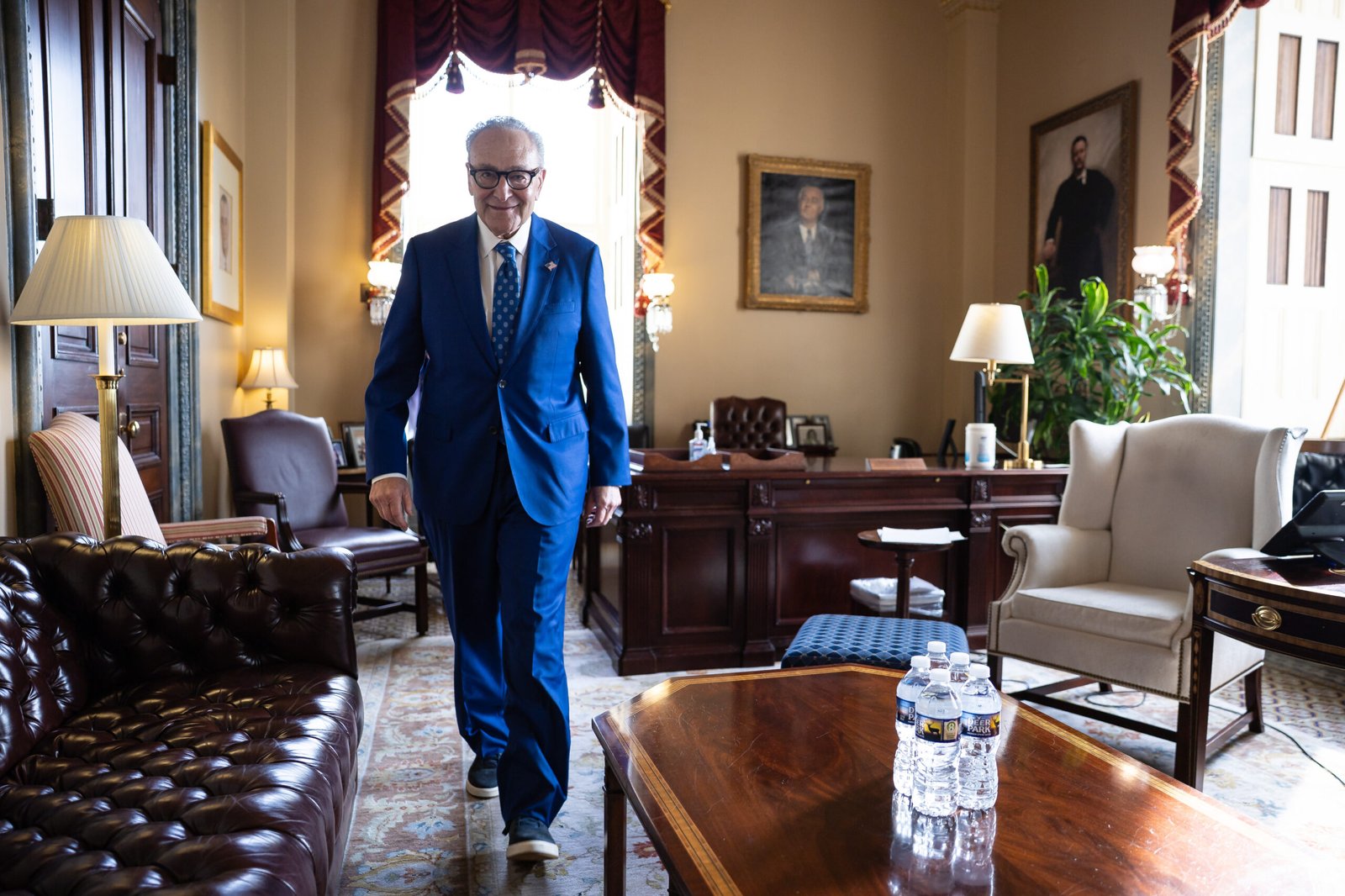
A tidal wave of Republican money is threatening to soak Democrats in the final stretch of the midterm campaign, and Chuck Schumer has a message for his party: Keep your sheets dry.
While the Senate minority leader warned in an interview Wednesday that they shouldn’t be “overconfident,” he painted a rosy picture where Democrats have the “wind in our sails” and are well positioned to overcome an “almost obscene” GOP funding advantage.
“Here’s how I’d sum up the election: Can enormous amounts of Republican money beat a Democratic enormous advantage in much better candidates and a much better political climate?” Schumer asked in his Capitol Hill office. “I think we win.”
Those assurances are emblematic of the rising confidence many Senate Democrats are now expressing as they prepare to leave for a seven-week recess. After months where a tough GOP-tilted map and a series of nasty primary battles cast a shadow over their battle to retake the majority, some are more openly acknowledging they could return to Washington as victors.
“It certainly feels like it’s going to be a wave election, and not for good reasons,” Sen. Chris Murphy (D-Conn.) said in an interview. “This president’s domestic and foreign policy has gone off the rails. People are paying more than ever before for basic necessities like gasoline, and we have the most corrupt White House in the history of the country. So that’s where we are.”
Sen. Richard Blumenthal (D-Conn.) said he was “increasingly hopeful,” while Sen. Ben Ray Lujan (D-N.M.) said Democrats are “in a position to earn the trust of voters across the country, win majorities in both the U.S. House and the U.S. Senate.”
Schumer, like most Senate Democrats, is being careful not to predict outright they will flip the chamber. They need to win four seats on net, including several that President Donald Trump won at least once.
But party leaders and strategists see an increasingly rosy political environment as high energy costs associated with the Iran war drive voter dismay, and Republicans grow publicly anxious about their prospects. They also believe they have landed on a winning message after more than a year in the messaging wilderness following Trump’s 2024 victory — “costs, chaos and corruption,” as Schumer put it Wednesday.
“I helped spread this in the caucus,” he said.
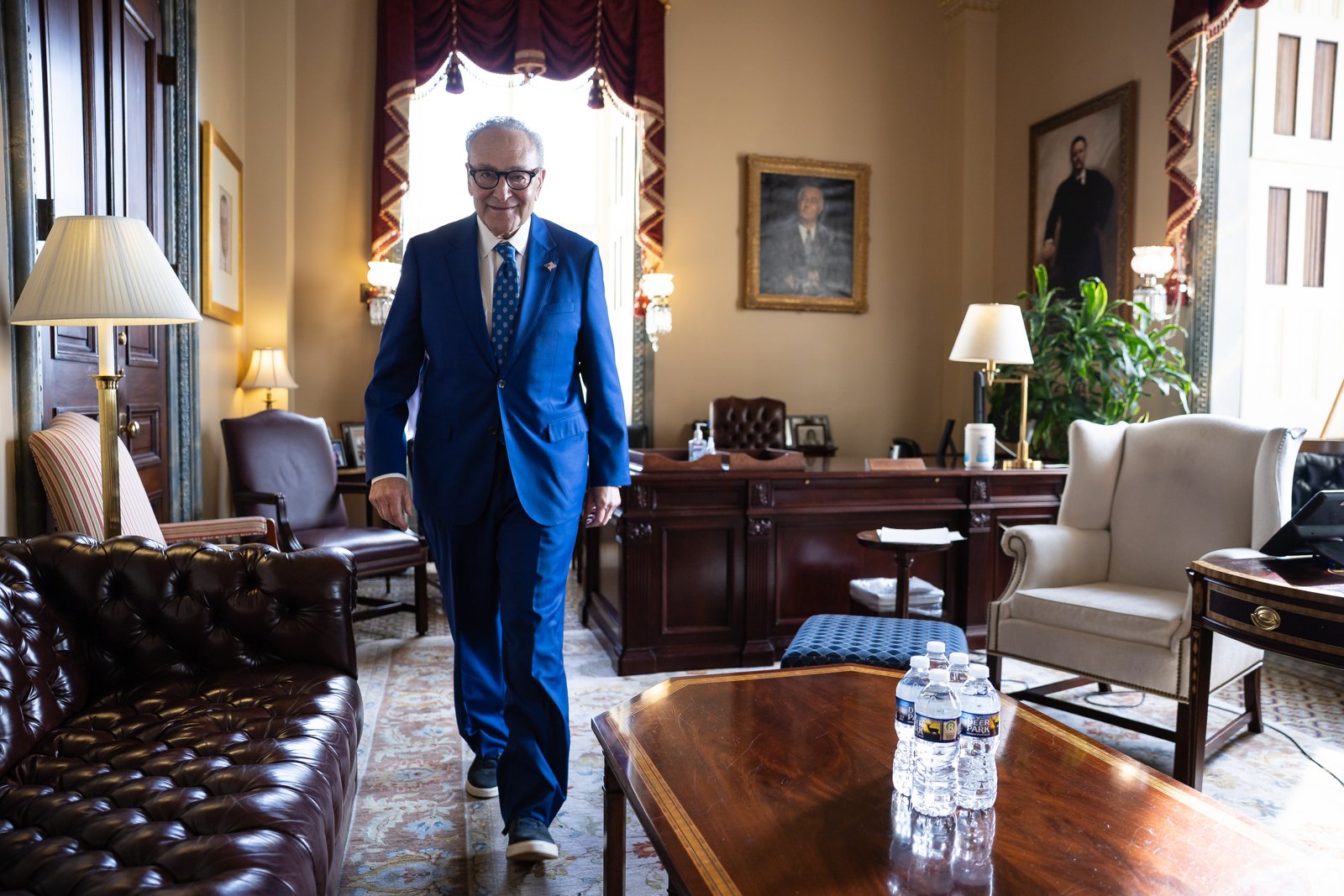
Schumer declined to handicap the national map in detail, but the party has expanded the range of states it is spending in. The main Schumer-affiliated super PAC announced this week it would spend more than $50 million in Texas — a place it had once been reluctant to invest in.
Brushing off questions about specific investments, Schumer said, “We’re in much better shape in state after state after state, whether they be states that are a little more purple or states that are a little more red.”
Republicans are striking a different tone, telegraphing that they hope to hold on to their majority by the skins of their teeth. In one sign of the deep anxiety, GOP leaders kept the Senate in session this week to hold a vote on an affordability-related measure championed by one of their endangered incumbents, Sen. Jon Husted of Ohio.
Sen. Thom Tillis (R-N.C.) put the GOP’s odds of success at “between 60, 70 percent,” acknowledging that any resulting majority would be “slim, maybe a net reduction.”
Asked Wednesday if he believed his party could hold on, Sen. John Kennedy (R-La.) said, “I don’t know. … I’m doing everything I can.”
“I try to see the world as it is,” he added. “They’re all going to be close races.”
Sen. Jim Justice (R-W.Va.) said there was a “really, really good chance” at least one of the chambers would flip, “and if Republicans aren’t concerned that it could very well happen in both, they’re living in a cave to me.”
The November battlefield is coming into clearer focus for both parties. They now largely agree that Georgia, once expected to be a top GOP pickup opportunity, is now safely in the hands of incumbent Sen. Jon Ossoff.
Democrats haven’t locked things up, however, in two other states where they are defending seats — Michigan and New Hampshire, where Sens. Gary Peters and Jeanne Shaheen, respectively, are retiring — though Democratic nominees lead in most polls there.
Even if Democrats hold on in those three states, they still need to win four seats currently held by Republicans.
The North Carolina seat Tillis is vacating is viewed as most likely to flip. After that, Democrats will need to cut a path through states like Maine, Ohio, Iowa, Alaska and Texas, with Kansas and Nebraska also seen as within reach by party leaders. Trump won all but Maine in 2024.
Schumer is facing pressure from some Democratic activists to go even deeper into GOP territory and invest serious money in Mississippi, Florida and South Carolina — where some polls show underfunded Democratic nominees nipping at the heels of GOP incumbents.
But some party strategists are leery of sinking donor cash into stretch races given the need to keep up with the flood of Republican spending in core states. Asked about that trade-off, Schumer said only Democrats would do “whatever it takes to win” and that he expects to spend the next five weeks fundraising.
“We have lots of different paths to victory, and we’re not going to turn any of them down,” he said.
There is plenty personally at stake for Schumer, who has been feeling heat from the party base for the better part of two years as they’ve bristled against the limits of Democrats ability to check Trump. As pressure has grown, Schumer has repeatedly touted his campaign recruiting successes as proof of his leadership skill.
He downplayed any divisions Wednesday, saying his caucus is “totally unified” going into the midterms and that he would seek to continue in the top spot regardless of the outcome.
“I am running for reelection for leader,” Schumer said. “Period.”
Calen Razor contributed to this report.
Sen. Ron Johnson blocked the Senate from passing a bill Wednesday to restore $810 million in federal funding President Donald Trump nixed Friday without Congress’ consent and stop him from using the controversial budget tactic again.
Democratic Sens. Jeff Merkley of Oregon and Patty Murray of Washington asked on the Senate floor to swiftly pass a measure that would nullify Trump’s latest move to unilaterally cancel money Congress appropriated and prevent similar attempts by blocking the president from sending requests to claw back federal dollars less than 90 days before the cash expires.
While objecting to passing the bill, Johnson said he supports the president doing “whatever it takes” to reduce federal spending.
“Personally, I wish it was a lot larger,” the Wisconsin Republican, who chairs the Budget Committee, said of the sum Trump canceled Friday. “That money doesn’t have to be spent, and it shouldn’t be spent.”
Merkley, the top Democrat on the Budget Committee, argued that Trump’s move is akin to exercising “a line-item veto” and taking “a wrecking ball” to the vision of the country’s founding fathers.
While Johnson objected to passing the bill, several prominent Republican lawmakers have slammed the Trump administration’s latest move to cancel federal funding and are discussing ways to head off another attempt.
Those Republican calls to stop Trump from employing the funding maneuver are a turnabout after more than a year of resistance to taking action. Democrats have repeatedly attempted to use funding bills to defend against this kind of eleventh-hour clawback but were rebuffed by Republicans.
“Time after time, they have shot down our attempts to stop this administration from defying Congress and robbing our constituents,” said Murray, who described Trump’s latest cancellation as “theft from the American people, plain and simple.”
Senate Commerce Chair Ted Cruz blocked an effort from Sen. Marsha Blackburn to pass her bill on the chamber floor Wednesday afternoon that would allow people to sue over artificial intelligence “deepfakes” — the latest episode in a long-running public rift between the two Republicans over AI legislation.
Blackburn of Tennessee argued the measure, the NO FAKES Act, would guarantee protections against the “proliferation harmful AI-created deepfakes” while ensuring artists and creative work are not impeded.
“Our bill would establish clear guardrails that protect our creators in Tennessee and across the entire country, in addition to establishing a federal intellectual property right in every American’s voice and visual likeness,” she said in a floor speech.
Blackburn sought to advance the bill by unanimous consent, a process that does not require a roll call vote but does permit any single senator to show up in person to object. That person Wednesday was Cruz, who argued the bill was not ready for primetime.
The Texas lawmaker said he had free speech concerns about the legislation as currently written — for example, would the AI-generated photos and videos like the ones frequently promoted on President Donald Trump’s social media accounts be deemed out of compliance? The same could end up being true for news parody websites like The Onion, Cruz added.
Blackburn said that free speech would not be jeopardized by her proposal, and that the bill instead targets online scamming activities that would certainly be illegal if conducted offline. Cruz was not convinced.
“I am happy to work with you,” Cruz ultimately told Blackburn. “But at least as of now, I object.”
Cruz and Blackburn have been at odds on the issue for some time, dating back to when a five-year deal to block states from enacting their own AI rules and regulations collapsed during One Big Beautiful Bill Act negotiations in 2025.
While Cruz voted for the NO FAKES Act in the Senate Judiciary Committee over the summer, he was unable to help broker a larger agreement with Blackburn and the White House to include it as part of a package of bills addressing preemption of state AI regulations and kids online safety issues.
Cruz also undercut Blackburn’s efforts during an Oval Office meeting over the summer, where he told Trump the package had no chance of moving in the Senate. The president ultimately held off on an endorsement.
Sen. Chris Coons (D-Del.), a NO FAKES co-sponsor, emphasized the broad support from the creative industry that lawmakers have worked to build.
“This is the most baked, ready-to-go AI-related bill there is,” Coons said as he walked onto the Senate floor Wednesday. “We’ve done hearings, we’ve done technical assistance, we’ve done markups. It’s broadly bipartisan.”
Cruz, who objected Tuesday to an attempt to pass an AI safety bill by unanimous consent, countered that his bill making it a crime to knowingly publish sexually explicit images on the internet without the subjects’ consent — real or AI-generated — is the only major AI bill to become law in the 119th Congress.
- ‘I think we win’: Schumer sets the tone as Senate Democrats grow more confident about November
- Ron Johnson blocks vote to stop Trump’s funding cancellations
- Trump says diesel export ban is still on the table
- Hegseth vows to shrink the Pentagon — and then announces plans to grow it
- Cruz kills Blackburn effort to pass AI deepfakes bill
- Sherrod Brown says Facebook ‘glitch’ cost campaign money, votes
- Key allies left out of Trump’s new in-crowd NATO group
- Jim Justice says he has a ‘short’ timeline for deciding on governor run
- Blackburn sues Jack Smith for obtaining her phone records
- Trump orders DC mosquito purge
-

 Politics2 years ago
Former ‘Squad’ members launching ‘Bowman and Bush’ YouTube show
-
Uncategorized2 years ago
Bob Good to step down as Freedom Caucus chair this week
-

 The Josh Fourrier Show2 years ago
DOOMSDAY: Trump won, now what?
-

 Politics2 years ago
Former Kentucky AG Daniel Cameron launches Senate bid
-

 The Dictatorship2 years ago
Pete Hegseth’s tenure at the Pentagon goes from bad to worse
-

 The Dictatorship2 years ago
Luigi Mangione acknowledges public support in first official statement since arrest
-

 Politics2 years ago
Blue Light News’s Editorial Director Ryan Hutchins speaks at Blue Light News’s 2025 Governors Summit
-

 The Dictatorship1 year ago
Mike Johnson sums up the GOP’s arrogant position on military occupation with two words