
Congress
John Thune casts doubt on hearing for Trump nominee who sent racist texts

Senate Majority Leader John Thune signaled Tuesday that President Donald Trump’s embattled nominee to lead the Office of Special Counsel should not go forward with a confirmation hearing later this week.
Paul Ingrassia used a racial slur in a private text group where he also said the Martin Luther King Jr. holiday should be “tossed into the seventh circle of hell” and that he has “a Nazi streak,” POLITICO reported Monday. That followed an earlier report about an accusation of sexual harassment against the 30-year-old White House official.
Asked if it would be a mistake for Ingrassia to appear before the Homeland Security and Governmental Affairs Committee for a scheduled Thursday hearing, Thune laughed then said, “Yeah.”
Ingrassia doesn’t appear to have the votes to advance out of the panel, with all Democrats expected to oppose him as well as at least three Republicans, and GOP leaders don’t believe he has the votes to be confirmed by the full Senate.
An attorney for Ingrassia, Edward Andrew Paltzik, said in a statement, “We do not concede the authenticity of any of these purported messages” and that “even if the texts are authentic, they clearly read as self-deprecating and satirical humor.”
“In reality, Mr. Ingrassia has incredible support from the Jewish community because Jews know that Mr. Ingrassia is the furthest thing from a Nazi,” Paltzik said.


Senate Armed Services Chair Roger Wicker lambasted the White House decision to invite Chinese leader Xi Jinping for a state dinner this week, calling the foreign head of state “a brutal, unelected and oppressive dictator” who cannot be trusted.
Wicker, typically a staunch defender of President Donald Trump and Republican loyalist, targeted most of his criticism at Xi and Chinese policy during a Senate floor speech Tuesday. But the comments were nonetheless a surprise rebuke of the president’s courting of Beijing amid broader concerns, such as the durability of U.S. security commitments to the Indo-Pacific, including in deterring a potential invasion of Taiwan from the Chinese mainland.
The Mississippi Republican urged Trump to press the Chinese premier on a variety of sensitive topics — including purported support for Iran, its military buildup and human rights abuses.
“Had the White House asked me for advice, I would have suggested the president not invite Xi Jinping to Washington for such a lavish welcome here in the United States, based on all of the troubling issues we have with President Xi and the Chinese Communist Party,” he said.
“I know the president tends to discuss trade and artificial intelligence with the Chinese leadership, and rightfully so,” he said. “Perhaps some progress will be made. But … during every minute of dialog, our commander in chief should keep in mind that his guest is a brutal, unelected and oppressive dictator who seeks to dominate his neighbors and whose massive military arsenal is aimed directly at the United States of America.”
The senior Republican’s comments on the Senate floor were delivered just a few hours before Xi’s expected arrival in Washington. Trump has scheduled a formal welcome ceremony for Xi and his wife at the White House on Thursday, along with talks between the two leaders throughout his three-day visit.
Trump is facing bipartisan criticism over the state visit by Xi. Wicker’s comments followed similar attacks on Chinese leadership from Sen. Dick Durbin (D-Ill.) and Ted Budd (R-N.C.).
“President Trump has been clear that under his leadership, the United States must engage with China, given the reality of our economic relationship,” Budd said. “But we can’t forget that China is also a competitor and an adversary.”
A federal appeals court ruling Tuesday on demonstrators’ access to the steps of the Capitol could bode poorly for President Donald Trump’s attempt to ban three media organizations from the White House.
The majority opinion, written by Trump appointee Neomi Rao, concluded that the East Steps of the Capitol are a “nonpublic forum” — just like most areas of the White House grounds, including the press facilities. While the government may impose restrictions on access to those nonpublic areas, the limits must be “viewpoint neutral,” apply “objective, workable standards” and not permit officials to exercise “unbridled discretion over a forum’s use,” the D.C. Circuit Court of Appeals panel concluded.
“A regulation that grants the government arbitrary control over who may speak invites the suppression of disfavored viewpoints and undermines the First Amendment’s core protections,” wrote Rao, who was joined in the majority by Judge Karen Henderson, a George H.W. Bush appointee.
The ruling, on the eve of a hearing over restoring White House accessfor Blue Light News, BLN and MS NOW, reaffirms the D.C. Circuit’s longstanding First Amendment precedents at an inopportune time for Trump. The president has explicitly described his ban on the three outlets as a punishment for publishing what he calls “fake news.”
“Fake News people and publications that only write negatively, and who violate our National Security by writing false and defamatory stories with unknown ‘sources,’ shouldn’t be allowed access to the most important Office anywhere in the World,” Trump said on social media Monday.
The outlets have said their access was revoked because the White House objected to their reporting and that the ban “threatens press freedom and the public’s right to independent journalism free from government interference.”
The D.C. Circuit would hear any appeals in the litigation over Trump’s media ban, and Trump has in fact already said he anticipates filing an appeal, presuming that he will be dealt a defeat in district court.
The White House did not immediately respond to a request for comment.
The D.C. Circuit’s Tuesday ruling stemmed from a lawsuit brought by Patrick Mahoney, a clergyman who sought to hold prayer vigils and demonstrations on the East Steps of the Capitol several months after the Jan. 6, 2021 attack, which resulted in new access restrictions. His permit was denied in part based on Capitol Police regulations that prohibit public demonstrations on the steps unless they are sponsored by a member of Congress.
Though the case has inched through the courts for years, Tuesday’s ruling resolves a key question, labeling the Capitol’s East Steps a “nonpublic forum” for which congressional authorities may restrict public access — in part because lawmakers use those steps to enter and exit the building.
But allowing members of Congress to sponsor gatherings on the steps creates an arbitrary system, the majority concluded.
“Because the protection of unpopular speech and advocacy is central to the First Amendment, we cannot leave it to the selective enforcement of members,” Rao wrote.
Notably, Rao’s opinion cites a D.C. Circuit ruling last year that concluded “it would be unreasonable to control access to White House press facilities through standardless discretion.”
The third judge on the panel, Clinton appointee Judith Rogers, dissented, but her opinion was even more protective of free-speech rights.
Rogers said she agreed with her colleagues that the “selective exception” for demonstrations sponsored by lawmakers was unconstitutional. However, she said she would have held that the lower portion of the Capitol steps was a public forum where the government was obligated to permit protest activity.
Ohio television stations are so far choosing to ignore a legal threat from GOP Rep. Max Miller and broadcast an ad from his Democratic challenger centered on the allegations of domestic abuse Miller faces from his ex-wife.
A lawyer for Miller demanded that Cleveland-area television station WKYC not publish “false, malicious, and defamatory statements” in a Thursday cease-and-desist letter first reported by Blue Light News.
WKYC ran the ad Tuesday morning, according to ad-tracking firm AdImpact, as did two other Cleveland stations, WEWS and WOIO.
The 30-second ad from the Poindexter campaign and Democratic Congressional Campaign Committee depicts a local sheriff listing the accusations levied against Miller levied by Emily Moreno, his ex-wife and the daughter of Sen. Bernie Moreno (R-Ohio). Miller has repeatedly denied the abuse allegations.
“The ad mentioned is filled with lies,” Miller spokesperson Abigail Angelos said in a statement. “Each of the statements in the advertisement are entirely unsubstantiated and contradicted by evidence.”
Representatives for the three TV stations did not immediately respond to requests for comment. Poindexter responded to the legal threat by tearing up the cease-and-desist letter in a campaign video.
Before the ad, Poindexter had focused his campaign on his working-class background and cost-of-living issues. Now the campaign has gotten intensely personal: The Democrat is on air publicizing Miller’s family dispute, while Miller’s campaign is lobbing accusations about Poindexter’s past run-ins with law enforcement in an ad paid for by the NRCC.
NRCC spokesperson Zach Bannon said in a statement that Poindexter is “completely out of touch with Northeast Ohio” and is a “life-long criminal” who is “fully embracing the radical far-left socialist agenda.”
Aaron Pellish contributed to this report.
- GOP Armed Services chair blasts White House welcome of Chinese leader
- Sen. Jon Husted: Iran war ‘needs to come to an end as quickly as possible’
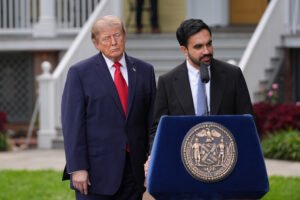
- Mamdani and Trump face frosty reception in Queens over Sunnyside Yard plan
- Trump says decision on possible diesel export ban to come ‘fast’
- Appeals court’s Capitol steps ruling may signal trouble for Trump on media ban
- Ohio stations ignore Max Miller’s legal threat, run Democratic challenger’s ad
- GOP Senator wants to subpoena Donald Trump Jr. over Russian-funded wedding
- Capitol agenda: Senate GOP eyes exit plan as trail calls
- ‘We need to stop the contagion’: GOP ramps up midterms defense in Trump states
- Abbott slaps halt on Texas data center permits
-

 Politics2 years ago
Former ‘Squad’ members launching ‘Bowman and Bush’ YouTube show
-
Uncategorized2 years ago
Bob Good to step down as Freedom Caucus chair this week
-

 The Josh Fourrier Show2 years ago
DOOMSDAY: Trump won, now what?
-

 Politics2 years ago
Former Kentucky AG Daniel Cameron launches Senate bid
-

 The Dictatorship2 years ago
Luigi Mangione acknowledges public support in first official statement since arrest
-

 The Dictatorship2 years ago
Pete Hegseth’s tenure at the Pentagon goes from bad to worse
-

 Politics2 years ago
Blue Light News’s Editorial Director Ryan Hutchins speaks at Blue Light News’s 2025 Governors Summit
-

 The Dictatorship1 year ago
Mike Johnson sums up the GOP’s arrogant position on military occupation with two words