
Politics
I’m an election law expert. Here’s what happens when ballots are burned.

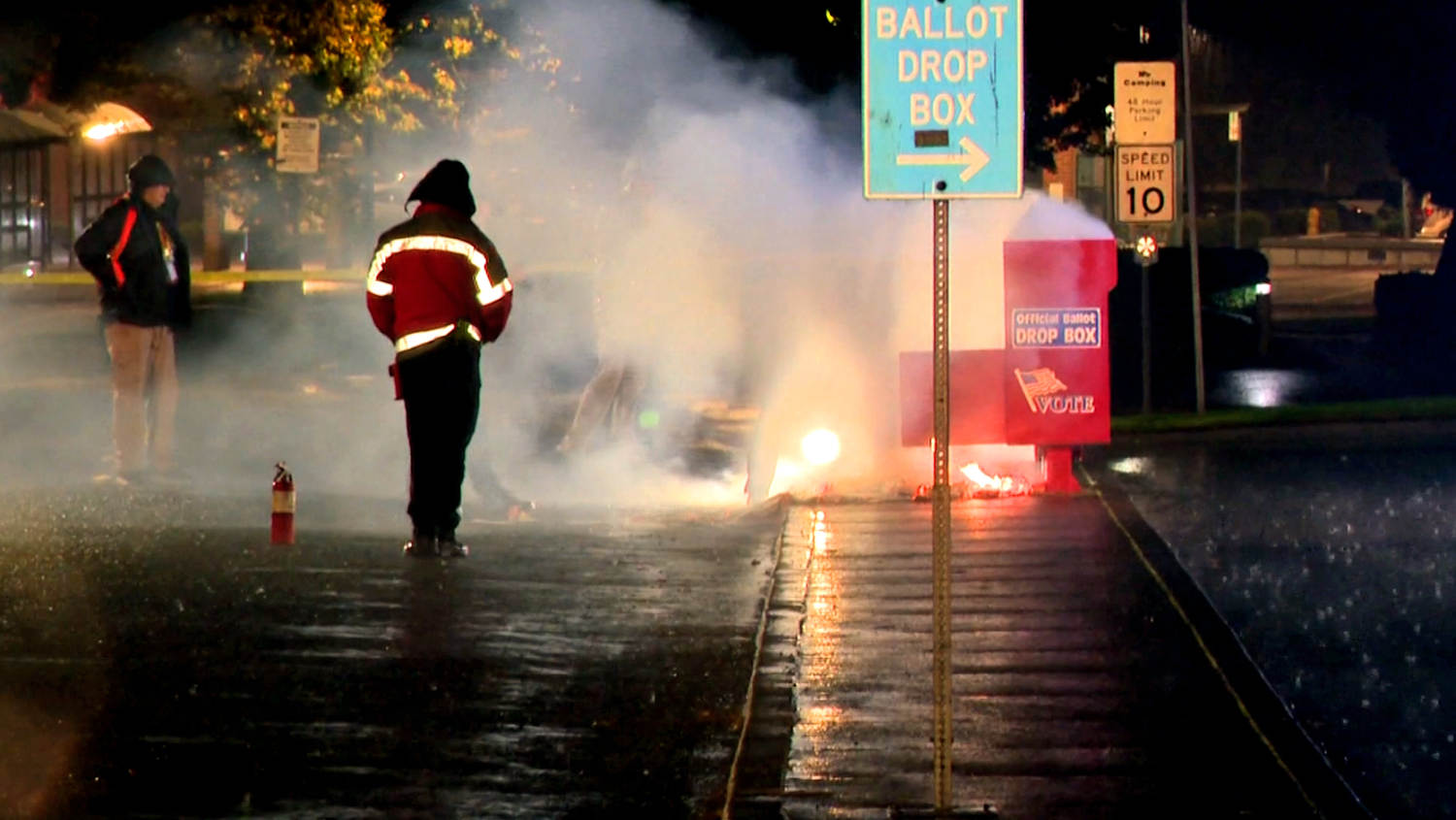
News of arson fires that started Monday in ballot boxes in Vancouver, Washington, and in Portland, Oregon, show that not all threats to the integrity of our elections come from well-organized militias or foreign governments. The Portland Police Bureau has already released photos of a vehicle authorities say was involved with at least one of the incidents, and possibly others. “We don’t know the motive behind these acts,” Assistant Chief Amanda McMillan said in a statement. “We do know acts like this are targeted and they’re intentional and we’re concerned about that intentional act trying to impact the election process. We’re dedicated to stopping this kind of behavior.”
That’s good to hear. Clearly, there are individuals determined to wreak havoc on our elections. And federal and state authorities need to extinguish this kind of violence before things get more out of hand.
Even if any ballots were destroyed in this week’s fires, voters should still be able to cast replacements.
In Oregon, the Multnomah County Elections Division said in a statement that “fire suppressant inside the ballot box protected virtually all the ballots.” Three ballots were damaged, and county Elections Director Tim Scott said the affected voters were being contacted.
But even if any ballots were destroyed in this week’s fires, voters should still be able to cast replacements.
Voters in Oregon and Washington are lucky enough to live in states with excellent election administration, including elaborate systems to track the path of one’s ballot from the time it is sent to a voter until the time it is received by election officials. Voters who might have put their ballots in one of the affected ballot boxes will have ample opportunity to contact election officials and get and then cast replacement ballots, assuring that they won’t be disenfranchised by this despicable antidemocratic act.
But there could be other attempts to interfere with the 2024 election over the next week that might not be so easily remedied. (One of the final episodes of the television show “Succession” features a not-implausible fire that destroys 100,000 uncounted mail-in ballots in Milwaukee, with grave, albeit fictional, electoral consequences.) And even if there aren’t large-scale attacks on our election processes, even the fear of violence or interference could deter people from voting. In 2022, for example, vigilantes patrolled a ballot drop box area in Arizona before a federal court enjoined the intimidating conduct. We don’t know what individuals or groups have planned for this time, but government officials are warning of possible extremist violence.
The potential for violent escalation makes it crucial for law enforcement to make the investigation and prosecution of Monday’s ballot attacks a priority. The FBI says it is coordinating with local authorities, which is the right move. We need law enforcement to act vigorously to identify the perpetrators of these crimes and bring them to justice.
There are a number of federal statutes that could be used to charge arsonists who burn ballots, including one that bars the destruction or mutilation of ballots and another that bars using force to interfere with voting. State laws also classify ballot burning and similar activities as crimes. Washington state, for example, prohibits tampering with voting materials and devices used in voting. Oregon law provides that a person “may not willfully alter or destroy a ballot cast at an election or the returns of an election.”
In addition to prosecuting the crimes that have already occurred, it is crucial to ensure that voters feel welcome and safe to vote in coming days.
In the end, the idea of free and fair elections means that eligible voters should be able to easily cast ballots that will be fairly and accurately counted, in a system free of violence and intimidation. It’s a sad testament to American democracy that this needs to be said, but it does. Now is the time for all of us to remain vigilant to assure free elections and a peaceful transition of power in the weeks and months ahead.
Richard L. Hasen is professor at UCLA School of Law, where he directs its Safeguarding Democracy Project. He is an NBC News/BLN election law analyst.



Leading Republicans are pulling back from the North Carolina Senate race, sending a clear message: What was a top-tier battleground at the start of the cycle is no longer worth the money.
The foremost Senate GOP super PAC, Senate Leadership Fund, is pausing its future spending in North Carolina and instead launching a seven-figure ad buy in deep-red Kansas, according to one person familiar with the move. The news was first reported by Semafor.
The dramatic change in strategy — less than four weeks before the midterms — comes after SLF previously spent more than $30 million to boost GOP nominee Michael Whatley. It also comes as public polling has continued to show Whatley unable to close the gap against popular former Gov. Roy Cooper, the Democratic candidate.
Republicans are now deprioritizing a state that President Donald Trump carried in all three presidential runs, and that Democrats haven’t won in the Senate since 2008.
“We are all clear-eyed about where North Carolina stands,” said one national GOP operative working on Senate races, who like others in this article was granted anonymity to speak candidly.
SLF isn’t the only major GOP group shifting away from North Carolina as Republicans focus on other must-win seats and deep-red states, amid the Iran war, high fuel prices and other economic fallout of the war in Iran.
Earlier Friday, the Koch-aligned Americans for Prosperity Action left North Carolina off its $22 million list of future spending across key Senate contests, as POLITICO reported. Another major Republican group focused specifically on boosting Whatley — Old North Action — removed $6.5 million in ad reservations from North Carolina’s Senate race last month.
“Michael Whatley is a good man who took one for the team — but with states like Alaska, Kansas, and Texas requiring continued resource commitments, there is only so much,” said another national GOP operative working on midterm races. “Especially against a very popular former Governor in Roy Cooper.”
The National Republican Senatorial Committee is currently running coordinated ad reservations with six of its battleground candidates. Whatley in North Carolina is not one of them, according to data from advertising tracking service AdImpact.
NRSC regional press secretary Nick Puglia said in a statement that “Whatley will put North Carolina families first by cutting taxes and keeping criminals locked up.”
Whatley for months has struggled to boost his name ID against the much better-known Cooper. Some recent public polls show Cooper leading Whatley by double-digit margins. Private polling has also hardly budged, despite the recent influx of spending, according to a person working on the race.
In a statement, Whatley spokesperson DJ Griffin said the team feels “confident we have the resources” to win in November.
“Roy Cooper recently said about federal elections in North Carolina, ‘Democrats are often ahead until they are not,’” Griffin said. “Undecided Voters who break late decide the election in North Carolina and the majority of those Late-Breakers typically go Republican.”
AFP Action and Old North Action did not immediately respond to a request for comment about North Carolina. SLF declined to comment.
SLF’s decision came as a shock to some, but not all, North Carolina Republicans — mostly because Senate Majority Leader John Thune has been scheduled to be in North Carolina for an event with Whatley on Thursday night. Thune ended up joining the event virtually, according to two people with direct knowledge of the matter.
For weeks, top Republicans acknowledged North Carolina may be slipping away. One Republican who attended a donor meeting with Senate Majority Leader John Thune and SLF during the Dallas convention told POLITICO that holding the state would be “tough.”
“The map has shifted a little bit, and to be fair, we knew that was going to be a tough one from the beginning,” said one GOP operative working on Senate races, granted anonymity to speak candidly about the landscape.
Democrats are not letting up, recognizing that the contest in the purple state could still be close.
“A Democrat has not won statewide federal office here in nearly two decades, and North Carolina is a 50-50 state,” Cooper campaign manager Jeff Allen said in a statement.
“We’re building a campaign to earn every vote and make sure North Carolinians know that Roy Cooper will fight for them, while Michael Whatley will continue to enrich himself at their expense,” Allen said.
One North Carolina GOP strategist said that while Whatley has been a “fine” candidate, the current political climate coupled with Cooper’s long record in the state may be too much to overcome. And while Republicans have repeatedly hammered Cooper on crime, he still has strong favorability ratings from his time as governor.
“He’s really kind of hard to paint as a radical, ’cause, you know, he’s like Aunt Martha. She’s just been there forever. And so it’s just very difficult to get any traction on that, because, you know, people say, ‘well, Roy’s okay,’” they said.
When told that SLF was moving money from North Carolina to Kansas, the strategist responded: “$6.50 diesel fuel will kick your ass.”
Adam Hamilton on faith, Trump and the fight for Kansas
lead image
- Top GOP groups scale back North Carolina spending
- October
- Sanders, AOC, Merkley propose bill to ban Flock cameras
- Capitol agenda: Dems spend big to help Hakeem’s dream
- The low-profile Democrat helping shape her party’s AI agenda
- ‘A game-changer’: House Dems aim for a big majority that could ease Hakeem Jeffries’ headaches
- Adam Hamilton on faith, Trump and the fight for Kansas

- New York grapples with kinks in $1B Medicaid system
- Top Democratic appropriator wants White House to pay for airing ‘propaganda’
- Barrage of lawsuits targets Trump’s funding cancellation
-

 Politics2 years ago
Former ‘Squad’ members launching ‘Bowman and Bush’ YouTube show
-
Uncategorized2 years ago
Bob Good to step down as Freedom Caucus chair this week
-

 The Josh Fourrier Show2 years ago
DOOMSDAY: Trump won, now what?
-

 Politics2 years ago
Former Kentucky AG Daniel Cameron launches Senate bid
-

 The Dictatorship2 years ago
Pete Hegseth’s tenure at the Pentagon goes from bad to worse
-

 The Dictatorship2 years ago
Luigi Mangione acknowledges public support in first official statement since arrest
-

 Politics2 years ago
Blue Light News’s Editorial Director Ryan Hutchins speaks at Blue Light News’s 2025 Governors Summit
-

 The Dictatorship1 year ago
Mike Johnson sums up the GOP’s arrogant position on military occupation with two words