
Congress
A district that went +20 for Trump now in play for Democrats


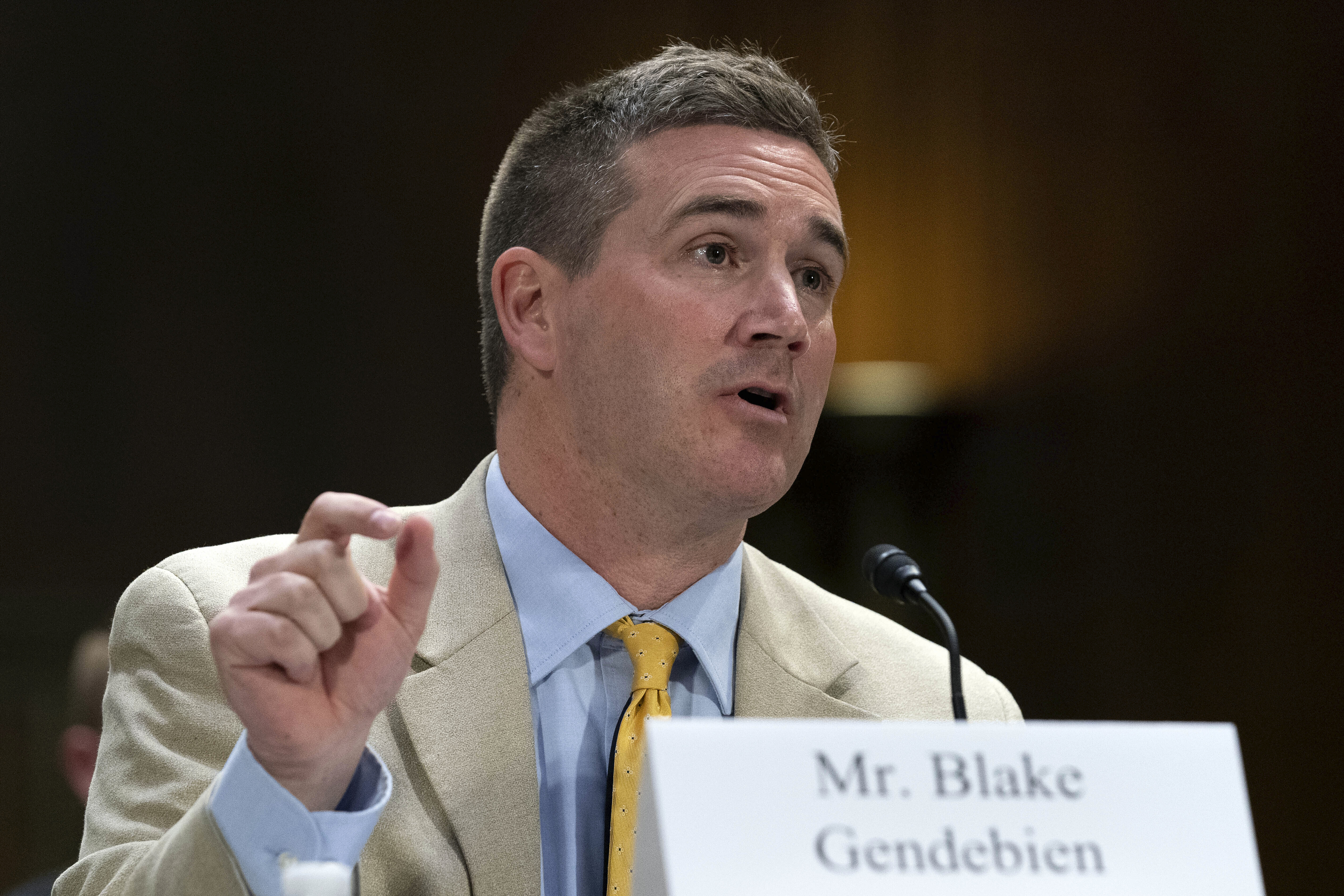
NEW YORK — A new internal poll shows a Democratic House candidate is in a dead heat with his Republican challenger in an upstate New York district President Donald Trump won by 20 points in 2024.
The poll, commissioned by Democratic candidate Blake Gendebien’s campaign and conducted by the left-leaning group Impact Research, found Gendebien trailing Republican Anthony Constantino by just one percentage point, 45-44, with 11 percent of voters undecided.
The district is currently represented by outgoing Republican Rep. Elise Stefanik, who congratulated Constantino on winning the GOP nomination Tuesday after he defeated Republican state Assemblymember Robert Smullen in a nasty primary.
Constantino, the CEO of a sticker company who’s self-funding his campaign with $10 million, earned Trump’s endorsement in April, a blow that proved fatal for Smullen’s primary campaign.
Constantino is an eccentric and passionate supporter of the president and recently recorded an adulatory rap album titled “Thank You President Trump.”
During the primary, he left a threatening voicemail to a constituent in the district, threatened to sue his opponent, whom he referred to as “Slimebob,” and frequently touted the 100-foot-wide Trump sign on top of his Sticker Mule factory, which he erected during Trump’s 2024 campaign. Constantino is also a former boxer.
Luke Martin, a pollster from Impact Research who works for the Gendebien campaign, said the campaign watched the primary in hopes they would face the polarizing Constantino.
“Our research has always shown that a wannabe DC insider like Constantino is very beatable in NY-21, but his rapidly increasing negatives had us concerned that we might lose our shot to run against him if he couldn’t keep it together through the primary,” Martin said in a statement. “The more money he spent, the more we saw his unfavorability tick up in our polls. The data was always clear that Robert Smullen would have been a more competitive Republican candidate for this district.”

After respondents received messaging on the two candidates, Gendebien, a dairy farmer, climbed ahead of Constantino, 49-40, with 11 percent still undecided. The poll quizzed 500 likely general election voters from May 26-31 and had a margin of error of plus-or-minus 4.4 percent.
Forty percent of those surveyed said they voted for Kamala Harris in the 2024 presidential election, and 58 percent said they voted for Trump. Twenty-three percent of respondents identified as Democrat, 27 percent said they were independents and 46 percent identified as Republicans.
There has been no independent polling of the district, which is one of the largest in the northeast and stretches from the northern Catskills region to the Canadian border. Trump won the district with 60 percent of the vote.
A potential curveball in the general election is whether Smullen, a retired Marine colonel, will continue to run for the seat despite losing the Republican primary. Smullen, who has the backing of the state’s Conservative Party, is on its ballot line in November. That would set up a three-way contest between him, Gendebien and Constantino.
Smullen has not ruled out running as a Conservative Party candidate. He has until Friday, July 3 to decline the ballot line.
Another potential factor to Smullen’s decision making is that the Conservative Party’s chair, Jerry Kassar, is in a bitter, personal feud with Constantino. Kassar is suing Constantino for defamation after Constantino said Kassar threatened to kill him. Kassar told Blue Light News it’s up to Smullen whether or not he wants to run on the Conservative line.
“The party itself has no role whatsoever, until an action is taken by the candidate,” Kassar said. “Bob has not indicated to me anything other than what has been public, which is that he’s interested in staying on but is thinking it through and will make a final decision soon.”
Gendebien’s campaign declined to release survey data on a three-way race.
Battleground New York, which works to flip competitive House seats by engaging disaffected voters, said the bruising Smullen-Constantino primary has put Democrats in a winning position.
“With Democrats surging and the race already tied, Republicans in NY-21 couldn’t afford a messy primary and they got one anyway,” said Andrew Grossman, a spokesperson for the group. “They spent the entire primary proving they can’t stand each other, and now they’ve handed voters a November ballot where they can choose between the guy the party hates and the guy the nominee hates.”


A GOP-aligned super PAC has more-than tripled its investment in the Ohio Senate race over the last week as it seeks to boost a socialist candidate — an apparent attempt to sink former Democratic Sen. Sherrod Brown’s chances.
Enough Promises Ohio, which was created last month, has spent a combined $1.58 million to promote Greg Levy and oppose Brown, according to recent filings from the Federal Election Commission. Levy, a candidate with the Party for Socialism and Liberation, is also on the ballot in the tight race for Senate between Brown and Ohio GOP Sen. Jon Husted. He’s running a longshot bid, currently polling at 5 percent, but could siphon away more progressive voters from Brown.
It wouldn’t be the first time this cycle that operatives for a major political party attempted to raise a third-party candidate’s profile to meddle with the outcome. Recent public polling shows a dead heat between Brown and Husted in the race.
The super PAC spent a total of $828,359 on mailers supporting Levy or opposing Brown. Spectrum News, The Washington Post and Axios previously reported Enough Promises Ohio spent $400,000 on such mailers, but the expenditure has since grown.
The group also poured an additional $753,000 into ads supporting Levy and opposing Brown over the weekend, including one video ad on Google that knocks Brown as someone who “sold us out” and boosts “real progressive Greg Levy.”
The campaign finance filings show Enough Promises Ohio used a printing company linked to a Republican political firm, Whistletop Strategies. Whistletop has worked with an affiliate of President Donald Trump’s MAGA Inc. super PAC and lists as its “director” Big Dog Strategies, which helped run Republican Sen. Bernie Moreno’s 2024 election campaign and is a consultant for the Ohio GOP.
Enough Promises Ohio did not respond to a request for comment. Neither did Big Dog Strategies.
Amy Natoce, a spokesperson for the Husted campaign, told Blue Light News, “our campaign had no involvement with the group you are referencing. Therefore, we have no comment.”
Levy himself has distanced himself from the PAC, calling its boosting of him an “attempted deception of voters” that’s “a form of digital blackface.” Levy is Black. His spokesperson, Charlie Koenigsmark, also told Blue Light News he and the campaign “completely condemn this attempt to manipulate voters.”
Brown did not respond to a request for comment.
Artificial intelligence is challenging some lawmakers’ confidence that they have the capacity to regulate it.
The slow pace of Congress and a challenging political environment are already working against lawmakers under pressure to address AI threats. There’s also a significant gap in tech policy expertise.
“We need to dramatically increase the base knowledge of Congress if we’re going to legislate meaningfully,” Rep. Sam Liccardo said in a recent interview.
One big concern is at the staffing level: getting people with a deep understanding of the technology around rank-and-file members. Aides who specialize in tech policy often get lured to private companies with huge salaries that can be hard to resist.
Some lawmakers, like Rep. Mark Takano, are advocating for an in-house hub — something like the long-defunct Office of Technology Assessment, which helped Congress understand emerging technology and its social and policy implications from 1972 until it was scrapped in 1995. A Takano aide said he’ll introduce a bipartisan bill to restore such an office in the coming weeks.
Members have also been leaning on fellows from TechCongress — a nonprofit founded by former congressional aide Travis Moore that places technology experts in member and committee offices.
Moore said in an interview that there are plenty of people who want to work on Capitol Hill, but it’s a matter of “Congress’s will and capacity to absorb that talent.”
Not everybody buys into the theory that staffing will solve the problem. Some conservatives, in particular, have seized on the lack of member expertise to argue for a hands-off regulatory approach.
“We don’t understand it well enough,” Sen. Cynthia Lummis, who has repeatedly brought in technology experts through the TechCongress fellowship, told reporters this month. “We don’t have the expertise to do it.”
“Do you really trust the members of Congress, who barely understand AI, to write the regulations around something?” added Rep. Eric Burlison in an interview last month.
There are a few members who consider themselves fluent in AI policy, including several who have joined working groups on it. They’ve taken educating their colleagues into their own hands but have not always seen great enthusiasm.
Liccardo, for example, recounted how he has brought in experts to brief lawmakers — including huge AI industry figures like Sam Altman of OpenAI and Dario Amodei of Anthropic— only to struggle to convince members to attend.
“We have had challenges in the past trying to get folks’ attention to the issues,” he said.
What else we’re watching:
— WRIGHT: LAWMAKERS ARE ‘WRONG’ ON RUSSIA: Energy Secretary Chris Wright on Sunday dismissed bipartisan criticism when asked about lawmakers warning that President Donald Trump’s diesel deal would help finance Russia. “In fact, they are all wrong. They don’t understand what President Trump’s doing,” Wright said on ABC News. Wright also defended Trump’s decision Friday exempting Russia from key sanctions outlined in the late Sen. Lindsey Graham sanctions law, which was enacted just last month and set to take effect Sunday. The moves have drawn bipartisan outcry.
— PILOT BILLS GET COMEDIAN’S HELP — Lawmakers are targeting year-end enactment of a pair of bipartisan bills aimed at helping pilots deal with mental health issues and hazy medication regulations, thanks in part to a comedian with an HBO show. Lawmakers and others credit Nathan Fielder, star of the docu-comedy “The Rehearsal” for raising awareness on the stresses pilots face in the hit show last year. They say Fielder wasn’t actively involved in lobbying despite pleas from some for help. “Frankly, I’m glad he elevated the story,” Rep. Sean Casten, one of the lawmakers leading the mental health legislation, told Safa. After passing the Senate late last month, the two bills are awaiting House action.
Katherine Tully-McManus, Jalen Beckford and Safa Wahidi contributed to this report.
Lawmakers are under pressure to pass legislation to address the threats from advanced artificial intelligence, but many have serious doubts they have the capacity to regulate the technology’s explosive growth.
Few are expecting lawmakers themselves — some of whom still proudly use flip phones — to become AI experts overnight. But while even congressional Luddites acknowledge there is urgency for Capitol Hill to quickly expand its expertise in tech policy to help with legislating, regulating and conducting effective oversight, there’s no consensus yet on how to achieve it.
“We need to dramatically increase the base knowledge of Congress if we’re going to legislate meaningfully,” Rep. Sam Liccardo (D-Calif.) said in a recent interview.
Congress already has a long track record of lagging behind as technological innovations transform the world beyond Washington: It has adopted a largely hands-off approach to regulating the Internet as it integrated into everyday life in the past 40 years, relying instead on existing laws that govern other industries and taking smaller piecemeal bites.
The challenging political environment won’t help speed things along now: Democrats are split over whether the answer is to put guardrails on the AI industry or ban “superintelligence” entirely, while many Republicans — including President Donald Trump — warn that any regulation would stifle innovation and cede ground to China.
Some members consider themselves fluent in AI policy, including several who have joined working groups on AI policy. Reps. Jay Obernolte (R-Calif.) and Don Beyer (D-Va.) have pursued masters degrees in AI and machine learning, in addition to many others who are self-taught.
The “overwhelming number” of lawmakers have some idea of what AI is and what it is capable of, Rep. Valerie Foushee (D-N.C.), co-chair of a House Democratic commission on AI policy, said in a recent interview. But, she added, “None of us can say that we understand where it’s going.”
The larger concern is at the staff level — putting people with real expertise around the rank-and-file members who don’t have the bandwidth or interest in educating themselves on the frontier of the industry. Aides who do specialize in tech policy often get lured to the industry with huge salaries that can be hard to resist.
That’s where Travis Moore, a former congressional staffer, has spent more than a decade trying to help.
In 2015, Moore left his post as legislative director for Rep. Henry Waxman (D-Calif.) and founded TechCongress, a nonprofit that places technology experts in member and committee offices. The hope is that those offices will be convinced to hire those fellows full-time — or at least recognize the need to secure in-house tech policy expertise.
“You should have a technologist at the table to at least mitigate the unknown unknowns,” Moore said, regardless of what members themselves know about technology.
As AI has boomed, so has demand for TechCongress’ fellows: In the last two years, Moore has fielded more than 1,200 applications for about 36 fellowship slots through the program, which does not accept funding from corporations or tech companies.
Of nearly 130 fellows selected through the program since its founding, Moore said 32 were later hired full-time. Two-thirds of all the fellows have pursued careers in public service, either on Capitol Hill or other government roles.
Rep. Lori Trahan (D-Mass.), one of the leaders on AI policy on Capitol Hill, is among the offices that currently employs a TechCongress fellow. The House Judiciary Committee, the House Foreign Affairs Committee and Sen. Brian Schatz (D-Hawaii) also host fellows.
Moore says his initiative has shown there are plenty of people who want to work on Capitol Hill to help inform some of the most pressing issues of the moment — even when more lucrative salaries in the private sector beckon.
“The constraint is not talent supply,” Moore said in an interview. Rather, he said, it’s a matter of “Congress’s will and capacity to absorb that talent.”
Some on Capitol Hill are advocating for an in-house hub — something like the long-defunct Office of Technology Assessment, which helped Congress understand emerging technology and its social and policy implications from 1972 until it was scrapped in 1995.
Rep. Mark Takano (D-Calif.) has long championed efforts to revive the OTA for years and expects to reintroduce his legislation restoring the office in the coming weeks with bipartisan backing, spokesperson Austin Clark said.
Not everybody buys into the theory that staffing will solve the problem. Some conservatives, in particular, have seized on the lack of member expertise to argue for a hands-off approach to regulation.
“We don’t understand it well enough,” Sen. Cynthia Lummis (R-Wyo.), who has repeatedly brought in technology experts through the TechCongress fellowship, told reporters this month. “You can’t address it based on what policymakers know about it on a one-size-fits-all universal basis. … We don’t have the expertise to do it.”
“Do you really trust the members of Congress, who barely understand AI, to write the regulations around something?” added Rep. Eric Burlison (R-Mo.) in an interview last month.
Others don’t see a hopeless cause, but a convenient excuse.
“I understand it’s hard, but lots of things we do here are hard,” Sen. Chris Murphy (D-Conn.) said in an interview, noting that lawmakers have had to bone up quickly on everything from nuclear energy policy to complex weapons systems and advances in health care, like biologic drugs.
“I just think the industry wants us to believe that there’s seven people who understand this, and that’s just not true,” Murphy said, accusing some of his colleagues of “just throwing shit up against the wall to try to figure out how to justify doing nothing.”
A few members on both sides of the aisle have taken educating their colleagues into their own hands. Obernotle says he helped tutor more than two dozen House members through the bipartisan AI working group he chaired in the previous Congress.
Liccardo, who represents parts of Silicon Valley, recounted how he has brought in experts to brief lawmakers — including huge AI industry figures like Sam Altman of OpenAI, Dario Amodei of Anthropic and Jensen Huang of Nvidia — only to struggle to convince members to attend.
“We have had challenges in the past trying to get folks’ attention to the issues,” he said. “We have a lot of work to do, I’ll just say, to get everybody up to speed.”
Riley Rogerson, Jordain Carney and Mia McCarthy contributed to this report.
- GOP lawmakers scramble to spare Ukraine from Trump
- Medicaid cuts haunt Republicans in battleground states
- GOP-linked PAC spends over $1M to boost third-party socialist in Ohio Senate race
- ‘A warning sign for polling’: Why one GOP pollster thinks a blue wave may fall short
- Capitol agenda: AI experts to school Congress wanted
- Ohio returns as a bellwether
- Inside the quiet money pullback — for both parties — in Georgia’s Senate race
- Wanted: Tech experts to help Congress regulate AI
- Wright defends Trump’s Russian diesel deal as ‘carrot’ for peace
- Democrats’ Tejano star sings to swing South Texas
-

 Politics2 years ago
Former ‘Squad’ members launching ‘Bowman and Bush’ YouTube show
-
Uncategorized2 years ago
Bob Good to step down as Freedom Caucus chair this week
-

 The Josh Fourrier Show2 years ago
DOOMSDAY: Trump won, now what?
-

 The Dictatorship2 years ago
Pete Hegseth’s tenure at the Pentagon goes from bad to worse
-

 Politics2 years ago
Former Kentucky AG Daniel Cameron launches Senate bid
-

 The Dictatorship2 years ago
Luigi Mangione acknowledges public support in first official statement since arrest
-

 Politics2 years ago
Blue Light News’s Editorial Director Ryan Hutchins speaks at Blue Light News’s 2025 Governors Summit
-

 The Dictatorship1 year ago
Mike Johnson sums up the GOP’s arrogant position on military occupation with two words