
Congress
The government’s top watchdog is retiring — but the Trump probes continue


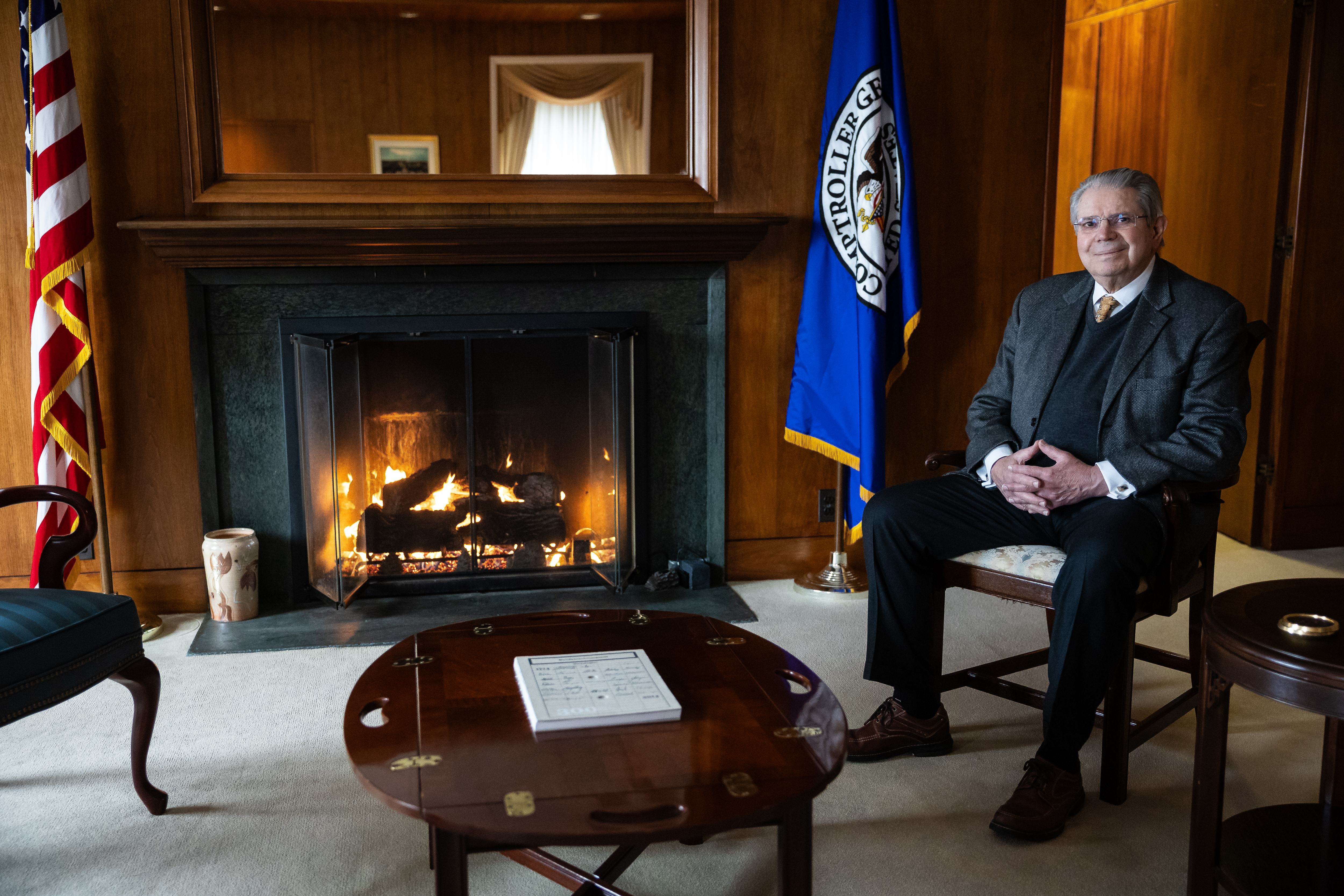
Gene Dodaro started his career at what is now the Government Accountability Office in 1973, as then-President Richard Nixon was battling Congress for control of federal cash.
More than a half-century later, Dodaro runs that watchdog agency amid another epic clash between Capitol Hill and the White House over President Donald Trump’s funding moves. Now, with his 15-year term as comptroller general coming to an end in late December, he’s getting ready to retire.
“I’m going into witness protection,” Dodaro, 74, said in a recent interview of his upcoming departure from the independent office with a workforce of more than 3,000.
He meant it as a joke. But Dodaro’s agency, which is tasked with auditing federal programs and helping lawmakers fulfill their constitutional duties, has been under an unprecedented level of scrutiny this year as conservative lawmakers and the White House publicly challenge GAO’s objectivity and seek to undermine its influence.
Adding to the pressure on Dodaro, the Supreme Court this fall appeared to endorse the view that only the comptroller general has the authority to sue the Trump administration for flouting impoundment law — not the groups losing out on federal cash.
Dodaro has declined to take such legal action, despite the urging of some lawmakers, including Senate Appropriations Chair Susan Collins. “People are already suing in many cases,” he reasoned, adding that the court’s decision “surprised” him and that he won’t be “cajoled” into suing.
“We’ll see what we need to do. But we need to be prudent and make sure that — when we do it — we’re in the strongest possible position to prevail,” he added.
Following the Supreme Court’s opinion, Collins said in a brief interview that it “goes without saying” this dynamic underscores the need for the lawmakers involved in the selection process to find a strong candidate to succeed Dodaro.

Dodaro’s last day is Dec. 29, at which point he will hand-pick an acting comptroller general to take the reins of the agency until the Senate confirms a permanent replacement. A panel of 10 lawmakers seated on a bipartisan commission is supposed to suggest candidates for Trump to nominate.
Whoever succeeds Dodaro will have to direct ongoing probes into Trump’s funding moves. To date, the agency has issued 11 opinions — five concluding the administration illegally withheld money, two citing some wrongdoing. Dozens are ongoing.
“The worst thing for GAO is to look like you have an agenda. That’s what concerns me about allegations like we’re against the current president’s agenda. We’re not,” he said. “Our job, and most of what we’re doing, is in response to actions they’ve taken. It’s not things we’re bringing up out of nowhere.”
Because the Office of Management and Budget has stonewalled GAO’s requests for information, the agency is forced to rely on evidence in the many lawsuits against the administration, Dodaro said.
Moreover, the GAO head said he has never spoken to Trump’s budget chief, Russ Vought. Multiple attempts to make contact during the first Trump administration were unsuccessful, he added.
“His public comments have led me to believe that wouldn’t be a successful approach here,” Dodaro said of Vought, who on social media this spring accused the office of taking a “partisan role in the first-term impeachment hoax,” a reference to GAO’s conclusion that Trump illegally withheld aid to Ukraine in 2019.
The past 11 months have been politically difficult for Dodaro in other ways. Earlier this year, top Republicans derided GAO for not blessing Senate GOP efforts to skirt filibuster rules to overturn state waivers issued under former President Joe Biden for pollution standards — and ignored the agency’s conclusion to boot.
Dodaro fended off Elon Musk’s attempt to send a downsizing team to GAO as part of the president’s now-disbanded Department of Government Efficiency initiative, before House Republicans proposed cutting the agency’s budget in half for the current fiscal year.
It’s not the first time the comptroller general has irked a party in power. During the Biden administration, GAO delivered its first-ever estimate of fraud in the federal government, pegging losses at between $233 billion and $521 billion dollars a year.
“OMB wasn’t happy,” Dodaro recalled.
Dodaro’s agency doesn’t always disappoint Republicans. Just last week, GOP lawmakers cheered a new GAO report reinforcing their arguments about fraud in the Obamacare insurance marketplace. To investigate this claim, GAO set up 24 fake accounts; 22 successfully enrolled in plans. It ended up costing the federal government thousands of dollars a month.
And Congress has averted several crises as a direct result of the watchdog’s warnings. That includes action to replace crucial weather satellites before they fail and to buoy the federal insurance program designed to protect Americans whose pension benefits are at risk.
“GAO is incredibly valuable … the ability for Congress to ask a hard question and ask them to chase it,” said Sen. James Lankford (R-Okla.), who added that Dodaro has for years aided him in a running effort to compel federal agencies to identify and describe each program they oversee.
Dodaro also started a partnership with experts at the National Academy of Sciences and launched an international effort to help developing countries run audit offices.
Sen. Gary Peters (D-Mich.), who is supposed to serve on the commission to recommend candidates for a Senate-confirmed comptroller general, said lawmakers “won’t find anybody as experienced and as knowledgeable” as Dodaro. “The integrity and professionalism he brought to the job, I thought, was exceptional.”
Dodaro attributes any praise to decades of relationship maintenance, including with top Trump administration officials who used to be members of Congress and senators who formerly served in the House.
“I try to pull out all the stops on my Italian charm,” he joked. “We’re not only in the auditing business. We’re in the relationship business.”
The next comptroller general could be anyone, and it could be a long time before that person is seated. Dodaro is the only Senate-confirmed GAO chief who was picked from inside the agency, and he held the position in an acting capacity for more than two years before then-President Barack Obama nominated him upon the recommendation of lawmakers. The Senate confirmed him by unanimous consent in 2010.
“If it can be done quickly, that’s fine. If it can’t, then they need to take their time to get the right person in the job, because it’s 15 years,” Dodaro said of the selection process for his successor.
“I have great confidence in the people at GAO … and I have confidence in the Congress to take their responsibility seriously and pick someone. This is their person — to serve them.”


Republicans were already struggling to defuse simmering voter frustrations over the cost of living ahead of the midterms. Then President Donald Trump rekindled his trade wars.
Trump’s latest actions — especially his decision to impose 50 percent tariffs on $20 billion worth of Canadian goods, inviting retaliatory duties from America’s No. 2 trading partner — has sparked new pushback from GOP lawmakers and candidates.
His moves are set to reverberate especially hard in a handful of states crucial to the party’s hopes of keeping their Senate majority. That includes northern border states, such as Maine and Michigan, as well as agriculture-heavy battlegrounds like Iowa and North Carolina that have been buffeted for more than a year by Trump’s embrace of hardball trade tactics.
“We’ve got 71 days, and right now we don’t have a positive message to tell farm country,” said retiring GOP Sen. Thom Tillis, whose North Carolina seat is at risk of flipping into Democrats’ hands in November.
Trump’s threat to impose tariffs on Canada is creating “tension,” Tillis added, and that “the party that owns that tension is the party that will probably suffer the consequences in November.”
Even the president’s latest bid to ease price pressures on Americans has generated unease among Republicans. While he touted his decision last week to temporarily allow the duty-free import of 300,000 metric tons of foreign beef as a win for consumers, the announcement was met with little praise from GOP lawmakers, who instead worry the bigger political impact will be to alienate key constituencies in rural states hosting competitive House and Senate races.
Rep. Tim Burchett (R-Tenn.) said in an interview Tuesday he’d spoken this week with the small farmers and ranchers who would bear the brunt of Trump’s beef import holiday.
“I think it could hurt us at the polls,” he said. “That’s a very strong group.”
The beef imports have jolted races in Iowa, where GOP Rep. Ashley Hinson, who is running to succeed retiring Sen. Joni Ernst, said in a social media post that the imports were “a bad idea” that would create “more uncertainty and instability for our farmers.”
Meanwhile, Rep. Zach Nunn, another Republican who is seeking reelection, said Friday at the Iowa State Fair alongside Agriculture Secretary Brooke Rollins that Trump is “right” that “we want to make sure that people can afford to eat” but that “we don’t do it on the backs of our cattlemen.”
But it’s the hefty Canada tariffs that could create the bigger problem for the GOP. Four border states — Maine, Michigan, New Hampshire and Alaska — as well as manufacturing-heavy Ohio are on the front lines of both the midterms and Trump’s North American trade war.
The economy is consistently the top issue for voters of both parties. Fifty-six percent of U.S. adults said cost-of-living concerns are among the top issues facing the country in a recent Blue Light News Poll.
A notable share of Trump’s own voters hold negative views about the current state of the economy — and how he is trying to improve it. A 33 percent plurality of Trump’s 2024 voters said rising prices are among the biggest failures of Trump’s second term, according to the survey conducted earlier this month by London-based Public First. Just 16 percent pointed to improving the cost of living as one of his biggest successes.
Among Trump voters who said things are less affordable now than a year ago, most blamed the Iran war (52 percent), but a sizable share (42 percent) blamed Trump’s tariffs on imported goods.
Vice President JD Vance defended the Canada tariffs Monday during a stop in Maine, saying Trump was taking long-overdue action to address unfair trade practices. But Sen. Susan Collins, who did not appear at the Vance event citing a scheduling conflict, told reporters over the weekend that she believed the Canada tariffs were a “mistake.”
“We produce a lot in Maine — our blueberries, our potatoes, our lobster, our lumber — that is processed across the border,” said Collins, who voted to undo prior Trump levies targeting Canada. “If it comes back with a huge tariff on it … that increases the cost of eating, building homes.”
Former Republican Sen. John Sununu, who is running to recapture his New Hampshire Senate seat this fall, said in a statement to Blue Light News Tuesday that “it makes no sense to start a trade war with our closest neighbor” as Democratic nominee Rep. Chris Pappas suggested Sununu “stands with Trump.”
“Canada is an important and valued trading partner for New Hampshire,” Sununu added. “As Senator, I’d encourage both sides to continue to negotiate and keep trade flowing between our countries.”
In Alaska, a group aligned with Senate Democrats has been hammering GOP Sen. Dan Sullivan with ads for months related to “raising costs” and tariffs as Democrats have sought to put in play a state Trump won handily three times. Multiple political forecasters now view the Alaska Senate race as a tossup between Sullivan and former Democratic Rep. Mary Peltola.
Campaign representatives for Sullivan and for former Rep. Mike Rogers, who is the GOP Senate nominee in Michigan, did not respond to requests for comment about the Canada tariffs.
The fallout from a trade war with Canada could also impact Republicans’ affordability message as they attempt to hold onto the House.
“The president picked an unnecessary fight with a friend,” retiring Rep. Don Bacon (R-Neb.) said in a text message Tuesday. “The trade war will hurt both Americans and Canadians and for no good reason.”
The latest trade anxiety is landing amid broader economic woes that can be traced in large part to energy price spikes associated with the Trump-initiated war with Iran — a conflict that has dragged on for months longer than many GOP lawmakers privately hoped. Democrats, in turn, have spent months using those price spikes and voters’ dissatisfaction with the war as ammunition to sink Republicans in key states that could hand them majorities in both the House and Senate.
Republicans have taken comfort in the Democratic infighting that has marked primary season and the ascendance of hard-left nominees in many races — including in Michigan, where the GOP hopes to flip the seat being relinquished by retiring Democratic Sen. Gary Peters. The new Canadian tariffs, however, threaten to distract from Rogers’ campaign to paint Democratic opponent, Abdul el-Sayed, as too extreme for the state.
“Americans are paying more for everything because GOP Senate candidates have served as a rubber stamp for Trump’s chaotic tariffs at the expense of their states,” DSCC spokesperson Tommy Garcia said in a statement Tuesday. “Come November, voters will hold them accountable for making life more expensive.”
Senate Republicans decamped to their home states earlier this month hoping that they would be able to use the August recess to focus on selling last year’s GOP tax cuts and a growing economy as they try to convince voters to overlook their cost-of-living concerns.
Republican Sen. Mike Rounds, who is seeking reelection in the reliably red agriculture state of South Dakota, said he thought his party is “in pretty good shape” to keep the majority. He added, though, that Republicans will need to “work hard” and “focus on what voters back home care about, which is the price of gas, price of groceries, making sure that in our ag economy we’re focused on helping to bring prices up for our commodity products.”
Others in the GOP have put voters’ affordability concerns in less rosy terms, including Sen. Jim Justice (R-W.Va.).
“I’ve been the voice that’s been saying, ‘You people are living in a cave if you don’t see that folks out there … are hurting,’” Justice told reporters last week. “And we need to absolutely be more in tune with them.”
Erin Doherty and Grace Yarrow contributed to this report.
Sen. Jon Ossoff is honing a new line of attack against his opponent for reelection, GOP Rep. Mike Collins, by zeroing in on an ongoing House Ethics Committee investigation into allegations that Collins’ congressional office misused taxpayer dollars.
“Congressman Collins must cooperate with this investigation, he must commit to testifying and he must explain to the public and the press why he has refused to cooperate, why he has obstructed, and why he has stonewalled this investigation to date,” Ossoff, a Georgia Democrat, said during a Tuesday morning press conference.
His comments come at a pivotal moment on two fronts. On the campaign trail, the midterms are fast approaching and Ossoff is fighting to hang onto his seat — and Democrats, in turn, are counting on the incumbent to help the party reclaim the Senate majority in one of this election cycle’s most closely-watched races.
Meanwhile, on Capitol Hill, there’s been a renewed focus in recent months on the need to hold members accountable for misconduct, and a bipartisan effort to overhaul the congressional ethics process is currently underway.
The Office of Congressional Conduct — a nonpartisan, quasi-independent entity tasked with vetting and reviewing ethics complaints to then pass onto the House Ethics Committee — in January released a report saying it found “substantial reason to believe” that Collins’ office used official funds for unauthorized purposes. Those purposes, according to the report, included appearing to hire and pay “a district intern who had a preexisting personal romantic relationship with the office of chief of staff who did not perform duties commensurate with her compensation.”
Collins’ chief of staff at the center of the accusations, Brandon Phillips, is no longer on payroll.
The Office of Congressional Conduct further noted in its report that Collins “refused to cooperate” with its review and recommended the House Ethics Committee issue the lawmaker with a subpoena. Ossoff on Tuesday argued that Collins needs to “cooperate fully with this matter” and that “this is not going away.”
A Collins’ campaign spokesperson, Meyer Siegfriend, said in a statement Tuesday afternoon that “Rep. Collins has fully cooperated with the House Ethics Committee on this bogus, politically motivated complaint and looks forward to the committee fully clearing him in short order” — something Ossoff “would know if [he] weren’t too busy abandoning Georgia to suck up to liberal activist donors in the Hamptons.”
The Office of Congressional Conduct did not immediately respond to a request for comment and the Ethics Committee, which is now conducting its own inquiry, does not comment on pending cases.
ALBANY, New York — Gov. Kathy Hochul wants to prove she can be a strong top of the ticket this year to sweep down-ballot Democrats into office and help her party regain control of the House.
The stakes are high for the moderate Democrat, who took office five years ago Monday and has worked to build an anemic state party apparatus into something more formidable. Yet she must also contend with the success of candidates backed by the Democratic Socialists of America who have defeated institutional Democrats this year — victories that stand to upend the establishment’s plans to compete in purple areas of New York.
Unlike some moderate Democrats who are trying to halt the socialists’ advance, Hochul has taken a big-tent view of the party.
“I think the party is broad. It’s vast, but there are still a lot of people outside our urban areas who would view themselves as more traditional Democrats in the sense of FDR and Kennedy and Carter and Clinton and Obama and Biden,” she told Blue Light News in an interview Monday. “But if, in certain districts, the democratic socialist brand is more appealing, and they think it stands for something that they want to support, my job is to make it all work out. I work with everybody, whoever the voters want.”
Hochul sat down with Blue Light News Monday to discuss her five years in office, how she’s pushing for House Democrats and the role New York City Mayor Zohran Mamdani will play in her reelection bid.
This interview has been edited for length and clarity.
What has been your biggest challenge in the last five years?
Overcoming inertia here in Albany. There have been so many times when I want to just be, you know, take bold action and do what’s right, and not have institutional opposition to so many of our grand plans. I’ve had to work through that. Overall, I’d say the biggest challenge is just having to navigate, and then also to have breakthroughs, and that sometimes leads to conflict.
I don’t mind conflict if the result is better for New Yorkers than the status quo. So I think it’s partially my impatience and my desire to shake up the status quo — felt sometimes it was running into a brick wall, and then I had to dismantle that brick wall.
Who’s to blame for that institutional inertia at this point? Is it part of the climate?
There’s all kinds of lobbyists and advocates and interest groups and legislators with specific agendas, and it’s the whole ecosystem of Albany. There have been dramatic improvements since it was labeled probably the most — what did they call it?
The most dysfunctional in the country.
The most dysfunctional in the country, and I think the two [legislative] leaders that we have now have worked hard to eliminate that reputation. But beyond just elected officials, there’s just a lot of institutional, strong interests out there that conspire against changing the status quo, and I am hardwired to drive for change. I’m not complaining. I did it, but if I thought about what was a challenge, that was a challenge. But we’re overcoming it. We have overcome it in many specific instances.
I know the car insurance changes were part of that frustration. Anything else kind of fell under that inertia?
Anything we wanted to do with the State Education Department. We wanted to change how we teach literacy, and it was 20 years of a debunked theory that other states had walked away from, but it was not walked away from here.
My cell phone ban — that was not embraced by institutional interests here, and there’s organizations that at first were very resistant. Teachers were on board, teachers came on board, and I was happy with that. But there’s just the administrative roles, and the parents were anxious. There’s all sorts of groups representing everybody, and I look at that as one of our greatest accomplishments. That has had the most immediate result, and of anything we could have done, that had the most immediate impact in a positive way.
That was kind of a signature policy, fair to say?
That and overall taking care of families, whether it’s making sure no child goes hungry, there’s not a single child in the state of New York who doesn’t get two out of three meals now provided by the state, breakfast and lunch. That is huge.
That and other tax credits for families have really helped drive down poverty rates among children. Proud of that. Our work in social media has been nation leading, putting in guardrails where there had been none to protect our children. So a lot of it centers around family, whether it’s what’s happening in schools, what’s happening for parents who have to pay the bills, grocery prices, the largest middle-class tax rate cut in 70 years, taking on taxes, taking on utility bills with our utility rebate, taking on costs of groceries with our inflation rebate.
We put $5,000 back in a family’s pocket with covering the school meals for your family of two kids. School meals, $1,000 tax break for children under the age of four, $500 for higher. All this combined to say, I hear you. So I think the number one issue I took on was affordability, but specifically focused on families that are struggling because that was my life story. That was my early, early years, and then, as even a young parent, it’s one income in the house. It was hard, and those experiences have really focused me on my priorities, have driven my priorities because I know that those priorities will help New Yorkers.
Is there anything that you would have done differently looking back on the last five years? Any mistakes, any regrets that you have?
I would say I wish that the rules hadn’t been changed in the process for nominating chief judges. You know, we were trying to really help make history and have the first Latino chief judge. This person had tremendous judicial temperament and passed with flying colors. I was surprised that then the rules were changed in committees here to make it more challenging. So I would say that was frustrating for me. But what would I have done differently? I wish I had won. I wish I had won on that, wish my candidate had been able to get the fair hearing and be successful. But again, a lot of interests conspired against him, and that was probably the one big loss.
Lieutenant governor selections have also been kind of tough.
The selection isn’t tough. You do what [you can] with all the information you have at that moment. You do what you think is right. So the process isn’t flawed. Obviously becoming governor unexpectedly five years ago today required me to have a very, very shortened process to identify an individual that could be supportive. I had a relationship with Brian Benjamin. I thought he was an ideal candidate. I had no idea that charges would be brought and then later dropped against him. How do you foresee that when you’re going through a process and selecting someone? So there’s nothing to change there.
Antonio Delgado. I didn’t know him well. I did not know that loyalty was such a problem for him, or understanding the role is not that of the governor, and he understood later. Probably too late. But I function very well now. Having been lieutenant governor, I would say I’ve been performing lieutenant governor and governor simultaneously, which is why I do what I need to do in the Capitol. I spend a lot of time going out around the state and touching people and listening directly — literally in Rochester the other day, sitting in a diner talking to young people very anxious about data centers. These are the best conversations I have. Just sitting down, randomly starting to have conversations with people, and I learn a lot. I perform both roles for now, and am looking forward to having a new lieutenant governor who understands the role and has tremendous experience in government. I’d say it’s been handicapped not having a number two the way my predecessor had a hardworking number two.
What would you say is the biggest difference between how you’re approaching the job today versus how you initially thought it would go this time five years ago?
I’ve learned that it’s important to build coalitions around that idea. I initially thought if an idea was meritorious, that it would prevail on the merits, and that’s not how it works here.
Building coalitions, outside support, doing a lot more legwork, even on the cell phones, for example. I took a year to go around and build support for it and overcome the opposition from anxious parents or school boards that didn’t want to have opposition from their community. They just wanted to be left alone. But me spending the time and then listening more to young people about how they were struggling, it made me feel even more emboldened in the cause, brought people along with me.
I wanted to be bold and ambitious on housing. I wanted to overcome years and years of resistance to building more housing because I knew it was a huge driver of expenses for families, young people being denied the opportunity to have that first home, if ever. Maybe they’ll afford a decent apartment sharing with five people from college. So that first [housing] plan was bold. It was rejected because we didn’t have a chance to explain ourselves, and it was weaponized politically. That became an issue in a place like Long Island — government-paid-for literature going to everybody’s house, showing giant skyscrapers in a nice little multi-million dollar neighborhood. So, those are things that we couldn’t have foreseen in our first months on the job when I put together this bold agenda. But round two, the next year, we were very successful. So that was a learning curve there, but definitely have overcome it. And everything I set out to do in this year’s budget, for example, many of which I was told were dead on arrival, they all happened. We know the path.
Has the Democratic Party in the last five years gone too far to the left for the comfort of many voters — the very same voters you’ll need this year?
I have a broad perspective of the Democratic Party in this state, having been in every corner many times and understanding that the politics really is local.
Someone who gets elected in a particular Congressional district in New York City would never get elected in the North Country, or the Southern Tier, or perhaps even Western New York. I understand that. My job as the leader of the party in New York is to allow the locals to decide who they want as their candidates, and be as supportive as I can.
[That] does not mean I embrace a particular philosophy, and it doesn’t mean the rest of the party, outside of certain districts, should be labeled with that either. But it doesn’t mean that there aren’t people in a district that want a certain brand of candidate and a label. And I’m not going to stand here as a leader of the party [and] say no. I need to win in November. Let’s stay focused on the prize. It is taking back our country, one Congressional seat at a time, and that’s why I’ve invested a lot of political capital, and fundraising time and effort, and calling candidates and helping them work through the challenges.
I was that candidate in 2011 who took a shot at a longshot run. People said I would never win, but I knew there was a path because people were fed up with what was happening in Washington. Medicare was under attack. I knew this could win in a Republican district. I didn’t have any help from the state party. My predecessor literally sent someone to Buffalo, my home in Hamburg, to tell me not to run, because the state party would not be there for me, and the national party [the Democratic Congressional Campaign Committee] was not there for a long time. So I said I’m not letting that happen to people. [The] state party should be a vehicle to help all of our candidates who get through a process selected by primary or designee, as I was in a special election. I feel really good about the efforts we’ve undertaken.
I think the party is broad. It’s vast, but there are still a lot of people outside our urban areas who would view themselves as more traditional Democrats in the sense of FDR and Kennedy and Carter and Clinton and Obama and Biden. But if, in certain districts, the democratic socialist brand is more appealing, and they think it stands for something that they want to support, my job is to make it all work out. I work with everybody, whoever the voters want. My job is to make it work out.
Why do you think so many younger voters are choosing a socialist candidate, or are open to socialism? We’ve seen polling show that they’re rejecting capitalism.
The world is changing so rapidly around them. It’s a frightening time. You don’t know whether AI is going to take a job that you were told you should go to school for and study STEM and study computer science and get a degree that’ll position you for the rest of your life. The rug has been pulled out from under a lot of young people for a variety of reasons. They didn’t ask for the pandemic. Everything got so expensive. Their lives were disrupted. If they had little kids, the little kids were learning from home, and they’re trying to keep it all together while they have their jobs. Mom stayed home.
This has been a wildly disruptive time for young people starting out, whether just getting out of school or a young family. And there’s a lot of anxiety. Will the jobs they thought were going to be there? Why can’t I afford to get an apartment? My parents were able to get an apartment. My parents could even buy a home in some cases. Why is that American dream on hold for me? I didn’t do anything wrong. I did everything I was asked to do by society.
I feel that deeply as a parent who sees young people struggling like that, and why even child care, which was an issue when I was having babies, why is it still a problem today? Why can’t we as a society, do more to help lift this burden off of families? Why can’t we do more to stand up for them against high utility bills? Why can’t we be supportive of them? I have incredible empathy for people who are just feeling very unsettled and anxious about the future, and I think that drives them to listen to voices that are offering more. But at the end of the day, I feel the same concern. I’m a moderate Democrat who is responding to their same anxieties, and maybe they don’t see that, but that is hardcore what I’m all about — fighting for families, reducing the burdens they have on childcare and school lunches and cost of living.
Our interests are more aligned than people believe. I don’t think it’s a socialism versus capitalism debate. Most people are not thinking that. The vast majority of New York Democrats are not caught up in that struggle, and they’re just not. They don’t have the luxury of even having those thoughts. They’re trying to pay the bills at the end of the month and see whether or not their job is going to be there, or are they going to be replaced by AI?
Do you expect the mayor to be campaigning with you? Have you talked to him about campaigning? Will he be helpful on the trail?
I think he’ll be helpful. Like I said, I really carved out a very different path in this role. People understand I get the job done. I’m here to get a job done, not to look for glory for myself, or get into fights with the mayor of New York and show I can win the battle because I’m bigger state government. It’s never been about battling egos here. So many people have told me they appreciate — whether or not they support the mayor — they appreciate the fact that I understand my role is to make New York City successful. That’s why I am making the relationship work. As is he — he is working with me to build a relationship where we’re both putting New York City first, and that is something that this state has not seen, perhaps ever. If you go back through history, there’s always conflict between the governor and the mayor, almost universally. I wanted to end that, and we did with Bill de Blasio, Eric Adams, Zohran Mamdani.
How eager are you to prove Nancy Pelosi wrong this year after her comments from four years ago saying that New York didn’t come through for House Democrats?
Forgot about it. Don’t even think about it. I didn’t have the luxury of time in ‘22 to build out a state party. I inherited a skeleton. I took two solid years to bulk it up. In 2024, I already proved that I’m a leader, and I know how to win races. We won five out of seven battleground races with money that I raised, opening up 42 field offices, hiring an additional 100 staffers, and that’s how we win. So I already established I know how to win. Give me two years. Now I’ve got four. We’re going to do it again.
Thanks for your time.
-

 The Josh Fourrier Show2 years ago
DOOMSDAY: Trump won, now what?
-

 Politics2 years ago
Former ‘Squad’ members launching ‘Bowman and Bush’ YouTube show
-

 The Dictatorship2 years ago
Luigi Mangione acknowledges public support in first official statement since arrest
-
Uncategorized2 years ago
Bob Good to step down as Freedom Caucus chair this week
-

 Politics2 years ago
Former Kentucky AG Daniel Cameron launches Senate bid
-

 Politics2 years ago
Blue Light News’s Editorial Director Ryan Hutchins speaks at Blue Light News’s 2025 Governors Summit
-

 The Dictatorship2 years ago
Pete Hegseth’s tenure at the Pentagon goes from bad to worse
-

 The Dictatorship12 months ago
Mike Johnson sums up the GOP’s arrogant position on military occupation with two words