
Congress
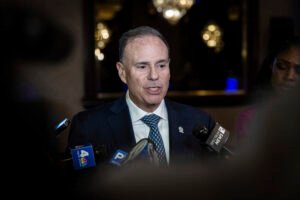
Why Mark Warner is sitting out the shutdown

Not so long ago, if there was a bipartisan group getting together to solve a problem in the Senate, you could count on Mark Warner to be involved.
The Virginia Democrat was part of the “talking stick” gang that helped quickly end a brief 2018 funding lapse. He was a part of a crew that helped cut a major infrastructure deal under former President Joe Biden, and he’s currently working with Republicans to forge an agreement on cryptocurrency regulation.
But as his colleagues hunt for a way out of the 31-day-and-counting government shutdown, Warner this time is hanging on the sidelines.
It’s a twist not only because of Warner’s history as a card-carrying bipartisan “gang” member who would frequently host gatherings at his Old Town Alexandria home. It’s also because of who he represents: His home state has the third-highest number of civilian government workers, plus tens of thousands more in military uniforms. Lawmakers from the Washington area have historically been voices of moderation urging both parties to avoid brinkmanship that could harm the federal workforce.
Yet as the shutdown’s toll has mounted, Warner and his home-state teammate, Democratic Sen. Tim Kaine, have stuck closely to their party’s line — sounding the alarm over the impending expiration of key federal health insurance subsidies and blaming the impending lapse of nutrition assistance on Republicans.
“He’s always been one of those guys who says, ‘I’ll be part of any gang,’ the sort of ultimate bipartisan leader,” said Rep. Don Beyer (D-Va.). “I think he’s just really frustrated and unhappy with the situation, the shutdown, with what’s happening to Virginians. … I think it just pisses him off.”
In Warner’s estimation, what sets this shutdown apart is his belief that it won’t be solved by a Senate gang, but by one person: President Donald Trump.
Warner publicly aired his concerns this week when he gabbed to reporters alongside Sen. Lisa Murkowski (R-Alaska), another bipartisan gang regular who has been involved in the current rank-and-file talks.
After she mentioned the virtues of cross-aisle conversations and the importance of trust, Warner said while Murkowski might feel free to negotiate without Trump’s blessing, “some of the others would have to get a permission slip.”
“I really do think, unlike in the past, you’ve probably got to get the president deeply engaged,” he added.
Warner’s office declined a request for an extended interview. But he confirmed in a brief exchange Thursday that he has not joined the pending shutdown talks — pointing to both his belief that Trump is the key player in ending the stalemate as well as his focus on helping land a cryptocurrency deal.
But there’s also a larger backdrop to Warner’s withdrawal — how the Senate’s partisan fault lines have hardened during the second Trump presidency.
Senate Republicans have repeatedly sidelined Democrats this year at major points, passing a sweeping domestic policy bill along party lines this summer that also included a debt ceiling hike — sidestepping a default cliff that has previously forced bipartisan compromise.
In March, Republicans drafted a stopgap funding bill on their own and then essentially dared Democrats to shut down the government. Senate Minority Leader Chuck Schumer flinched then, but one big hint that Democrats wouldn’t be up for a repeat was that Warner did not join him at that time in helping to advance the shutdown-averting legislation. In a statement with Kaine, Warner explained that the stopgap gave a “blank check to Donald Trump and Elon Musk to continue attacking the federal workforce.”
Now he’s repeatedly voted against the latest House-passed spending patch, which would fund the government until Nov. 21. Warner has backup from fellow Virginia Democrats, who say Trump’s willingness to take a sledgehammer to the federal government this year is affecting what they are hearing back home.
“They’re viewing the shutdown sort of as a continuity of the Donald Trump term two status quo,” Kaine said. He summed up his constituents’ feelings as, “It’s good that you are fighting finally because we’ve been on the receiving end of this since Jan. 20, and it’s time somebody stands up to this guy.”
Warner, unlike Kaine, is up for reelection next year, and political prognosticators widely expect him to easily keep his seat. But Warner, 70, has taken nothing for granted politically after narrowly squeaking out a win by less than a percentage point in 2014. In 2020, Warner won by 12 points.
These days, Warner is leaning into his willingness to fight Trump and calling himself one of Republicans’ “top targets” in his fundraising efforts, even though there’s little to suggest he’s worried about a razor-thin November contest.
“I am doing everything in my power to stop Trump and his unelected co-president from overhauling the federal government so they can enrich themselves and leave Americans in the dust. But that makes me one of their top targets,” Warner wrote in one recent online fundraising solicitation.
Warner has also been sharply critical of Trump and his administration on various other fronts. As the top Democrat on the Senate Intelligence Committee, he held a lengthy news conference Thursday to lambast the administration for briefing Senate Republicans on recent military strikes on alleged drug traffickers in the Caribbean but not Democrats.
“The one area that I thought we could maintain some level of comity … was around national security, but not from this crowd,” he said, describing the difference between Trump’s first and second terms as “night and day.”
Bob Holsworth, a longtime Virginia political analyst, said Warner’s more “aggressively critical” stance toward Trump is part of a long-running political evolution.
“It reflects the changes that have occurred nationally and certainly in Virginia,” Holsworth said. “Virginia … clearly on state-wide elections tilts blue.”
Warner has also embraced a push led by Sen. Cory Booker (D-N.J.) in recent years to get Democratic lawmakers more comfortable delivering their message online, including by cutting shareable short-form videos. In one recent shutdown-themed clip, Warner sought to debunk “as many Republican lies as I can in 90 seconds.”
And he leaned into social media to dispel rumors being circulated from some Republicans who thought the in-cycle senator would quickly relent on the shutdown and vote for the House-passed stopgap. “Not caving,” he wrote on X.
Beyer predicted that if the shutdown does play into Warner’s race next year it would only help him.
“They’re never going to assign blame on the shutdown to him — [Republicans] have the White House, they have the Senate, they have the House,” he said. “Regardless of the national landscape, he’s been a constructive part of our polity and our economy now for a generation.”


House Democrats aren’t letting rogue members off the hook for bucking their party. They hope Minority Leader Hakeem Jeffries won’t either.
“Obviously, there’s got to be” punishment for the two Democrats who twice this month bucked their party to advance a slate of Republican priorities, Rep. Jared Moskowitz (D-Fla.) said in an interview.
“Otherwise, then,” he said, “it’s open season.”
Democrats are watching closely how — and if — Jeffries doles out consequences for Reps. Jared Golden of Maine and Marie Gluesenkamp Perez of Washington who have twice provided the decisive votes for GOP procedural measures this month. Jeffries and his leadership team condemned the two members when they first defected two weeks ago, slamming a “breach of trust” warranting a “serious response” but have yet to inflict any public consequences.
On Tuesday, they defied leadership a second time, infuriating House Democrats and resurrecting questions about how leadership plans to keep its caucus in line — especially if they have a slim majority next term.
“We have to all be united, and I think it’s pretty simple,” said one House Democrat who was granted anonymity to speak candidly. “If there’s not [a punishment], I find it hard to see a path forward in the majority, which we’re all pushing for.”
Asked if leadership should punish the two aisle-crossers, Rep. Troy Carter pointed to his time as minority leader of the Louisiana state Senate: “When I had members that did not work within the confines of the philosophical views of our party, I took them off our caucus.”
“I don’t want to second-guess anybody’s timing, but I will tell you that these things cannot allow to fester,” he added. “We have to have a strict message: Either you’re with the team on those fundamental issues of governance or you aren’t.”
Multiple members, including Carter, said that removing Gluesenkamp Perez from the Appropriations Committee should be considered. (While members are just as angry at Golden, they acknowledge he’s beyond punishment given he is retiring at the end of this term.)
“I suspect that there are a number of appropriate consequences that [leaders] could implement,” Rep. Sydney Kamlager-Dove (D-Calif.) said in an interview. “And, ultimately, it’s their decision. I certainly don’t want that to be a caucus decision. That should be a leadership decision.”
One leader, Whip Katherine Clark of Massachusetts, suggested she is open to removing Gluesenkamp Perez from Appropriations, telling reporters Wednesday morning that “team players get to sit on exclusive committees.”
After the first instance where the two Democrats defected on Sept. 1, Jeffries kicked the matter to a caucus rules panel, saying afterward he wanted to pursue action against the two members “sooner rather than later.” The panel continues to deliberate on what should happen if members vote with Republicans on procedural measures.
Jeffries said that week that he’d had a “productive” and “forward-looking” conversation with Gluesenkamp Perez, but he has said much less after Tuesday’s floor drama.
“I’ll have more to say about the issue when I have more to say about the issue,” he told Blue Light News shortly after the vote.
The House passed the sweeping Russia sanctions bill long championed by the late Sen. Lindsey Graham on Wednesday, sending the legislation to the White House for President Donald Trump’s signature after more than a year of congressional maneuvering.
The 262 to 159 vote ends a nearly two-year lull in Ukraine assistance from Congress, which had not passed any major Ukraine efforts since a 2024 emergency aid package. The bill faced a number of obstacles on the path to the Resolute Desk, including significant opposition from some House Democrats who argued that the bill would give the White House too much tariff power.
After weathering a number of storms to make it out of Capitol Hill, the legislation is all but guaranteed to get Trump’s signature.
The long-anticipated legislation issues mandatory sanctions on Russia’s leadership and energy sector — as well as new sanctions on collaborators in Moscow’s defense industry and its so-called shadow fleet. Advocates of the bill, including Ukrainian President Volodymyr Zelenskyy, have argued it would give the White House necessary tools to squeeze Russia economically, curbing the flow of funds to Moscow’s war machine.
But, to many Democrats’ dismay, the legislation also includes a 100% tariff on top buyers of Russian energy. Opponents of the bill have cautioned that the tariff provision would hand another cudgel for Trump to use against not only U.S. foes but also global allies — an action the White House has repeatedly taken since Trump returned to office.
“We cannot grant more tariff power that we know he will abuse,” Rep. Gregory Meeks (D-N.Y.) said in comments on the House floor Wednesday.
Meeks, the top Democrat on the House Foreign Affairs Committee, argued that the tariffs would worsen the economic pain already felt by everyday Americans and that without a security assistance package or more air defense, they would not do enough to concretely help Ukraine.
In comments on the House floor earlier Wednesday, House Minority Leader Hakeem Jeffries outlined why he planned to withhold support for the measure.
“The manner in which this bill has been written doesn’t require the president of the United States to impose sanctions on Russia,” Jeffries said. “In fact, there are so many loopholes written into the bill, I believe, that it’s very unlikely that the sanctions relief contemplated in the legislation will ever see the light of day.”
That disagreement has caused a growing rift among Democrats in recent days. Fifty-eight House Democrats broke with Jeffries to vote yes on the measure.
In a letter addressed to House Democrats, Senate Foreign Relations ranking member Jeanne Shaheen (D-N.H.) urged her colleagues to pass the legislation, warning that failing to do so would send a dangerous message to both Russian leader Vladimir Putin and other international foes.
“Congress’s failure to impose additional costs would send a dangerous signal,” Shaheen wrote. “The Kremlin is watching. Kyiv is watching. Our NATO allies are watching. So are Beijing, Tehran and Pyongyang.”
Sen. Rand Paul blocked an attempt by fellow Republican Sen. John Kennedy to quickly pass legislation that would require companies to build a “kill switch” into their artificial intelligence model.
Kennedy, of Louisiana, went to the Senate floor Wednesday to try to pass his bill without holding a formal vote — a step that can be prevented by any one of his 99 colleagues. He argued that the measure was effectively a short-term step, with Congress unlikely to pass more sweeping AI legislation in the immediate future even amid fears that technological advancements could spiral out of human control.
“We are not going to get up off our ice-cold lazy butts and address this anytime soon,” Kennedy said about Congress’ inability to pass a more comprehensive bill. “But still we’ve got this risk out there that we know is real of one of these models becoming the Terminator.”
Paul, however, blocked Kennedy’s request to pass the bill through a unanimous consent agreement, saying from the Senate floor, “I think we should have as many facts as possible before we dictate rules for the whole economy.”
“I don’t oppose the spirit of this bill but I do ask that we make sure that we have all the information,” the Kentucky lawmaker added.
Paul tried to amend Kennedy’s bill to establish a group that could make recommendations on AI guardrail policies to the Senate Commerce Committee. Kennedy rejected that suggestion.
“My mama didn’t raise a fool,” he said, adding, “a committee is a way to kill this.”
Kennedy’s push for a vote comes after he told reporters Monday that he intended to roll out legislation and attempt to pass it this week, even while he acknowledged that he didn’t yet have any formal buy-in from his colleagues. He also appeared to know by earlier in the day Wednesday that he was running into a roadblock, saying in an interview that he expected Paul to offer a counterproposal.
- Democrats keep pressure on Hakeem Jeffries to punish rogue members
- House passes GOP-backed bill targeting data center power costs
- House passes Russia sanctions bill, handing Trump more leverage against Moscow
- Rand Paul kills Kennedy’s AI ‘kill switch’ bill
- Jay Jacobs gets his first-ever challenger for state Dem chair
- ‘The US can’t lose’: Pentagon plows ahead on AI despite warnings
- House votes to hold Leon Black in contempt of Congress
- GOP’s gas tax holiday push falters in House
- Bonamici ‘exploring’ bid for Scott’s education leadership
- Ted Cruz: ‘It’s still my hope’ to have an AI markup this month
-

 Politics2 years ago
Former ‘Squad’ members launching ‘Bowman and Bush’ YouTube show
-
Uncategorized2 years ago
Bob Good to step down as Freedom Caucus chair this week
-

 Politics2 years ago
Former Kentucky AG Daniel Cameron launches Senate bid
-

 The Josh Fourrier Show2 years ago
DOOMSDAY: Trump won, now what?
-

 The Dictatorship2 years ago
Luigi Mangione acknowledges public support in first official statement since arrest
-

 The Dictatorship2 years ago
Pete Hegseth’s tenure at the Pentagon goes from bad to worse
-

 Politics2 years ago
Blue Light News’s Editorial Director Ryan Hutchins speaks at Blue Light News’s 2025 Governors Summit
-

 The Dictatorship1 year ago
Mike Johnson sums up the GOP’s arrogant position on military occupation with two words