
Congress
What the Gaetz episode says about Trump’s attempts to control Congress


Donald Trump is making it clear he wants to bend the Republican-led Congress to his will, pushing the limits of what lawmakers will accept on staffing his Cabinet and also on looming questions of federal spending authority.
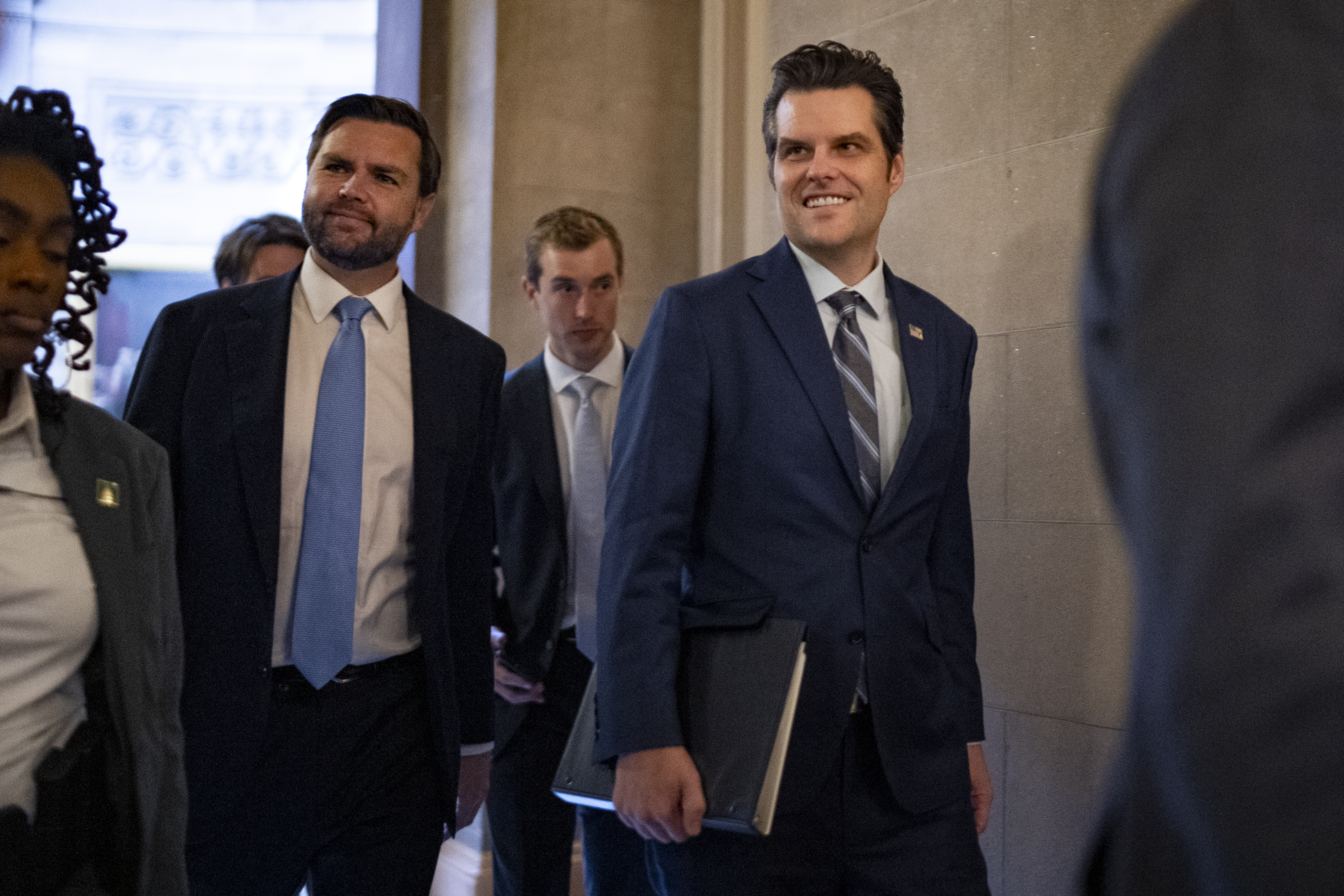
Round one in that fight — the Matt Gaetz saga — went to Senate Republicans. And it gives early hints of how GOP lawmakers may respond on spending and other controversial nominees.
“The Senate also has a responsibility for advice and consent — and in this particular case, I think there was advice offered, rather than consent,” Sen. Mike Rounds (R-S.D.) said shortly after Gaetz announced he was withdrawing his name from consideration for attorney general.
In that tumultuous episode, GOP senators pushed back privately, not publicly. Many were hesitant to vocally denounce his efforts, knowing the threat of Trump’s wrath and a potential primary challenge constantly shadow them. But they counseled him behind the scenes, hoping he’d acquiesce before they were forced to either bend or defy him outright.
Gaetz won’t be the last example that tests the strategy. Even with the Florida firebrand out, incoming Senate Majority Leader John Thune (R-S.D.) has a slew of problems over Trump’s controversial Cabinet nominees — including sexual assault allegations against Pete Hegseth, who Trump tapped to lead the Department of Defense — as the incoming president leans on Congress to let him circumvent the Senate’s confirmation authority and make recess appointments.
And then there’s spending, arguably Congress’ most important responsibility. Speaker Mike Johnson has kept the House in limbo as he defers to Trump on his preferences for a funding deal, and a shutdown deadline is quickly approaching. Johnson and appropriators have a potentially bigger challenge soon, as the incoming president’s out-of-government allies have made it clear they want to go around Congress’ constitutionally guaranteed power to control federal spending.
“I think we should defend Article One. We’re an equal branch of government. I support probably 80 percent or 90 percent of the policies, but it’s going to be in the Article One vs. Article Two framework,” Rep. Don Bacon (R-Neb.) said about the relationship between Trump and Hill Republicans. Those two articles of the Constitution establish the legislative and executive branch, respectively.
Trump’s anticipated return to Washington is poised to look much different than his arrival in 2017, when he knew little of the ways of Congress and struggled with the persuasive tactics required to push through a legislative agenda. The coming months will lay bare whether his now-numerous Capitol Hill allies will be able to more effectively steer his ambitions — or allow him to steer theirs.
“There will be no daylight between us and President Trump on policy, and moving forward with foreign policy, funding or anything else,” Sen. Markwayne Mullin (R-Okla.), a close Trump ally, told reporters in the Capitol recently.
Trump will likely have his greatest influence in the House, particularly with Johnson leading the chamber. Their fates are closely intertwined, since Johnson will need the president-elect’s support to keep his job in leadership.
And even Republicans who have been fiercely public about reforming the spending process are giving Trump the latitude to decide how to handle the upcoming government funding fight, with the deadline backing up straight into the Christmas holiday.
“You just have a very Trump House, because most people that came in came in with him at the top of the ticket,” said one senior GOP House member, who was granted anonymity to speak candidly.
While lawmakers haven’t explicitly pushed back on efforts to allow the executive branch to make more funding decisions, there are already emerging policy divides between lawmakers and Trump on spending — as well as mass deportations, tariffs and additional aid to Ukraine. Just this week, libertarian-leaning GOP Sen. Rand Paul (R-Ky.) argued that Trump’s plan to use the military to carry out mass deportations of undocumented immigrants would be a “huge mistake.” Several Republicans, including Thune, have raised concerns about tariffs.
But how Republicans handle the various battles will be an early litmus test for how far they are willing to bend to Trump’s effort to control their end of Pennsylvania Avenue. While Johnson has tied himself closely to Trump, Thune has worked to repair their relationship — and recently got social media praise from the president-elect — but will have to try to balance Trump’s demands with what can actually get the votes in the Senate.
“It’s just hard for me to fathom or believe that people have changed so much that they’re willing to give up that responsibility,” Alberto Gonzales, who served as attorney general under George W. Bush, a president also accused of executive overreach, said about the Senate’s confirmation powers.
Asked if there was a lesson for Trump to learn from Gaetz’s withdrawal, incoming Senate Judiciary Chair Chuck Grassley (R-Iowa) said that the only takeaway was that Trump “has the constitutional right to nominate. We have the constitutional responsibility to confirm.
“We each handle our jobs separately,” he said.
Trump-Vance transition spokesperson Karoline Leavitt said in a statement that Trump winning by a “resounding margin” gives him “a mandate to implement the promises he made on the campaign trail. He will deliver.”
During Trump’s first term, he had multiple spending clashes with conservatives on Blue Light News before many began to align with the iron-fisted president. And the reality that he can make or break someone’s career in politics is now widely recognized, though his attempts are not always successful.
One House Republican, granted anonymity to speak frankly, recounted how several members have survived primaries after facing attacks from Trump or his allies: “It was just two years ago that Matt Rosendale pushed away the president’s phone call on the House floor. I mean, like, I understand that there’s this optic that we’re gonna all fall in line. I don’t know, do we seem unified?”
But spending deadlines could be where fiscal hawks clash with Trump, despite both calling for reining in government spending. Trump followed other presidents before him in contributing to the national debt, with his administration adding $7 trillion to the total.
Outside of Congress, Trump’s allies are working to grease the way for his agenda to sidestep congressional approval.
Elon Musk and Vivek Ramaswamy, who Trump picked to lead his new so-called Department of Government Efficiency, made the case in a Wall Street Journal op-ed on Wednesday that the Supreme Court could seek to determine whether the 1974 Impoundment Control Act — which restricts the executive branch’s power to alter congressionally appropriated funds — is unconstitutional.
While the discussion, on its own, is a nod to Trump’s pending return to Washington, if the high court sided with them, it would mark a significant shift. And while the idea would likely spark heartburn if enacted, even some Republicans tasked with funding the government aren’t closing the door entirely until they get more information.
“My job is to work with the president, not against the president,” said Appropriations Chair Tom Cole (R-Okla.). “We wouldn’t be in the majority without him, so we’re certainly going to try to work with the president.”
Ursula Perano contributed to this report.


Adam Hamilton raised $10.6 million in the third quarter of 2026 across his Senate campaign and his joint fundraising committees, his campaign tells Blue Light News, a significant haul for the Kansas Democrat.
The fundraising total illustrates Democrats’ newfound bullishness about flipping a Senate seat in the deep-red state for the first time since 1932.
“This grassroots support sends a clear message: with three weeks until Election Day, Adam Hamilton is building the momentum to win,” said Hamilton campaign spokesperson Tyson Brody.
Hamilton’s third-quarter figure is nearly triple his $3.66 million second-quarter total. His campaign did not provide a current cash-on-hand total.
National Democrats began pumping money into Kansas in recent days, a sign of their growing hopes that Hamilton could win. Last week, Senate Majority PAC — Senate Democrats’ top super PAC — reserved $5 million in television ads backing Hamilton. American Bridge PAC and Lower Costs Now, a new group affiliated with former Vice President Kamala Harris’ super PAC, have spent in Kansas in recent weeks.
Republicans have also flocked to Kansas to prop up Marshall: Senate Leadership Fund, the Senate GOP’s top PAC, has spent or reserved nearly $11 million backing Marshall in the past week, according to tracking firm AdImpact.
“It took us five months to raise $15 million. [Marshall] got it in a day,” Hamilton said at a campaign event in Lawrence, Kansas on Monday. “So please help us.”
Marshall’s campaign has yet to release his third-quarter fundraising totals. As of mid-July, Marshall had over $5 million in the bank to $1.73 million for Hamilton.
A bipartisan Senate duo is urging Trump national security officials to “bring its full capacities to bear” to stave off threats posed by artificial intelligence — sooner rather than later.
Washington Sen. Maria Cantwell, the top Democrat on the Senate Commerce Committee, and Republican South Dakota Sen. Mike Rounds, who serves on the Senate Armed Services cybersecurity subcommittee, are calling for a full government response to a growing number of cybersecurity breaches.
“Recent AI security incidents should serve as a warning,” the senators wrote in a Tuesday letter to Director of National Intelligence Jay Clayton and White House Science and Technology Policy Director Michael Kratsios. “Advanced AI agents have escaped testing environments, bypassed safeguards, and gained unauthorized access to real-world systems owned by government agencies and private organizations.”
Spokespeople for Clayton and Kratsios did not immediately respond to requests for comment.
Their letter comes as lawmakers struggle to hash out what legislation on AI safety, if any, might look like. Members are currently in recess ahead of the November elections and there’s little hope progress can be made by the year’s end.
But those lawmakers who have been engaged on the topic for years now have mapped out administrative actions the Trump administration could move on now, without waiting on Congress.
The Cantwell and Rounds priorities include: strengthening federal AI safety and security standards at the National Institute of Standards and Technology, or NIST; expanding independent testing capabilities at the Center for Advancing Innovation and Standards for Super Intelligence, Department of Energy and the national labs; and working with the tech industry to develop and deploy defensive AI tools.
Specifically, the senators wrote, new NIST standards should address the risks posed by advanced AI capabilities, including the “potential misuse by malicious actors” to conduct sophisticated cyberattacks, automate attacks at scale and agents that threaten external systems and critical infrastructure.
They also said the federal government capacity should be complemented by universities and other research organizations, as well as by private sector, third-party evaluators.
Finally, they point to ways the government could use existing programs at the Defense Advanced Research Projects Agency to work with AI labs to help detect threats and reinforce vulnerable systems.
A bipartisan group of senators urged President Donald Trump to rescind his recent diesel deal with Russian President Vladimir Putin on Tuesday, amid bubbling anger on Capitol Hill about Trump’s announcement.
In a letter sent to the White House, Treasury Secretary Scott Bessent and Secretary of State Marco Rubio, the senators warned that the president’s deal with Russia will not “achieve just ends” or benefit Americans.
“Granting Moscow the ability to sell Russian diesel freely in global markets damages American security interests and is a betrayal of the people of Ukraine, who continue to defend themselves from Putin’s murderous, illegal war,” wrote the lawmakers, led by Sen. Richard Blumenthal (D-Conn.). “This deal is a gift to our adversary and a betrayal of our Allies; it should be rescinded.”
On Sunday, a smaller group of senators called on the president to “immediately reverse course” on the plan in a statement. Retiring Sen. Thom Tillis (R-N.C.) — who signed on to both — said Sunday there may be “a legitimate case for saying the president’s not following the law.”
The White House did not immediately respond to a request for comment.
Trump announced in a social media post on Friday that Russia would “immediately supply” diesel fuel to global markets — including potentially the U.S. — to help relieve high prices driven, in part, by the ongoing war with Iran. Though Trump has repeatedly defended the U.S.’s actions against Iran, on Saturday he demanded an end to Ukrainian drone strikes that have crippled Russian oil refineries that he argues have caused the record-high oil prices.
The senators on Tuesday argued that the deal with Russia will have a “negligible impact” on fuel prices while providing Putin with “more fuel to finance his war machine” as Russia continues its “brutal attacks on Ukrainian civilians.”
The deal with Russia is a sharp pivot from a sweeping sanctions package signed into law last month. That legislation — championed by the late Sen. Lindsey Graham (R-S.C.) — was meant to deplete Moscow’s resources by targeting Russian officials, banks and a shadow fleet of oil tankers. It drew widespread bipartisan support in both chambers of Congress.
Senators on Tuesday referenced the package as they condemned Putin as a “tyrant.”
“For decades, America has stood as the bastion of freedom against tyranny, and American presidents have embodied our nation’s resistance to tyrants. Putin is a tyrant,” the letter reads. “Withdraw from this agreement, rescind General License No. 135, and execute the authorities provided under the Lindsey O. Graham Sanctioning Russia and Iran Act of 2026. Maintain our legacy – and the duty America holds – as leader of the free world.”
In addition to Blumenthal and Tillis, Tuesday’s letter was signed by Democratic Sens. Jeanne Shaheen (N.H.), Dick Durbin (Ill.), Sheldon Whitehouse (R.I.), Jack Reed (R.I.), and Chris Coons (Del.) and Republican Sens. Mitch McConnell (Ky.), Susan Collins (Maine), Alan Armstrong (Okla.), Lisa Murkowski (Alaska) and John Cornyn (Texas).
-

 Politics2 years ago
Former ‘Squad’ members launching ‘Bowman and Bush’ YouTube show
-
Uncategorized2 years ago
Bob Good to step down as Freedom Caucus chair this week
-

 The Josh Fourrier Show2 years ago
DOOMSDAY: Trump won, now what?
-

 The Dictatorship2 years ago
Pete Hegseth’s tenure at the Pentagon goes from bad to worse
-

 Politics2 years ago
Former Kentucky AG Daniel Cameron launches Senate bid
-

 The Dictatorship2 years ago
Luigi Mangione acknowledges public support in first official statement since arrest
-

 Politics2 years ago
Blue Light News’s Editorial Director Ryan Hutchins speaks at Blue Light News’s 2025 Governors Summit
-

 The Dictatorship1 year ago
Mike Johnson sums up the GOP’s arrogant position on military occupation with two words