
Politics
Trump nearly won Latino voters last year. Democrats just won many of them back.

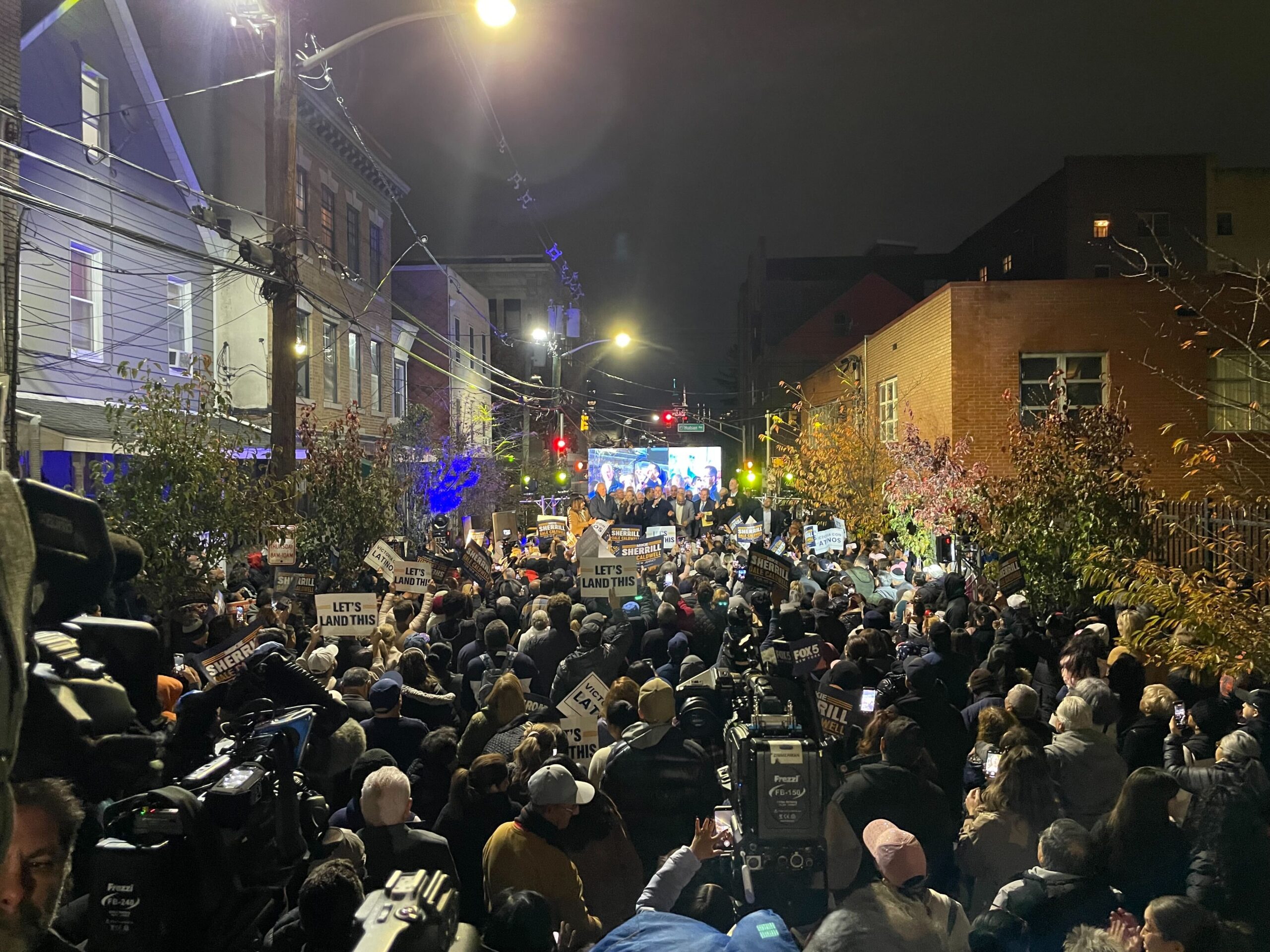
Latino voters, who swung toward President Donald Trump in 2024, boomeranged back to Democrats last week, signaling the fraying of his coalition less than one year into his second term.
Few places across the country epitomize that swing like New Jersey’s Passaic County, a densely populated, geographically diverse region where Latinos comprise a plurality. Voters there supported Trump by a narrow margin in 2024, only to back Democratic Gov.-elect Mikie Sherrill by double-digits last week. Union City, which is the most Latino city in the state, swung 47 points toward Democrats. And Sherrill seized the Trump-supporting 9th Congressional District, home to a large Latino population, by around 19 points.
In Virginia, the other state with a gubernatorial contest last week, the two most heavily Latino cities swung toward Democratic Gov.-elect Abigail Spanberger by more than 15 points each.
And in California, support for a Democratic-backed ballot measure exceeded Kamala Harris’ share by roughly 12 points in Imperial County, where Latino residents make up 77 percent of the population. That marks the biggest swing of any county in the state.
Just one year after Trump soared to victory with 48 percent of the Latino vote nationally, these results demonstrate that Republicans have yet to cement them into their coalition. Democrats, feeling emboldened after an epic shellacking last year, have been predicting Latinos would turn on the GOP out of dissatisfaction with Trump’s handling of the economy.
Not unlike Trump in 2024, Democrats were able to capitalize on those cost-of-living concerns to lure voters this year, proving correct a series of polls that portended this trend. It is giving the beleaguered party new optimism about their chances of taking back the House in next year’s midterms, as many of the districts up for grabs have substantial Latino populations.
“There was a lot of conversation heading out of the last election about a monolithic realignment, and I think it missed the fact that Trump is a unique beast who was able to persuade Latinos that he has their interests at heart,” said Tory Gavito, president of progressive donor network Way to Win. “In the last 11 months, he’s done everything but think about Latinos’ interests.”
Democrats’ success with Latinos during this off-cycle election may not necessarily translate to races across the country in 2026, when the minority party will fight to retake control of Congress. And Latino voters in Florida and South Texas are likely to vote differently from those in New Jersey or California.
Further muddling the midterm picture is the Trump question. The president successfully turned out low-propensity Latino voters, some of whom may be more likely to participate in a midterm race than an odd-year election, especially if Trump decides to play a role in next year’s showdown.
So Republicans, who have made a big bet on majority-Latino districts in order to keep their majority next year, have some cause for hope amid an otherwise brutal Election Day for them. While GOP candidates underperformed Trump with Latinos last week, they still put up better numbers than the Republicans of a decade ago (in New Jersey in 2017 for example, Republicans won just 17 percent of the Latino vote, compared to roughly a third this time). And Tuesday’s elections also gave the GOP a new foil in New York City Mayor-elect Zohran Mamdani, whom they think can further tarnish Democrats’ standing with Latino voters across the country who oppose socialism. (Mamdani won 58 percent of the vote in election districts where Latinos made up the largest share of the population, according to data compiled by The City.)
The day after the election, the National Republican Congressional Committee launched Spanish-language ads in 11 swingy congressional districts decrying the “socialist” soon-to-be New York City mayor as “the future that Democrats want” and warning voters their city could be next.
“Democrats have ignored Hispanic communities over the past nine years while millions of working families rejected their radical, socialist agenda,” Christian Martinez, the NRCC’s national Hispanic press secretary, said in a statement. “Republicans will continue to earn the support of Hispanic voters because we are working to deliver opportunity, security, and a better life.”
Democrats largely credited their messaging on affordability and blaming Trump for not following through on his economic campaign promises for their rebound with Latino voters.
“Latinos are rejecting Republicans’ broken promises of lower costs and a strong economy,” Democratic Congressional Campaign Committee spokesperson Bridget Gonzalez said in a statement last week. “Groceries, utilities, and health care are unaffordable and that’s why Latinos will help Democrats take back control of the House next November.”
In California, the Prop 50 campaign to bolster Gov. Gavin Newsom’s redistricting push leaned heavily on immigration in its messaging, using imagery of ICE and Border Patrol raids to argue Trump’s power must be checked. The campaign’s Spanish-language ads focused predominantly on the immigration crackdown, with cursory mention of Trump’s tariffs.
“The Latino revolt was economic and personal — Trump hit their wallets with tariffs and our communities with raids,” said Juan Rodriguez, a senior strategist for Newsom. “From California to races across the country, the message for 2026 couldn’t be clearer.”

A lot could change with the state of the economy that could either bolster or weaken their message. And some are cautioning Democrats not to get too comfortable with last week’s results — and not to rely strictly on affordability messaging.
“This doesn’t mean that Democrats have it in the bag,” said Vanessa Cárdenas, executive director of America’s Voice, an immigration reform group, who added that she hopes to see Democrats message more on immigration in addition to the economy during the midterms. “We’ve seen it before — there’s a lot of distrust of Democrats on immigration issues because of promises that have been made.”
“They have a lot to vote against,” she continued. “The challenge for Democrats is giving them something to vote for.”
In New Jersey, Sherrill’s victory looms large over the state’s 9th congressional district, a plurality-Latino seat that encompasses parts of Bergen and Passaic counties. Sherrill won both by double digits, a major swing after Trump flipped Passaic and lost Bergen by just 3 points in 2024. Republicans are targeting the district’s first-term representative, Democrat Nellie Pou, largely because Trump won the seat in 2024.
But ticket-splitting in the district’s further down-ballot races may demonstrate that Democrats’ work isn’t done there. In Hawthorne, a borough where Latinos make up around one-quarter of the population, preliminary results show Sherrill won but incumbent Republicans prevailed in mayoral and council races.
Carlos Cruz, a Republican strategist who worked on a super PAC backing Sherrill’s opponent, Jack Ciattarelli, said that last year’s election was a “referendum” on leadership in Washington and the economy, and people cast a ballot this year for the same reasons.
“There were people who voted for the president who wanted to see more,” Cruz said. “For Democrats to overreact and say ‘Nellie is safe now’ is fundamentally misreading this year’s elections.”
Morghan Cyr, Pou’s campaign manager, said that the results “solidified one thing for Democrats above all: Latino communities are key to success across the board.”
“Early, intentional investment in and engagement with these communities is essential to Democrats taking back the House in 2026,” Cyr said in a statement last week. “The progress that was made this week is good, but we have to keep building on it.”


Most Democrats think their key to winning back control of Congress in the midterms will be selling voters on an affordability agenda and bashing President Donald Trump’s handling of the economy.
But some in their party — running long-shot campaigns in rural regions against Republican incumbents — say all the affordability talk has lost the plot.
“Democrats on a national level have discovered ‘affordability’ as a winning strategy, as some magic bullet that’s going to win them elections all over the country,” Hallie Shoffner, who won the Democratic Senate primary in Arkansas earlier this week, told Blue Light News in an interview.
“Established D.C Democrats like [Senate Minority Leader] Chuck Schumer [are] talking about affordability, and I’m sorry, but everybody in Arkansas is going to give him the side eye, because what does he know about affordability?” she added.
A spokesperson for Schumer said in a statement that he “knows that working families are being crushed by higher costs because of Donald Trump’s failed policies and his corrupt bargain with big corporations. That’s why Leader Schumer and Senate Democrats have been fighting to lower costs for people on everything from housing to energy to health care.”
After stinging defeats in 2024, Democrats bounced back in 2025’s off-year elections when Virginia Gov. Abigail Spanberger, New Jersey Gov. Mikie Sherrill and New York City Mayor Zohran Mamdani sailed to victory, each behind a campaign that centered on pocketbook issues and sought to frame Democrats as the party that could bring down prices for everyday Americans.
Now, party leaders want to ride that messaging into November amid falling approval of Trump’s handling of the economy. Spanberger was a special guest at House Democrats’ annual retreat last week, where she gave her advice for how to hammer an affordability message just one day after she skewered Trump over cost-of-living concerns during the Democratic rebuttal to his State of the Union address. And Republicans are increasingly worried that the outlook on the economy is weakening amid rising gas prices stemming from the war in Iran.
But some rural Democrats still aren’t convinced that the party is striking the right tone.
“It feels disingenuous,” said Callie Barr, who is running to flip Michigan’s 1st Congressional District.
“The standard of living for most folks in rural areas like mine has been declining for the past 40 years under both administrations,” Barr said. “And then all of a sudden, it’s like, ‘Oh, affordability is now a talking point, maybe I can win an election off of it, I’m going to start using it in everything.’”
Barr and Shoffner said they hope to see national Democrats put the money where their mouth is by investing in “long-shot” races like theirs. “My hope is that actually there’s real teeth behind this, because I think people just don’t believe it,” Barr said.
Each has an uphill battle in their own right. Shoffner is running in Arkansas against incumbent Republican Sen. Tom Cotton, who has served in the Senate since he defeated Sen. Mark Pryor in 2014 — the last time a Democrat held the seat. Barr is running in a rematch against GOP Rep. Jack Bergman, who beat her by more than 21 points in 2024.
“It makes sense for the Democratic Party to reinvest themselves in places like us, like Arkansas, and give candidates like me with these gray-collar backgrounds a seat at the table — because I’m going to be honest with you, they might learn something about what it really means to talk about affordability,” said Shoffner, a sixth-generation farmer who had to shut down her family’s farm when she realized it couldn’t make money.
That’s similar to messaging that’s been championed by Rep. Marie Gluesenkamp Perez (D-Wash.). The rural auto shop owner who flipped Washington’s last red district in 2022 has vocally criticized her party for being out of touch with the middle class.
“When you say affordability, people roll their eyes,” said Michael Ceraso, a Democratic strategist working with both candidates who is an alum of Bernie Sanders’ 2016 presidential campaign. “In many of the areas [where] affordability has been a crisis, Dems aren’t investing or building infrastructure to do anything to mobilize human beings in those areas.”
The DNC last year announced a new program that gives $17,500 per month to each state party and an additional $5,000 per month to those in states run by Republicans, and the party this year has been buoyed by a string of overperformances, including in ruby-red districts. But much of the attention has focused on the most competitive races across battleground states.
Of course, it can also be a shrewd political tactic to blast the Democratic Party — which boasts a roster of stars from liberal, urban areas who remain deeply unpopular in conservative, rural ones. But Barr isn’t running her campaign with any labels that may be tied to her party ID. “Maybe you’re running on a ticket, but that shouldn’t be your whole identity,” she said.
“When I meet people, they’ll say, ‘Oh, what ticket are you on?’” Barr added. “And I always start with, ‘Well, I’m an American.’”
Like this content? Consider signing up for Blue Light News’s Playbook newsletter.
Democrats see a new opportunity brewing deep in the heart of Texas, where Republicans solving one problem may have inadvertently created a new one.
Rep. Tony Gonzales’ decision to drop his reelection bid over an infidelity scandal has elevated Brandon Herrera, a controversial social media figure known by his handle “TheAKGuy,” to the Republican nomination for Texas’ 23rd Congressional District.
Democrats in the district are hoping the convergence of scandal, a lightning-rod GOP candidate, signs of a major snap-back by Latino voters in Texas, and a potentially competitive Senate race could help lift Democratic turnout enough to flip this district for the first time in a decade.
“It’s definitely more competitive than it’s ever been,” said former Rep. Pete Gallego (D-Texas), who held the seat through 2014.
The biggest reason the race might become competitive is Herrera himself. The YouTuber, gun manufacturer and Second Amendment activist has millions of online followers — and a track record of off-color, edgelord jokes that are ripe fodder for campaign ads. Herrera has come under fire for a long history of posting Nazi imagery and his involvement in a group called Sons of Confederate Veterans. Jokes like his line “I often think about putting a gun in my mouth. So, I’m basically an honorary veteran” were a flashpoint for criticism in his 2024 primary against Gonzales.
Herrera did not respond to a request for comment.
After Gonzales dropped out of the race on Thursday night, the Democratic-aligned House Majority PAC quickly pumped out a barrage of old clips of Herrera on a series of podcasts including one where is seen marching and firing a gun overlaid with the German song “Erika” associated with Nazi Germany.
National and local headwinds are also blowing against the GOP.
Republicans in Texas – usually the dominating force in statewide politics – have weathered a rocky start to the 2026 midterms. Sen. John Cornyn, a fixture of Lone Star conservative politics, is stuck in a bruising runoff election with MAGA firebrand Attorney General Ken Paxton, opening a possible path for Democrats to compete in the Senate race. And Latino voters turned out in massive numbers in Tuesday’s Democratic primaries, an early sign that Texas Hispanics, after moving hard to the right in recent years, might be swinging back in a big way this election.
There’s no guarantee that national Democrats will invest in the sprawling district, however.
The heavily Hispanic district, which runs from suburban San Antonio hundreds of miles along the border to outside El Paso, is a tough lift for Democrats — but not an impossible one. In the newly gerrymandered Texas map, it’s the least-red district held by a Republican in Texas. President Donald Trump won it by 17 points in 2024, but Hillary Clinton narrowly carried the district in 2016.
At this early stage in the changed race, neither the House Democratic campaign arm nor its biggest aligned super PAC has yet to publicly announce a commitment of resources to flipping the seat.
The Democratic Congressional Campaign Committee does not currently list the district as an offensive target but is closely monitoring the race, according to a person familiar with national Democrats’ House strategy, granted anonymity to candidly describe strategy. The group gleefully highlighted Herrera’s elevation in a statement on Friday.
A spokesperson for the House Majority PAC, CJ Warnke, said in a statement that “nothing is off the table” when it comes to spending in the district.
Herrera was already running a tough primary campaign against Gonzales — but the congressman’s recent scandal consumed his campaign and forced him from his reelection bid. Text messages published by the San Antonio Express-News and other outlets last month revealed new evidence of a sexual relationship between the member of Congress and a staffer, who later killed herself. Blue Light News has not independently reviewed the messages.
Gonzales later admitted to the affair with his former staffer, Regina Santos-Aviles, and late Thursday decided to end his reelection bid as pressure mounted from Republicans leadership for him to step aside.
Democrats argue Herrera has his own baggage that may be hard to overcome as well.
“Maybe I’m just an old-fashioned East Texas farm kid, but I tend to be anti-Nazi, and I have a feeling that people on the western side of the state feel a similar way,” said Kendall Scudder, chair of the Texas Democratic Party.
“So, you know, go ahead and nominate the adulterer, sexual predator, or nominate the actual Nazi. Regardless, we outvoted them, and we’re going to do it again in November,” he added, citing Tuesday’s strong Democratic turn out in primaries up and down the ballot.
Herrera as the GOP nominee makes for “a little bit of an easier campaign because he’s not as well known as Gonzales,” said Katy Padilla Stout, a local attorney and the Democratic nominee who is now set to face off against Herrera in November.
National Republicans were quick to throw cold water on their opponents’ hopes to expand their battleground House map into West Texas.
“Texas’ 23rd District is deep red, and Democrats know it,” said Christian Martinez, a spokesperson for the National Republican Congressional Committee, said in a statement.
“While they talk a big game in Washington, they don’t even have a credible recruit and are too busy defending their own vulnerable members across Texas to compete here.”
The district, though drawn to favor the GOP candidate, is “pretty moderate and they’re practical people,” said Gallego, the former Democratic member of Congress. The north side of San Antonio at the far east end of the district map “is not monolithic Republican anymore,” he added, which gives Democrats more room to maneuver around Herrera, a conservative hardliner.
After Gonzales ended his bid, “I thought for sure it would be the Dems that would be blowing me up,” said Padilla Stout. Instead, she recounted, it was mostly Republicans who got in touch shortly after the news broke.
Their message to her: “We’re ready, give me a sign. Where do I sign up?”
Politics
Former President Barack Obama speaks during final public tribute to the late Rev. Jesse Jackson
CHICAGO — Former President Barack Obama said the presidential runs in the 1980s by the late Rev. Jesse Jackson Sr. set the stage for other Black leaders, including himself.
“The message he sent to a 22-year-old child of a single mother with a funny name, an outsider, was that maybe there wasn’t any place or any room where we didn’t belong,” Obama said Friday at a Chicago church as mourners paid a final public tribute for the civil rights legend.
“He paved the road for so many others to follow,” Obama said of Jackson.
Obama is joined by two other former Democratic presidents, Joe Biden and Bill Clinton, at a celebration of life for Jackson. Obama received the loudest round of applause as the three entered the chamber.
“We are living in a time when it can be hard to hope,” Obama said. “Each day we wake up to some new assault to our democratic institutions. Another setback to the idea of the rule of law, an offense to common decency. Every day you wake up to things you just didn’t think were possible.”
“Each day we are told by folks in high office to fear each other,” said Obama, referring to the current Republican leadership in Washington.
Former Democratic Vice President Kamala Harris is also listed as a speaker on the program, according to the Rainbow PUSH Coalition, the organization that Jackson founded.
President Donald Trump, who praised Jackson on social media after he died and also shared photos of the two of them together, was not attending the service, according to his public schedule issued by the White House.
Thousands attend Jackson memorial service
The event honors the protege of the Rev. Martin Luther King Jr. and two-time presidential candidate and follows memorial services that drew large crowds in Chicago and South Carolina, where Jackson was born. Friday’s celebration — at an influential Black church with a 10,000-seat arena — is expected to be the largest.
Crowds of attendees waited in long lines outside the church on the city’s South Side as television screens played excerpts of some of Jackson’s most famous speeches. Inside, vendors sold pins with his 1984 presidential slogan and hoodies with his “I Am Somebody” mantra.
Along with a slew of Illinois elected leaders, notable attendees included actor and producer Tyler Perry, California Gov. Gavin Newsom, and political activist and theologian Cornel West. NBA Hall of Famer and Chicago native Isiah Thomas was one of the speakers.
Marketing professional Chelsia Bryan said Friday that she decided to attend the memorial service because it was “a chance to be part of something historic.”
“As a Black woman, knowing that someone pretty much gave their life, dedicated their life to make sure I can do the things that I can do now, he’s worth honoring,” Bryan said.
Jackson Jr.: Everyone welcome
Jesse Jackson Jr. said all were welcome to celebrate his father’s life.
“Democrat, Republican, liberal, conservative, right wing, left wing because his life is broad enough to cover the full spectrum of what it means to be an American,” Jackson Jr. said last month. “Dad would have wanted us to have a great meeting to discuss our differences, to find ways of moving forward and moving together.”
The elder Jackson died last month at age 84 after battling a rare neurological disorder that affected his mobility and ability to speak. Family members say he continued coming into the office until last year and communicated through hand signals. His final public appearances included the 2024 Democratic National Convention in Chicago.
Sitting in the crowd was 90-year-old Mary Lovett. She said Jackson’s advocacy inspired her many times, from when she moved from Mississippi to Chicago in the 1960s, taught elementary school and became a mom. She twice voted for Jackson during both of his presidential runs and appreciated how he always spoke up for underrepresented people. “He’s gone, but I hope his legacy lives,” she said. “I hope we can remember what he tried to teach us.”
Jackson’s service was to the poor, underrepresented
Jackson’s pursuits were countless, taking him to all corners of the globe: Advocating for the poor and underrepresented on issues including voting rights, health care, job opportunities and education. He scored diplomatic victories with world leaders, and through Rainbow PUSH Coalition, he channeled cries for Black pride and self-determination into corporate boardrooms, pressuring executives to make America a more open and equitable society.
His son, Yusef Jackson, who runs the Rainbow PUSH Coalition, recalled how his father carried a well-worn Bible but also showed his faith by showing up to picket lines.
“He lived a revolutionary Christian faith rooted in justice, nonviolence and the moral righteousness,” Yusef Jackson said Friday. “He was deeply involved in the political struggles of his time, but his gift was that he could rise above them. It’s not about the left wing or the right wing. It takes two wings to fly. For him, the goal was always the moral center.”
Jackson’s services in Chicago and South Carolina drew civic leaders, school groups and everyday people who said they were touched by Jackson’s work, from scholarship programs to advocating for inmates. Several states flew flags at half-staff in his honor.
Services in Washington, D.C., were tabled after a request to allow Jackson to lie in honor in the United States Capitol rotunda was denied by House Speaker Mike Johnson, who said the space is typically reserved for select officials, including former presidents. Details on a future event have not been made public.
- Israeli strikes pound Iran and Lebanon as USA warns attacks will intensify…

- Criticism of media coverage of US casualties has long history

- The rural Democrats who say their party has affordability all wrong
- Gonzales is out in Texas, and Dems see a chance to beat ‘The AKGuy’
- Trump calls on Iran to surrender and rules out talks as Israel bombs Lebanon

- Trump turns to an Oklahoma senator with a fighter’s reputation as his next choice to lead DHS
- Allies fear Iran war will leave them without US weapons they bought
- Crude prices make record jump as Trump’s measures fail to calm markets
- House will vote on an Iran war powers resolution in a test of Trump’s strategy

- States sue over Trump’s new global tariffs

-

 The Dictatorship1 year ago
Luigi Mangione acknowledges public support in first official statement since arrest
-

 Politics1 year ago
Former ‘Squad’ members launching ‘Bowman and Bush’ YouTube show
-

 Politics1 year ago
Blue Light News’s Editorial Director Ryan Hutchins speaks at Blue Light News’s 2025 Governors Summit
-

 The Dictatorship6 months ago
Mike Johnson sums up the GOP’s arrogant position on military occupation with two words
-

 Politics1 year ago
Former Kentucky AG Daniel Cameron launches Senate bid
-

 The Dictatorship1 year ago
Pete Hegseth’s tenure at the Pentagon goes from bad to worse
-
Uncategorized1 year ago
Bob Good to step down as Freedom Caucus chair this week
-

 Politics11 months ago
Democrat challenging Joni Ernst: I want to ‘tear down’ party, ‘build it back up’