
Congress
Trump doesn’t give Congress much to do before the midterms

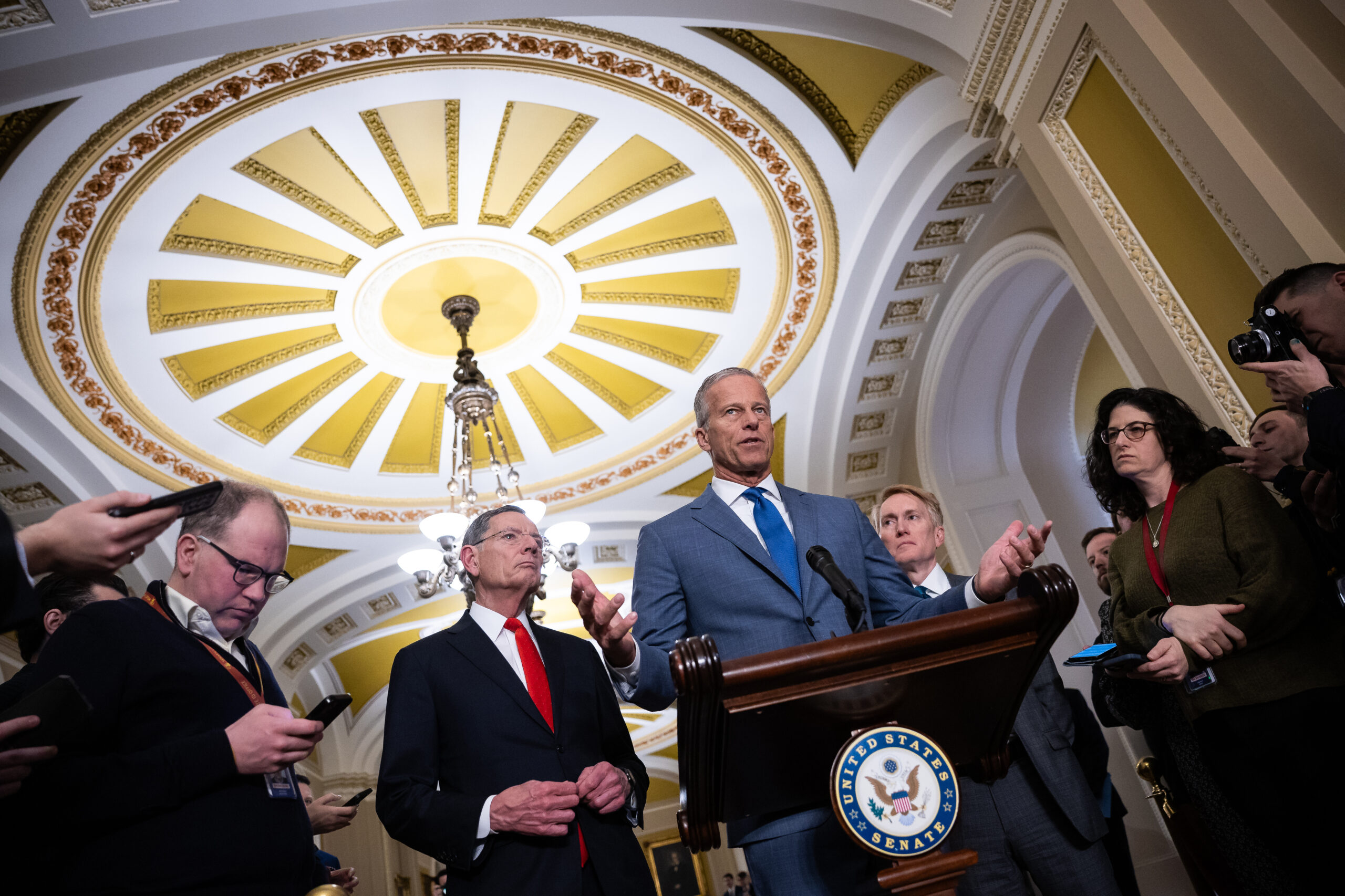
President Donald Trump sketched out his vision Tuesday night of Republican governance heading into the midterms. Congress is barely in the picture.
From a legislative perspective, Trump’s State of the Union address was notable for what it didn’t include. He gave Republicans a pass on trying to revive his global tariff campaign after a major Supreme Court setback. He didn’t demand another party-line domestic policy bill before November, and he even skipped a jab at one of his favorite punching bags, the Senate filibuster.
Instead, Trump used the bulk of the speech to lean into red-meat issues like illegal immigration and gender-affirming health care, while encouraging lawmakers to tackle a few relatively minor topics — many of which have already been churning behind the scenes for months.
“He wasn’t really pushing us to do anything we don’t [already] want to do,” Sen. Kevin Cramer (R-N.D.) said.
The upshot is that Trump’s prime-time address is unlikely to make more than a ripple in the congressional agenda over the coming months. It’s the reality, Republicans acknowledged Wednesday, of life in Washington right now: Despite its trifecta, the party’s legislative ambitions are being hemmed in by its barely-there majorities.
“I think we know what the agenda items are,” Rep. Ryan Mackenzie (R-Pa.) said. “Accomplishing those is going to be hard with a small majority.”
GOP leaders on Capitol Hill are vowing to focus on pocketbook issues heading into the midterms, as they try to convince skeptical voters the party is responding to lingering economic angst.
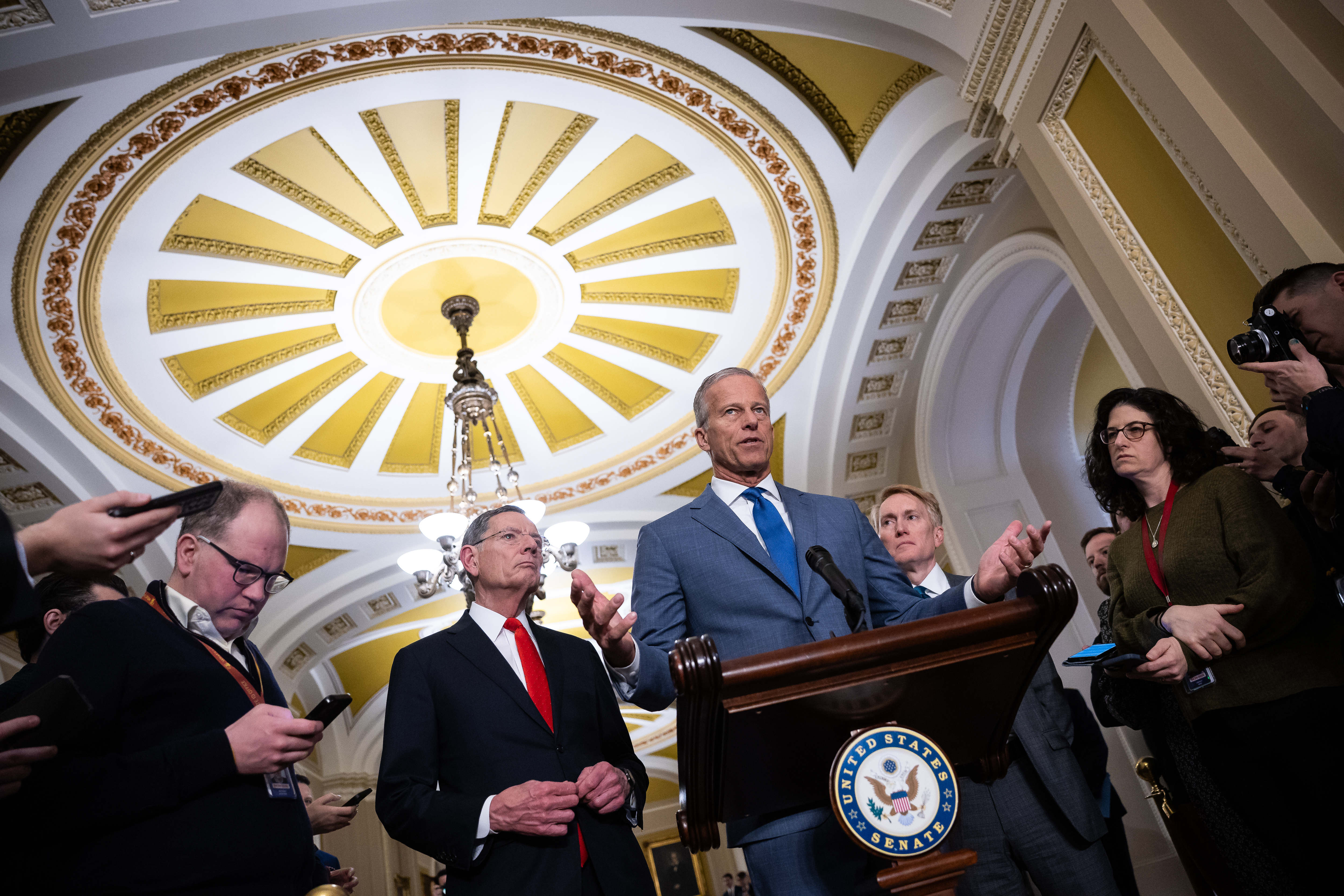
The Senate, for example, is expected to tee up a bipartisan housing bill at the end of this week, and Majority Leader John Thune hinted Wednesday that other measures, such as an energy permitting overhaul, could be on the chamber’s to-do list for the rest of this Congress.
But Trump showed only passing concern about lawmakers’ anxieties Tuesday, sending the message that the economy was on the rebound — asserting that prices were falling just fine and that last year’s GOP megabill did quite enough to address any voter concerns.
He mentioned “affordability” only to engage in a blame game — accusing Democrats of embracing that word “knowing full well that they caused and created the increased prices that all of our citizens had to endure.”
Instead, Trump pressed lawmakers to “codify” a drug pricing plan his administration negotiated with some pharmaceutical manufacturers and rolled out a retirement savings program that largely builds on a bipartisan law signed by his predecessor, Joe Biden. He also weighed in on the housing proposal, urging members to limit home purchases by institutional investors.
Those matters have already been percolating on Capitol Hill, with internal divisions among Republicans creating major obstacles in some cases.
“On our side, obviously, they’re not unanimous,” Thune said about the housing and drug proposals. “There are a lot of these things that are not just that clear cut.”
The situation in the House is even more tenuous. While the thin GOP majority there was able to eke through a partisan elections bill Trump highlighted Tuesday, they have had a harder time building support for another bill that earned a presidential endorsement: a ban on lawmaker stock-trading.
Speaker Mike Johnson, while not ruling anything out, acknowledged his “small margin” will affect what items on Trump’s wishlist, if any, ultimately make it to the president’s desk. Republicans can currently lose just one vote on party-line matters, and one GOP lawmaker, Rep. Tony Gonzales of Texas, is facing pressure to resign amid allegations of an affair with a subordinate who died by suicide.
“I’ve got effectively a zero-vote margin at the point that we are now, so I’ve got to have near-unanimity among Republican priorities,” Johnson said. “I would like to say we could do some bipartisan things, but it’ll be up to the Democrats.”
Rep. Mike Haridopolos (R-Fla.) characterized the House GOP as a “micromajority” Wednesday and questioned whether one of its members — Kentucky Rep. Thomas Massie, who frequently breaks with Trump — even still qualified as a Republican: “I don’t know what party he belongs to, but it’s not ours.”
Trump did use his bully pulpit Tuesday to urge Senate Republicans to act on the House-passed elections bill, the SAVE America Act, that would place new restrictions on the ability to vote. That included an apparent appeal to Thune, who was in the House chamber for the speech.
But Trump didn’t push to skirt the 60-vote legislative hurdle by forcing Democrats to hold the floor in a so-called “talking filibuster” to oppose the bill — as some conservatives personally lobbied Thune on the House floor Tuesday to do, the Senate leader acknowledged.
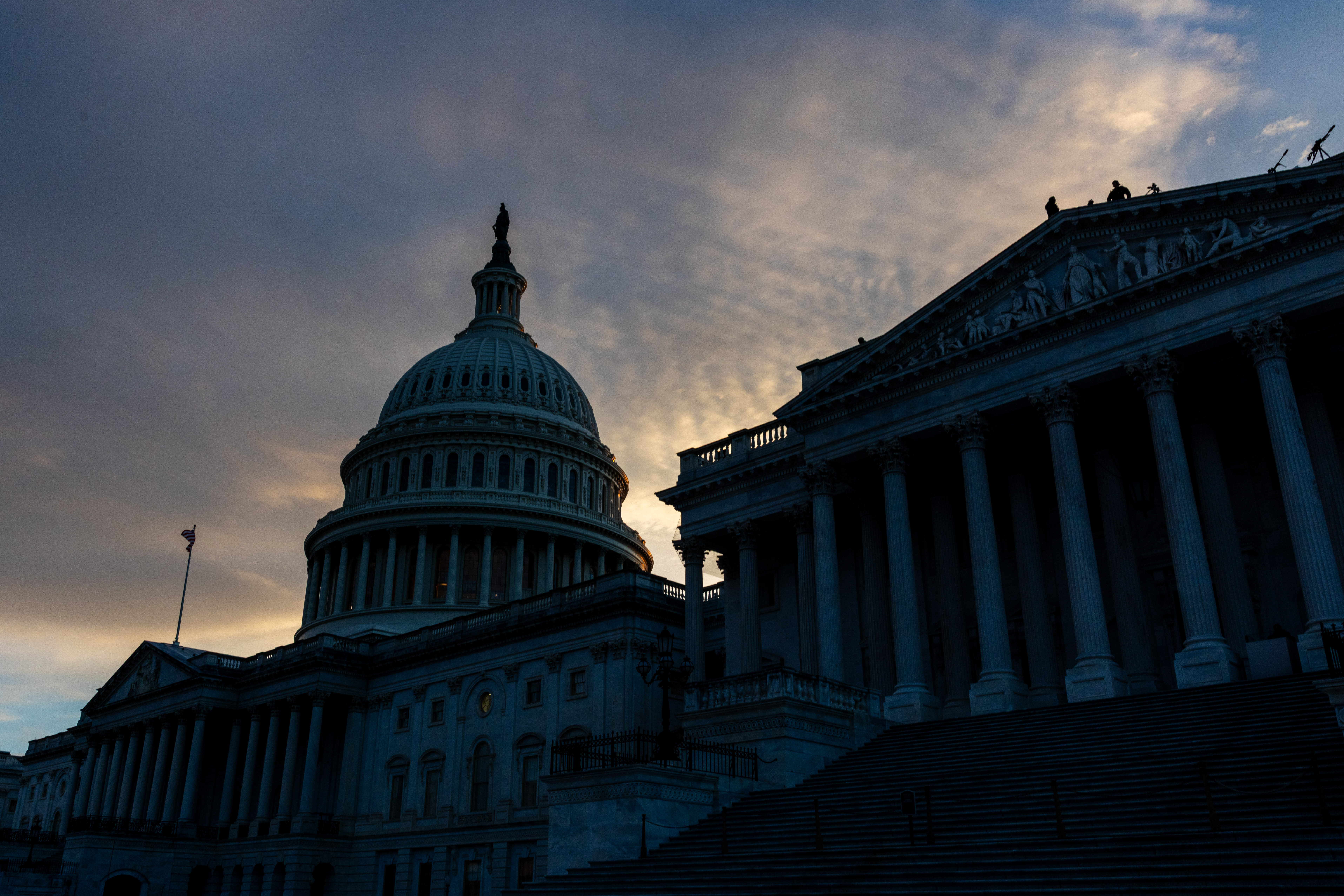
Thune said he has tentative plans to bring the bill to the floor sometime next month, so long as the Department of Homeland Security shutdown is resolved. But the lack of a sustained presidential push to upend existing filibuster rules makes it even more likely the legislation is likely to sputter out.
Thune, who has repeatedly warned about the potential pitfalls of the talking filibuster approach, said Wednesday it was “a very real possibility” the bill could be brought up under the usual approach that would allow Democrats to quickly block it.
The reality of Congress’ legislative morass isn’t stopping some Trump allies, who are either running for reelection or for another office, from trying to use his State of the Union speech as a springboard to action.
Sen. Lindsey Graham (R-S.C.), who has linked himself closely to Trump, said Wednesday that Republicans “need to legislate with the same spirit as President Trump’s speech.” And GOP Rep. Andy Biggs, who is running for governor of Arizona, touted his own legislation that he said aligns with Trump’s priorities.
“I urge House Leadership to quickly move my bills that align with his priorities,” he said in a statement. “The time to act is now.”
Some conservatives continue to urge Congress to pass another party-line policy bill under filibuster-skirting budget reconciliation rules to give the party a messaging boost before the midterms.
But others who listened to Trump’s speech Tuesday weren’t nearly so inspired. One House Republican granted anonymity to speak candidly quipped, “It was certainly light on details.”
A GOP senator, also granted anonymity, summed up the congressional agenda for the foreseeable future in one word: “Slow.”


Americans — and Congress — are divided on whether it’s acceptable to fall behind other countries in the race to develop advanced artificial intelligence.
And that fear of international competition is emerging as a key point of tension slowing down any path to AI safety legislation.
Even as almost two thirds of respondents in a new Blue Light News poll said there’s a real possibility that AI could destroy humanity, they’re split on whether it’s acceptable to slow down and potentially fall behind other countries like China in an AI arms race.
A plurality, 43 percent, say it is okay for the U.S. to fall behind if that means developing AI more responsibly and securely, while 37 percent take the opposite view. Voters who backed Donald Trump in 2024 favor the competition-first position by 50 percent compared to just 34 percent of Kamala Harris voters.
Republican Energy and Commerce Chair Brett Guthrie argued the U.S. cannot risk Chinese AI dominance, and that AI legislation is too complex to rush — even if that means pushing off until next year consideration of a measure by his panel.
“We absolutely can’t surrender,” he said Wednesday at Blue Light News’s Decoded Summit.
Meanwhile, the head of the Congressional Progressive Caucus said competition isn’t a reason to avoid guardrails.
“The AI race is not an arms race that you win,” Rep. Greg Casar said at the Decoded Summit.
Other lawmakers from both sides of the aisle are trying to strike a balance. Rep. John Moolenaar, chair of the House Select Committee on the Chinese Communist Party, acknowledged lawmakers “do have a responsibility for public safety” while saying it was also important to “beat China when it comes to the AI race.”
Still, the emerging divisions spotlight a long road ahead for any consensus from Congress.
An attempt to quickly pass a bill requiring companies to build a “kill switch” into their AI models from Republican Sen. John Kennedy was blocked Wednesday by Sen. Rand Paul on the chamber’s floor.
And while Guthrie’s Senate counterpart, Commerce Chair Ted Cruz said Wednesday his hope was still to mark up this month a bipartisan AI safety bill from Majority Leader John Thune and Sen. Amy Klobuchar, lawmakers haven’t reached agreement to finalize the measure. Thune himself said Wednesday he was unsure it would happen before the midterms.
Cracks are also starting to show among the leading AI companies on what role they want Congress to play.
One example: Anthropic’s policy chief Sarah Heck declined at Blue Light News’s summit to endorse a proposal for congressionally mandated independent AI monitoring — a day after competitor OpenAI endorsed it. The proposal is a key provision in Reps. Jay Obernolte and Lori Trahan’s bipartisan AI safety measure.
The House’s early dismissal Wednesday only added to time pressure on lawmakers, who will return to a lame duck session with an already full calendar.
What else we’re watching:
— LEE BULLISH ON PERMITTING: Energy and Natural Resources Chair Mike Lee told fellow Republicans during a closed-door lunch Wednesday he is “guardedly optimistic” that negotiators will reach a long-sought deal on a bill to ease permitting approval for energy projects. “We were told today that the Democrats are going to agree to a permitting bill, and it’s going to be drafted and ready for us to vote on,” Kennedy said in an interview. Still, the top negotiators have yet to clinch an agreement, meaning the timeline could slip until after the midterms.
— SPY LAW TIMING UNCLEAR: The Office of the Director of National Intelligence recently warnedCongress that if it doesn’t vote on a controversial surveillance law by Nov. 20, the program could go dark, but it’s unclear congressional leadership can meet that deadline. Thune told reporters this week that there is an “interest” in trying to get Section 702 of the Foreign Intelligence Surveillance Act reauthorized, but didn’t commit to getting a vote before the midterms. With the House gone, reauthorization will wait until at least mid-November, regardless.
Riley Rogerson, Mia McCarthy, Anna Wiederkehr, Jordain Carney, John Sakellariadis and Josh Siegel contributed to this report.
Americans are divided on whether it’s acceptable to fall behind other countries in the race to develop advanced artificial intelligence. So is Congress.
A new POLITICO Poll finds that Americans broadly recognize serious risks from frontier AI models, but many — particularly President Donald Trump’s voters — also prioritize maintaining a lead over other countries, including China.
Even as 63% of the poll’s respondents said there’s a real possibility that AI could destroy humanity, they’re split on whether it’s acceptable to slow down and potentially fall behind in order to mitigate that risk.
A plurality, 43%, say it is acceptable for the U.S. to fall behind other countries if that means developing AI more responsibly and securely, while 37% take the opposite view, saying the U.S. should not stand down, even if that requires taking risks. Voters who backed Trump in 2024 favor the competition-first position by 50% to 38%.
That split is already playing out on Capitol Hill as AI safety zooms to the center of congressional conversations. With legislation only slowly taking shape, fear of international competition stands to be a major point of tension during any bipartisan negotiations — with most lawmakers’ views divided closely along party lines.
Many Republican lawmakers said in interviews this week that pausing AI development could give China an opening to overtake U.S. capabilities. Democrats are also looking over their shoulders at Chinese advances, but they are cautioning that competition is not a reason for Congress to avoid instituting AI guardrails.
“The AI race is not an arms race that you win,” Rep. Greg Casar (D-Texas) said during Wednesday’s Blue Light News Decoded Summit. “It’s an arms race that we need to end, and we need to protect the American people.”
Casar, the chair of the Congressional Progressive Caucus, has teamed up with Sen. Bernie Sanders (I-Vt.) in calling for a ban on “superintelligence” to stave off the existential threats to humanity — a concern that bubbled to the fore last week when a former Anthropic researcher warned AI could “kill us all.”
Senior Republicans are denigrating proposals like Casar’s, arguing that the U.S. cannot risk Chinese AI dominance. Rep. Brett Guthrie (R-Ky.), chair of the powerful House committee overseeing the tech industry, said as much at the summit.
“We absolutely can’t surrender,” he said. “And I think that’s what it would be if we stopped AI development.”
Guthrie further argued AI legislation is too complex to rush and that the Energy and Commerce Committee he leads might not take up AI legislation before next year. That sentiment is in line with Speaker Mike Johnson, who said this week that the U.S. must “maintain our edge over China.” Meanwhile, Trump has called the AI panic a “HOAX” and said that federal regulations would allow China to leapfrog the U.S.
Some Republicans have been almost flippant about the dilemma policymakers face in reconciling a potentially dangerous technology with their fear of Chinese competition.
“If there are going to be killer robots, I’d rather they be American killer robots,” Sen. Ted Cruz of Texas said in a recent POLITICO interview. Like Guthrie, Cruz chairs a committee overseeing tech matters.
Among the bipartisan group of lawmakers who have locked arms in warning about the Chinese threat on other fronts, the familiar partisan divide is still emerging on AI regulation.
“We can lead in innovation and lead in safety,” said Rep. Greg Stanton (D-Ariz.), who sits on the bipartisan Select Committee on the Chinese Communist Party. “So if Trump or anyone else comes at it that we can only do one but not the other, he’s not looking at the history of the United States of America.”
Rep. Don Bacon of Nebraska, a moderate Republican China hawk, said he is “very reluctant to hinder AI” via regulation.
“They’re going to have to make the good case why we need it,” he said. “We don’t want to hinder our AI research. We can’t afford to fall behind China.”
Some, however, are being careful to strike a balanced tone as the AI safety conversation kicks into high gear.
Rep. John Moolenaar (R-Mich.), chair of the House China panel, acknowledged lawmakers “do have a responsibility for public safety” while saying it was also important to “beat China when it comes to the AI race.”
“There’s economic benefits to that,” he said. “There’s national security issues, but we want to have common sense and a deliberative process.”
Rep. Josh Gottheimer (D-N.J.), an Intelligence Committee member and a co-chair of House Democrats’ AI commission, said China is “not waiting for anyone else.”
“So you can’t just leave the race, but you need to make sure you do it in the right way,” he added.
Opinions are sharper when it comes to Trump’s upcoming meeting with Chinese President Xi Jinping next week and whether he should even broach some type of cooperation on AI safety.
“I don’t trust him,” Rep. Joe Wilson (R-S.C.), a senior member of the House Foreign Affairs Committee, said when asked if Trump should engage with Xi on AI. “I trust Trump.”
But many Democrats say it’s a mistake to engage in an AI arms race, with some explicitly reaching for analogies with the nuclear arms race that ended in Cold War treaties with a former global rival — the Soviet Union — limiting bomb tests and missile deployments.
Rep. Ted Lieu of California, another co-chair of the Democratic AI commission, said Trump could start small by asking Xi to “commit that they’re never going to let AI launch a nuclear weapon by itself.”
“There are things that we can do to get other countries to follow the lead the U.S. has taken in AI,” he said.
House Democrats aren’t letting rogue members off the hook for bucking their party. They hope Minority Leader Hakeem Jeffries won’t either.
“Obviously, there’s got to be” punishment for the two Democrats who twice this month bucked their party to advance a slate of Republican priorities, Rep. Jared Moskowitz (D-Fla.) said in an interview.
“Otherwise, then,” he said, “it’s open season.”
Democrats are watching closely how — and if — Jeffries doles out consequences for Reps. Jared Golden of Maine and Marie Gluesenkamp Perez of Washington who have twice provided the decisive votes for GOP procedural measures this month. Jeffries and his leadership team condemned the two members when they first defected two weeks ago, slamming a “breach of trust” warranting a “serious response” but have yet to inflict any public consequences.
On Tuesday, they defied leadership a second time, infuriating House Democrats and resurrecting questions about how leadership plans to keep its caucus in line — especially if they have a slim majority next term.
“We have to all be united, and I think it’s pretty simple,” said one House Democrat who was granted anonymity to speak candidly. “If there’s not [a punishment], I find it hard to see a path forward in the majority, which we’re all pushing for.”
Asked if leadership should punish the two aisle-crossers, Rep. Troy Carter pointed to his time as minority leader of the Louisiana state Senate: “When I had members that did not work within the confines of the philosophical views of our party, I took them off our caucus.”
“I don’t want to second-guess anybody’s timing, but I will tell you that these things cannot allow to fester,” he added. “We have to have a strict message: Either you’re with the team on those fundamental issues of governance or you aren’t.”
Multiple members, including Carter, said that removing Gluesenkamp Perez from the Appropriations Committee should be considered. (While members are just as angry at Golden, they acknowledge he’s beyond punishment given he is retiring at the end of this term.)
“I suspect that there are a number of appropriate consequences that [leaders] could implement,” Rep. Sydney Kamlager-Dove (D-Calif.) said in an interview. “And, ultimately, it’s their decision. I certainly don’t want that to be a caucus decision. That should be a leadership decision.”
One leader, Whip Katherine Clark of Massachusetts, suggested she is open to removing Gluesenkamp Perez from Appropriations, telling reporters Wednesday morning that “team players get to sit on exclusive committees.”
After the first instance where the two Democrats defected on Sept. 1, Jeffries kicked the matter to a caucus rules panel, saying afterward he wanted to pursue action against the two members “sooner rather than later.” The panel continues to deliberate on what should happen if members vote with Republicans on procedural measures.
Jeffries said that week that he’d had a “productive” and “forward-looking” conversation with Gluesenkamp Perez, but he has said much less after Tuesday’s floor drama.
“I’ll have more to say about the issue when I have more to say about the issue,” he told Blue Light News shortly after the vote.
- Capitol agenda: China fears drive AI divide
- JD Vance faces test in White House meeting with Israel-backing radio host
- Industry titans’ warning to Congress: Do what we say or health insurance premiums go up
- Poll: China fears drive polarization on AI regulations
- Democrats keep pressure on Hakeem Jeffries to punish rogue members
- House passes GOP-backed bill targeting data center power costs
- House passes Russia sanctions bill, handing Trump more leverage against Moscow
- Rand Paul kills Kennedy’s AI ‘kill switch’ bill
- Jay Jacobs gets his first-ever challenger for state Dem chair
- ‘The US can’t lose’: Pentagon plows ahead on AI despite warnings
-

 Politics2 years ago
Former ‘Squad’ members launching ‘Bowman and Bush’ YouTube show
-
Uncategorized2 years ago
Bob Good to step down as Freedom Caucus chair this week
-

 Politics2 years ago
Former Kentucky AG Daniel Cameron launches Senate bid
-

 The Josh Fourrier Show2 years ago
DOOMSDAY: Trump won, now what?
-

 The Dictatorship2 years ago
Luigi Mangione acknowledges public support in first official statement since arrest
-

 The Dictatorship2 years ago
Pete Hegseth’s tenure at the Pentagon goes from bad to worse
-

 Politics2 years ago
Blue Light News’s Editorial Director Ryan Hutchins speaks at Blue Light News’s 2025 Governors Summit
-

 The Dictatorship1 year ago
Mike Johnson sums up the GOP’s arrogant position on military occupation with two words