
Congress
‘This is just the beginning’: 1 year in, there’s no end in sight for Congress’ Epstein probe

The House Oversight Committee’s Jeffrey Epstein investigation will hit the one-year mark later this month, and the saga isn’t ending anytime soon.
No matter which party ends up in control in the next Congress, the Oversight panel will remain under pressure to continue to investigate the late convicted sex offender and the web of power players who may have been complicit in his crimes.
Democrats are making clear that they view the committee’s work under Republican leadership as incomplete and that the Epstein case will be central to their oversight of President Donald Trump’s administration if they win the majority in the midterms.
“This is just the beginning,” Rep. Melanie Stansbury of New Mexico, an Oversight Democrat, said in an interview. “I believe this is the administration’s Watergate. I think that it’s clear that they are complicit in covering crimes and shielding the president from accountability and evading the law, and so I’d like to see all of them in front of the committee under oath.”
Republicans, meanwhile, say that the public’s appetite for answers in the Epstein case won’t be satiated no matter what new details the panel unearths.
“People are never satisfied with the congressional investigation throughout history,” said Oversight Chair James Comer of Kentucky, who, due to GOP term limits, will no longer be the panel’s top Republican in the next Congress.
While he had hoped to wrap up interviews by the August recess, Comer added, “It’s probably going to be hard because it seems like … after every deposition we get another name or two that we need to talk to.”
That means the congressional Epstein probe could continue for the foreseeable future, not only out of hopes of finding a smoking gun but also because the political incentives to keep investigating — for Democrats as well as Republicans — are impossible to resist.
The panel has interviewed more than a dozen people, and none so far have shared any new information culminating in criminal charges. But the panel has made history by making a host of powerful people answer for their willful association with a convicted sex offender — among them Commerce Secretary Howard Lutnick, the billionaire investor Leon Black and tech mogul and philanthropist Bill Gates. Black and Gates both admitted to knowing about Epstein’s criminal history, at least in part, while continuing to associate with him.
There have been some other revelations, too. Sarah Kellen, a former Epstein assistant, gave lawmakers the names of two men potentially implicated in Epstein’s misdeeds: Hair stylist Frédéric Fekkai and former Miami Beach mayor Philip Levine, who both have denied wrongdoing.
Black, in the middle of his transcribed interview, was slapped with subpoenas that will force him to reappear and hand over nondisclosure agreements that could be tied to Epstein.
And ousted former Attorney General Pam Bondi underscored the extent to which her then-deputy, Todd Blanche, led the Justice Department’s haphazard release of the Epstein files after Congress forced the department’s hand last fall. Blanche — now the acting attorney general vying to lead the DOJ permanently — is expected to be heavily questioned about the matter at his Senate confirmation hearing next week, and House Oversight could separately call him in to speak with the panel in the coming weeks.
Rep. Robert Garcia of California, who is poised to become Oversight chair next year if Democrats sweep the fall elections, noted the ongoing investigation has also set a new precedent: The panel’s decision earlier this year to compel the sworn testimony of former President Bill Clinton, he said, could pave the way for subpoenaing other commanders-in-chief.
That includes Trump, who has drawn scrutiny for his own relationship with Epstein. Democrats have argued the administration has concealed the extent of that relationship, but Trump has maintained that he and Epstein had a falling-out long before Epstein’s death by suicide behind bars in 2019. The president has not been charged with wrongdoing.
There are, however, clear limits to what Congress can do to bring people to account. Already, committee Republicans have recommended that the Justice Department investigate allegations against Fekkai and Levine.
In a statement, a DOJ official confirmed the department had received the recommendation from the committee, and the FBI was looking into it.
“The allegations Kellen made in her interview to Oversight included names of purported perpetrators that she apparently did not raise in her FBI interviews during the course of the investigations into Epstein and Maxwell,” the official said. “The FBI is in the process of confirming that. If, during the course of their review, FBI encounters of evidence of a federal crime, they will investigate that matter.”
Comer hinted that the House Oversight Committee would pursue criminal referrals to the DOJ, too: “We believe there are people that deserve to be prosecuted, and we’re going to do everything in our ability to see that happen. I promised the survivors that.”
Garcia said some witnesses who came to testify voluntarily and were not sworn in under oath would, in a Democratic majority, be called back again to give formal depositions, such as Bondi. Committee Democrats have also expressed an interest in subpoenaing testimony from FBI Director Kash Patel as they explore not just Epstein’s network of associates but the federal government’s uneven handling of the matter.
The Epstein probe will not be over, Garcia pledged, “until they release all the files and until … ideally, criminal convictions out of the DOJ.”
But any referrals would be merely advisory — only the Trump administration can decide who to target with federal charges. It’s also highly unlikely that a sitting president could be compelled to participate in the committee’s Epstein probe through a subpoena.
Rep. Thomas Massie (R-Ky.) suggested that the House effort was only serving to provide cover for the Justice Department to avoid accountability.
“Frankly, bringing all these people in is still part of the charade and the diversion from what should happen, which is, the DOJ should bring charges against people for whom there’s credible evidence,” Massie, who lost his reelection primary to a Trump-backed challenger, said in an interview. “Everything that happens in Oversight is just a part of trying to shellac over the whole thing.”
Massie teamed up last year with Rep. Ro Khanna (D-Calif.) to force a vote on legislation requiring the Justice Department to make public all the Epstein materials in its possession. The Trump White House sought to block the measure, and with Republicans not wanting to disobey their president or alienate their base clamoring for transparency, Speaker Mike Johnson sent the House home rather than keep members in town to writhe amid the uproar.
But before lawmakers departed, Democrats forced a surprise bipartisan vote during an Oversight subcommittee hearing compelling the Justice Department to turn over the Epstein files to Congress. That vote launched the Epstein probe at a time when the DOJ was still refusing to cooperate fully on its own — a shift that took place in November, when Trump finally relented and allowed Congress to pass Massie and Khanna’s Epstein Files Transparency Act with near-unanimous support.
Since that time, the rollout of the files has been full of mistakes, including botched disclosures of victim information and excessive redactions. Lawmakers of both parties argue the DOJ has not fully complied with the law.
Rep. Tim Burchett (R-Tenn.), another Oversight Committee member, said he didn’t know how the Epstein investigation would end but wasn’t optimistic there would be a satisfying conclusion.
“This town moves — I mean, glaciers run past us,” Burchett said. “We’ve been studying the Kennedy assassination, and we’re still getting information on it. … I don’t have a lot of faith in the system. I don’t care who’s in charge. I think that the sewer is too deep.”


Artificial intelligence is challenging some lawmakers’ confidence that they have the capacity to regulate it.
The slow pace of Congress and a challenging political environment are already working against lawmakers under pressure to address AI threats. There’s also a significant gap in tech policy expertise.
“We need to dramatically increase the base knowledge of Congress if we’re going to legislate meaningfully,” Rep. Sam Liccardo said in a recent interview.
One big concern is at the staffing level: getting people with a deep understanding of the technology around rank-and-file members. Aides who specialize in tech policy often get lured to private companies with huge salaries that can be hard to resist.
Some lawmakers, like Rep. Mark Takano, are advocating for an in-house hub — something like the long-defunct Office of Technology Assessment, which helped Congress understand emerging technology and its social and policy implications from 1972 until it was scrapped in 1995. A Takano aide said he’ll introduce a bipartisan bill to restore such an office in the coming weeks.
Members have also been leaning on fellows from TechCongress — a nonprofit founded by former congressional aide Travis Moore that places technology experts in member and committee offices.
Moore said in an interview that there are plenty of people who want to work on Capitol Hill, but it’s a matter of “Congress’s will and capacity to absorb that talent.”
Not everybody buys into the theory that staffing will solve the problem. Some conservatives, in particular, have seized on the lack of member expertise to argue for a hands-off regulatory approach.
“We don’t understand it well enough,” Sen. Cynthia Lummis, who has repeatedly brought in technology experts through the TechCongress fellowship, told reporters this month. “We don’t have the expertise to do it.”
“Do you really trust the members of Congress, who barely understand AI, to write the regulations around something?” added Rep. Eric Burlison in an interview last month.
There are a few members who consider themselves fluent in AI policy, including several who have joined working groups on it. They’ve taken educating their colleagues into their own hands but have not always seen great enthusiasm.
Liccardo, for example, recounted how he has brought in experts to brief lawmakers — including huge AI industry figures like Sam Altman of OpenAI and Dario Amodei of Anthropic— only to struggle to convince members to attend.
“We have had challenges in the past trying to get folks’ attention to the issues,” he said.
What else we’re watching:
— WRIGHT: LAWMAKERS ARE ‘WRONG’ ON RUSSIA: Energy Secretary Chris Wright on Sunday dismissed bipartisan criticism when asked about lawmakers warning that President Donald Trump’s diesel deal would help finance Russia. “In fact, they are all wrong. They don’t understand what President Trump’s doing,” Wright said on ABC News. Wright also defended Trump’s decision Friday exempting Russia from key sanctions outlined in the late Sen. Lindsey Graham sanctions law, which was enacted just last month and set to take effect Sunday. The moves have drawn bipartisan outcry.
— PILOT BILLS GET COMEDIAN’S HELP — Lawmakers are targeting year-end enactment of a pair of bipartisan bills aimed at helping pilots deal with mental health issues and hazy medication regulations, thanks in part to a comedian with an HBO show. Lawmakers and others credit Nathan Fielder, star of the docu-comedy “The Rehearsal” for raising awareness on the stresses pilots face in the hit show last year. They say Fielder wasn’t actively involved in lobbying despite pleas from some for help. “Frankly, I’m glad he elevated the story,” Rep. Sean Casten, one of the lawmakers leading the mental health legislation, told Safa. After passing the Senate late last month, the two bills are awaiting House action.
Katherine Tully-McManus, Jalen Beckford and Safa Wahidi contributed to this report.
Lawmakers are under pressure to pass legislation to address the threats from advanced artificial intelligence, but many have serious doubts they have the capacity to regulate the technology’s explosive growth.
Few are expecting lawmakers themselves — some of whom still proudly use flip phones — to become AI experts overnight. But while even congressional Luddites acknowledge there is urgency for Capitol Hill to quickly expand its expertise in tech policy to help with legislating, regulating and conducting effective oversight, there’s no consensus yet on how to achieve it.
“We need to dramatically increase the base knowledge of Congress if we’re going to legislate meaningfully,” Rep. Sam Liccardo (D-Calif.) said in a recent interview.
Congress already has a long track record of lagging behind as technological innovations transform the world beyond Washington: It has adopted a largely hands-off approach to regulating the Internet as it integrated into everyday life in the past 40 years, relying instead on existing laws that govern other industries and taking smaller piecemeal bites.
The challenging political environment won’t help speed things along now: Democrats are split over whether the answer is to put guardrails on the AI industry or ban “superintelligence” entirely, while many Republicans — including President Donald Trump — warn that any regulation would stifle innovation and cede ground to China.
Some members consider themselves fluent in AI policy, including several who have joined working groups on AI policy. Reps. Jay Obernolte (R-Calif.) and Don Beyer (D-Va.) have pursued masters degrees in AI and machine learning, in addition to many others who are self-taught.
The “overwhelming number” of lawmakers have some idea of what AI is and what it is capable of, Rep. Valerie Foushee (D-N.C.), co-chair of a House Democratic commission on AI policy, said in a recent interview. But, she added, “None of us can say that we understand where it’s going.”
The larger concern is at the staff level — putting people with real expertise around the rank-and-file members who don’t have the bandwidth or interest in educating themselves on the frontier of the industry. Aides who do specialize in tech policy often get lured to the industry with huge salaries that can be hard to resist.
That’s where Travis Moore, a former congressional staffer, has spent more than a decade trying to help.
In 2015, Moore left his post as legislative director for Rep. Henry Waxman (D-Calif.) and founded TechCongress, a nonprofit that places technology experts in member and committee offices. The hope is that those offices will be convinced to hire those fellows full-time — or at least recognize the need to secure in-house tech policy expertise.
“You should have a technologist at the table to at least mitigate the unknown unknowns,” Moore said, regardless of what members themselves know about technology.
As AI has boomed, so has demand for TechCongress’ fellows: In the last two years, Moore has fielded more than 1,200 applications for about 36 fellowship slots through the program, which does not accept funding from corporations or tech companies.
Of nearly 130 fellows selected through the program since its founding, Moore said 32 were later hired full-time. Two-thirds of all the fellows have pursued careers in public service, either on Capitol Hill or other government roles.
Rep. Lori Trahan (D-Mass.), one of the leaders on AI policy on Capitol Hill, is among the offices that currently employs a TechCongress fellow. The House Judiciary Committee, the House Foreign Affairs Committee and Sen. Brian Schatz (D-Hawaii) also host fellows.
Moore says his initiative has shown there are plenty of people who want to work on Capitol Hill to help inform some of the most pressing issues of the moment — even when more lucrative salaries in the private sector beckon.
“The constraint is not talent supply,” Moore said in an interview. Rather, he said, it’s a matter of “Congress’s will and capacity to absorb that talent.”
Some on Capitol Hill are advocating for an in-house hub — something like the long-defunct Office of Technology Assessment, which helped Congress understand emerging technology and its social and policy implications from 1972 until it was scrapped in 1995.
Rep. Mark Takano (D-Calif.) has long championed efforts to revive the OTA for years and expects to reintroduce his legislation restoring the office in the coming weeks with bipartisan backing, spokesperson Austin Clark said.
Not everybody buys into the theory that staffing will solve the problem. Some conservatives, in particular, have seized on the lack of member expertise to argue for a hands-off approach to regulation.
“We don’t understand it well enough,” Sen. Cynthia Lummis (R-Wyo.), who has repeatedly brought in technology experts through the TechCongress fellowship, told reporters this month. “You can’t address it based on what policymakers know about it on a one-size-fits-all universal basis. … We don’t have the expertise to do it.”
“Do you really trust the members of Congress, who barely understand AI, to write the regulations around something?” added Rep. Eric Burlison (R-Mo.) in an interview last month.
Others don’t see a hopeless cause, but a convenient excuse.
“I understand it’s hard, but lots of things we do here are hard,” Sen. Chris Murphy (D-Conn.) said in an interview, noting that lawmakers have had to bone up quickly on everything from nuclear energy policy to complex weapons systems and advances in health care, like biologic drugs.
“I just think the industry wants us to believe that there’s seven people who understand this, and that’s just not true,” Murphy said, accusing some of his colleagues of “just throwing shit up against the wall to try to figure out how to justify doing nothing.”
A few members on both sides of the aisle have taken educating their colleagues into their own hands. Obernotle says he helped tutor more than two dozen House members through the bipartisan AI working group he chaired in the previous Congress.
Liccardo, who represents parts of Silicon Valley, recounted how he has brought in experts to brief lawmakers — including huge AI industry figures like Sam Altman of OpenAI, Dario Amodei of Anthropic and Jensen Huang of Nvidia — only to struggle to convince members to attend.
“We have had challenges in the past trying to get folks’ attention to the issues,” he said. “We have a lot of work to do, I’ll just say, to get everybody up to speed.”
Riley Rogerson, Jordain Carney and Mia McCarthy contributed to this report.
Retiring Nevada Republican Rep. Mark Amodei said he won’t vote for the Trump-endorsed GOP candidate vying to replace him amid a string of stolen valor and other accusations — and warned that the once-safe Republican seat President Donald Trump won by 14 points is at risk of flipping blue on Election Day.
Amodei said in an interview Saturday he would “absolutely not” vote for businessperson David Flippo in Nevada’s 2nd District. “I think the seat’s at risk,” he added, citing a string of stolen valor and financial allegations against Flippo.
“You say, well, the president endorsed him,” Amodei added. “It’s like, well whoever was advising the president on, ‘Hey, this would be a good place for you to go ahead and weigh in,’ gave him awful advice. The vetting process — quote unquote — must have been nearly non-existent.”
Amodei specifically cited a series of allegations against Flippo as disqualifying, for reportedly lying about his military service and also failing to file financial disclosures on time.
“It’s just one thing after another. The stolen valor accusations — all that. But you’re just sitting here going, ‘What the heck?’” Amodei said. Flippo has said apparent exaggerations about his military service on campaign materials were mistakes by his staff and others. Still, GOP officials have been weighing whether Trump should campaign in the region to help boost Flippo before Election Day, according to two people with knowledge of the matter. The district has never been represented by a Democrat.
Amodei said he plans to vote early in the coming days and “is looking seriously” at casting his ballot for the independent candidate.
Amid the deteriorating landscape, national Republicans are increasingly wary about Republicans like Flippo holding onto seats in once-safe red districts. Trump won the Northern Nevada seat that encompasses Reno and nearby rural counties by double digits in 2024 and Amodei has held it for 15 years.
On paper, Democrats should have no business playing there. And, national Republicans are still bullish on their chances of holding onto the seat, arguing it’s safer than other red districts they’re more worried about. But Republicans have watched Democrat Teresa Benitez-Thompson, a former Nevada Assembly majority leader, make the race much tighter than comfortable.
Limited general election polls have Flippo either up or trailing by several points. The Trump-aligned MAGA Inc. super PAC just dropped its first spending into the district in recent days, looking to boost Flippo who has self-funded a large part of his campaign.
Nevada Republicans — once bullish about flipping the Las Vegas-area 1st and 3rd Districts — are now paying increasing attention to Amodei’s Northern Nevada district. The economic headwinds that have hit farm states across the country have slammed Nevada’s so-called cattle counties, and demographic change in Reno has favored Democrats in recent years.
Amodei, who has refused to endorse Flippo, views him as entirely the wrong candidate for the district. Flippo is “somebody who air drops into the district,” Amodei said, “announces their intent, pulls out of another district in Las Vegas, within hours of when I said, ‘Hey, I think the time is right for me to retire.’” Amodei also questioned Flippo’s delays in filing his financial disclosures.
“It’s the cynical attitude towards the process to me that has just been staggering in terms of the end justifies the means,” Amodei added.
Amodei said he believes Republicans still have a shot at holding onto their House majority, and he’s told Speaker Mike Johnson he “sincerely” wants the Louisiana Republican to stay on as speaker next Congress.
But Amodei warned the larger landscape for House Republicans has turned darker, compared to a year ago when Republicans “were feeling pretty good, and the winds were at our back.”
“It’s gone,” he said, adding “the mood of the country right now does not feel warm.”
“There’s absolutely no, ‘Yeah, I’d rather be us than them,’” Amodei said. “It’s like everybody better button up their chin strap and be ready to play through the fourth quarter.”
Samuel Benson contributed to this report.
- ‘A warning sign for polling’: Why one GOP pollster thinks a blue wave may fall short
- Capitol agenda: AI experts to school Congress wanted
- Ohio returns as a bellwether

- Inside the quiet money pullback — for both parties — in Georgia’s Senate race
- Wanted: Tech experts to help Congress regulate AI
- Wright defends Trump’s Russian diesel deal as ‘carrot’ for peace
- Democrats’ Tejano star sings to swing South Texas

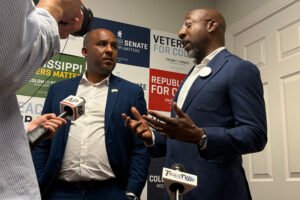
- Warnock wants Democrats to focus on the South. He’s starting in Mississippi.
- Retiring GOP congressmember will ‘absolutely not’ vote for successor in at-risk seat
- Sullivan walks the line with Trump in Alaska Senate race
-

 Politics2 years ago
Former ‘Squad’ members launching ‘Bowman and Bush’ YouTube show
-
Uncategorized2 years ago
Bob Good to step down as Freedom Caucus chair this week
-

 The Josh Fourrier Show2 years ago
DOOMSDAY: Trump won, now what?
-

 The Dictatorship2 years ago
Pete Hegseth’s tenure at the Pentagon goes from bad to worse
-

 Politics2 years ago
Former Kentucky AG Daniel Cameron launches Senate bid
-

 The Dictatorship2 years ago
Luigi Mangione acknowledges public support in first official statement since arrest
-

 Politics2 years ago
Blue Light News’s Editorial Director Ryan Hutchins speaks at Blue Light News’s 2025 Governors Summit
-

 The Dictatorship1 year ago
Mike Johnson sums up the GOP’s arrogant position on military occupation with two words