
Politics
‘There’s something bigger going on’: Democratic state election chiefs rebuff Trump bid to seize voter rolls

Democratic state election officials say the Justice Department’s letter to Minnesota over its voter rolls represents a significant escalation, with several warning that the Trump administration could use immigration enforcement to exert influence over November’s midterm elections.
The officials are baffled by the Trump administration’s continued demand for access to state voter information and refuse to comply, telling Blue Light News they view the requests as part of a broader effort by the administration to insert itself into state election proceedings.
Minnesota Secretary of State Steve Simon, a Democrat, has been at the center of the push after Attorney General Pam Bondi wrote in a letter to Gov. Tim Walz that one condition of restoring “law and order” in the state amid the administration’s aggressive immigration crackdown would be for Minnesota to turn over its voter rolls to the federal government.
Minnesota — one of two dozen states, along with the District of Columbia, sued by the administration — has rejected the request, prompting an unprecedented legal clash between the Justice Department and state election officials.
“To me, [it] seems to be a project in service of the president’s longstanding but false view that election systems around the country are rigging elections,” Simon told Blue Light News. “And this project seems to be in service of that, and that’s the best I can tell.”
Simon said he has not heard back from the Trump administration since responding to the Bondi letter. “This was already a dispute, but it was a dispute being fought where it belongs, which is in a court of law,” he said.
Arizona Secretary of State Adrian Fontes, a Democrat running for reelection this year, called the letter to officials in Minnesota “extortion” and echoed the suggestion that the effort was aimed at something beyond voter rolls.
“The voter roll stuff is not about voter rolls. There’s something bigger going on,” Fontes said in an interview this week, as dozens of secretaries of state gathered in Washington for a meeting of the National Association of Secretaries of State. “They’re bits and pieces, interchangeable in this jigsaw puzzle, and we’re being told something that’s not true,” he added.
The highly unusual push for access to states’ voter rolls is part of a yearlong campaign by the Trump administration, which says it is seeking to ensure that states’ voter registration practices comply with federal law and safeguard election integrity. The White House has requested voter records from nearly every state and Washington, D.C. The move comes as Trump frequently repeats his false claim that the 2020 presidential election was “rigged.”
The White House and Justice Department did not immediately respond to Blue Light News’s request for comment on this story.
At least 11 states have complied with the administration’s request, according to the Brennan Center.
Wyoming is one of the states that complied, and its secretary of state, Chuck Gray, a Republican, told reporters on Friday that it has been “very disturbing” to watch Democrats rebuff the administration’s request to engage in what he described as regular upkeep of voter rolls.
“We’ve been engaging in routine voter list maintenance that people support in making sure the voter lists are clean,” he said.
The Justice Department has sued the 24 states — most, but not all, of which are helmed by Democrats — that have refused to comply, with most citing concerns over exposing sensitive voter information.
“I’m certainly concerned that people may fear that the Department of Justice having access to the voting rolls might make them a target in some way,” said Maine Democratic Secretary of State Shenna Bellows.
“This Justice Department has weaponized its office to target people based on identity and based on political affiliation,” she said.
Uzoma Nkwonta, a partner at Elias Law Group, which is representing several states in litigation over the voter roll demands, called the effort “another example of overreach by the Department of Justice and the federal government.” “The fact that DOJ officials have stated publicly that they expect to see hundreds of thousands individuals removed from the rolls once they have this data … should set off a red flag,” Nkwonta said, noting that maintaining voter registration lists is a responsibility for the states, not the federal government.


Politics
‘Profoundly unhelpful’: Texas Republicans worry Bo French’s xenophobic posts make a tough year worse
Texas Republicans were already fretting about slipping support with voters of color. Then Bo French got on X.
The Republican nominee for Texas Railroad Commissioner posted a photo of a crowd of University of Texas football fans, most of them people of color, saying, “The problem is now obviously far worse than anyone imagined.”The Sunday morning comments, which appeared to target South Asian students, sent Lone Star Republicans into a frenzy, worried about the impact the rhetoric could have on GOP candidates up and down the ballot, including Attorney General Ken Paxton’s high-profile Senate race and Texas Gov. Greg Abbott’s reelection fight.
A number of Republican lawmakers, including some in tough races, quickly denounced the post as racist, as others squirmed with carefully worded statements. And GOP operatives winced at the potential electoral backlash — in a year that’s already looking tougher-than-normal for a party that has dominated the state for decades. Still, no one explicitly called for him to drop out of the race.
“His post on social media is profoundly unhelpful if his goal is to see Republicans win statewide races in a tough political environment in 50 days,” said Matt Mackowiak, an Austin-based GOP consultant who advised Sen. John Cornyn’s (R-Texas) unsuccessful primary campaign against Paxton.
Cornyn condemned the post, asking whether other GOP officials would “condemn the intolerance and racism, or look the other way while it becomes normalized.”
Rep. Monica De La Cruz (R-Texas), who is facing a tough reelection fight in a Hispanic-majority district, told Blue Light News in a statement she’s willing to “condemn racism” wherever it comes from.
“All I see in that photograph is a group of kids celebrating a Longhorns win. What can be more Texan than that?” De La Cruz said, before taking a shot at her Democratic opponent, Bobby Pulido, for his past racial comments.
And Karl Rove, a longtime adviser to former President George W. Bush, called French a “bigot” at a private lunch event and said he’s voting for French’s Democratic opponent, The Texas Tribune reported. Meanwhile, state Rep. Jon Rosenthal, the Democrat running against French, said he had his best fundraising day of the cycle after French’s post.
French didn’t respond to requests for comment. He repeatedly stood by his comments since Sunday morning. During a local radio appearance Monday, he said he didn’t have any personal animosity against the students at the football game, but said that it is “not racist to point out that we should be favoring Texans over foreigners” and that his fellow Republicans are afraid of being called racist.
The divide emerging among Texas Republicans over the social media post — and Democrats’ eagerness to capitalize on it — show just how precarious the party finds its position this cycle. Texas Republicans were already worrying about losing support from Hispanic and other minority voters amid a tough economic environment and President Donald Trump’s unpopular immigration agenda. They need to hold onto or improve the incremental gains they made over previous cycles with voters of color in a fast-changing state where non-Hispanic white people now only make up 37% of the population. The stakes are high this cycle: Most polls show Paxton slightly trailing in a Senate race that could determine control of the upper chamber; Abbott appears to be in the toughest of his four election fights; and the state is home to several key House races.
“I don’t think [French’s post] independently and universally sours voter sentiment. But it contributes to GOP declining numbers with Hispanic voters particularly in the South Texas congressional races which we hope to win,” said Alfredo Rodriguez, a Dallas-based Republican strategist, who called on French to “stop the petty political theatrics.”
The blast radius of French’s posts was wide enough to garner carefully worded responses from the top of the ticket. Abbott said in a Sunday statement that French’s post “is not my message,” before noting unity “doesn’t mean that Texas cannot also lead in having the toughest immigration laws of any state in America and freezing H1B visas at our universities.”
Two of the students in the photo told the Dallas Morning News that they’re U.S. citizens. Most UT students are Texans — state law requires that 90% of each freshman class come from in-state — and there is no evidence that the students in the photo French posted are foreigners.
Some Republicans weren’t thrilled about Abbott’s response.
“This had nothing to do with illegal immigrants,” said Anang Mittal, an Indian American national GOP strategist, of Abbott’s comments. “These were students at a college game. They’re not H-1B. If they’re students, they’re on a student visa. … It’s pretty damn disgusting of Greg Abbott to say, ‘I condemn racism, but also, like, we’re keeping all the Indians out.’ That’s essentially what that tweet read to me.”Democrat James Talarico called Paxton out on social media, asking if he would follow Cornyn’s lead in denouncing French’s post. The GOP nominee replied that he condemns “racism in all its forms” — and then claimed Talarico had a “history of dividing Texans by race.”
Spokespeople for Paxton and Abbott did not respond to requests for comment.
Other Republicans were less willing to fully denounce French’s comments.
“I don’t really know the guy. I heard he said some not so pleasant things,” said Rep. Troy Nehls (R-Texas), who said he hadn’t seen the posts — but launched into a criticism of immigration nonetheless. “I am concerned about the number of people living in this country, and we don’t even know who they really are,” he said. ”Shut the border down for 10 years, and then let’s try to figure out who we got in this country because we don’t even know.”
Sen. Andy Kim (D-N.J.), who campaigned with Talarico in Houston on Sunday, said French’s posts came up in conversations with every Asian American voter he met.
“Everyone was talking about it,” Kim said. “Every single Asian American that I was with yesterday raised this with me. They were saying this is an example of, ‘Not only are they not courting us or engaging with us, but they’re actively demonizing us, actively being xenophobic and racist towards us.’ We need leaders that stand up against this.”
The political damage could also extend — potentially for years — to Texas’ small but growing Indian American population, the demographic group French appeared to target in his posts. Both Dallas and Houston have significant Indian American populations. In 2019, an event at a Houston stadium headlined by Trump and Indian Prime Minister Narendra Modi drew over 50,000 attendees.
French’s comments could alienate those same voters, said Brendan Steinhauser, a Republican consultant in Austin.
“He just irritated a bunch of people, many of whom could be supporters and could be Republicans,” said Steinhauser, a University of Texas graduate. “I’d be willing to bet a lot of those kids that he was posting a photo of are probably, you know, their parents might be Republicans, or they might be Republicans, or conservatives, or independent-leaning conservatives.”
If French is elected, he would sit on a commission that regulates Texas’ powerful oil, gas and mining industries — which has little to do with immigration or social issues. But French, a longtime provocateur in Texas political circles, has a history of incendiary statements. Just last year, Republicans were calling on French to resign as chair of the Tarrant County Republican Party after he published an online poll asking whether Muslims or Jews were “the bigger threat to America.” He deleted the post and said he regretted it, adding “antisemitism has no place in the Republican Party.” This spring, he unseated a well-financed Republican incumbent for Texas Railroad Commission.
French isn’t the only politician in Texas who has made singling out Muslims part of his political brand. Lt. Gov. Dan Patrick has made “preventing Shariah law in Texas” one of his legislative priorities. Patrick didn’t respond to a request for comment. Abbott, Paxton and Cornyn have all called for investigations and other government action to stop development of a commercial and residential development being built by the East Plano Islamic Center, a mosque outside Dallas. And just last month, Abbott threatened to withhold funding from Dallas Fort Worth International Airport to block plans for ritual washing facilities for Muslim travelers in the airport’s terminals. There’s little difference between French’s attacks and the other politicians’ actions, said Yasir Qadhi, an Islamic scholar at the Islamic center.“It is the same mindset,” he said in an interview. “What we’re witnessing is really an unprecedented and increasingly brazen form of racism. It’s unfiltered, it’s unapologetic, it’s even stripped of even the pretense of political correctness. You know, this is a type of racism we’ve never seen in our lifetimes.”
When French unleashed a string of inflammatory social media posts in 2025, several GOP officeholders — including Patrick, the lieutenant governor — called on him to resign as county GOP chair. But Republicans now refuse to tell French to drop out now “because that might mean that there would be a Democrat elected statewide,” said Glen Whitley, a Republican former Tarrant County judge. “That’s the bottom line.”
“That’s part of my frustration with the Republican Party altogether: They talk about being Christian, but they get up every morning to talk about who they hate,” said Whitley, who still identifies as Republican but endorsed Talarico for Senate.
Joey Fox contributed to this report.
NEW YORK — A state lawmaker who gained national attention for his opposition to unchecked AI during a failed campaign for Congress this year is launching a $30 million effort to unite Democrats around regulating the technology, according to the organization’s new website.
New York Assemblymember Alex Bores is unveiling the organization — called “Who Decides” — on Tuesday to “build the winning Democratic answer to AI,” according to a website that was publicly available Monday night.
“Who Decides’ goal is that by 2028, Democratic candidates from the top of the ticket on down run with a common AI safety agenda,” reads an announcement on the site dated Tuesday. “That means addressing the harms people already see and the broader danger that increasingly powerful and out-of-control systems could destabilize our economy, our democracy, and our safety.”
It was not immediately clear whether Who Decides would be organized as a federal super PAC, 501(c)(4) nonprofit or other type of group. The website has a “donate” link that redirects to a webpage hosted by “Give Butter,” an organization focused on helping nonprofits fundraise. The announcement said the group would reject “corporate money or contributions from senior executives at frontier AI companies.”
Bores did not immediately respond to questions about the organization Monday night, including whether Bores, a sitting state lawmaker, personally fundraised for the group while holding public office. He is launching the organization with his former chief of staff, Anna Myers, the website says.
The apparent launch of Who Decides comes at a moment when the quickly-advancing technology has become a major political issue.
Last week, a former Anthropic researcher issued a dire warning that artificial intelligence has a chance of bringing about the end of humanity. The concerns from the researcher, Jacob Coxon, who also worked for OpenAI, were followed up by calls from the leaders of Anthropic and OpenAI, along with Elon Musk, to regulate the industry and slow development to build more guardrails.
Politicians have scrambled to respond, with both parties trying to coalesce around a policy agenda — and political message — on the rapidly evolving issue. Former President Barack Obama called last week for Democrats to focus on AI, and prominent party strategists from across the ideological spectrum gathered to begin mapping out a strategy.
President Donald Trump rejected recent calls from Republicans and Democrats to quickly regulate the industry in a spate of Monday social media posts.
“We don’t let five people write the laws for hundreds of millions of Americans,” Bores says in the launch announcement on the website, an apparent reference to the top executives in the AI industry. “There is no reason to let them write the rules for AI.”
The group says on the site it will focus on 11 states that it says will be key to the 2028 presidential primary and general election: South Carolina, Nevada, New Hampshire, New Mexico, Michigan, Virginia, Arizona, Georgia, North Carolina, Pennsylvania and Wisconsin. It says it will conduct quarterly national and state polls, host national conferences and partner with local groups in the states.
Earlier this year, Bores lost the primary for retiring Manhattan Democratic Rep. Jerry Nadler’s seat. His campaign largely centered on a push to regulate artificial intelligence following his work to pass the RAISE Act in the state Legislature, which aimed to enact safeguards for the technology. His campaign attracted a combined $21 million from super PACs backed by dueling factions of the AI community, which spent both in support and opposition of him. Democratic Assemblymember Micah Lasher ultimately won the primary and is all but assured to win in November in the deep-blue seat.
“The lesson Bores and Myers took from those fights was that confronting the AI industry is fertile political ground and that public demand for answers on AI policy exists but remains scattered,” the website said, referencing his congressional campaign. “What’s missing is a coalition capable of turning that energy into a governing consensus before the technology, the economic dislocation, and the partisan battle lines harden.”
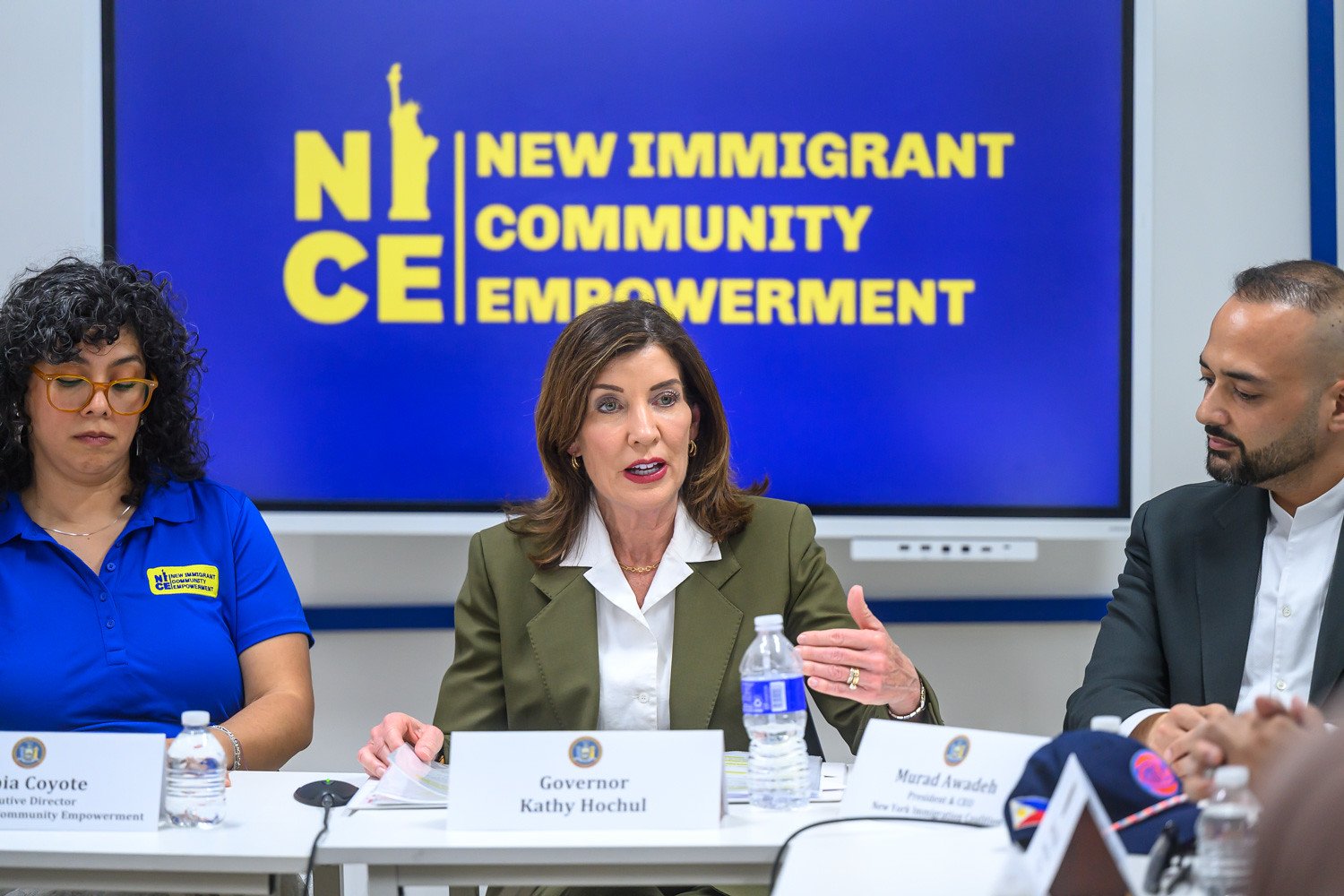
ICE TO SEE YOU: Gov. Kathy Hochul’s office is advising local governments that zoning and state environmental laws can stymie Immigration and Customs Enforcement from building or expanding detention facilities in their communities.
Those legal barriers — spelled out in a letter sent today by Hochul to local government leaders — represent the latest effort by her administration to halt ICE’s efforts in New York.
“We need localities focused on keeping our communities safe, which depends upon the efforts of local law enforcement, civil servants, and regulators,” Hochul wrote in the letter, which was exclusively obtained by Playbook. “While my administration will continue to demand answers and transparency from federal immigration authorities, should you become aware of these projects, my office is ready to partner with you to determine any appropriate next steps to protect our local communities.”
The missive is a new front in Hochul’s broader push to erect roadblocks against President Donald Trump’s sweeping deportation campaign — which includes a push to build or convert facilities in parts of New York.
New York lawmakers and Hochul agreed in May to a package of sweeping measures meant to limit Trump’s immigration enforcement.
Included in those measures were provisions that required expanded public notice — including holding at least two hearings — for the expansion or construction of an immigration detention facility. The law also prohibits local governments from providing financial benefits meant to offset the cost of a facility.
Hochul’s Republican critics have railed against the measures, which were first proposed during the aggressive deportation crackdown in Minnesota, which left two U.S. citizens dead.
Broome County Sheriff Fred Akshar is set to testify Tuesday to the House Judiciary Committee in Washington on “the continuing tragedy of sanctuary laws.” Akshar’s office did not immediately return a message seeking comment.
Local government officials have already sounded an alarm this year over ICE’s apparent efforts to expand the agency’s detention capacity by leasing or expanding sites in Batavia, Newburgh and Rochester.
Hochul wrote to Homeland Security Secretary Markwayne Mullin earlier this summer requesting more information on ICE’s New York plans.
Last month her administration got a reply.
An ICE official wrote to the governor that the agency has “not directed the establishment of a detention facility” in Rochester. In Batavia, ICE is “in the early stages” of weighing a bedspace and usage expansion at a site. And in the Hudson Valley, the agency confirmed that “an acquisition [is] underway to identify a new facility to lease through the General Services Administration” that would house its investigations, enforcement and removal operations.
Details were scant in the letter, but the response is the first time the federal government has formally laid out any of its plans for ICE expansion in New York to state officials.
On Monday in New York City, Mayor Zohran Mamdani and state Attorney General Letitia James offered some of their own push back: two lawsuits seeking to stop the Trump administration from making it harder for immigrants lawfully in the U.S. to change their status.
The suits target a federal rule change set to take effect Friday. The change would give immigration agents more leeway to deny green cards or visas to lawful immigrants on the basis of being a “public charge” — someone who’s using social safety net programs. The rule change would allow agents to factor in the use of Medicaid or food assistance into their decision making.
The Trump administration has said the rule is necessary to ensure the country is not authorizing immigrants who drain public resources.
Mamdani countered that, rather than saving the U.S. money, the change will force immigrants to forgo routine medical care, increasing the likelihood of medical emergencies.
“None of this is abstract,” Mamdani said. “People could die as a result of these changes.”
James said the administration’s rule change is overly broad and flies in the face of more than 100 years of legal precedent.
“This public charge rule goes back to 1822, where Congress basically said that it only applies to individuals who cannot support themselves, not individuals who apply every now and then for public assistance because they fall on hard times,” she said. — Nick Reisman and Joe Anuta
From the Capitol

REGENTS EXAM PHASE-OUT COMING: The high school class of 2027 will be the final one required to pass the state Regents exams to graduate.
The state Board of Regents authorized the Education Department today to move forward with the next phase of the “New York Inspires” program. As part of that program, the board voted last year to adopt a framework that lets students demonstrate proficiency through other measures like projects or coursework. That framework will replace the Regents exam.
While the Regents will remain as an option, it will no longer be a requirement for high school graduation, beginning with students graduating in 2028, education officials said during the board’s monthly meeting today.
“For years, we looked at what elite private schools provide for their students and they do not worry about the Regents exam,” State Education Commissioner Betty Rosa said. “They don’t even worry when you apply to colleges that it’s on their transcript.”
The department said it plans to advance the regulation changes to the board by February 2027 so it can implement the changes in the 2027-28 school year. The board unanimously passed a resolution to that effect today.
Districts will have to develop strategies for assessment that draw on multiple sources of evidence, including classroom performance, student work and state assessments.
Some Regents board members sought more clarity on resources to support families.
“What I did not hear was what resources, what tools do we have for parents and students who are in this purgatory period?” said Regents member Hasoni Pratts, a New York City public school parent.
The news comes as the state grapples with abysmal performance on this year’s reading exams — despite New York spending more per pupil than any other state in the country. Experts and advocates have been questioning what those results say about student learning, and precisely what led to those fluctuations. — Madina Touré
FROM CITY HALL

DEEPFAKE CRACKDOWN: Manhattan District Attorney Alvin Bragg announced today that his office seized control of a dozen domains used to create, disseminate and sell AI deepfake porn.
The sites in question featured AI-generated images and videos of roughly 1,200 individuals — primarily women and celebrities — engaging in sexually explicit activity.
“These horrific violations of privacy follow victims into their careers and personal lives, and take an immense toll on their emotional and mental well-being,” Bragg said. “We were able to seize these domains because a brave survivor stepped forward. And while victims of these sites are largely celebrities, we know that anyone can be a victim of these crimes, particularly in domestic violence cases.”
New York penal law prohibits the dissemination of pornography without a subject’s consent, and violations are punishable by up to a year in prison. That statute was updated in 2023 to explicitly prohibit AI-generated porn.
Bragg’s announcement comes as lawmakers in Albany and Washington grapple with the looming threat of artificial intelligence. But Bragg declined to comment on the potential role of the Manhattan DA’s office in working towards larger scale AI regulation.
“This is a crime in New York State,” he said, referring to the circulation of deepfake pornography. “We don’t have to talk about regulation, legislation. This is a crime now.” —Molly Reinmann
FROM THE CAMPAIGN TRAIL
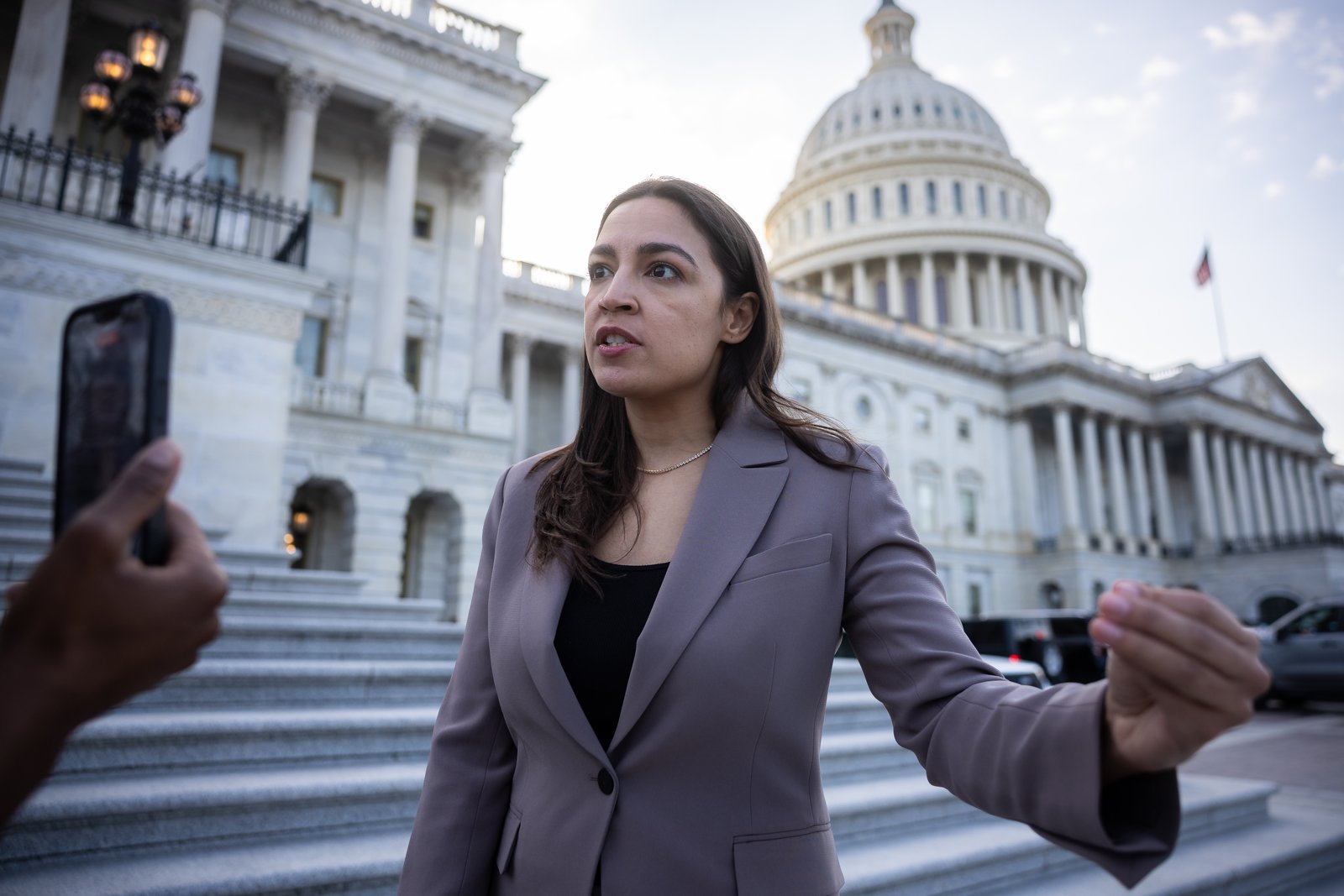
2028 VISION: Rep. Alexandria Ocasio-Cortez is leaning into the speculation swirling around her 2028 aspirations.
“In some ways, I understand the interest. But I wanted to write to you today to be direct about what I’m focused on,” Ocasio-Cortez wrote in a fundraising email. “Frankly, I could not care less about titles or positions for myself. That’s not why I got into this work. What matters to me is changing this country so that it finally works for all of us, and that’s why my focus is on the decision working people around the country will make in the next 50 days.”
She added that her political operation is “mobilizing resources, not just to get me re-elected or build for a future campaign, but most importantly to win the midterms and take back the majority.”
Ocasio-Cortez, who’s been active on the trail boosting down-ballot candidates, has kept the door open for either a Senate run or a presidential bid in 2028 — though some progressives are urging her to aim for the White House.
Any clarity on her 2028 decision before this coming Election Day seems unlikely, though — especially given how “concerned” she says she is “by how some in our party are talking” about the midterms.
“There is a narrative taking hold in Washington that the Republicans are already cooked,” her email continued. “That kind of complacency is how we grasp defeat from the jaws of victory. … All of this is why I am not spending this fall thinking about myself. I am spending it working my butt off to deliver a majority in the House and the Senate.” — Madison Fernandez
A DIFFERENT LAUDER GIVES: Estee Lauder Chair William Lauder gave $500,000 to the super PAC backing Republican gubernatorial candidate Bruce Blakeman.
Lauder’s contribution comes after his uncle, prolific GOP donor Ronald Lauder, ceased his political giving this year. Ronald Lauder was the principal backer of a super PAC aiding Republican Lee Zeldin’s 2022 bid against Hochul.
William Lauder wasn’t the only deep-pocketed titan to donate to the Blakeman PAC recently. Home Depot founder Ken Langone, a GOP megadonor who once led Republicans for Cuomo, gave $50,000. — Nick Reisman
IN OTHER NEWS
— STALLED SECURITY: More than eight months into his term, Mamdani is still waiting on federal security clearance. (Gothamist)
— LEGIONELLA LOCATIONS: A Yankee Stadium cooling tower tested positive for the bacteria that can cause Legionnaires’ disease, according to the New York City Health Department. (Daily News)
— SIGN LANGUAGE: A PAC funded by Knicks owner James Dolan launched a $250,000 billboard campaign backing Blakeman and blaming Hochul for an exodus from the state. (NY Post)
Missed this morning’s New York Playbook? We forgive you. Read it here.
-

 Politics2 years ago
Former ‘Squad’ members launching ‘Bowman and Bush’ YouTube show
-
Uncategorized2 years ago
Bob Good to step down as Freedom Caucus chair this week
-

 Politics2 years ago
Former Kentucky AG Daniel Cameron launches Senate bid
-

 The Dictatorship2 years ago
Luigi Mangione acknowledges public support in first official statement since arrest
-

 The Josh Fourrier Show2 years ago
DOOMSDAY: Trump won, now what?
-

 The Dictatorship2 years ago
Pete Hegseth’s tenure at the Pentagon goes from bad to worse
-

 Politics2 years ago
Blue Light News’s Editorial Director Ryan Hutchins speaks at Blue Light News’s 2025 Governors Summit
-

 The Dictatorship1 year ago
Mike Johnson sums up the GOP’s arrogant position on military occupation with two words