
Politics
The World Cup has returned to a radically hotter America

Dangerously hot temperatures are blanketing the central and eastern United States as the soccer tournament enters its knockout rounds, putting tens of millions of people at risk.
Roughly a quarter of all matches since the start of the games are expected to be played in hazardous heat, according to an analysis by World Weather Attribution, which models how climate change influences extreme weather events. It also warns that the wet bulb global temperature — a measure of temperature, humidity and factors affecting heat stress in the human body — could rise high enough to justify postponing some games. Sticky, hot weather is not unusual in North America during summer. But extreme heat has intensified since the U.S. last hosted the World Cup in 1994.
“Around half of human-caused climate change has occurred since the World Cup was last hosted in North America in 1994. As a result, the climate that the tournament is being played in today has fundamentally shifted in just 32 years,” Joyce Kimutai, an extreme weather and climate change researcher at Imperial College London and lead author of the WWA study, said in an email.
Players aren’t the only ones that are affected. Fans often spend hours in stifling heat while attending outdoor celebrations or watch festivals. Stadium workers are also at risk. Organizers have attempted to reduce the threat by installing cooling stations and scheduling some games at off-peak heat hours. But the current heat wave could hit the games hard.
The National Weather Service estimates that more than 175 million people will endure temperatures this week that put them at major or extreme risk of heat-related health impacts. Some of the places facing the greatest dangers include World Cup host cities like Philadelphia, New York and Atlanta, where street parties filled with sweaty crowds and free-flowing alcohol put fans at greater risk of heat illness.
“A whole bunch of warm bodies standing close to each other does make it more difficult to cool down,” said Kristie Ebi, a scientist at the University of Washington who specializes in climate change and public health. “And alcohol of course is not a fluid one drinks for hydration. It tends to dehydrate people.”
Some host cities, like Kansas City, are bracing for this week’s heat after enjoying cooler-than-average temperatures during the tournament. Others, like Miami, have been sweltering since the games began.
“Pretty much every game in Miami has been played under oppressively hot and humid conditions,” said Tom DiLiberto, media director at Climate Central, which reports on the impacts of climate change and has been tracking its effects on the World Cup games.
Three games at Miami’s open-air stadium have been held at 6 p.m., when the sun is near its hottest point of the day. Climate Central estimates that there is a “high likelihood” that heat could impact player performance at all seven matches in Miami’s stadium and that climate change is increasing the odds of such heat by up to 20 percentage points.
Officials in Miami-Dade County say they’ve been tailoring their heat protocols since the World Cup began, adding new interventions as they experience the matches. The county’s emergency management department has added additional hydration stations near the stadium and elsewhere in the city, as well as cooling and misting stations, after observing a lot of people in need of relief. Officials have also tailored the languages on signs directing international visitors to cooling stations.
“We’ve learned from each of these matches,” said Jesse Spearo, assistant director of Miami-Dade’s department of emergency management. “Each one has changed a little bit.”
Other host cities have turned to Miami for advice. “Weather has always been kind of a big talking point with this group because Miami is always hot,” Spearo said. “We have been coordinating with them … saying this is what we’ve been doing for people, this is what we’ve learned, this is what you should be emphasizing to fans.”
Public health agencies that track heat-related hospitalizations in host cities say they haven’t seen statistical spikes directly linked to the World Cup. But fan celebrations have offered cautionary tales: 110 heat-related medical incidents were reported at a Houston fan festival on the World Cup’s opening day, FOX Weather reported. And Miami-Dade’s fire rescue teams have reported an uptick in heat-related illnesses among people requiring medical transport, Spearo said.
The extreme temperatures this week could put host cities under strain.
State and county emergency management agencies in most host cities affected by the heat wave did not respond to requests for comment on their heat action plans. A spokesperson for the Dallas emergency management office referred questions to the city’s FIFA organizing committee, which referred questions to FIFA.
A FIFA spokesperson said climate-related risks “are assessed as part of overall tournament planning and managed in close coordination with the host cities, stadium authorities and national agencies.” It’s working with medical experts and national meteorological and emergency management authorities on contingency plans, the spokesperson said.
Ebi, the public health expert, said the biggest challenges around the collision of extreme heat and international sporting events often revolve around communication strategies.
“The protections that need to be in place for periods of high temperatures are the same for all human beings,” she said. “What’s different is how do you reach people who may not be watching the news? How do you reach people who may not have English as a first language?
As public health experts worry about spectators in this week’s heat, some scientists also worry that FIFA isn’t doing enough to protect its players.
It’s “absolutely ridiculous” for FIFA to be hosting games at 5 p.m. and 6 p.m. in a place like Miami, said Douglas Casa, a kinesiology professor at the University of Connecticut and head of the Korey Stringer Institute, which researches ways to prevent athlete deaths from things like extreme heat.
“We can anticipate the risks, and there’s a lot of strategies you can have in place to absolutely minimize the risks,” he said, pointing to holding games later in the day, extending hydration breaks when temperatures are high and having aggressive cooling strategies during halftime.
Casa signed onto a May letter to FIFA with more than 20 climate and public health experts that called FIFA’s current guidelines on heat stress mitigation “inadequate” and “impossible to justify,” saying they could put players at risk of heat injury.
FIFA’s heat guidelines for players only mandate cooling breaks if the wet bulb global temperature, or WBGT, exceeds 32 degrees Celsius (89.6 degrees F). It leaves the decision to cancel or suspend a match to the organizers.
That doesn’t line up with guidance from the global players’ union known as FIFPRO, which recommends breaks once the WBGT exceeds 26 degrees and says matches should be delayed if the WBGT temperatures top 28 degrees.
“FIFPRO believes that FIFA’s guidelines do not do enough to protect the health and performance of players,” the organization says on its website.
“FIFA continues to monitor conditions in real time, integrating Wet Bulb Globe Temperature and Heat Index surveillance, and stands ready to apply established contingency protocols should extreme weather events occur,” the FIFA spokesperson said. “Outdoor matches during the hottest parts of the day have been strategically limited, kick-off times adjusted in certain markets, and matches expected in warmer windows prioritised for covered stadiums where possible.”
When Qatar hosted the last men’s World Cup in 2022, FIFA moved the matches to November to avoid the hottest time of year. But summers elsewhere are quickly becoming a concern as climate change accelerates.
Temperatures are forecast to be close to 100 degrees on Saturday when Paraguay takes on France in Philadelphia. Even Toronto, which isn’t used to such extreme heat, is expected to see temperatures in the 90s for its Thursday game.
It also doesn’t end with this year’s matches, said DiLiberto from Climate Central. The next men’s World Cup in 2030 will be in Morocco, Spain and Portugal — areas that saw a major heatwave this month and have much less access to air conditioning.
“If you take these sorts of huge events and put them in incredibly hot conditions in places without air conditioning, you can expect to see a whole host of other health issues,” DiLiberto said.


Democrats are salivating over, and Republicans are bracing for, a potentially massive blue wave. One GOP pollster is urging everyone to calm down.
Patrick Ruffini, a founding partner at Echelon Insights, has been loudly throwing cold water on Democrats’ hopes of sweeping the red state Senate seats that have become battlegrounds in a worsening national environment for Republicans.
“The polls are, I think, intentionally inflating the size of the battleground,” Ruffini told Blue Light News.
Democrats are pushing to flip Senate seats in Iowa, Texas, Ohio and Alaska — all states that President Donald Trump won by at least 11 points in 2024 — with dreams of going even deeper into the map Kansas, South Carolina and even Mississippi. Sensing a potential disaster, Republicans have significantly curtailed their investments in North Carolina and Georgia to direct resources elsewhere.
Ruffini, who isn’t polling for candidates or party committees in any federal races, said he’s skeptical of Democrats flipping some of those seats, particularly in the Midwest, and gives the GOP a coin flip’s chance at keeping control of the Senate.
If a blue wave were to come, he said it would defy the ingrained partisanship in deep-red states that has mirrored growing political polarization around the country.
“I think it would be somewhat of a historic shift if that were to happen,” he said.
Here’s more from Blue Light News’s chat with Ruffini, edited for length and clarity. A more condensed version of this interview ran in Blue Light News’s Morning Score campaign newsletter.
You’ve been pretty publicly skeptical of polling that indicates a big tsunami for Democrats in November. Why is that?
I think we can read the environment right, but the map wrong.
The pretty large shift towards Democrats that we’re seeing on the generic ballot and in a lot of individual races, I’m not saying that’s not going to materialize. What I am more skeptical of is… the ability of any major party in this polarized era that we’re in to rack up significant gains in states that went double digits for the other side.
I’m not ruling out — I think there will be some [examples]. I think Alaska is one where it’s both an idiosyncratic state, and [Democratic nominee Mary] Peltola has shown some specific candidate-centered strength. Nor would it shock me if [Democrat] James Talarico wins, despite the history in Texas. That would not surprise me, just given the candidate quality disparity, particularly on the Ken Paxton side.
Where I get more skeptical is when you move into the Midwest, where there has historically been pretty large polling errors [overstating Democrats’ chances] in states like Iowa, Ohio. And I think you can extend that to the Democratic enthusiasm around Kansas.
Is your skepticism coming more from the quality of the individual polls that you’re seeing that are showing massive Democratic surges in the Midwest, or is it the history of these states that you’re betting will ultimately win out?
I think fundamentals are going to play an important role, particularly in states where there was a solid Trump advantage. We’re not talking about a state like North Carolina or Georgia that’s only for Trump narrowly, where Democrats, at least in the Senate races, are clearly favored.
Historically the presumption is that states tend to converge on their base partisanship in the closing days of an election, but especially that’s been the pattern in the Midwest.
Specifically as it relates to the polls this year, I think any pollster you would talk to, including myself, is experiencing significant non-response bias favoring Democrats.
When you’re seeing high-propensity Democrats [responding to polls] at twice the rate of high-propensity Republicans, when we know that the turnout on both sides would be roughly evenly paired, that’s a warning sign for polling in this cycle.
It seems like there’s some GOP internal polling saying that Republicans are worried about these states, because they are moving money around to triage certain races. I’m curious if you feel like they’re wrong to be making those decisions?
Absolutely not. They’re not wrong. You do have to take the polls somewhat seriously in the sense of, if you do get a poll that’s within the margin of error, I think you’re duty-bound to spend money in those places and not to ignore what could be a potential signal.
I think that control of the Senate comes down to Texas, so they’re right to be spending money there. If you just look at the amount of money being spent in Texas versus Kansas, obviously it’s a much, much bigger state, and you need to spend much more money.
But it’s not something along the lines of ‘the battleground has shifted. It’s a foregone conclusion. Democrats are going to win the Senate,’ and then the battleground entirely shifts to a state like Kansas or to Iowa, right? I don’t think we’re seeing that.
It sounds like the issue you have is how the broader public is interpreting these polls rather than the polls themselves?
The polls are, I think, intentionally inflating the size of the battleground. And to some extent it’s happening both ways. The polls showing a margin-of- error race in Minnesota is possible, right? I’m not as concerned about a polling error in Minnesota as I am in Kansas.
But because of the number of Democratic internals and because of the incentive of Democratic internals to show close races across the battleground, what you generally tend to see is more of an inflated sense of how big the battleground actually is. A lot of these races just break a certain way.
We’ve reported that Republicans are privately conceding that the House is lost. Is that your reading of the data too?
That’s the best reading of the data. That said, if there’s a three-point polling error or something, then I think it gets very, very tight and anything can happen. But I think that’s the most likely outcome.
What is your prediction for the number of Senate seats Republicans will have?
My prediction for both the probability and the seat count is 50-50. There’s a 50-50 chance Republicans hold the Senate. I think if they do, it’s with 50 seats, probably. But obviously, that can tilt very easily.
Which of these states do you think are going to flip for Democrats?
Alaska is clearly favored. I mean, I don’t know if it’s clearly favored, but I think it’s at least still Democrat. I think Texas is going to be very, very close. I just think the partisanship of the state is — people forget it’s a little bit more Republican than it was back in 2018. I think Republicans are probably being underestimated in Ohio because of the past Midwestern polling error.
At the same time, I would say it’s still uphill in Maine and Michigan to some degree. I think Susan Collins has really been the lone bright spot, at least in terms of the conventional wisdom, the narrative in the Senate for Republicans. I think she has a fighting chance, but I think Republicans are still probably under a 50% chance in both Michigan and Maine, just due to the nature of their partisan lean.
If at the end of all of this it is a real blue wave in the Senate, what will have happened to have made you wrong?
If that happens, we will have seen a level of depolarization in the electorate that we haven’t seen since around 2012. You really have to go back in history for a state like Kansas to flip.That would be pretty unique historically, where it’s a flip where you have an incumbent losing.
That’s the kind of thing that used to happen in Senate races a lot, and then things, starting with Trump, got a lot more polarized. So what that would mean is, maybe this is the start of a new political era. But I think it would be somewhat of a historic shift if that were to happen.
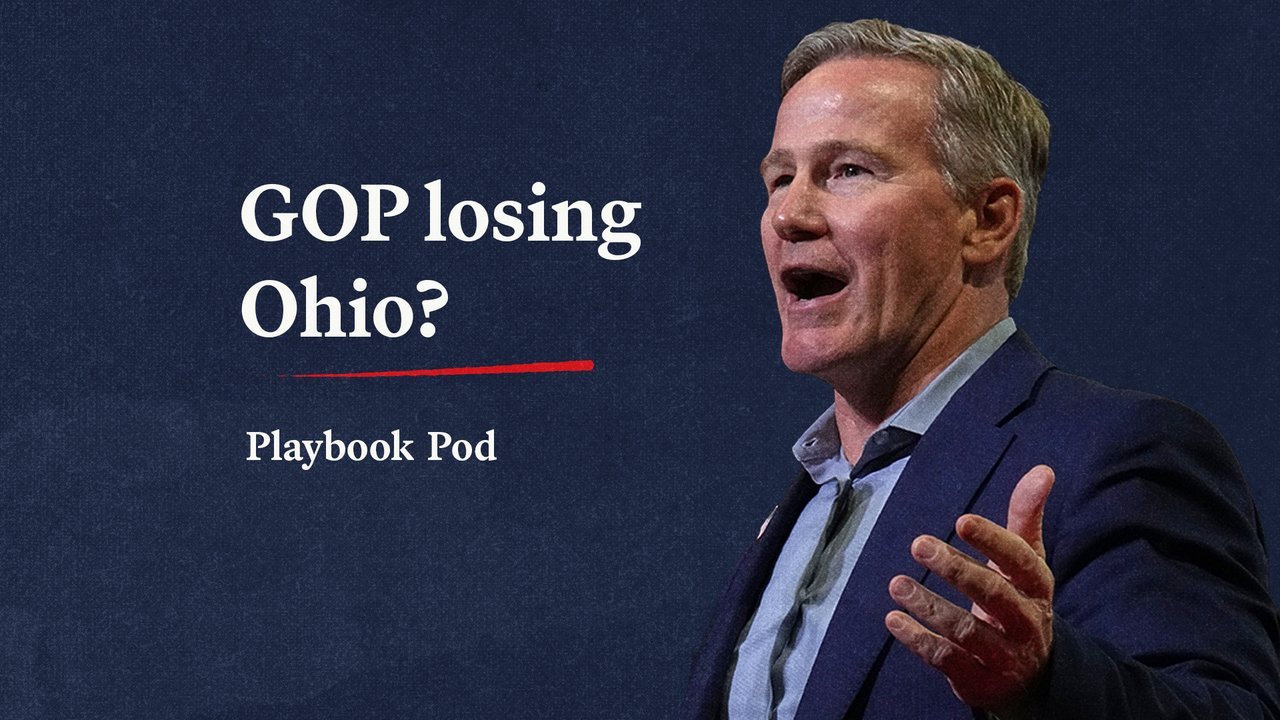
Ohio returns as a bellwether
lead image
The money spigot is sputtering in Georgia’s Senate race amid growing expectations that Democratic Sen. Jon Ossoff will win reelection.
The Senate Leadership Fund, Republicans’ top Senate super PAC, did not spend on broadcast television in the state last week — the first week they were off air in the race, according to tracking firm AdImpact. Neither did Democrats’ Senate Majority PAC.
Senate Majority PAC will also be dark again this week, the Chuck Schumer-aligned group shared first with Blue Light News. It was not immediately clear whether SLF would follow suit. The group declined to comment on their future spending plans in the state.
The spending slowdown underscores how dramatically Georgia’s place on the Senate map has shifted, as Ossoff maintains wide margins over Republican Rep. Mike Collins in public polling and fundraising. Georgia was expected to be one of the cycle’s most expensive and preeminent battlegrounds — now some of the biggest outside spenders are pulling back and turning their attention to more competitive races in redder territory.
The two major Senate super PACs have closely mirrored each other’s spending decisions in recent weeks, with neither fully retreating from the state. They still both technically have future ad reservations booked past this week, but those are not binding, leaving both sides with the flexibility to redirect money as they assess the Senate map. And with two weeks until Election Day and early voting already underway in Georgia, it’s unclear whether either will spend any more in the state.
“National Republicans are abandoning Mike Collins as he continues to show Georgians why he’s unelectable and unfit for office. We are committed to seeing Jon Ossoff through to victory as we come to the final days of this campaign,” SMP spokesperson Lauren French said in a statement.
Collins’ campaign, in a statement, said they were “grateful to every group that’s standing with Rep. Collins and welcome their continued support.”
“With early voting underway, he’s working every day to earn the vote of every Georgian, because Jon Ossoff is a radical leftist who wants to raise their taxes and make their families less safe. Rep. Collins will keep making that case until Ossoff is held accountable on Election Day,” Collins spokesperson Meyer Siegfried said in a statement.
Ossoff’s campaign didn’t respond to a request for comment.
SMP had pledged in the spring to spend $20 million on television for the race, but as of Friday had only spent or reserved $11.5 million, per AdImpact. SLF had announced an initial $44 million investment, but has so far only spent or reserved roughly $20 million.
No Going Back PAC, which is affiliated with President Donald Trump’s MAGA Inc. super PAC, has also dramatically scaled back its own spending on the race over the last two weeks, according to AdImpact.
Republican operatives are still monitoring Georgia’s governor’s race, where recent public polling shows GOP nominee Rick Jackson slightly ahead of Democratic nominee Keisha Lance Bottoms. Republicans believe Jackson’s strength could keep the Senate race closer than currently expected.
But they have grown increasingly pessimistic about their prospects of flipping Georgia’s Senate seat, as Collins trails Ossoff in the polls and the overall environment for the GOP continues to grow more difficult. SLF’s decision to go dark last week — so close to the election — raises questions about how much more the group will ultimately invest in the state.
“Every dollar Schumer spends in Georgia is one not spent on offense in red states. Republicans’ financial advantage doesn’t just show up in more ads, it keeps Dems on defense,” a person familiar with SLF’s spending plans told Blue Light News.
Ossoff also holds a massive fundraising advantage over Collins, who had just over $1 million cash on hand as of Oct. 1, giving Ossoff a major financial cushion in the final stretch even before the major Senate super PACs pulled back their spending.
The GOP has been triaging races across the map: SLF shifted money out of North Carolina, another perennial battleground, while moving resources toward defending GOP-held seats in states like Kansas and South Carolina, where the Senate contests have become increasingly competitive.
Still, even as the money going into Georgia has continued to slow, Trump appears to be prioritizing the longtime battleground.
At a rally in Dalton on Friday, he urged voters to “pretend” he’s on the ballot, while praising Collins and the state’s GOP governor’s nominee, Rick Jackson.
Meredith Lee Hill and Andrew Howard contributed.
- ‘A warning sign for polling’: Why one GOP pollster thinks a blue wave may fall short
- Capitol agenda: AI experts to school Congress wanted
- Ohio returns as a bellwether

- Inside the quiet money pullback — for both parties — in Georgia’s Senate race
- Wanted: Tech experts to help Congress regulate AI
- Wright defends Trump’s Russian diesel deal as ‘carrot’ for peace
- Democrats’ Tejano star sings to swing South Texas

- Warnock wants Democrats to focus on the South. He’s starting in Mississippi.
- Retiring GOP congressmember will ‘absolutely not’ vote for successor in at-risk seat
- Sullivan walks the line with Trump in Alaska Senate race
-

 Politics2 years ago
Former ‘Squad’ members launching ‘Bowman and Bush’ YouTube show
-
Uncategorized2 years ago
Bob Good to step down as Freedom Caucus chair this week
-

 The Josh Fourrier Show2 years ago
DOOMSDAY: Trump won, now what?
-

 The Dictatorship2 years ago
Pete Hegseth’s tenure at the Pentagon goes from bad to worse
-

 Politics2 years ago
Former Kentucky AG Daniel Cameron launches Senate bid
-

 The Dictatorship2 years ago
Luigi Mangione acknowledges public support in first official statement since arrest
-

 Politics2 years ago
Blue Light News’s Editorial Director Ryan Hutchins speaks at Blue Light News’s 2025 Governors Summit
-

 The Dictatorship1 year ago
Mike Johnson sums up the GOP’s arrogant position on military occupation with two words