
Politics
The head of the Postal Service still doesn’t understand mail voting

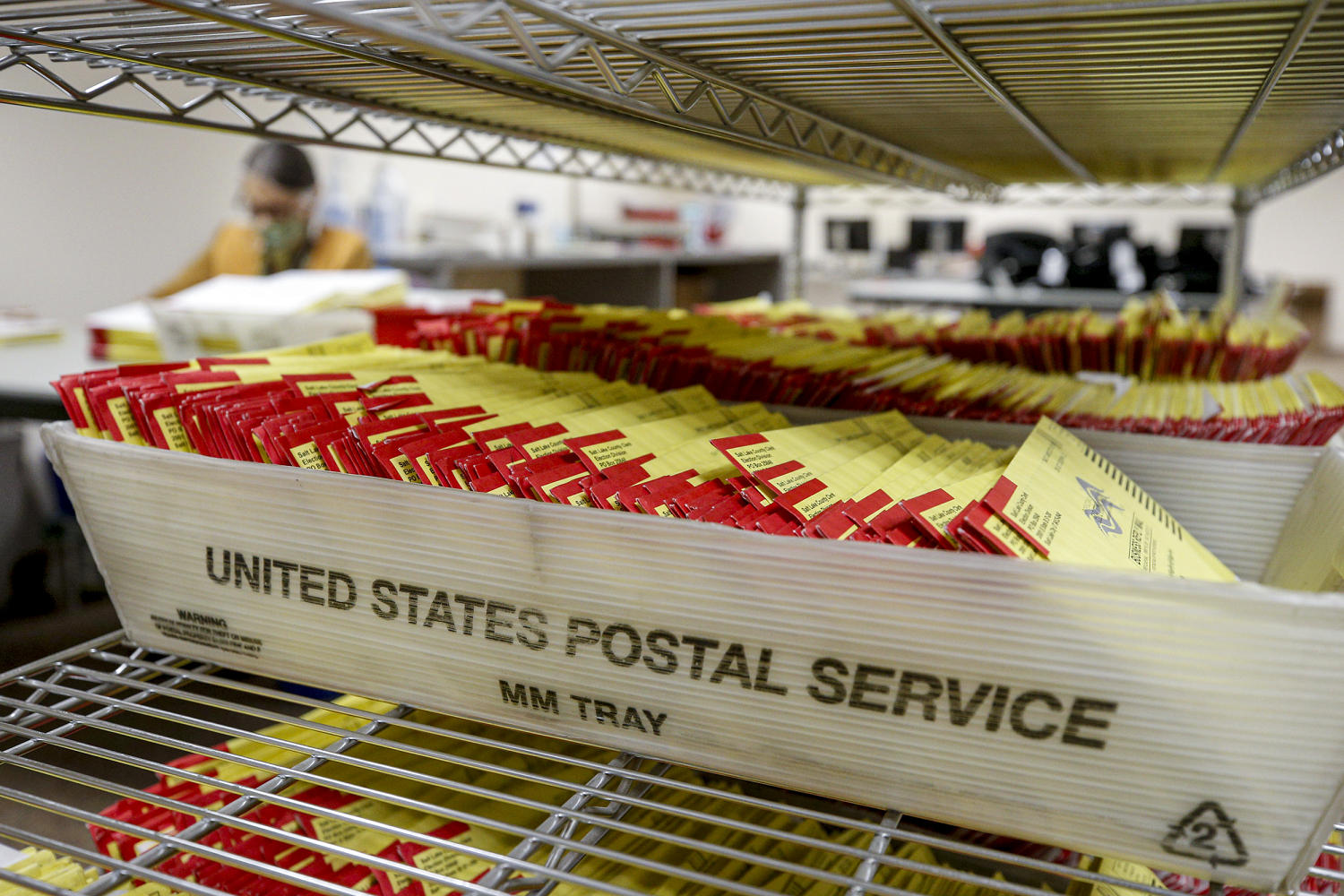
Four years ago, many Americans were outraged to learn that the U.S. Postal Service was cutting services, even as Donald Trump was making baseless claims about vote-by-mail.
Genuine concerns among Democrats over the possibility of mail ballots’ being rejected for late delivery began to bleed into conspiracy theories about Trump-appointed Postmaster General Louis DeJoya North Carolina businessman who donated more than $685,000 to help put on the 2020 Republican National Convention.
In the end, the Postal Service performed admirablydespite the surge in mail voting and the difficult circumstances. DeJoy was not, as some feared, a Trump lackey looking to tear down your local post office in order to hand the election to his favored candidate — but more of a run-of-the-mill Republican appointee with an obsession for cutting costs and a tin ear for politics.
His response was so tone-deaf he’d be kicked off “America’s Got Talent” if he were singing it.
As if to underline the point, he resurfaced in August to reassure voters that the Postal Service is ready to handle mail ballots in this year’s presidential election. A reporter with The Associated Press asked whether he had learned anything from overseeing the crush of mail ballots in 2020, and his response was so tone-deaf he’d be kicked off “America’s Got Talent” if he were singing it.
Echoing every clueless executive trying to explain something away, DeJoy said the Postal Service needed to be bolder in its messaging.
“We have to be louder than the noise in communicating how well we’re going to do and that things are going to be OK. Things are going to be good. We’re in a better operating position than we ever have been,” he said.
To be fair, DeJoy has a point. The Postal Service is on more solid financial footing than it’s been in years, thanks in part to his helping shepherd an overhaul through Congress. And vote-by-mail remains a great way to cast your ballotespecially if you work long hours or take care of young children and might find it difficult to get to a polling place on Election Day.
A Postal Service watchdog and a group of state elections officials have recently raised concerns about how the agency is training workers in handling mail ballots.
But a Postal Service watchdog and a bipartisan group of state elections officials have recently raised concerns about how the agency is training workers in handling mail ballots. These are legitimate concerns raised by serious people — definitely not “noise” that can be addressed by being “louder.” And DeJoy should respond by making an immediate, agencywide push to address them and reassure the public.
First, in July, the Postal Service inspector general released an audit of its “election mail readiness” for the November election, which found inconsistent training and handling of mail ballots that could lead to some ballots’ being rejected. To be clear, the report found that 97% of election and political mail was processed on time, so we’re not talking about undermining democracy here. But this is an area where the goal should be 100%. No one should have their ballots thrown out because the local mail carrier didn’t read the employee handbook closely.
Then, on Wednesday, the National Association of Secretaries of State, a nonpartisan group of top state elections officials, sent DeJoy a six-page letter saying they had “serious questions” about lost or delayed election mail that could lead to some ballots’ not being counted in November.
“We implore you to take immediate and tangible corrective action to address the ongoing performance issues,” they wrote.
It’s important to understand the broader context here. One of the issues raised by the inspector general’s report was that some postal workers didn’t know that they were supposed to postmark mail ballots, which are handled differently from regular mail. But a number of states won’t accept mail ballots that don’t have legible postmarks, which is considered proof that the ballots were sent before Election Day. And in a close election, you can bet that some enterprising Trump supporter will raise conspiracy theories about unpostmarked ballots and sue to try to get them thrown out.
The worst-case scenario is that an election is decided by whether or not those ballots are counted. But even in the best-case scenario, the fight needlessly undermines trust in the election and hurts the Postal Service’s reputation.
The Postal Service is just a piece of this puzzle. American elections would be better served if lawmakers didn’t set unnecessarily restrictive rules for perceived political advantage, candidates didn’t spread conspiracy theories, lawyers didn’t try to get legitimate ballots thrown out for spurious reasons and postal workers were all trained in how to handle mail ballots properly.
If you’re a voter, you can do your part by casting your mail ballot early (don’t wait until the final week before Election Day!) and carefully (make sure to sign the envelope!) or using a ballot drop box where available.
But in the absence of all of that, DeJoy should make sure that the Postal Service is doing everything it can to get mail ballots delivered on time. Talking louder isn’t enough.

Ryan Teague Beckwith is a newsletter editor for BLN. He has previously worked for such outlets as Time magazine, Bloomberg News and CQ Roll Call. He teaches journalism at Georgetown University’s School of Continuing Studies.


‘We are winning elections’: Bernie Sanders on Democrats’ progressive wing
lead image
Politics
Trump wants the Postal Service to radically overhaul mail voting. But ballots are already going out.
President Donald Trump’s controversial demands for the Postal Service to overhaul and monitor millions of mail ballots hit another snag on Friday, when North Carolina became the first state in the nation to start sending out ballots for the November election.
In March, Trump signed the initial executive order, which aimed to crack down on mail-in voting — which he regularly alleges without evidence is a vector for widespread voter fraud — and assert an unprecedented amount of federal control over the upcoming elections.
Under this order and the subsequent rule drafted by the U.S. Postal Service, the USPS would refuse to deliver ballots to states that failed to provide lists of eligible mail voters or did not adhere to an approved envelope design style.
Since then, the order has faced legal challenges, and it remains paused by a federal judge’s orders. But the Trump administration has asked the Supreme Court to allow the new rule to proceed — something current and former election officials from both parties say would be both a legal nightmare that oversteps the federal government’s traditional role in elections and a logistical one that is happening far too close to the November election to implement even if they agreed with it.
“Why the hell are you rocking the boat this late in the game?” said Stephen Richer, a former Republican recorder of Maricopa County, Arizona, who has clashed with Trump allies for defending the security of the 2020 election.
Still, election officials are trying to project a sense of normalcy for voters, particularly in North Carolina, which serves as a test of whether established local election systems can operate normally amid intensifying federal scrutiny.
“I want to emphasize this point because there has been a lot of outside noise: Our county workers are ready,” Sam Hayes, a longtime Republican lawyer in the state and now executive director of the North Carolina State Board of Elections, said in a Thursday afternoon press conference.
He added, “All we can do is what we’re doing. … It is business as usual as far as I’m concerned.”
Despite the legal challenges, the Trump administration has continued to press the courts to let it proceed. The Trump administration asked the Supreme Court on Thursday to lift an order from a Massachusetts judge which temporarily prevents the USPS from enforcing their rule. It is the second time the Trump administration has asked the Supreme Court to step in, after winning an earlier victory in which the high court dismissed an earlier hold on the rule as premature.
“The uncertainty is coming from a single activist judge who continues to try and obstruct President Trump from implementing commonsense measures to protect the security of mail-in ballots and ensure only Americans vote in American elections,” White House spokesperson Lauren Bis said in a statement. “These safeguards for mail ballots were proposed months ago giving election officials ample time to prepare for the 2026 election.”
The USPS did not immediately respond to requests for comment.
Election officials said that if the rule goes into effect this close to November, it would cause chaos and place added strain on the USPS and election officials. And an anonymous federal whistleblower said in a report circulated earlier this week by Sen. Richard Blumenthal (D-Conn.) that the USPS was moving forward in a “secretive, rushed, chaotic, and fundamentally flawed process” to try to implement the new system ahead of the midterms.
In the coming weeks, states across the country will follow North Carolina’s lead. Nine other states will begin mailing ballots in the next two weeks, according to a tracker from the National Conference of State Legislatures — with the biggest day for mailing coming 45 days before the election in mid-September.
“It would be so outrageous to try to let this go into effect. It’s hard to even imagine,” said Ben Hovland, a senior fellow for democracy at the progressive think tank Center for American Progress and former Democratic commissioner with the Election Assistance Commission who was fired by Trump in July.
He added, “It would be a break-glass moment for our democracy.”
The rule would require meticulous changes to ballot handling and tracking practices that Hovland said are impossible to implement before Election Day in about two months, effectively disenfranchising millions of voters.
“Ballots are printed. Envelopes are printed. You can go on and on with all the practical reasons that show that implementing something like this at this time is not feasible,” he said.
Richer said he doubted the new rules would bring about more security. Even if the USPS received lists from the states, according to the postal service’s final rule, it would not do any additional vetting of the list, Richer said.
“It’s just that the mail ballots have to be on that list, and I don’t see what added value for election integrity that does,” he said.
He added, “It creates a lot of administrative burden, and I think it creates a lot more opportunity for error.”
While a decision looms in the courts, election officials and experts cast doubt on the likelihood of the rules going into effect before November. A more pressing issue, they said, is the confusion and uncertainty surrounding mail-in ballots, which could subvert and change the behaviors of voters.
“It makes things seem messy or difficult, and it can dissuade people from participating or coming out to vote,” Hovland said. “It certainly also helps establish a pretext to make bad faith claims about election results.”
Hovland said that while none of these claims of voter fraud are backed up with facts, they could cause Americans to lose faith in the voting process.
Still, some current officials contended they were well-prepared for whatever happens — and that they’d be able to communicate effectively with voters who have become increasingly buffeted by dramatic rhetoric about the once-unmentioned nuts and bolts of actually running an election.
“There’s always a lot of noise around elections, that’s not going to change, and it can be hard to differentiate that from what’s actually going on on the ground,” said Jason Tyson, director of external affairs for the North Carolina State Board of Elections.
As Election Day approaches, Tyson and election officials said they urge voters to check their registration status and make a plan to vote.
He added, “I think we’ve got a really well-trained, solid staff who are ready, and who have gone through all of the checks and balances and points of contact that we need to do to get to where we are.”
Missouri’s Supreme Court suspended a congressional map that state Republicans drew last year that would have netted the GOP an additional House seat, likely keeping the seat in Democratic hands this November.
The court ruled unanimously on Thursday that a referendum petition organized by Democrats to put the new congressional maps to a vote was incorrectly deemed insufficient by Republican Secretary of State Denny Hoskins, and ordered that the gerrymandered map be put to a vote in the fall.
Voters will ultimately decide the fate of the new lines in November. But in the meantime, it cannot be in place for the midterms, meaning Rep. Emanuel Cleaver’s original Kansas City-based district will likely stay in Democrats’ hands this fall.
- Sen. Kennedy rails against AI developers as ‘high IQ stupid people’
- ‘We are winning elections’: Bernie Sanders on Democrats’ progressive wing
- The Norwegian gas plant that could safeguard Europe from Trump
- NATO races to guard against Russian nuclear subs without the US
- Confirmation of measles death gives Pennsylvania governor another chance to call out RFK Jr.
- How Talarico is countering Trump’s midterms convention
- ‘I don’t think anyone is really comfortable’: Democrat leading on AI raises alarms at Trump, Zuckerberg call
- Trump wants the Postal Service to radically overhaul mail voting. But ballots are already going out.
- House Dem election leader’s message to states: Count faster
- Capitol agenda: What Johnson’s early exit could leave behind
-

 Politics2 years ago
Former ‘Squad’ members launching ‘Bowman and Bush’ YouTube show
-
Uncategorized2 years ago
Bob Good to step down as Freedom Caucus chair this week
-

 Politics2 years ago
Former Kentucky AG Daniel Cameron launches Senate bid
-

 The Dictatorship2 years ago
Luigi Mangione acknowledges public support in first official statement since arrest
-

 The Josh Fourrier Show2 years ago
DOOMSDAY: Trump won, now what?
-

 The Dictatorship2 years ago
Pete Hegseth’s tenure at the Pentagon goes from bad to worse
-

 Politics2 years ago
Blue Light News’s Editorial Director Ryan Hutchins speaks at Blue Light News’s 2025 Governors Summit
-

 The Dictatorship12 months ago
Mike Johnson sums up the GOP’s arrogant position on military occupation with two words