
Politics
The head of the Postal Service still doesn’t understand mail voting

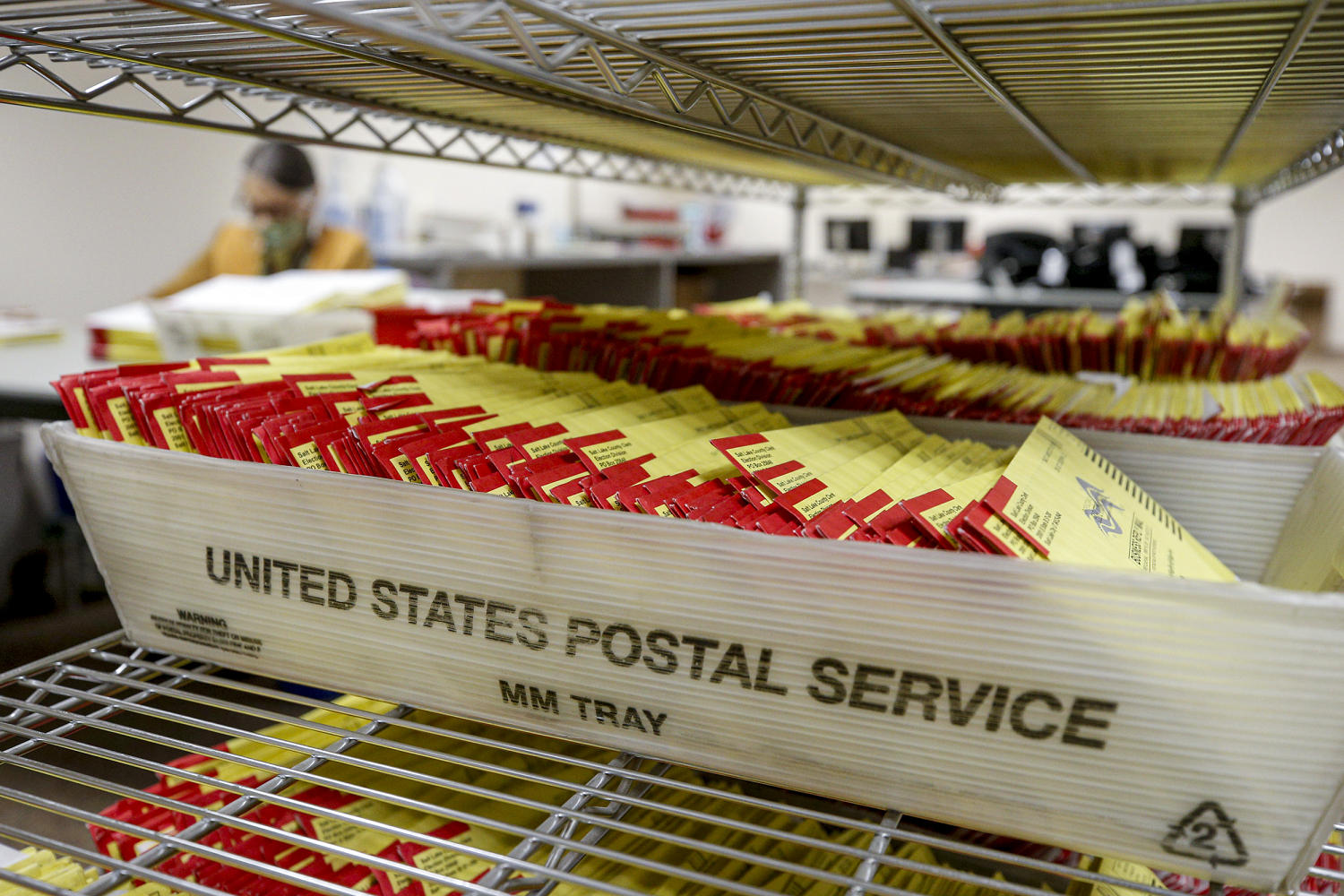
Four years ago, many Americans were outraged to learn that the U.S. Postal Service was cutting services, even as Donald Trump was making baseless claims about vote-by-mail.
Genuine concerns among Democrats over the possibility of mail ballots’ being rejected for late delivery began to bleed into conspiracy theories about Trump-appointed Postmaster General Louis DeJoya North Carolina businessman who donated more than $685,000 to help put on the 2020 Republican National Convention.
In the end, the Postal Service performed admirablydespite the surge in mail voting and the difficult circumstances. DeJoy was not, as some feared, a Trump lackey looking to tear down your local post office in order to hand the election to his favored candidate — but more of a run-of-the-mill Republican appointee with an obsession for cutting costs and a tin ear for politics.
His response was so tone-deaf he’d be kicked off “America’s Got Talent” if he were singing it.
As if to underline the point, he resurfaced in August to reassure voters that the Postal Service is ready to handle mail ballots in this year’s presidential election. A reporter with The Associated Press asked whether he had learned anything from overseeing the crush of mail ballots in 2020, and his response was so tone-deaf he’d be kicked off “America’s Got Talent” if he were singing it.
Echoing every clueless executive trying to explain something away, DeJoy said the Postal Service needed to be bolder in its messaging.
“We have to be louder than the noise in communicating how well we’re going to do and that things are going to be OK. Things are going to be good. We’re in a better operating position than we ever have been,” he said.
To be fair, DeJoy has a point. The Postal Service is on more solid financial footing than it’s been in years, thanks in part to his helping shepherd an overhaul through Congress. And vote-by-mail remains a great way to cast your ballotespecially if you work long hours or take care of young children and might find it difficult to get to a polling place on Election Day.
A Postal Service watchdog and a group of state elections officials have recently raised concerns about how the agency is training workers in handling mail ballots.
But a Postal Service watchdog and a bipartisan group of state elections officials have recently raised concerns about how the agency is training workers in handling mail ballots. These are legitimate concerns raised by serious people — definitely not “noise” that can be addressed by being “louder.” And DeJoy should respond by making an immediate, agencywide push to address them and reassure the public.
First, in July, the Postal Service inspector general released an audit of its “election mail readiness” for the November election, which found inconsistent training and handling of mail ballots that could lead to some ballots’ being rejected. To be clear, the report found that 97% of election and political mail was processed on time, so we’re not talking about undermining democracy here. But this is an area where the goal should be 100%. No one should have their ballots thrown out because the local mail carrier didn’t read the employee handbook closely.
Then, on Wednesday, the National Association of Secretaries of State, a nonpartisan group of top state elections officials, sent DeJoy a six-page letter saying they had “serious questions” about lost or delayed election mail that could lead to some ballots’ not being counted in November.
“We implore you to take immediate and tangible corrective action to address the ongoing performance issues,” they wrote.
It’s important to understand the broader context here. One of the issues raised by the inspector general’s report was that some postal workers didn’t know that they were supposed to postmark mail ballots, which are handled differently from regular mail. But a number of states won’t accept mail ballots that don’t have legible postmarks, which is considered proof that the ballots were sent before Election Day. And in a close election, you can bet that some enterprising Trump supporter will raise conspiracy theories about unpostmarked ballots and sue to try to get them thrown out.
The worst-case scenario is that an election is decided by whether or not those ballots are counted. But even in the best-case scenario, the fight needlessly undermines trust in the election and hurts the Postal Service’s reputation.
The Postal Service is just a piece of this puzzle. American elections would be better served if lawmakers didn’t set unnecessarily restrictive rules for perceived political advantage, candidates didn’t spread conspiracy theories, lawyers didn’t try to get legitimate ballots thrown out for spurious reasons and postal workers were all trained in how to handle mail ballots properly.
If you’re a voter, you can do your part by casting your mail ballot early (don’t wait until the final week before Election Day!) and carefully (make sure to sign the envelope!) or using a ballot drop box where available.
But in the absence of all of that, DeJoy should make sure that the Postal Service is doing everything it can to get mail ballots delivered on time. Talking louder isn’t enough.

Ryan Teague Beckwith is a newsletter editor for BLN. He has previously worked for such outlets as Time magazine, Bloomberg News and CQ Roll Call. He teaches journalism at Georgetown University’s School of Continuing Studies.


- ‘We love you!’: The MAGA base gives RFK Jr. a rousing welcome
- DHS stopgap set for quick House action after Rules Committee vote
- Rand Paul weighs a 2028 presidential bid
- Trump to send Congress his budget request April 3
- ‘Meltdown’: DHS shutdown set to drag on after House GOP rejects Senate deal
- Troop deployments test Republicans’ nerves on Capitol Hill
- Trump’s overlapping troubles are starting to resemble a set of political Russian nesting dolls
- A ‘Love Story’ that feels more like an invasion of privacy

- The Epstein class thinks it runs America. Today, No Kings protesters send their response.
- Israel says it faces an incoming missile from Yemen, the first such launch of the war

-

 The Dictatorship1 year ago
Luigi Mangione acknowledges public support in first official statement since arrest
-

 Politics1 year ago
Former ‘Squad’ members launching ‘Bowman and Bush’ YouTube show
-

 Politics1 year ago
Former Kentucky AG Daniel Cameron launches Senate bid
-

 Politics1 year ago
Blue Light News’s Editorial Director Ryan Hutchins speaks at Blue Light News’s 2025 Governors Summit
-

 The Dictatorship7 months ago
Mike Johnson sums up the GOP’s arrogant position on military occupation with two words
-

 The Dictatorship1 year ago
Pete Hegseth’s tenure at the Pentagon goes from bad to worse
-
Uncategorized1 year ago
Bob Good to step down as Freedom Caucus chair this week
-

 Politics11 months ago
Democrat challenging Joni Ernst: I want to ‘tear down’ party, ‘build it back up’