
Congress
Mass firing threats don’t faze Democrats

President Donald Trump said Monday he’s on the verge of enacting mass firings of federal workers. But Democrats say it won’t make them budge in the increasingly rancorous shutdown standoff.
The mass layoffs, dreamed up by White House budget director Russ Vought, would be the most significant pressure point yet as the shutdown enters a seventh day Tuesday — if Trump follows through. Already he has blown past Vought’s own prediction that firings would start by the end of last week, and no action was taken in the immediate aftermath of a fifth failed Senate vote Monday to reopen the government.
But ahead of that vote, Democrats projected defiance and argued the White House threats are hollow — not because they don’t believe the administration won’t follow through, but because they think it would be swinging the meat-axe regardless.
“They were firing people right and left before the government shutdown,” said Sen. Dick Durbin of Illinois, the No. 2 Senate Democrat, when asked about the threats.
Proceeding with “reductions in force,” as Vought has threatened, would go well beyond the typical shutdown furloughs, where federal workers are hired back once the government reopens. But they would be in keeping with the Trump administration’s sledgehammer approach to the federal bureaucracy since January.
Trump officials have made no secret they are using the threats as a cudgel in the shutdown fight: One of his top economic advisers, Kevin Hassett, said Sunday the administration was closely watching how Democrats voted Monday night — in effect, daring them to risk their own constituents’ livelihoods.
More than 20 percent of the federal workforce resides in the District of Columbia, Maryland and Virginia. But even Democrats representing the capital’s suburbs shrugged off the threat.
“[Federal workers] know that he’s going to move forward with firing as many federal government employees as he possibly can,” Rep. Glenn Ivey (D-Md.) told reporters. “And this is a threat that they don’t think is any different from what he’s been doing before, and I think they’re right.”
Sen. Chris Van Hollen (D-Md.) was more direct in a gaggle with reporters last week, calling Trump’s plans “Mafia-style threats and blackmail.”
They have backing from federal worker unions, who have generally encouraged Democrats to keep up their fight against Trump as lawmakers urge Republicans to come to the negotiating table on health care. Democrats also believe that the threat of a steep premium hike for Affordable Care Act insurance plans will resonate with voters in the midterms.
Two of the biggest unions, the American Federation of Government Employees and the American Federation of State, County and Municipal Employees, filed a federal lawsuit last week seeking to block Vought from proceeding with any layoffs during a shutdown — arguing that mass firings are among the nonessential activities that must be curtailed during an appropriations lapse.
Asked about the threats Monday, Trump said if the shutdown continues, “It could, at some point it will” trigger layoffs
The firings aren’t the only pressure point bearing down on lawmakers and the administration. Most civilian federal workers will miss their first payback Friday, while active duty military members could go without pay starting Oct. 15.
Durbin acknowledged that there might be a “tripping point” where the fallout from a shutdown forces a resolution but could not say what it might be.
Senate Minority Leader Chuck Schumer told reporters shortly after Monday night’s vote that if there are layoffs “it falls on Donald Trump’s shoulders.”
“He’s doing it, not Democrats,” the New York Democrat said. “And the American people know that.”
Democrats have been buoyed by polling that shows voters holding Trump and Republicans more responsible for the shutdown than Democrats — for now. That has given Democrats confidence in their positions, with some saying they have been emboldened by the mass-firing threats.
“Having been in many budget negotiations, I know that the person to make the first threat is usually the one with the least leverage,” said Rep. Sarah Elfreth (D-Md.).
Trump suggested Monday he was already in talks with Democrats about their health care demands, but top Democratic leaders quickly batted down that claim while emphasizing that they stand ready to negotiate.
“I do not know of any Democrats who have spoken to President Trump or members of his administration on this issue of reopening the government, enacting a bipartisan spending agreement, and addressing the Republican health care crisis,” House Minority Leader Hakeem Jeffries told reporters Monday, while Schumer similarly told reporters that it was his “understanding” that Trump had not spoken to any Democrats.
Some Republicans, like Alabama Sen. Tommy Tuberville, have defended Trump and Vought’s threats, saying layoffs are necessary to address a “bloated” federal bureaucracy. “We’ve got to find some way to cut back on the debt we have,” Tuberville added.
But others have reacted to the mass firing threats with unease. They worry that the Trump administration’s bald attempts to focus political pain on Democrats and their constituencies muddles their attempt to keep the shutdown blame game focused solely on Schumer and Senate Democrats — and makes a solution to the standoff harder to find.
“I think that digs us a deeper hole,” Sen. Thom Tillis (R-N.C.) said last week in reference to Vought’s campaign targeting blue states. “I think if you do that, you’re going to create a bad faith environment.”
Jennifer Scholtes contributed to this report.


A large contingent of House Republicans — encompassing hard-liners, Budget Committee members, panel chairs and party leaders — piled into Speaker Mike Johnson’s office Thursday afternoon to discuss a second party-line package, according to four people granted anonymity to share details of the private meeting.
Among the lawmakers attending were Budget Chair Jodey Arrington of Texas and Republican Study Committee Chair August Pfluger, also of Texas.
Reps. Chip Roy of Texas, Byron Donalds of Florida, Tom McClintock of California and Josh Brecheen of Oklahoma were also on hand, alongside Pennsylvania Reps. Lloyd Smucker and Scott Perry.
“We’re definitely preparing to move forward,” Johnson said in an interview as he left the meeting, regarding the House GOP Conference’s plans to pursue another bill through the filibuster-skirting budget reconciliation process. “We’re talking about more details. Lots of work going on.”
One of the biggest issues members are trying to work through at the moment is how to close the wide gap between Republicans in the House and Senate. Most House Republicans want a more expansive bill with myriad conservative policy priorities to ride alongside war and defense funding, while the Senate GOP is largely pushing for a more narrowly-focused measure, according to the four people.
Senate Democrats rejected a GOP photo ID amendment Thursday, an issue that Republicans are eager to use as a cudgel in the midterms.
Senators voted 53-47 on the amendment from Ohio Sen. Jon Husted, which needed 60 votes to advance. Republicans wanted to add the language to their election bill, known as the SAVE America Act.
Senate Minority Leader Chuck Schumer said the amendment “would impose the single strictest voter ID law in America.”
“Stricter than Texas. Stricter than Florida. Stricter than any state in the country,” he said.
Senate Majority Leader John Thune said he wants to clinch a bipartisan Department of Homeland Security funding agreement Thursday.
“I think the Dems are now in possession of what I think is our last and final” offer, Thune told reporters. “So let’s hope this gets it done.”
“We’re going to know soon,” he added.
The South Dakota Republican declined to discuss details of the offer but suggested it was similar to where the discussions were headed over the weekend. GOP senators then were looking at a bipartisan deal that would fund most of DHS but leave out funding for ICE’s Enforcement and Removal Operations.
That offer was rejected by Democrats. But two people granted anonymity to discuss the revised proposal said it, too, omitted only ERO money but included additional language to try to address some of Democrats’ concerns.
Spokespeople for Senate Minority Leader Chuck Schumer did not immediately respond to a request for comment.
The Senate is expected to vote again on the House-passed DHS bill Thursday afternoon. The House is also voting again on DHS funding Thursday and is planning to leave town Friday morning for a two-week holiday recess. Progress in the Senate could prompt House GOP leaders to stay in session in hopes of sending a bill to President Donald Trump.
Asked about the Senate vote, Thune said he hoped there would be “some finality in this real soon.”
- New IOC policy bans transgender women from women’s Olympic events

- Talarico’s loving response to death wish shows rifts among white Christians

- Trump’s ‘highlight reel’ briefings on Iran war raise concerns about U.S. intelligence

- ‘Tone-deaf’: Trump’s GOP loses ground to Democrats on the economy
- The Tea, Spilled by Morning Joe: ‘Fire ‘em all’

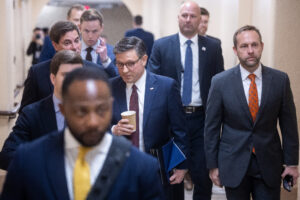
- House Republicans huddle with Johnson to plot party-line package
- Senate rejects voter ID
- John Thune says he’s aiming to land DHS deal Thursday
- House Republicans huddle with Johnson to plot party-line package
- Senate rejects voter ID
-

 The Dictatorship1 year ago
Luigi Mangione acknowledges public support in first official statement since arrest
-

 Politics1 year ago
Former ‘Squad’ members launching ‘Bowman and Bush’ YouTube show
-

 Politics1 year ago
Former Kentucky AG Daniel Cameron launches Senate bid
-

 Politics1 year ago
Blue Light News’s Editorial Director Ryan Hutchins speaks at Blue Light News’s 2025 Governors Summit
-

 The Dictatorship7 months ago
Mike Johnson sums up the GOP’s arrogant position on military occupation with two words
-

 The Dictatorship1 year ago
Pete Hegseth’s tenure at the Pentagon goes from bad to worse
-
Uncategorized1 year ago
Bob Good to step down as Freedom Caucus chair this week
-

 Politics11 months ago
Democrat challenging Joni Ernst: I want to ‘tear down’ party, ‘build it back up’