
Politics
LA’s next mega-event test: The coming climate Olympics

Los Angeles leaders are spending billions to make the 2028 Olympics a story of climate and environmental policy progress, reports Alex Nieves.
Transit and community groups want to know whether the investment will be part of the region’s Olympic legacy or just a flash in the pan.
The question of just how enduring their efforts will be was a throughline Tuesday and Wednesday at the Los Angeles Cleantech Incubator’s Road to 2028 summit — an event focused on leveraging the Olympic Games to accelerate clean energy and transportation development in the state’s most populous region.
The overall vibe of the conference was an optimistic one, as Los Angeles County and dozens of cities are hustling to secure hundreds of buses, plant trees and clean waterways before millions of people descend on the region in two years for the Games. But some attendees were already wondering what comes after the two-week mega event is over.
“When we look to the future, if once the games leave and we have not left communities better than the way we found them, then we have all lost,” said Cynthia Mitchell-Heard, CEO of the Los Angeles Urban League, speaking on a panel of grant recipients who’ve received funding from the LA Olympics organizing committee for environmental projects. (The Urban League received $100,000 to create a workforce development program for people affected by last year’s Altadena fire.)
Catherine Baltazar, associate director of advocacy and organizing at Climate Resolve, argued that throwing dollars at infrastructure projects won’t guarantee long-term progress in communities that have historically lacked resources and disproportionately borne the brunt of climate change.
“Investment should not end when the Games end,” Baltazar said. “We know that these communities will continue long after the Games, and so for me, that’s the legacy that I want.”
The focus on the post-2028 future comes in part because of what was seen as a successful test run during this summer’s World Cup. The region hosted eight matches at SoFi Stadium in Inglewood, avoiding any major snafus while seeing a significant spike in public transit use.
While the Olympics will be far larger than the World Cup, the region has structural advantages over many past Olympic host cities, including enough existing venues to house every sporting event. Much of the preparation now is centered on buying and leasing roughly 1,700 buses — including 500 electric school buses — to shuttle fans to and from venues that will be transit-only.
Transit advocates argue that those investments, including recent expansions of Los Angeles’ light-rail system, don’t solve for structural budget deficits that could threaten service cuts — as bus and rail operators have already warned about farther north in the Bay Area.
Los Angeles’ legislative delegation has failed the last two years to secure a boost in the state budget for systems like LA Metro, which faces a $2.3 billion deficit through 2030. Metrolink, a commuter rail line that serves six counties across Southern California, has indefinitely extended a 20 percent reduction in weekday service amid a $30 million deficit.
Matt Petersen, CEO of the Cleantech Incubator, told Blue Light News the budget challenge has only intensified under a Trump administration hostile toward clean transportation.
“Local governments are struggling, states are struggling on how to put the resources where they’re needed,” he said. “I think the bottom line is: Without the feds, it’s super hard.”
But he said he still believes that Los Angeles is “well on the way to being ready” for the Games and to leave a lasting benefit for the community.
“That’s really what we’re here to do,” he said. “Ten years after the Games, what will we have seen manifest because of this moment?”


A ruling from the Supreme Court on Tuesday means Missouri voters will likely go to the polls this fall under the same congressional map used two years ago, not one Republican state lawmakers adopted to try to pick up an additional House seat for the GOP.
Justice Brett Kavanaugh turned down a Republican-backed emergency appeal that sought to block a Missouri Supreme Court ruling last week restoring earlier district lines and ordering voters to weigh in on the redistricting plan in November for use in future elections.
Kavanaugh issued the ruling because he handles urgent matters arising in the 8th Circuit, which includes Missouri. Kavanaugh issued no explanation of his decision, nor did he indicate that he referred the matter to the full court, as is customary in significant cases. Missouri officials could ask another justice for relief, but such requests are almost never granted.
The justices rarely disturb state courts’ decisions about matters like the referendum petitions in Missouri that sought to put the redistricting before voters for approval.
However, lawyers for Missouri Secretary of State Denny Hoskins warned the Supreme Court that the state faced “disaster” and “unprecedented chaos” in part because primaries already took place under the new lines last month.
Democrats argued any last-minute chaos to Missouri’s election administration was intentionally created by Hoskins, pointing to Republican leaders in the state arguing that delaying the decision on the redistricting referendum would benefit Republicans.
President Donald Trump denounced the state supreme court ruling last week.
“The Election Process, as usual, is being disturbed in America!” he wrotein a post on Truth Social. “Missouri must be able to use the map that was in effect just a couple of months ago, in the Primary. This is a Dark Day for “Justice” in Missouri!”
LAS VEGAS — If California Gov. Gavin Newsom runs for president in 2028, next-door Nevada will be a crucial test. This fall’s governor’s race is offering a preview.
As GOP Gov. Joe Lombardo runs for reelection, he’s trying to pin high Nevada fuel prices — a majority of which is imported from California — on “Gavin Newsom’s energy policies.” He lambasts California as too expensive and too regulated. And he’s hammering his Democratic opponent, Attorney General Aaron Ford, for accepting Newsom’s endorsement, betting that it will turn off Nevada swing voters.
“The contrast is simple: I’m fighting Gavin Newsom’s agenda and Aaron Ford is trying to import it into Nevada,” Lombardo said in a statement to Blue Light News.
This could be a test run for 2028, when Newsom may call upon Nevadans — one-fifth of whom were born in California — to deliver him a primary victory in the early-voting state, and possibly a presidential victory.
“They understand California costs more,” Donna West, chair of the Nevada Democratic Party’s senior caucus, said of Nevada’s California expats. “They also understand that California is the fourth-largest economy in the entire world, and that Gavin Newsom ran that as effectively as he possibly can.”
Newsom’s office declined to comment. A person close to the governor, granted anonymity to discuss the sentiment in his orbit, said they are “thrilled” Republicans are spending money to “plaster Newsom’s name across a key early state.”
“Republicans seem awfully concerned about an endorsement from someone who leads the 2028 Democratic field in Nevada by nearly 2-to-1,” the person said, pointing to a November 2025 Emerson poll of a hypothetical 2028 Democratic primary field.
Ford, for his part, shrugs off the attacks.
“Lombardo tries to cast blame elsewhere, but everyone knows that when the war started in February, that we saw our gas prices increase almost immediately,” Ford told Blue Light News after a recent town hall in Las Vegas. “People believe their own eyes, and they remember their experiences.”
The demonization of California is nothing new in Nevada politics: For years, Republicans have blasted their western neighbor as too expensive and too woke.
But the stakes are higher, and the connection more palpable, this year, as Newsom explores a presidential bid. He would likely need to perform very well in Nevada, now second on the Democratic calendar, to build early momentum toward the party nomination. And come November 2028, he’d need to fare well in Nevada again, this time among the state’s general electorate, a plurality of which are independents.
Newsom has stumped for Democrats across the country this cycle, and he blitzed through the South this week, including a swing through South Carolina, whose Democrats will vote first, right before Nevada, in 2028.
But Republicans are looking to weaponize Newsom’s Silver State swing in July, where Ford introduced him at a new Las Vegas field office as “the governor of the great state of California.”
“Our next president!” an audience member shouted, eliciting cheers.
The Lombardo-aligned Better Nevada PAC shared polling with Blue Light News in July showing Newsom’s favorability 20 points underwater in Nevada and losing a hypothetical 2028 head-to-head with Vice President JD Vance. Shortly thereafter, the PAC began an ad blitz tying Ford to the California governor.
Billboards touting Newsom’s endorsement of Ford, paid for by the PAC, now line highways across Nevada, and digital and streaming ads have run consistently since the visit. “Newsom and Ford: Shared vision. Shared values,” one ad says.
A person familiar with the PAC’s internal polling, granted anonymity to discuss private data, said it shows Newsom’s endorsement is now the second-most-known datapoint about the attorney general.
“Gavin Newsom is the singular most unpopular elected official in Nevada,” said Jeremy Hughes, a longtime Nevada GOP strategist running the Lombardo-aligned PAC. “Aaron Ford brought him into the state. … There’s no better way to help him out than to put up these signs and run ads, letting people know that he’s excited about being endorsed by Gavin Newsom.”
Republicans in the state have long blamed Californian expats for housing shortages and rising prices and connect their opponents to California liberals. A surge of ex-Californians leaving the state during the Covid-19 pandemic, some fleeing high taxes and cost of living, accelerated the trend.
Sam Brown, the GOP nominee for U.S. Senate in 2022, blasted the “energy policies of Gavin Newsom”; in 2018, GOP governor nominee Adam Laxalt lamented the “Californization” of Nevada, even as Californians bankrolled his campaign. During Lombardo’s first run for governor in 2022, he slammed incumbent Democratic Gov. Steve Sisolak for taking his cues from Newsom: “Don’t let Steve Sisolak turn Nevada into California,” one post said. Republicans tied their opponents to Nancy Pelosi for decades.
Lombardo’s argument this time around is more focused. He notes that the vast majority of Nevada’s gasoline comes from California, and argues that California’s efforts to cut carbon emissions have caused fuel prices to soar. A gallon of gas in Nevada costs nearly $5, according to AAA, one of the highest prices in the nation.
“The policies coming from Gavin Newsom and California Democrats … don’t stop at their state line,” Lombardo said in a statement. “Nevada and other states import a significant portion of our fuel from California, so when Governor Newsom shuts down refineries and imposes regulations that reduce supply and increase costs, Nevada families feel the consequences at the pump.”
It’s a strategy that allows Lombardo — running in a difficult national environment for incumbent Republicans — to acknowledge voters’ economic pain without blaming President Donald Trump or his own party. Indeed, Lombardo shared an April column in the Nevada Independent that placed blame at the feet of both Newsom and Trump. (Lombardo, in his post, blamed only Newsom.)
Democrats don’t think voters will buy it. ‘“As far as gas prices, it’s so obviously increased since the war,” Rep. Dina Titus said. “People in Nevada aren’t stupid.”
Ford has his own millstone to saddle Lombardo with: the president. At a recent town hall in Las Vegas, he repeatedly blasted the “Lombardo-Trump economy” that is “making everything too expensive.”
“Voters absolutely tie the handling of the economy to Trump,” said Mike Noble, an independent Phoenix-based pollster who works in Nevada regularly. “Instead of blaming Trump, why not tie it to the boogeyman next door and blame California?”
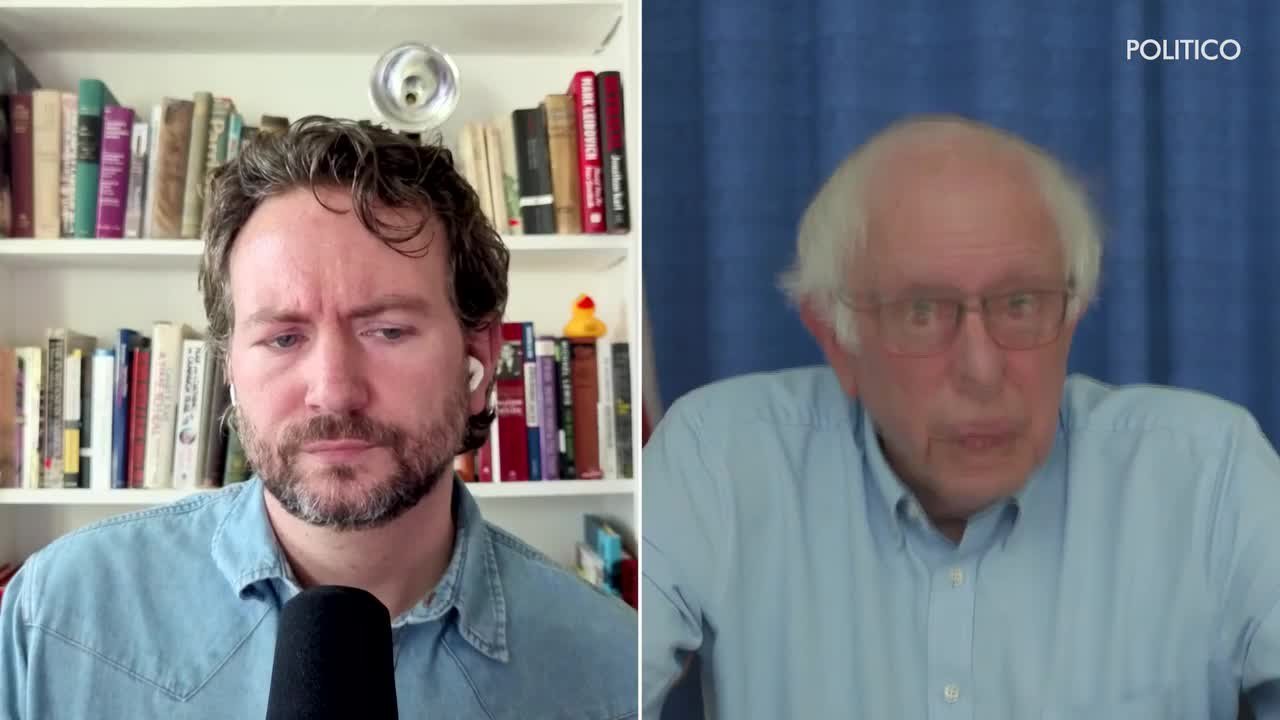
‘We are winning elections’: Bernie Sanders on Democrats’ progressive wing
lead image
- Supreme Court rejects bid to revive Missouri’s pro-GOP redistricting before midterms
- Capitol agenda: Republicans hope Trump won’t dominate Dallas
- The House Democrat who’s making AI regulation her No. 1 priority
- Republicans are hoping ‘Trump-a-palooza’ isn’t only about Trump
- Kathy Hochul is trying to hold the center in a disruptive political age
- Gavin Newsom’s first 2028 test: This fall, in Nevada
- Sen. Kennedy rails against AI developers as ‘high IQ stupid people’
- ‘We are winning elections’: Bernie Sanders on Democrats’ progressive wing
- The Norwegian gas plant that could safeguard Europe from Trump
- NATO races to guard against Russian nuclear subs without the US
-

 Politics2 years ago
Former ‘Squad’ members launching ‘Bowman and Bush’ YouTube show
-
Uncategorized2 years ago
Bob Good to step down as Freedom Caucus chair this week
-

 Politics2 years ago
Former Kentucky AG Daniel Cameron launches Senate bid
-

 The Josh Fourrier Show2 years ago
DOOMSDAY: Trump won, now what?
-

 The Dictatorship2 years ago
Luigi Mangione acknowledges public support in first official statement since arrest
-

 The Dictatorship2 years ago
Pete Hegseth’s tenure at the Pentagon goes from bad to worse
-

 Politics2 years ago
Blue Light News’s Editorial Director Ryan Hutchins speaks at Blue Light News’s 2025 Governors Summit
-

 The Dictatorship12 months ago
Mike Johnson sums up the GOP’s arrogant position on military occupation with two words