
Congress
Johnson takes hands-off approach to picking his policy leaders

Speaker Mike Johnson is taking a hands off approach as he finally puts his stamp on the House Republicans who will shape his conference’s policy ambitions — a break from his predecessors that has some lawmakers struggling to intuit his preferences.
On Thursday, the Republican Steering Committee finished selecting committee chairs for next year, minus the few who Johnson gets to pick unilaterally. It was his first time driving the selection process for panel leaders, which involves the Steering panel recommending chairs who are typically approved by a full conference vote. His allies have privately kvetched over the past year that he was being forced to operate in a Kevin McCarthy-organized House.
Unlike McCarthy, Johnson did not indicate who he would back to lead the panels ahead of time, pledging that he would stay neutral.
“[With] McCarthy you had a pretty good idea of where he was going and who he liked in the race, and I think maybe some people expected this speaker to do the same,” said Rep. David Joyce (R-Ohio), a member of the Steering Committee. “People are inferring things — that he’s tipping the scale — but Mike’s been very straightforward.”
Lawmakers still tried to read into Johnson’s actions and defer to the speaker. That was particularly true during Rep. Brian Mast’s (R-Fla.) presentation to lead the Foreign Affairs Committee on Monday, when he won an upset victory over Rep. Ann Wagner (R-Mo.), according to two people in the room at the time.
A series of rumors flurried about how Mast won, including false claims that Donald Trump was calling every Steering member to lobby for him, though nearly a dozen lawmakers on the committee said they had not heard from the president-elect. Some lawmakers claimed the Florida delegation lobbied hard for him, saying no one from their state would win a gavel otherwise (multiple Sunshine State lawmakers are headed for prominent spots in the Trump administration). Others said Mast’s presentation was so strong it swayed Steering members to his side.
And some claimed the reason was simpler: Johnson made an offhand remark that hinted he was backing Mast. So a race between four competitors was decided quickly, on the first round of ballots, according to three people familiar with the meeting, granted anonymity to share private details.
Then there was the case of Rep. Sam Graves (R-Mo.) seeking a waiver to continue leading the Transportation Committee, House Republicans had several theories as to why Steering granted a request they typically deny. Some believed Graves would resign if he didn’t get the waiver, potentially crippling Republicans’ ability to pass ambitious legislative priorities in the early months of next year. Others thought he received support from other chairs on the panel who may want a waiver for themselves down the line.
But some people familiar with the Steering meeting noted that Johnson made an innocuous comment that might’ve tipped the scales in that case, too. The speaker said something like: it seemed they were all in agreement and asked to move forward with a voice vote. No one wanted to vote against him — at least not openly.
The ultimate outcome of the contested chair elections was largely a mixed bag for different factions of the conference. Mast is an ardent Trump supporter, who already has strong existing relationships with Sen. Marco Rubio (R-Fla.), who Trump intends to nominate to be secretary of State; Rep. Mike Waltz (R-Fla.), who will be Trump’s national security adviser; and Rep. Mario Diaz-Balart (R-Fla.), who oversees State Department funding on the Appropriations Committee.
Then there’s Rep. Brett Guthrie (R-Ky.), who was selected to lead the Energy and Commerce Committee, an amiable Kentucky Republican who’s known as a team player and avid fundraiser. Two Steering members said it just came down to Guthrie running a stronger race. And Rep. French Hill (R-Ark.), who secured the Financial Services gavel, was once an ardent McCarthy ally who notably voted “present” during an internal roll call vote when Johnson ran for speaker.
Some members of the panel said Johnson’s hands-off approach coupled with the influx of new Steering members — roughly a third of the panel’s membership is new — made for a true meritocracy this time around.
“What I’m sensing in there: You’ve got a new Steering Committee. They are not held to the old ideas and rules. … You haven’t sensed the speaker having his thumb on the scale. I’m sure he has his preferences, but I don’t see that he has communicated that. And I think it’s a meritocracy at this point,” said Rep. Barry Loudermilk (R-Ga.), a member of the panel.


Senate Majority Whip John Barrasso told reporters Monday the chamber will vote Tuesday to take up a House-passed elections bill known as the SAVE America Act.
The Wyoming Republican, whose job it is to help round up support, said he is “doing everything I can to make sure we get on this bill tomorrow.”
Republicans will need a simple majority to begin debate on the partisan legislation; they can lose three members and still let Vice President JD Vance break a tie.
So far, Sen. Thom Tillis (R-N.C.) has said he’s a “no,” while Republicans are also watching GOP Sens. Lisa Murkowski of Alaska and Mitch McConnell of Kentucky.
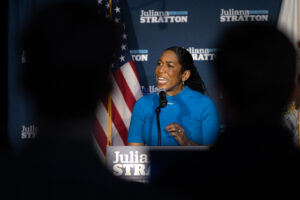
The family of the late Rev. Jesse Jackson walked back a posthumous endorsement of Illinois Lt. Gov. Juliana Stratton’s Senate campaign on Monday, after the family said Jackson’s endorsements for Tuesday’s primaries were not completed before his death.
On Saturday, Stratton’s campaign touted an endorsement from Jackson, who died last month, and his son Yusef. The announcement came after Stratton saw Rainbow PUSH Coalition, the Jackson family’s organziation, passing out sample ballots — which were also obtained by Blue Light News — that recommended Stratton.
“[Jackson’s] example has been a north star for me, and I’m deeply honored to have received his trust, support, and endorsement before his passing,” Stratton said in a statement on Saturday.
But on Monday, Yusef Jackson, who is the organization’s COO, said the draft sample ballot was “released without authorization” and that the Jackson family and Rainbow PUSH Coalition are not making political endorsements this cycle.
His father “began the process of reviewing candidates and identifying those he intended to support in the upcoming primary election,” Yusef Jackson said in the statement. “However, given his passing just over a month ago, the process was never fully completed. Out of respect for my father, we decided not to publicly release his intended selections given the process had not been finalized.”
The Stratton campaign said on Monday that officials with Rainbow PUSH Coalition said she had been endorsed by Jackson.
“Juliana spoke on Saturday at Rainbow PUSH for a Women’s History Month event and officials told her she received the endorsements. Organizers shared the sample election ballot that was already being distributed and encouraged her to share the news,” the Stratton campaign said in a statement.
The endorsement mix-up draws further scrutiny on the split among Black Democrats in Illinois between Stratton and Rep. Robin Kelly (D-Ill.), who are both seeking to succeed retiring Sen. Dick Durbin. Some Democrats in the state have expressed concern that Stratton and Kelly could split the vote in Tuesday’s primary, creating a path for Rep. Raja Krishnamoorthi (D-Ill.) to win the nomination.
Rep. Jonathan Jackson (D-Ill.) told Blue Light News prior to the family’s statement that his father “never got in on Black-on-Black fights.”
Jonathan Jackson added that the races the late Jesse Jackson “was excited about” were himself and former Rep. Jesse Jackson Jr.’s comeback bid.
“He wouldn’t do that. He was always pushing the community forward,” Jackson said. “This smells of desperation.”
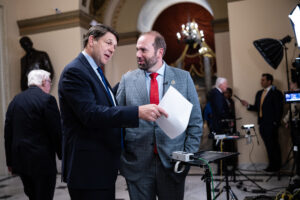
Speaker Mike Johnson said he supports President Donald Trump’s effort to build a global coalition ensure safe passage of commerce through the Strait of Hormuz — even if Trump “didn’t anticipate it” being necessary before launching airstrikes against Iran.
Speaking to reporters after attending a Washington event with Trump, Johnson said the president told him that “he anticipated the strait of Hormuz would be closed.”
“I don’t know that he didn’t anticipate it in the front end, but now it’s necessitated,” Johnson said. He added that the coalition is “a reasonable thing” for other countries to assist with and “it would be helpful.”
Asked about how much a potential supplemental package to fund the military action would cost, Johnson said, “We don’t know yet.” Estimates for the cost of the war have exceeding $1 billion per day.
- Jesse Jackson’s family grapples with Illinois Senate endorsement controversy
- Johnson on Trump’s Hormuz plan
- House Budget chair eyes more safety-net cuts for second megabill
- Capitol agenda: Trump’s Doral demands ripple through GOP
- Trump is failing at the business of war
- Federal judge temporarily blocks RFK Jr.’s changes to vaccine policy
- What Brendan Carr’s media threats are really about
- Monday’s Mini-Report, 3.16.26
- Senate GOP ready to move on elections bill
- Jesse Jackson’s family grapples with Illinois Senate endorsement controversy
-

 The Dictatorship1 year ago
Luigi Mangione acknowledges public support in first official statement since arrest
-

 Politics1 year ago
Former ‘Squad’ members launching ‘Bowman and Bush’ YouTube show
-

 Politics1 year ago
Blue Light News’s Editorial Director Ryan Hutchins speaks at Blue Light News’s 2025 Governors Summit
-

 Politics1 year ago
Former Kentucky AG Daniel Cameron launches Senate bid
-

 The Dictatorship6 months ago
Mike Johnson sums up the GOP’s arrogant position on military occupation with two words
-

 The Dictatorship1 year ago
Pete Hegseth’s tenure at the Pentagon goes from bad to worse
-

 Politics11 months ago
Democrat challenging Joni Ernst: I want to ‘tear down’ party, ‘build it back up’
-
Uncategorized1 year ago
Bob Good to step down as Freedom Caucus chair this week