
Politics
In pursuit of a Jim Crow gerrymander, Georgia’s governor calls another special session

Georgia Gov. Brian Kemp is officially joining the GOP’s push to reinstitute Jim Crow governance after conservative Supreme Court justices opened the door to racist gerrymandering with their decision in the Callais v. Louisiana case.
On Wednesday, Kemp — who has signed multiple voter suppression laws in recent years — called for a special legislative session in an effort to gerrymander his state’s congressional districts ahead of the 2028 elections. The map would take effect after this year’s midterms.
Kemp, notably, has been floated as a potential presidential candidate in 2028. His announcement comes as other Republican governors have eagerly pressed conservatives in their states to rig their congressional maps in their favor, now that the Supreme Court has effectively allowed them to draw majority-Black districts out of existence.
Next month’s special session will mark the third time in five years that Georgia Republicans will attempt to gerrymander their map, a remarkable data point underscoring the GOP’s illiberalism in the state.
These repeated returns to the well were rebuked by the Georgia state Senate’s minority leader, Harold Jones II. In a statement on Xhe said in part:
If Republicans ever used their power to help Georgians, they wouldn’t have to waste time and money redrawing the maps every few years to keep their majorities.
June will be our third redistricting since 2021. Republicans need to undo their last gerrymander because it wasn’t good enough to keep their waffling political party in power. Most parties would try out some new ideas. Republicans choose to strip political power from Black people and undo the progress the South made in the last 60 years.
Jones also noted that Black people make up Georgia’s largest bloc of middle-class and working-class voters, adding: “When Republicans strip Black people’s political power away, it doesn’t just strip one community of power. It strips political power from every single middle and working class person and hands it over to billionaires and big corporations.”
🚨Senate Minority Leader Harold Jones II released the following statement today on Governor’s Kemp’s call for special session:
“If Republicans ever used their power to help Georgians, they wouldn’t have to waste time and money redrawing the maps every few years to keep their… pic.twitter.com/85Sv2ChNSC
— Georgia Senate Democrats (@GASenateDems) May 13, 2026
As the Southern Poverty Law Center explained in JanuaryGeorgia Republicans forced through a map in 2021 that voting rights activists said discriminated against Black voters. After a federal court struck down that map, Georgia Republicans replaced it with a different map in 2023 that has been similarly criticized.
And now — amid what some people fear could be the largest purge of Black lawmakers from Congress since the Jim Crow era — Kemp is planning yet another assault on Black political power.
And he’s not stopping there. Just a day prior to calling the special session, Kemp signed a law to make elections for district attorneys and other offices nonpartisan in five Atlanta counties where Democratic DAs are in charge, all of whom are Black women.
As writers Jeff Singer and David Nir explained in The Downballotthis change, which is being challenged by Fulton County District Attorney Fani Willis, could make it easier for Republicans to flip these five offices.
Ja’han Jones is an MS NOW opinion blogger. He previously wrote The ReidOut Blog.


LAS VEGAS — If California Gov. Gavin Newsom runs for president in 2028, next-door Nevada will be a crucial test. This fall’s governor’s race is offering a preview.
As GOP Gov. Joe Lombardo runs for reelection, he’s trying to pin high Nevada fuel prices — a majority of which is imported from California — on “Gavin Newsom’s energy policies.” He lambasts California as too expensive and too regulated. And he’s hammering his Democratic opponent, Attorney General Aaron Ford, for accepting Newsom’s endorsement, betting that it will turn off Nevada swing voters.
“The contrast is simple: I’m fighting Gavin Newsom’s agenda and Aaron Ford is trying to import it into Nevada,” Lombardo said in a statement to Blue Light News.
This could be a test run for 2028, when Newsom may call upon Nevadans — one-fifth of whom were born in California — to deliver him a primary victory in the early-voting state, and possibly a presidential victory.
“They understand California costs more,” Donna West, chair of the Nevada Democratic Party’s senior caucus, said of Nevada’s California expats. “They also understand that California is the fourth-largest economy in the entire world, and that Gavin Newsom ran that as effectively as he possibly can.”
Newsom’s office declined to comment. A person close to the governor, granted anonymity to discuss the sentiment in his orbit, said they are “thrilled” Republicans are spending money to “plaster Newsom’s name across a key early state.”
“Republicans seem awfully concerned about an endorsement from someone who leads the 2028 Democratic field in Nevada by nearly 2-to-1,” the person said, pointing to a November 2025 Emerson poll of a hypothetical 2028 Democratic primary field.
Ford, for his part, shrugs off the attacks.
“Lombardo tries to cast blame elsewhere, but everyone knows that when the war started in February, that we saw our gas prices increase almost immediately,” Ford told Blue Light News after a recent town hall in Las Vegas. “People believe their own eyes, and they remember their experiences.”
The demonization of California is nothing new in Nevada politics: For years, Republicans have blasted their western neighbor as too expensive and too woke.
But the stakes are higher, and the connection more palpable, this year, as Newsom explores a presidential bid. He would likely need to perform very well in Nevada, now second on the Democratic calendar, to build early momentum toward the party nomination. And come November 2028, he’d need to fare well in Nevada again, this time among the state’s general electorate, a plurality of which are independents.
Newsom has stumped for Democrats across the country this cycle, and he blitzed through the South this week, including a swing through South Carolina, whose Democrats will vote first, right before Nevada, in 2028.
But Republicans are looking to weaponize Newsom’s Silver State swing in July, where Ford introduced him at a new Las Vegas field office as “the governor of the great state of California.”
“Our next president!” an audience member shouted, eliciting cheers.
The Lombardo-aligned Better Nevada PAC shared polling with Blue Light News in July showing Newsom’s favorability 20 points underwater in Nevada and losing a hypothetical 2028 head-to-head with Vice President JD Vance. Shortly thereafter, the PAC began an ad blitz tying Ford to the California governor.
Billboards touting Newsom’s endorsement of Ford, paid for by the PAC, now line highways across Nevada, and digital and streaming ads have run consistently since the visit. “Newsom and Ford: Shared vision. Shared values,” one ad says.
A person familiar with the PAC’s internal polling, granted anonymity to discuss private data, said it shows Newsom’s endorsement is now the second-most-known datapoint about the attorney general.
“Gavin Newsom is the singular most unpopular elected official in Nevada,” said Jeremy Hughes, a longtime Nevada GOP strategist running the Lombardo-aligned PAC. “Aaron Ford brought him into the state. … There’s no better way to help him out than to put up these signs and run ads, letting people know that he’s excited about being endorsed by Gavin Newsom.”
Republicans in the state have long blamed Californian expats for housing shortages and rising prices and connect their opponents to California liberals. A surge of ex-Californians leaving the state during the Covid-19 pandemic, some fleeing high taxes and cost of living, accelerated the trend.
Sam Brown, the GOP nominee for U.S. Senate in 2022, blasted the “energy policies of Gavin Newsom”; in 2018, GOP governor nominee Adam Laxalt lamented the “Californization” of Nevada, even as Californians bankrolled his campaign. During Lombardo’s first run for governor in 2022, he slammed incumbent Democratic Gov. Steve Sisolak for taking his cues from Newsom: “Don’t let Steve Sisolak turn Nevada into California,” one post said. Republicans tied their opponents to Nancy Pelosi for decades.
Lombardo’s argument this time around is more focused. He notes that the vast majority of Nevada’s gasoline comes from California, and argues that California’s efforts to cut carbon emissions have caused fuel prices to soar. A gallon of gas in Nevada costs nearly $5, according to AAA, one of the highest prices in the nation.
“The policies coming from Gavin Newsom and California Democrats … don’t stop at their state line,” Lombardo said in a statement. “Nevada and other states import a significant portion of our fuel from California, so when Governor Newsom shuts down refineries and imposes regulations that reduce supply and increase costs, Nevada families feel the consequences at the pump.”
It’s a strategy that allows Lombardo — running in a difficult national environment for incumbent Republicans — to acknowledge voters’ economic pain without blaming President Donald Trump or his own party. Indeed, Lombardo shared an April column in the Nevada Independent that placed blame at the feet of both Newsom and Trump. (Lombardo, in his post, blamed only Newsom.)
Democrats don’t think voters will buy it. ‘“As far as gas prices, it’s so obviously increased since the war,” Rep. Dina Titus said. “People in Nevada aren’t stupid.”
Ford has his own millstone to saddle Lombardo with: the president. At a recent town hall in Las Vegas, he repeatedly blasted the “Lombardo-Trump economy” that is “making everything too expensive.”
“Voters absolutely tie the handling of the economy to Trump,” said Mike Noble, an independent Phoenix-based pollster who works in Nevada regularly. “Instead of blaming Trump, why not tie it to the boogeyman next door and blame California?”
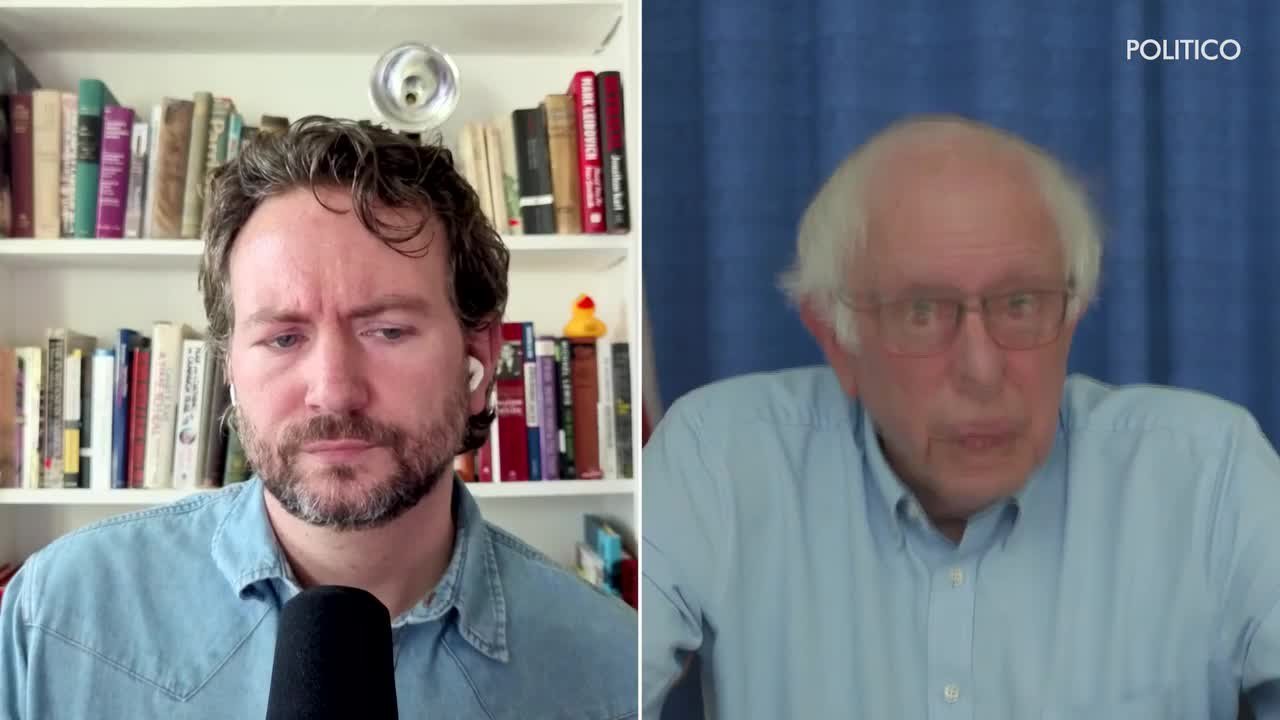
‘We are winning elections’: Bernie Sanders on Democrats’ progressive wing
lead image
Politics
Trump wants the Postal Service to radically overhaul mail voting. But ballots are already going out.
President Donald Trump’s controversial demands for the Postal Service to overhaul and monitor millions of mail ballots hit another snag on Friday, when North Carolina became the first state in the nation to start sending out ballots for the November election.
In March, Trump signed the initial executive order, which aimed to crack down on mail-in voting — which he regularly alleges without evidence is a vector for widespread voter fraud — and assert an unprecedented amount of federal control over the upcoming elections.
Under this order and the subsequent rule drafted by the U.S. Postal Service, the USPS would refuse to deliver ballots to states that failed to provide lists of eligible mail voters or did not adhere to an approved envelope design style.
Since then, the order has faced legal challenges, and it remains paused by a federal judge’s orders. But the Trump administration has asked the Supreme Court to allow the new rule to proceed — something current and former election officials from both parties say would be both a legal nightmare that oversteps the federal government’s traditional role in elections and a logistical one that is happening far too close to the November election to implement even if they agreed with it.
“Why the hell are you rocking the boat this late in the game?” said Stephen Richer, a former Republican recorder of Maricopa County, Arizona, who has clashed with Trump allies for defending the security of the 2020 election.
Still, election officials are trying to project a sense of normalcy for voters, particularly in North Carolina, which serves as a test of whether established local election systems can operate normally amid intensifying federal scrutiny.
“I want to emphasize this point because there has been a lot of outside noise: Our county workers are ready,” Sam Hayes, a longtime Republican lawyer in the state and now executive director of the North Carolina State Board of Elections, said in a Thursday afternoon press conference.
He added, “All we can do is what we’re doing. … It is business as usual as far as I’m concerned.”
Despite the legal challenges, the Trump administration has continued to press the courts to let it proceed. The Trump administration asked the Supreme Court on Thursday to lift an order from a Massachusetts judge which temporarily prevents the USPS from enforcing their rule. It is the second time the Trump administration has asked the Supreme Court to step in, after winning an earlier victory in which the high court dismissed an earlier hold on the rule as premature.
“The uncertainty is coming from a single activist judge who continues to try and obstruct President Trump from implementing commonsense measures to protect the security of mail-in ballots and ensure only Americans vote in American elections,” White House spokesperson Lauren Bis said in a statement. “These safeguards for mail ballots were proposed months ago giving election officials ample time to prepare for the 2026 election.”
The USPS did not immediately respond to requests for comment.
Election officials said that if the rule goes into effect this close to November, it would cause chaos and place added strain on the USPS and election officials. And an anonymous federal whistleblower said in a report circulated earlier this week by Sen. Richard Blumenthal (D-Conn.) that the USPS was moving forward in a “secretive, rushed, chaotic, and fundamentally flawed process” to try to implement the new system ahead of the midterms.
In the coming weeks, states across the country will follow North Carolina’s lead. Nine other states will begin mailing ballots in the next two weeks, according to a tracker from the National Conference of State Legislatures — with the biggest day for mailing coming 45 days before the election in mid-September.
“It would be so outrageous to try to let this go into effect. It’s hard to even imagine,” said Ben Hovland, a senior fellow for democracy at the progressive think tank Center for American Progress and former Democratic commissioner with the Election Assistance Commission who was fired by Trump in July.
He added, “It would be a break-glass moment for our democracy.”
The rule would require meticulous changes to ballot handling and tracking practices that Hovland said are impossible to implement before Election Day in about two months, effectively disenfranchising millions of voters.
“Ballots are printed. Envelopes are printed. You can go on and on with all the practical reasons that show that implementing something like this at this time is not feasible,” he said.
Richer said he doubted the new rules would bring about more security. Even if the USPS received lists from the states, according to the postal service’s final rule, it would not do any additional vetting of the list, Richer said.
“It’s just that the mail ballots have to be on that list, and I don’t see what added value for election integrity that does,” he said.
He added, “It creates a lot of administrative burden, and I think it creates a lot more opportunity for error.”
While a decision looms in the courts, election officials and experts cast doubt on the likelihood of the rules going into effect before November. A more pressing issue, they said, is the confusion and uncertainty surrounding mail-in ballots, which could subvert and change the behaviors of voters.
“It makes things seem messy or difficult, and it can dissuade people from participating or coming out to vote,” Hovland said. “It certainly also helps establish a pretext to make bad faith claims about election results.”
Hovland said that while none of these claims of voter fraud are backed up with facts, they could cause Americans to lose faith in the voting process.
Still, some current officials contended they were well-prepared for whatever happens — and that they’d be able to communicate effectively with voters who have become increasingly buffeted by dramatic rhetoric about the once-unmentioned nuts and bolts of actually running an election.
“There’s always a lot of noise around elections, that’s not going to change, and it can be hard to differentiate that from what’s actually going on on the ground,” said Jason Tyson, director of external affairs for the North Carolina State Board of Elections.
As Election Day approaches, Tyson and election officials said they urge voters to check their registration status and make a plan to vote.
He added, “I think we’ve got a really well-trained, solid staff who are ready, and who have gone through all of the checks and balances and points of contact that we need to do to get to where we are.”
- Capitol agenda: Republicans hope Trump won’t dominate Dallas
- The House Democrat who’s making AI regulation her No. 1 priority
- Republicans are hoping ‘Trump-a-palooza’ isn’t only about Trump
- Kathy Hochul is trying to hold the center in a disruptive political age
- Gavin Newsom’s first 2028 test: This fall, in Nevada
- Sen. Kennedy rails against AI developers as ‘high IQ stupid people’
- ‘We are winning elections’: Bernie Sanders on Democrats’ progressive wing
- The Norwegian gas plant that could safeguard Europe from Trump
- NATO races to guard against Russian nuclear subs without the US
- Confirmation of measles death gives Pennsylvania governor another chance to call out RFK Jr.
-

 Politics2 years ago
Former ‘Squad’ members launching ‘Bowman and Bush’ YouTube show
-
Uncategorized2 years ago
Bob Good to step down as Freedom Caucus chair this week
-

 Politics2 years ago
Former Kentucky AG Daniel Cameron launches Senate bid
-

 The Josh Fourrier Show2 years ago
DOOMSDAY: Trump won, now what?
-

 The Dictatorship2 years ago
Luigi Mangione acknowledges public support in first official statement since arrest
-

 The Dictatorship2 years ago
Pete Hegseth’s tenure at the Pentagon goes from bad to worse
-

 Politics2 years ago
Blue Light News’s Editorial Director Ryan Hutchins speaks at Blue Light News’s 2025 Governors Summit
-

 The Dictatorship12 months ago
Mike Johnson sums up the GOP’s arrogant position on military occupation with two words