Politics
How Trump plans to avoid a ‘Saturday Night Massacre’
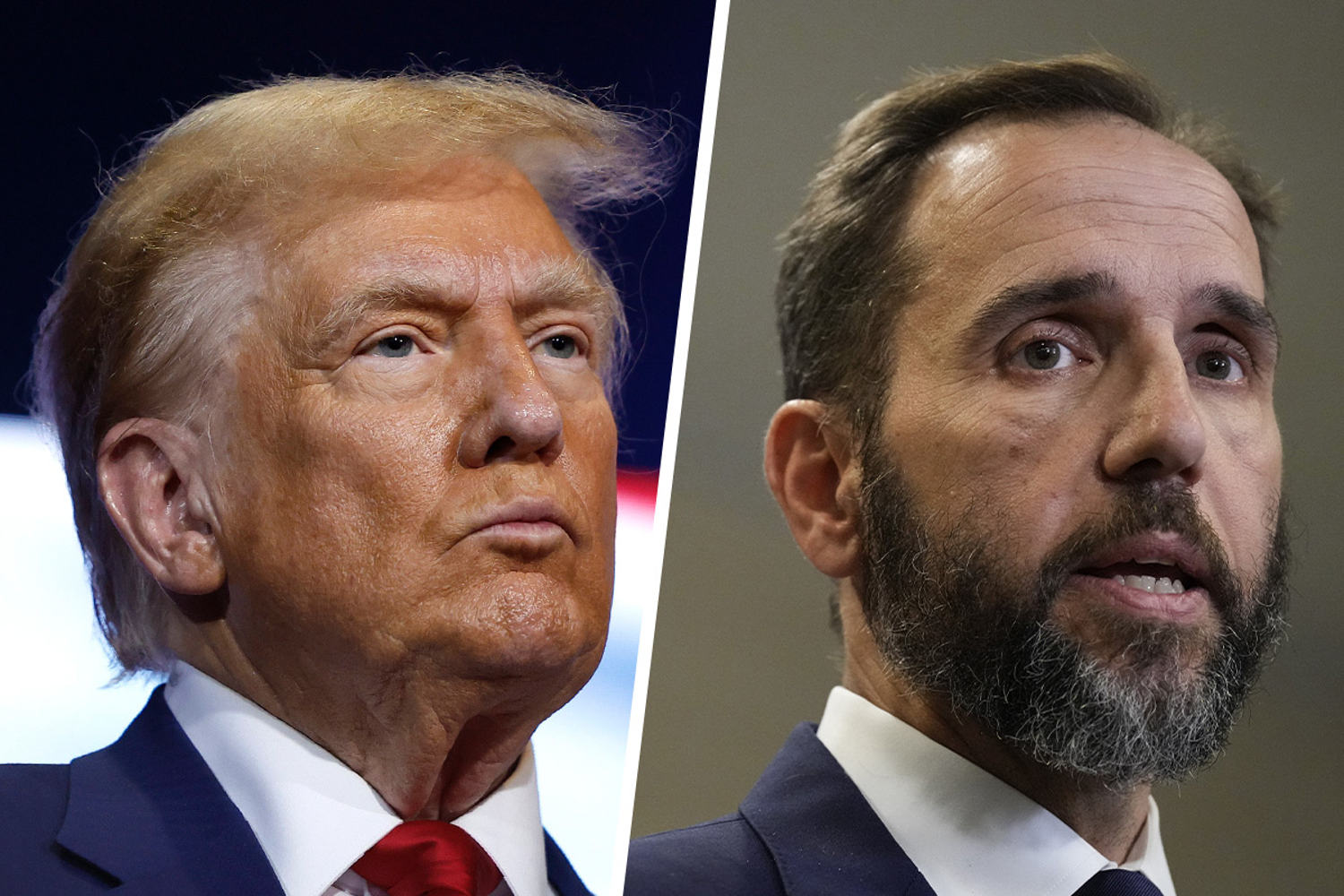
Donald Trump told a conservative radio host Thursday that, if elected, he would fire special counsel Jack Smith “within two seconds.” It’s hard to hear this without recalling how another Republican president, Richard Nixon, tried this same maneuver as a last-ditch attempt to avoid having to comply with a special prosecutor’s subpoena for what turned out to be incriminating audio tapes. Nixon’s directive to fire then-special prosecutor Archibald Cox led to the “Saturday Night Massacre,” when Nixon’s attorney general and deputy attorney general resigned rather than carry out Nixon’s order.
But Trump may have come up with a plan to avoid the messy Nixon-era optics of multiple resignations.
Given that he’s no student of history, Trump may not know that a president can’t fire a special counsel — at least not directly.
In November 2022, Attorney General Merrick Garland appointed Smith as special counsel and authorized him to conduct two investigations. The first covered possible crimes committed by Trump in connection with his attempts to retain the power of the presidency after losing the 2020 election, while the second concerned possible crimes surrounding his retention of classified documents in Florida. As a result of this appointment, Smith indicted Trump on four counts for crimes allegedly committed on and around Jan. 6, 2021, and 40 counts in the classified documents case.
Unsurprisingly, then, Trump has attacked Smith ever since his appointment, and is now promising to fire Smith as one of his first acts should he be elected to a second term.
Given that he’s no student of history, Trump may not know that a president can’t fire a special counsel — at least not directly. Only the attorney general can fire a special counsel. This is why, in 1973, when Nixon wanted to shut down Cox, he ordered Attorney General Elliot Richardson to do so. Richardson refused and immediately resigned. Nixon then turned to his deputy attorney general, William Ruckelshaus, and ordered him to fire Cox. Ruckelshaus also refused and resigned. Nixon then moved on to the No. 3 guy at the Department of Justice, Solicitor General Robert Bork and ordered him to fire Cox. Bork did so, though a court later would rule the firing was unlawful.
Trump has considered firing a special counsel once before. During Robert Mueller’s Russia investigation, Trump considered asking Deputy Attorney General Rod Rosenstein to fire Mueller (Attorney General Jeff Sessions had recused himself from overseeing the inquiry). But his White House counsel Don McGahn threatened to resign, and even loyal Republicans like Sen. Lindsey Graham warned that “any effort to go after Mueller could be the beginning of the end of the Trump presidency.”
This time, though, Trump may have a scheme to ensure a Justice Department official will do his dirty work. ABC News recently reported that Trump’s transition team has none other than Judge Aileen Cannon on the short list to be Trump’s attorney general. NBC News and BLN haven’t confirmed the report, which cited “sources familiar with the matter.” But Cannon’s appeal to Trump is obvious, as she might be just the person whom Trump could count on to fire Smith.
Trump likely won’t even have to tell Cannon to fire Smith, because, in substance, she already has.
Cannon was nominated to the federal bench by Trump (and confirmed after he lost the 2020 election). When the FBI seized classified documents from Mar-a-Lago, Trump’s Florida property, Trump filed suit contesting the legality of the seizure. Cannon was assigned to preside over the litigation, and her ruling appointing a special master to the matter effectively stopped the criminal investigation dead in its tracks. When the Department of Justice appealed, the 11th Circuit Court of Appeals reversed Cannon not once but twice for abusing her judicial discretion.
After Smith indicted Trump for crimes including unlawful retention of classified materials, obstructing justice and violating our nation’s espionage laws, the trial was unfortunately assigned to Cannon. After months of foot-dragging, she dismissed the charges against Trump, concluding that special counsels are unconstitutional. Cannon made this ruling notwithstanding the fact that special counsels and special prosecutors have been used in the criminal justice system dating back to the 1800s, and every judge and court that has ever litigated the issue has ruled that they are lawful and constitutional.
It’s fair to say that Trump hit the jackpot by having Cannon preside over and dismissing his criminal case. He certainly thinks so: though Trump has relentlessly and often viciously criticized virtually all other judges who are presiding over his criminal and civil cases, he has praised Cannon effusively every step of the way.
Now, the kicker: Let’s assume Trump nominates Cannon to be attorney general and she is confirmed by the Senate. Trump likely won’t even have to tell Cannon to fire Smith, because, in substance, she already has. Trump would be able to avoid the messy “Saturday Night Massacre” debacle that was part of Nixon’s downfall.
Trump’s promise to fire Smith is a final warning to voters that he is proudly and enthusiastically corrupt to his core. In the event voters return him to office, he undoubtedly will once again be willing to use that office’s powers to evade criminal accountability. And, given that the Supreme Court’s immunity ruling has given Trump a blueprint for how to continue to evade criminal accountability, it’s not hyperbole to conclude that in the upcoming election, the health of American democracy is on the line.
Glenn Kirschner, a former assistant U.S. attorney for Washington, D.C., is an NBC News and BLN legal analyst.
Politics
Rubio’s 2028 profile rises with Venezuela — and so do his risks
Donald Trump has handed Marco Rubio the keys to Venezuela. It could make or break the secretary of State should he run for president in 2028.
Rubio has quickly emerged as the administration’s point person on Venezuela, the man standing behind the president as he declared “we’re going to run the country.” Rubio plastered his face across the Sunday news shows to explain the operation that captured Venezuelan leader Nicolás Maduro, then went on in the days after to defend it in briefings to Congress.
Photoshopped memes are now circulating of Rubio sporting a sash with the national colors of Venezuela, like those the country’s presidents wear. Rubio is in on the joke, taking to X on Thursday to humorously knock down “rumors” that he was “a candidate for the currently vacant HC and GM positions with the Miami Dolphins.”
But it’s the American presidency that could be at stake.
“Venezuela could make him president — or ensure that he never is,” said Mark McKinnon, a longtime political adviser and former aide to President George W. Bush.
Blue Light News reported in November that Rubio privately had said that he’d back JD Vance for president if he runs in 2028, which Rubio publicly confirmed to Vanity Fair.

“If JD Vance runs for president, he’s going to be our nominee, and I’ll be one of the first people to support him,” Rubio told Vanity Fair, a line his aides pointed Blue Light News to when asked for comment for this story.
Few political strategists, however, are buying that line, and Rubio has changed his mind on not running for office before.
“He’s quietly stacking internal GOP capital, from what I hear from people in my circles within the Republican Party,” said Buzz Jacobs, senior adviser on Rubio’s 2016 presidential campaign. “As of today, could Marco Rubio enter the presidential race and be very competitive, even against the vice president? I think the answer is undeniably yes.”
Rubio has spent much of his career railing against Venezuela’s socialist dictatorship, a close ally of the regime in Cuba, his parents’ homeland.
“Their experience with the evils of socialism and communism is in his DNA,” said Cesar Conda, Rubio’s first Senate chief of staff. “It guides his world view.”
Rubio ran against Trump for the presidency in 2016; he called Trump a “con artist.” But since Trump won and effectively commandeered the Republican Party, Rubio has adjusted many of his policy positions and his rhetoric. He has surrounded himself with America First staffers and advisers who help push forward the Trump administration’s muscular foreign policy.

Trump shortlisted him for the vice presidency in 2024, but Rubio ended up at the State Department instead. To the surprise of many political observers, Rubio fell into lockstep with Trump on issues many thought would be a red line for him. He enthusiastically shut down pathways for refugees and ended funding for democracy and human rights programs, causes he once championed. Taking such steps helped him stay in Trump’s good graces, enough so that the president named him acting national security adviser as well.
Trump has often cozied up to autocrats, but he has never liked Maduro. In recent days, he made it clear he sees Venezuela as a source of oil and other natural resources for the U.S. to exploit. Rubio has long painted Maduro as a thug who thwarted democracy.
For much of this year, both men pushed the idea that Maduro had to be dealt with, alleging he led a drug cartel killing Americans with its products. They got their wish: Maduro is now in U.S. custody in New York.
But the South American country’s fate is far from clear. Many of Maduro’s cronies remain in power, even though Trump insists that they will do what the U.S. demands. Trump told the New York Times this week that the U.S. could be running Venezuela for years.
“I understand that in this cycle and society we now live in, everyone wants instant outcomes. They want it to happen overnight,” Rubio told reporters after briefing the Senate Wednesday. “It’s not going to work that way.”
Members of Congress were not notified of the Maduro operation in advance, and many are fuming about what they say is a continued lack of transparency.
Sen. Tim Kaine (D-Va.) said Rubio’s briefing “raised more questions than it answered.”
“It’s time to let the public in on this, and let the public see what’s at stake,” said Kaine, a member of the Senate Foreign Relations Committee.
Venezuela is unlikely to be a quick or easy fix. The country is roughly twice the size of California, with a shattered economy, a varied landscape, and many armed groups in a population of 30 million. The Maduro cronies left behind have their own internal rivalries, and some control military forces.
Despite Trump and Rubio’s warnings to the remaining members of the regime to fall in line and capitulate to U.S. demands, it’s possible the Venezuelan state could collapse.
And it may not end with Venezuela: Rubio and Trump are warning other countries to get in line with what the U.S. wants from them, including Colombia, Mexico and Venezuela.
“If I lived in Havana and I was in the government, I would be concerned, at least a little bit,” Rubio said in a Saturday press conference just hours after the Venezuela operation.
The potential chaos ahead could leave Rubio on the outs with key GOP voting blocs. Those include anti-interventionist conservatives, who remain wary of Rubio’s neoconservative instincts, and Republican Latino voters, especially in Florida, some who desperately want regime change in the nations their families fled and others who are frustrated by the region’s instability.
Then, of course, there’s the general public, a good chunk of whom want the U.S. to avoid another repeat of Iraq and Afghanistan. According to a Reuters/Ipsos poll conducted after the raid, 72 percent of Americans are concerned the U.S. will get “too involved” in Venezuela.
As Rubio has become the face of the effort, Vance, a potential rival in 2028, has largely kept away from it. He was not at the makeshift Mar-a-Lago situation room while the raid unfolded on Saturday, a fact his spokesperson attributed to concern “a late-night motorcade movement … may tip off the Venezuelans.” Vance was “deeply integrated in the process and planning of the Venezuela strikes and Maduro’s arrest,” the spokesperson said.
Rubio also has to consider some practical matters: If he wants to run for president, he will need to raise money, build a campaign infrastructure and take all the other steps needed before the GOP primary kicks into full gear.
That’s especially difficult to do while secretary of State, a position that traditionally has stayed away from the partisan domestic scene. Former Secretary of State Hillary Clinton had been out of the Obama administration for more than a year before she publicly moved toward a presidential campaign.
Rubio would likely have to leave the administration after another year or so to have time for all the logistics, as jostling for the 2028 presidential campaign will kick off by early next year.

Most U.S. presidential elections don’t hinge on foreign policy, though candidates from John McCain back to Hubert Humphrey have been damaged by their party’s foreign adventurism. Still, the first year of Trump’s second term has been surprisingly heavy on foreign policy — and any Republican running in 2028 will likely have to grapple with the results of Trump’s bold international moves.
“The MAGA base is very loyal to Trump. It will watch if people are disrespectful to him,” said Alex Gray, a former National Security Council official during the first Trump administration.
There are also factions of the GOP — including members of the Cuban and Venezuelan diasporas — who will stand by hardline moves against the regimes there no matter what the cost. Mike Madrid, a GOP strategist, said he has heard from many Latino Republicans who are impressed by how much Trump relies on Rubio. Whenever Trump needs “an adult in the room, he seems to look towards Marco’s leadership,” Madrid said.
But Madrid and other party strategists aren’t about to start taking bets on the GOP primary yet. After all, the situation in Venezuela is just one of multiple Trump foreign policy adventures that could turn into quagmires.
For Rubio in particular, “what may look like the president knighting him as a sort of competent successor may actually, in fact, be him carrying all the weight of the unpopular actions of the president in a couple of years,” Madrid said. “There’s a greater likelihood of that than not.”
Politics
Trump calls for one-year 10 percent cap on credit card interest rates
President Trump on Friday night called on credit card companies to cap interest rates at 10 percent. “Please be informed that we will no longer let the American Public be ‘ripped off’ by Credit Card Companies that are charging Interest Rates of 20 to 30%, and even more…
Read More
Politics
Washington National Opera to leave Kennedy Center amid Trump takeover
The Kennedy Center on Friday confirmed the Washington National Opera (WNO) will leave the renowned venue. “After careful consideration, we have made the difficult decision to part ways with the WNO due to a financially challenging relationship,” a Kennedy Center spokesperson told NewsNation. “We believe this represents the best path forward for both organizations and…
Read More
-
The Dictatorship11 months agoLuigi Mangione acknowledges public support in first official statement since arrest
-
The Dictatorship4 months agoMike Johnson sums up the GOP’s arrogant position on military occupation with two words
-
Politics11 months agoBlue Light News’s Editorial Director Ryan Hutchins speaks at Blue Light News’s 2025 Governors Summit
-
Politics11 months agoFormer ‘Squad’ members launching ‘Bowman and Bush’ YouTube show
-

Politics11 months agoFormer Kentucky AG Daniel Cameron launches Senate bid
-

The Dictatorship11 months agoPete Hegseth’s tenure at the Pentagon goes from bad to worse
-

Uncategorized1 year ago
Bob Good to step down as Freedom Caucus chair this week
-

Politics9 months agoDemocrat challenging Joni Ernst: I want to ‘tear down’ party, ‘build it back up’