
Congress
How Hakeem Jeffries is handling the most divisive issue in Democratic politics

House Democrats are fiercely divided over a proposed cut to Israel aid. Minority Leader Hakeem Jeffries hasn’t so far tried to unite them.
Lawmakers were set to weigh in on the matter last week before an unrelated Republican meltdown sent them home early for the Independence Day recess — but not before it forced a reckoning inside the Democratic ranks on an issue that has dominated party primaries this year.
Hard-left candidates Darializa Avila Chevalier and Brad Lander in New York as well as Melat Kiros in Colorado ousted incumbents after hitting them — and leaders — for taking money from the American Israel Public Affairs Committee.
Now, thanks to an appropriations amendment proposed by Rep. Thomas Massie (R-Ky.) that would cut off aid to Israel, the internal fight among Democrats is live on Capitol Hill — and Jeffries is in the middle of it.
As Democrats wrestled with how to approach the politically thorny vote, Jeffries offered little guidance, preferring to let his members hash out their differences in two lengthy private caucus meetings.
“Politics, at least in the Democratic primary, has evolved to the point where folks who don’t know this issue very well are looking for guidance,” Rep. Greg Landsman of Ohio, a pro-Israel Democrat, said in an interview last week.
Jeffries, who represents a significant orthodox Jewish community in his Brooklyn congressional district, historically has been a strong supporter of Israel. When he first ran for the House in 2012, Sen. Chuck Schumer called him a “true blue friend of Israel” in the course of endorsing him in an open-seat primary.
But the politics surrounding Israel have been transformed in the decade-and-a-half since — and especially since Prime Minister Benjamin Netanyahu launched his invasion of Gaza in the wake of the October 2023 Hamas terror attacks.
Now U.S. support for Israel has emerged as a major internal Democratic fault line and portends to be a massive headache for Jeffries next year as Israel skeptic after Israel skeptic wins the party’s primaries.
He has given some signals in recent months about how he plans to handle the shift in sentiment — in short, very carefully.
Jeffries declined to state his position on the Massie amendment last week, saying in response to a question from Blue Light News, “There’s a lot that needs to happen differently to get to a place where there’s a just and lasting peace between Israel and the Palestinians, and we all need to focus on actually achieving a two-state solution once and for all.”
He has told members he plans to give more specific guidance once a vote is confirmed. In one of the caucus meetings, Jeffries read a statement opposing the amendment from the left-leaning pro-Israel group J Street, according to a person in the room granted anonymity to discuss the private remarks.
Members across the ideological spectrum said last week they appreciated having forums to deliberate, and many suggested it could offer a model for how the potential speaker could manage his caucus in a majority. But some Democrats warned an agree-to-disagree posture might not always fly on sensitive issues.
Massie’s Israel amendment is unlikely to be adopted — very few of his fellow Republicans are expected to support it — but it has fractured House Democrats along loosely ideological lines all the same.
Progressives generally support the amendment, which would also cut $3.3 billion in foreign military aid in addition to blocking funding for Israel. Meanwhile, many leadership-aligned members and moderates have said the amendment is poorly written and believe it could also restrict humanitarian support for Palestinians.
The friction led leaders to convene a pair of hour-plus caucus meetings that several House Democrats repeatedly described as “intense.” The meetings, four of those present said, were not intended to galvanize the caucus behind a leadership-driven position, but rather present an opportunity for members to air their perspectives.
The meetings were scheduled after concerns emerged about Massie’s amendment during a weekly leadership meeting last month. Rep. Becca Balint (D-Vt.), who was present, said members demanded time to openly discuss the issue, and Jeffries complied.
Balint said the message sent to leaders was, “We need to talk about it sooner rather than later.”
“This is really a very robust conversation that we need to have, whether it comes up this week or in the future,” she said. “How do we continue to address this issue when we know it’s going to be the issue that the Republicans are going to use to try to drive a wedge between us?”
One progressive House Democrat who has been critical of party leaders, Rep. Delia Ramirez of Illinois, said the meetings were the first caucuswide opportunity to discuss Israel during her two terms in Congress.
“I don’t think it’s been an easy process for him as a leader,” Ramirez said about Jeffries. “But I do appreciate that he’s open for us to have a real dialogue, and that he hasn’t in any way suppressed the voices of the people there. He’s been really intentional about listening.”
As minority leader, Jeffries has rallied his caucus around several discharge petitions — including one to extend expiring Affordable Care Act tax credits — and a war powers resolution to restrain the Trump administration on Iran. Those efforts have tended to divide Republicans and force uncomfortable conversations within the GOP conference.
If elected speaker, Jeffries would control the floor agenda and could stave off some of the most politically divisive votes. But even in the minority, Republicans would have the same tools at their disposal as Jeffries, which they could use to force Democrats to confront their own internal disagreements — including on Israel.
Jeffries has kept his powder dry on other contentious topics this term. As the House considered extending key surveillance powers in April, he stayed in the background, instead leaving it to Rep. Jim Himes of Connecticut, the top Intelligence Committee Democrat, and Rep. Jamie Raskin of Maryland, the top Judiciary Committee Democrat, to make their respective cases for and against.
When a 45-day extension of the spy power came to the floor, Democrats split 94-85.
But Jeffries later showed on that issue that he can galvanize his caucus when consensus emerges. After Trump appointed MAGA ally Bill Pulte to serve as acting director of national intelligence, Jeffries rallied nearly all of his caucus to oppose an extension until Pulte is no longer serving.
“There are issues where he knows that we’ve got to stick together,” said a House Democrat who was granted anonymity to discuss internal caucus dynamics. “There are issues that he knows that people have different ways of thinking, like on [Israel]. And I think that’s good that he allows us to do that, because if he would whip one way or the other, there’s some people that feel very strongly.”
Rep. Don Beyer (D-Va.) said Jeffries’ predecessor as top Democrat, Rep. Nancy Pelosi of California, also had to pick her political battles — despite her reputation as a hard-nosed leader who made firm decisions and brooked little dissent afterward. But he said he was not surprised to see a softer touch in Jeffries.
“I don’t think Hakeem is the kind of guy to bash heads,” Beyer said in an interview. “He will try to do it by persuasion, by showing the common good, by saying, ‘This is good for America.’”


Artificial intelligence is challenging some lawmakers’ confidence that they have the capacity to regulate it.
The slow pace of Congress and a challenging political environment are already working against lawmakers under pressure to address AI threats. There’s also a significant gap in tech policy expertise.
“We need to dramatically increase the base knowledge of Congress if we’re going to legislate meaningfully,” Rep. Sam Liccardo said in a recent interview.
One big concern is at the staffing level: getting people with a deep understanding of the technology around rank-and-file members. Aides who specialize in tech policy often get lured to private companies with huge salaries that can be hard to resist.
Some lawmakers, like Rep. Mark Takano, are advocating for an in-house hub — something like the long-defunct Office of Technology Assessment, which helped Congress understand emerging technology and its social and policy implications from 1972 until it was scrapped in 1995. A Takano aide said he’ll introduce a bipartisan bill to restore such an office in the coming weeks.
Members have also been leaning on fellows from TechCongress — a nonprofit founded by former congressional aide Travis Moore that places technology experts in member and committee offices.
Moore said in an interview that there are plenty of people who want to work on Capitol Hill, but it’s a matter of “Congress’s will and capacity to absorb that talent.”
Not everybody buys into the theory that staffing will solve the problem. Some conservatives, in particular, have seized on the lack of member expertise to argue for a hands-off regulatory approach.
“We don’t understand it well enough,” Sen. Cynthia Lummis, who has repeatedly brought in technology experts through the TechCongress fellowship, told reporters this month. “We don’t have the expertise to do it.”
“Do you really trust the members of Congress, who barely understand AI, to write the regulations around something?” added Rep. Eric Burlison in an interview last month.
There are a few members who consider themselves fluent in AI policy, including several who have joined working groups on it. They’ve taken educating their colleagues into their own hands but have not always seen great enthusiasm.
Liccardo, for example, recounted how he has brought in experts to brief lawmakers — including huge AI industry figures like Sam Altman of OpenAI and Dario Amodei of Anthropic— only to struggle to convince members to attend.
“We have had challenges in the past trying to get folks’ attention to the issues,” he said.
What else we’re watching:
— WRIGHT: LAWMAKERS ARE ‘WRONG’ ON RUSSIA: Energy Secretary Chris Wright on Sunday dismissed bipartisan criticism when asked about lawmakers warning that President Donald Trump’s diesel deal would help finance Russia. “In fact, they are all wrong. They don’t understand what President Trump’s doing,” Wright said on ABC News. Wright also defended Trump’s decision Friday exempting Russia from key sanctions outlined in the late Sen. Lindsey Graham sanctions law, which was enacted just last month and set to take effect Sunday. The moves have drawn bipartisan outcry.
— PILOT BILLS GET COMEDIAN’S HELP — Lawmakers are targeting year-end enactment of a pair of bipartisan bills aimed at helping pilots deal with mental health issues and hazy medication regulations, thanks in part to a comedian with an HBO show. Lawmakers and others credit Nathan Fielder, star of the docu-comedy “The Rehearsal” for raising awareness on the stresses pilots face in the hit show last year. They say Fielder wasn’t actively involved in lobbying despite pleas from some for help. “Frankly, I’m glad he elevated the story,” Rep. Sean Casten, one of the lawmakers leading the mental health legislation, told Safa. After passing the Senate late last month, the two bills are awaiting House action.
Katherine Tully-McManus, Jalen Beckford and Safa Wahidi contributed to this report.
Lawmakers are under pressure to pass legislation to address the threats from advanced artificial intelligence, but many have serious doubts they have the capacity to regulate the technology’s explosive growth.
Few are expecting lawmakers themselves — some of whom still proudly use flip phones — to become AI experts overnight. But while even congressional Luddites acknowledge there is urgency for Capitol Hill to quickly expand its expertise in tech policy to help with legislating, regulating and conducting effective oversight, there’s no consensus yet on how to achieve it.
“We need to dramatically increase the base knowledge of Congress if we’re going to legislate meaningfully,” Rep. Sam Liccardo (D-Calif.) said in a recent interview.
Congress already has a long track record of lagging behind as technological innovations transform the world beyond Washington: It has adopted a largely hands-off approach to regulating the Internet as it integrated into everyday life in the past 40 years, relying instead on existing laws that govern other industries and taking smaller piecemeal bites.
The challenging political environment won’t help speed things along now: Democrats are split over whether the answer is to put guardrails on the AI industry or ban “superintelligence” entirely, while many Republicans — including President Donald Trump — warn that any regulation would stifle innovation and cede ground to China.
Some members consider themselves fluent in AI policy, including several who have joined working groups on AI policy. Reps. Jay Obernolte (R-Calif.) and Don Beyer (D-Va.) have pursued masters degrees in AI and machine learning, in addition to many others who are self-taught.
The “overwhelming number” of lawmakers have some idea of what AI is and what it is capable of, Rep. Valerie Foushee (D-N.C.), co-chair of a House Democratic commission on AI policy, said in a recent interview. But, she added, “None of us can say that we understand where it’s going.”
The larger concern is at the staff level — putting people with real expertise around the rank-and-file members who don’t have the bandwidth or interest in educating themselves on the frontier of the industry. Aides who do specialize in tech policy often get lured to the industry with huge salaries that can be hard to resist.
That’s where Travis Moore, a former congressional staffer, has spent more than a decade trying to help.
In 2015, Moore left his post as legislative director for Rep. Henry Waxman (D-Calif.) and founded TechCongress, a nonprofit that places technology experts in member and committee offices. The hope is that those offices will be convinced to hire those fellows full-time — or at least recognize the need to secure in-house tech policy expertise.
“You should have a technologist at the table to at least mitigate the unknown unknowns,” Moore said, regardless of what members themselves know about technology.
As AI has boomed, so has demand for TechCongress’ fellows: In the last two years, Moore has fielded more than 1,200 applications for about 36 fellowship slots through the program, which does not accept funding from corporations or tech companies.
Of nearly 130 fellows selected through the program since its founding, Moore said 32 were later hired full-time. Two-thirds of all the fellows have pursued careers in public service, either on Capitol Hill or other government roles.
Rep. Lori Trahan (D-Mass.), one of the leaders on AI policy on Capitol Hill, is among the offices that currently employs a TechCongress fellow. The House Judiciary Committee, the House Foreign Affairs Committee and Sen. Brian Schatz (D-Hawaii) also host fellows.
Moore says his initiative has shown there are plenty of people who want to work on Capitol Hill to help inform some of the most pressing issues of the moment — even when more lucrative salaries in the private sector beckon.
“The constraint is not talent supply,” Moore said in an interview. Rather, he said, it’s a matter of “Congress’s will and capacity to absorb that talent.”
Some on Capitol Hill are advocating for an in-house hub — something like the long-defunct Office of Technology Assessment, which helped Congress understand emerging technology and its social and policy implications from 1972 until it was scrapped in 1995.
Rep. Mark Takano (D-Calif.) has long championed efforts to revive the OTA for years and expects to reintroduce his legislation restoring the office in the coming weeks with bipartisan backing, spokesperson Austin Clark said.
Not everybody buys into the theory that staffing will solve the problem. Some conservatives, in particular, have seized on the lack of member expertise to argue for a hands-off approach to regulation.
“We don’t understand it well enough,” Sen. Cynthia Lummis (R-Wyo.), who has repeatedly brought in technology experts through the TechCongress fellowship, told reporters this month. “You can’t address it based on what policymakers know about it on a one-size-fits-all universal basis. … We don’t have the expertise to do it.”
“Do you really trust the members of Congress, who barely understand AI, to write the regulations around something?” added Rep. Eric Burlison (R-Mo.) in an interview last month.
Others don’t see a hopeless cause, but a convenient excuse.
“I understand it’s hard, but lots of things we do here are hard,” Sen. Chris Murphy (D-Conn.) said in an interview, noting that lawmakers have had to bone up quickly on everything from nuclear energy policy to complex weapons systems and advances in health care, like biologic drugs.
“I just think the industry wants us to believe that there’s seven people who understand this, and that’s just not true,” Murphy said, accusing some of his colleagues of “just throwing shit up against the wall to try to figure out how to justify doing nothing.”
A few members on both sides of the aisle have taken educating their colleagues into their own hands. Obernotle says he helped tutor more than two dozen House members through the bipartisan AI working group he chaired in the previous Congress.
Liccardo, who represents parts of Silicon Valley, recounted how he has brought in experts to brief lawmakers — including huge AI industry figures like Sam Altman of OpenAI, Dario Amodei of Anthropic and Jensen Huang of Nvidia — only to struggle to convince members to attend.
“We have had challenges in the past trying to get folks’ attention to the issues,” he said. “We have a lot of work to do, I’ll just say, to get everybody up to speed.”
Riley Rogerson, Jordain Carney and Mia McCarthy contributed to this report.
Retiring Nevada Republican Rep. Mark Amodei said he won’t vote for the Trump-endorsed GOP candidate vying to replace him amid a string of stolen valor and other accusations — and warned that the once-safe Republican seat President Donald Trump won by 14 points is at risk of flipping blue on Election Day.
Amodei said in an interview Saturday he would “absolutely not” vote for businessperson David Flippo in Nevada’s 2nd District. “I think the seat’s at risk,” he added, citing a string of stolen valor and financial allegations against Flippo.
“You say, well, the president endorsed him,” Amodei added. “It’s like, well whoever was advising the president on, ‘Hey, this would be a good place for you to go ahead and weigh in,’ gave him awful advice. The vetting process — quote unquote — must have been nearly non-existent.”
Amodei specifically cited a series of allegations against Flippo as disqualifying, for reportedly lying about his military service and also failing to file financial disclosures on time.
“It’s just one thing after another. The stolen valor accusations — all that. But you’re just sitting here going, ‘What the heck?’” Amodei said. Flippo has said apparent exaggerations about his military service on campaign materials were mistakes by his staff and others. Still, GOP officials have been weighing whether Trump should campaign in the region to help boost Flippo before Election Day, according to two people with knowledge of the matter. The district has never been represented by a Democrat.
Amodei said he plans to vote early in the coming days and “is looking seriously” at casting his ballot for the independent candidate.
Amid the deteriorating landscape, national Republicans are increasingly wary about Republicans like Flippo holding onto seats in once-safe red districts. Trump won the Northern Nevada seat that encompasses Reno and nearby rural counties by double digits in 2024 and Amodei has held it for 15 years.
On paper, Democrats should have no business playing there. And, national Republicans are still bullish on their chances of holding onto the seat, arguing it’s safer than other red districts they’re more worried about. But Republicans have watched Democrat Teresa Benitez-Thompson, a former Nevada Assembly majority leader, make the race much tighter than comfortable.
Limited general election polls have Flippo either up or trailing by several points. The Trump-aligned MAGA Inc. super PAC just dropped its first spending into the district in recent days, looking to boost Flippo who has self-funded a large part of his campaign.
Nevada Republicans — once bullish about flipping the Las Vegas-area 1st and 3rd Districts — are now paying increasing attention to Amodei’s Northern Nevada district. The economic headwinds that have hit farm states across the country have slammed Nevada’s so-called cattle counties, and demographic change in Reno has favored Democrats in recent years.
Amodei, who has refused to endorse Flippo, views him as entirely the wrong candidate for the district. Flippo is “somebody who air drops into the district,” Amodei said, “announces their intent, pulls out of another district in Las Vegas, within hours of when I said, ‘Hey, I think the time is right for me to retire.’” Amodei also questioned Flippo’s delays in filing his financial disclosures.
“It’s the cynical attitude towards the process to me that has just been staggering in terms of the end justifies the means,” Amodei added.
Amodei said he believes Republicans still have a shot at holding onto their House majority, and he’s told Speaker Mike Johnson he “sincerely” wants the Louisiana Republican to stay on as speaker next Congress.
But Amodei warned the larger landscape for House Republicans has turned darker, compared to a year ago when Republicans “were feeling pretty good, and the winds were at our back.”
“It’s gone,” he said, adding “the mood of the country right now does not feel warm.”
“There’s absolutely no, ‘Yeah, I’d rather be us than them,’” Amodei said. “It’s like everybody better button up their chin strap and be ready to play through the fourth quarter.”
Samuel Benson contributed to this report.
- ‘A warning sign for polling’: Why one GOP pollster thinks a blue wave may fall short
- Capitol agenda: AI experts to school Congress wanted
- Ohio returns as a bellwether

- Inside the quiet money pullback — for both parties — in Georgia’s Senate race
- Wanted: Tech experts to help Congress regulate AI
- Wright defends Trump’s Russian diesel deal as ‘carrot’ for peace
- Democrats’ Tejano star sings to swing South Texas

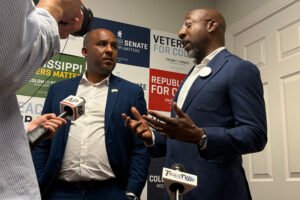
- Warnock wants Democrats to focus on the South. He’s starting in Mississippi.
- Retiring GOP congressmember will ‘absolutely not’ vote for successor in at-risk seat
- Sullivan walks the line with Trump in Alaska Senate race
-

 Politics2 years ago
Former ‘Squad’ members launching ‘Bowman and Bush’ YouTube show
-
Uncategorized2 years ago
Bob Good to step down as Freedom Caucus chair this week
-

 The Josh Fourrier Show2 years ago
DOOMSDAY: Trump won, now what?
-

 The Dictatorship2 years ago
Pete Hegseth’s tenure at the Pentagon goes from bad to worse
-

 Politics2 years ago
Former Kentucky AG Daniel Cameron launches Senate bid
-

 The Dictatorship2 years ago
Luigi Mangione acknowledges public support in first official statement since arrest
-

 Politics2 years ago
Blue Light News’s Editorial Director Ryan Hutchins speaks at Blue Light News’s 2025 Governors Summit
-

 The Dictatorship1 year ago
Mike Johnson sums up the GOP’s arrogant position on military occupation with two words