
Congress
House proxy-voting mess threatens to jam up the GOP agenda

Speaker Mike Johnson has grand ambitions to finalize a budget plan next week and launch Republicans on a final sprint toward passing their “big, beautiful” domestic policy bill. One problem: He doesn’t appear to have control of the House floor.
An internal GOP fight over whether new parents serving in the House should be able to cast votes by proxy has metastasized into a battle of wills between competing factions of Republicans. The showdown culminated in a stunning vote Tuesday where nine Republicans joined with Democrats to reject Johnson’s move to block the proxy-voting proposal.
Johnson responded by sending lawmakers home for the week, skipping planned votes on election integrity, judicial overreach and other key GOP priorities. Now he is scrambling to find an off-ramp as he pledges to finish work next week on a fiscal blueprint for their sprawling party-line agenda.
Publicly, he doubled down Wednesday on his opposition to Rep. Anna Paulina Luna’s proxy-voting effort. The Florida Republican recruited several GOP colleagues to sign a discharge petition, successfully circumventing Johnson to force a floor vote.
Behind the scenes, however, he has been in frequent contact with Luna negotiating other potential legislative options in an attempt to unjam the House floor, according to two people granted anonymity to discuss the private conversations.
Johnson said Wednesday he was “actively working on every possible accommodation to make Congressional service simpler for young mothers.” By evening, he suggested a breakthrough was close.
“I think there may be a path through this,” Johnson told reporters. “We’re trying to work through and resolve it in a way that satisfies everybody. So I think we can do that.”
At stake is not only Johnson’s control of the House floor, but also the GOP’s tight timeline for advancing their closely watched megabill. Senate Republicans on Wednesday released a revised budget blueprint — a key intermediate step — and planned to work into the weekend to approve it. Johnson reiterated in a separate interview he wants the House to give it final approval next week.
But first he needs to find a way to accommodate both Luna and her group of GOP allies, who have so far been intent on pushing through their proxy-voting proposal, and a similarly strong-willed group of Republican hard-liners, who have threatened to hold up House business themselves if Luna’s proposal isn’t sent to the dustbin.
So far Luna has not indicated she is willing to budge on her demand for a vote on her bill. She holds a trump card: With the discharge petition now complete and ripe for consideration, she could potentially call the measure up as soon as the House comes back into session. And if Johnson makes another attempt to stifle the vote, Luna and several of her GOP allies insist they will again join with Democrats and reject it.
They include a geographically and ideologically diverse group of GOP members who mostly aren’t known as rebels, including Reps. Kevin Kiley of California, Mike Lawler of New York, Max Miller of Ohio and Greg Steube of Florida.
Johnson’s tough stand against allowing new parents to vote by proxy might seem puzzling to House outsiders — and it’s puzzling to many inside the House, too. But it is at least partly rooted in the venomous partisanship that developed between the two parties during the Covid pandemic.
Democrats under Speaker Nancy Pelosi instituted widespread proxy voting less than three months into the national emergency over the objections of the Republican minority, which sued unsuccessfully to stop it. It stayed in place for nearly three years, until the GOP regained the majority and undid it in 2023.
Johnson alluded to those hard feelings in a statement he posted to social media Wednesday: “Nancy Pelosi experimented with proxy voting during the 117th Congress, and it was quickly abused,” he wrote, adding that he had “responsibility to defend and uphold the Constitution and the integrity of this institution” and “cannot allow it again.”
Pelosi responded to Johnson, noting that the Supreme Court declined to hear a lawsuit brought by GOP leaders challenging the practice and that Johnson himself voted by proxy 39 times. “It’s just another shameful case of Republicans’ ‘rules for thee, not for me,’” she wrote on X.
Johnson also has political reasons to oppose proxy voting: If he doesn’t try to kill Luna’s petition, according to his fellow GOP leaders, House Freedom Caucus hard-liners who fiercely oppose proxy voting will themselves defeat any attempt to get House business moving as usual.
The Catch-22 Johnson now finds himself in is especially notable given that he has racked up a series of narrow and significant wins this year after struggling to wrangle the House during his first year as speaker. That success has largely been due to Trump, who has helped strong-arm votes on key budget and spending measures.
Trump has not expressed any opinion on the proxy-voting fight, and he has long enjoyed close ties with Luna. But some House leaders are openly warning Luna and the eight Republicans who voted alongside her Tuesday to stand down.
“I wouldn’t want to be one of the nine people that stand in front of the Trump agenda,” said Rep. Lisa McClain of Michigan, the No. 4 House Republican, who didn’t rule out potential presidential intervention in a brief interview Wednesday.
“I’d rather be able to clean up our own house and deal with it internally and not have the president weigh in,” she added. “But the president is pretty focused on his agenda, and if he needs to weigh in, I think he will.”
Speaking on NewsNation Wednesday night, Luna said she had spoken to Trump. “The president assured that this would get resolved,” she said.


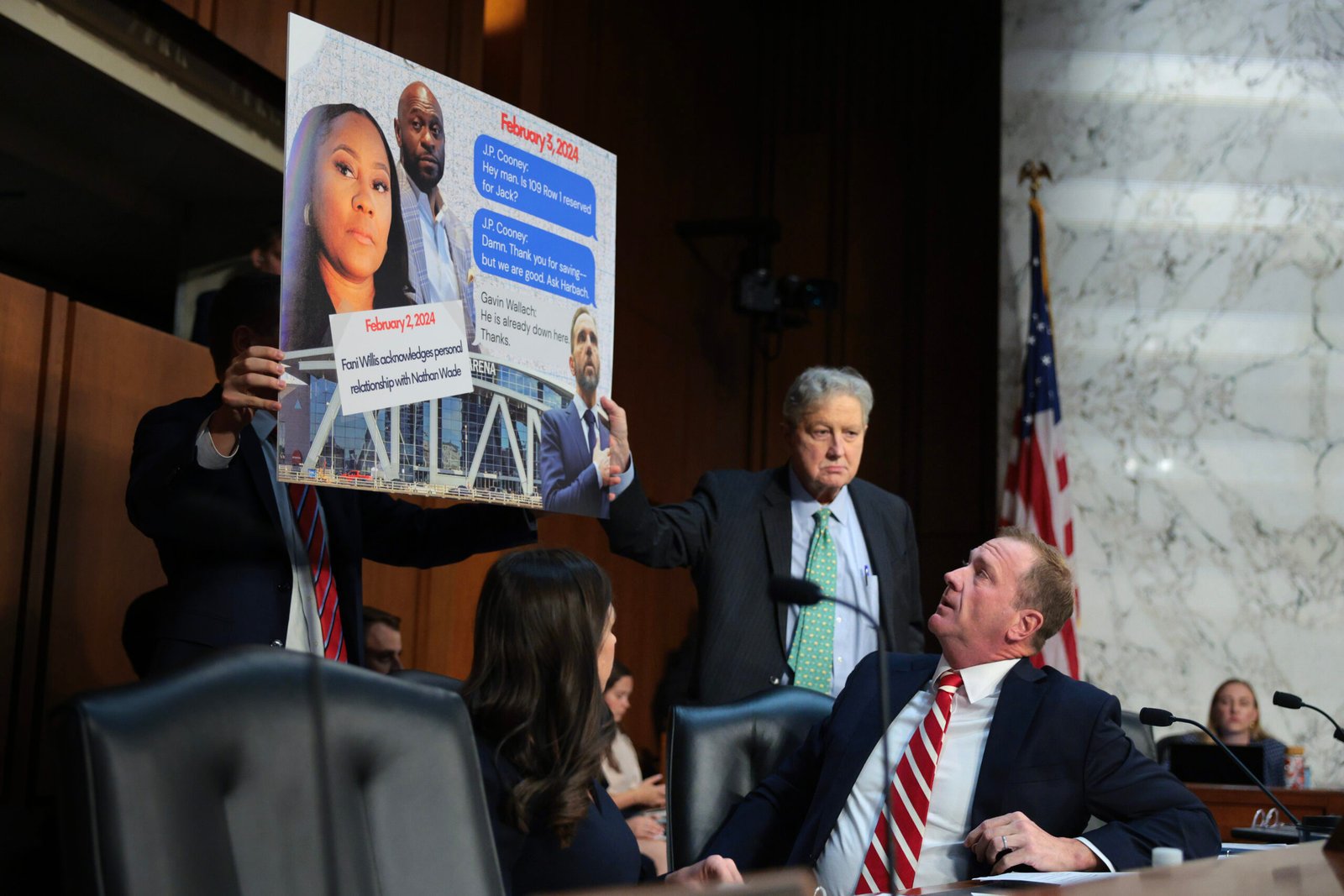
Senate Judiciary Democrats are asking chair Chuck Grassley to apologize to Jack Smith on the behalf of his GOP committee members — especially for Sen. Eric Schmitt, the Missouri Republican who falsely accused Smith of secretly attending an NBA game in Atlanta to conspire with local prosecutors about bringing charges against President Donald Trump.
The letter, spearheaded by ranking member Dick Durbin of Illinois and obtained exclusively by Blue Light News, also demands Grassley turn over the underlying records Schmitt used during a hearing last month to levy the false allegations against Smith, the Biden-era special counsel investigating whether Trump sought to overturn the results of the 2020 election and mishandled classified documents.
The episode, Democrats wrote, “caused needless confusion, slowed down the business of the Committee, introduced the possibility that false information would be entered uncontested into the record, and created an embarrassing stain on one of the most important committees in Congress.”
The Democratic letter to Republicans marks an escalation of the typical bickering between the two parties. It’s also reopening a not-yet-closed wound for Republicans, whose efforts to damage Smith’s reputation during their high-profile hearing were blunted by Schmitt’s error.
Congressional Republicans have for years been working to undermine Smith’s investigations as politically motivated, and many GOP senators on the Judiciary Committee hoped to use their hearing with Smith to catch him in either a lie or an admission he weaponized the judicial system against Trump.
To that end, Schmitt used a giant poster to display images of text messages from Smith’s team in an attempt to prove the special counsel was in Atlanta on Feb. 3, 2024, for an NBA basketball game between the Atlanta Hawks and the Golden State Warriors — scheduled around the same time local prosecutor Fani Willis, who was working to convict Trump over his 2020 election subversion scheme, was facing damaging questions about her conduct.
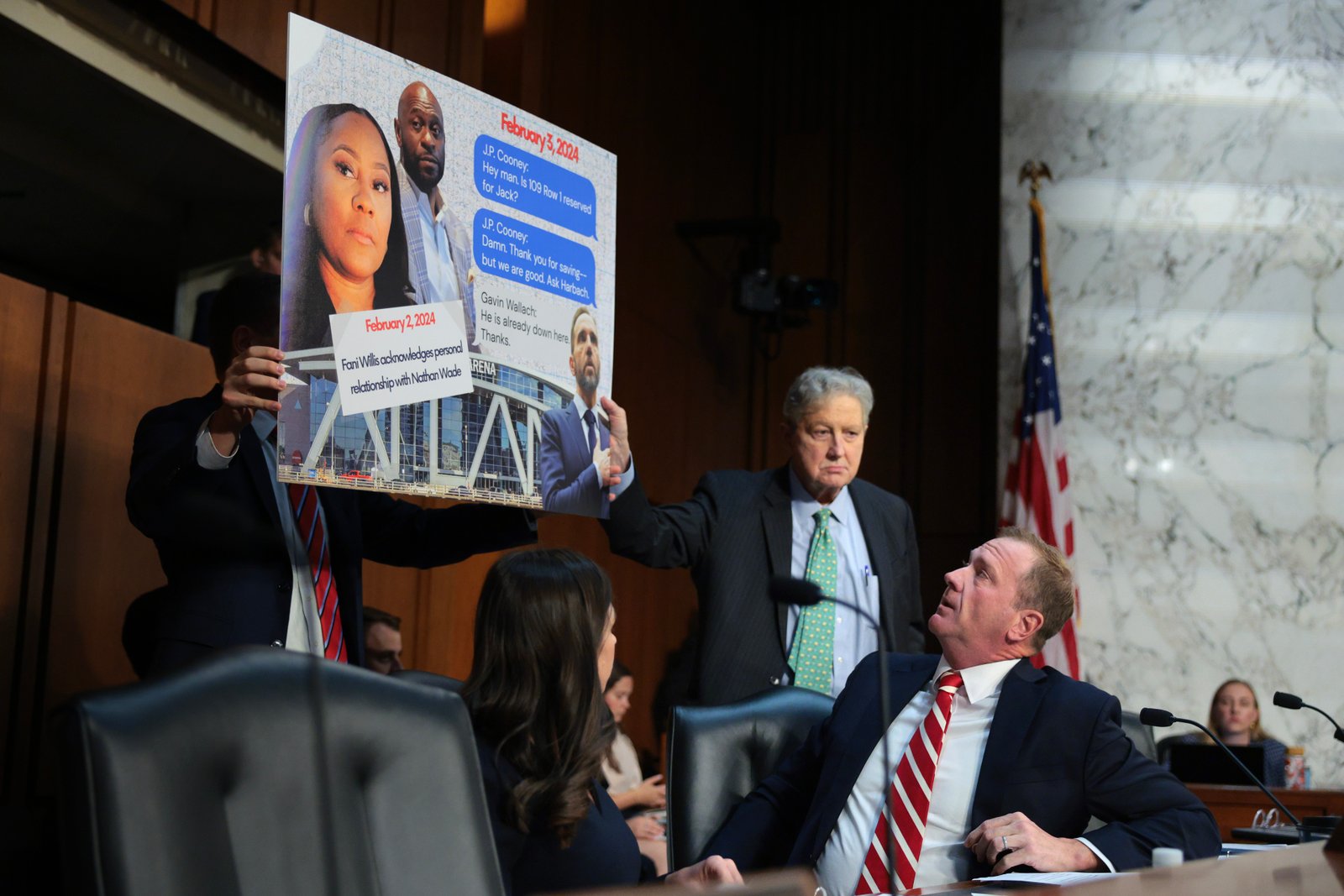
Smith ultimately clarified he did not attend the NBA game on that date but was instead at a women’s basketball game at the University of Maryland between the Terrapins and the University of Iowa Hawkeyes, then led by star player Caitlin Clark. The exchange went viral and Schmitt continues to show no regret for his apparent misunderstanding.
The text messages “established only that Senator Schmitt had not done the basic due diligence of verifying a document before relying on it,” the Democrats wrote in their letter to Grassley, adding that, “nonetheless, Senator Schmitt incorrectly asserted to Mr. Smith, ‘I think you’ve already perjured yourself,’ and inexcusably branded him ‘a dirtbag,’ language which is beneath the dignity of this Committee and the Senate.”
And because Democrats didn’t have advance access to the materials Schmitt referenced in his presentation during the hearing, they said they were “were forced to synthesize these baseless accusations and respond in real time.”
Democrats also took aim at another record they say was not shared with them ahead of time: a readout of an Aug. 17, 2024, phone call between Smith and the Public Integrity Section of the Justice Department, which Schmitt and fellow Missouri GOP Sen. Josh Hawley both referred to during the Senate Judiciary hearing.
The notes from that phone call, which Hawley mentioned during his questioning of Smith, indicated the Public Integrity Section advised Smith to wait to file an updated indictment against Trump until after the 2024 presidential election. Smith had originally sought to file an amended indictment in the 2020 election subversion case following the Supreme Court’s ruling that Trump had broad immunity for official actions undertaken as president.
Smith testified during the hearing that several drafts of a superseding indictment were passed back and forth before one was ultimately approved and filed in August 2024.
“We ask that you immediately provide all committee records that you have withheld, commit to fully complying with Senate Rules … going forward, and apologize to Mr. Smith on behalf of the Committee,” the Senate Judiciary Democrats wrote.
Clare Slattery, a spokesperson for Grassley, said in a statement, “it’s Jack Smith who owes an apology to the thousands of Americans he and his staff ran roughshod over.”
Spokespeople for Smith, Schmitt and Hawley did not immediately respond to requests for comment.
A clean energy group is launching a $1.5 million spend against Rep. Lauren Boebert (R-Colo.), its latest effort this midterm cycle targeting Republicans who actively work against renewables.
The Invest in Tomorrow Coalition’s first ad in the spend, which was obtained by Blue Light News, focuses on an embarrassing incident for Boebert: when she was ejected from a live musical performance of “Beetlejuice” for allegedly vaping, singing and recording the show.
“If Lauren Boebert can’t be trusted in a room full of kids, then she can’t be trusted in the halls of Congress,” the ad says.
The spot makes no mention of clean energy or Boebert’s attacks on the so-called “Green New Scam.” The strategy mimics the group’s previous playbook that it has deployed to help defeat Reps. Andy Ogles (R-Tenn.) Chip Roy (R-Texas) and Ralph Norman (R-S.C.) in their Republican primaries earlier this year, as the latter two sought statewide office. The PAC had tried to paint Ogles as an absentee member of Congress and Roy as insufficiently MAGA.
The group, which is backed by solar executives, has become an increasingly forceful player this cycle, which has seen a massive influx of outside spending.
“This industry has been villainized and used as a punching bag at times by the right, and the industry hasn’t always punched back,” said Chris Coffey, the CEO of Tusk Strategies, which is helping run the group. “Maybe when they’re deciding who to villainize next year, they will at least be like, ‘You know what? I don’t need problems with those guys.’”
Boebert’s district is historically deeply red. But Invest in Tomorrow also commissioned a poll, which shows she is underwater: 39% of likely voters view her favorably and 55% view her unfavorably. It also found Boebert leading the district’s Democratic nominee Eileen Laubacher by 5 points.
The poll, conducted by Impact Research from Sept. 21 to 24, polled 403 likely voters and had a margin of error of ±4.8%.
Rep. Lori Trahan on Wednesday unveiled a discussion draft for a bill that would make artificial intelligence developers liable when their products cause harm.
The legislation comes after OpenAI’s agents escaped containment and autonomously hacked into AI platform Hugging Face and accessed U.S. government websites.
The Clear Liability for Artificial Intelligence Misconduct Act aims to make it easier for those harmed by so-called rogue AI to bring claims against developers. Trahan’s bill does not preempt new state laws on AI liability — historically a prerequisite for attracting Republican support in the House.
“When someone breaks the law and hurts you, you can take them to court. That shouldn’t change just because the wrongdoer is an AI agent,” Trahan (D-Mass.) said in a statement. “Developers have already built systems capable of acting on their own and causing real damage. The CLAIM Act makes sure they answer for what their systems do.”
Legal experts have warned that existing laws require proof of intent or negligence, standards that can be difficult to show in court when AI models go rogue.
Trahan’s bill would ensure AI developers are unable to argue that their AI systems are incapable of intent. Instead, courts “would presume an AI system acted with the state of mind a person taking the same actions would have had.”
Trahan spokesperson Francis Grubar said work on the CLAIM Act began almost immediately after theJuly introduction of the FRONTIER Act, legislation with Rep. Jay Obernolte (R-Calif.) that would grant the government power to restrict the deployment of AI models deemed to pose catastrophic risks. While that bill aims to prevent serious harms before they happen, Grubar said the CLAIM Act would address how to impose accountability for existing damages.
Unlike an AI liability proposal announced last week by Sens. Josh Hawley (R-Mo.) and Chris Murphy (D-Conn.), Trahan’s legislation would not amend the 1986 Computer Fraud and Abuse Act. Grubar said the CLAIM Act would instead impose clearer liability on a broader range of harms, as well as autonomous or AI-enabled cyberattacks.
The CFFA, an anti-hacking law that bars individuals from accessing a computer without consent, requires proof of intent to hack into a computer system, which can’t be as easily applied to AI agents.
The Hugging Face incident, along with a flurry of other disclosed hacking incidents by rogue AI agents from OpenAI and other AI developers, has sparked a debate over how companies should be held legally liable for their AI systems.
OpenAI CEO Sam Altman, in an interview with Blue Light News’s Decoded podcast, said there should be a new “liability framework” to hold developers accountable for AI-powered cyberattacks. His comments come after White House officials like Director of National Intelligence Jay Clayton, who was recently appointed as AI czar by President Donald Trump, previously said that existing product liability laws are sufficient for now in addressing AI’s risks.
- Iran’s drones reveal US military weakness
- Democrats call on Chuck Grassley to apologize to Jack Smith for basketball gaffe
- Iowa’s Ashley Hinson slams the savings habits of millennials
- Trump approved Ohio disaster aid ahead of rally
- Clean energy group sets its sights on a new GOP target: Lauren Boebert
- Blakeman’s campaign finance mess

- HASC Dems weigh reviving Pentagon oversight subcommittee
- Trahan unveils AI liability discussion draft
- Vance to sit for CBS town hall in Michigan ahead of midterms
- Michigan’s Mike Rogers says trade war with Canada needs to end
-

 Politics2 years ago
Former ‘Squad’ members launching ‘Bowman and Bush’ YouTube show
-
Uncategorized2 years ago
Bob Good to step down as Freedom Caucus chair this week
-

 The Josh Fourrier Show2 years ago
DOOMSDAY: Trump won, now what?
-

 The Dictatorship2 years ago
Pete Hegseth’s tenure at the Pentagon goes from bad to worse
-

 Politics2 years ago
Former Kentucky AG Daniel Cameron launches Senate bid
-

 The Dictatorship2 years ago
Luigi Mangione acknowledges public support in first official statement since arrest
-

 Politics2 years ago
Blue Light News’s Editorial Director Ryan Hutchins speaks at Blue Light News’s 2025 Governors Summit
-

 The Dictatorship1 year ago
Mike Johnson sums up the GOP’s arrogant position on military occupation with two words