
Congress
He’s facing very long odds. So why are New York Republicans betting on Bruce Blakeman?

ALBANY, New York — Empire State Republicans expect Nassau County Executive Bruce Blakeman to turbo charge down-ballot turnout as their party’s gubernatorial nominee — boosting GOP candidates in crucial suburban swing races as he mounts an otherwise uphill battle to unseat Democratic Gov. Kathy Hochul.
If Blakeman falls short in an underdog bid, New York Republicans can still be successful in what’s shaping up to be a tough political environment.
“Blakeman’s top appeal for Republicans, particularly in swing suburbs, can be realized even if he loses,” said Larry Levy, dean of the National Center for Suburban Studies at Hofstra University. “He could help them on Long Island, Westchester and the Hudson Valley to possibly win seats that could make a difference on which party controls the gavels in Congress. Blakeman is in a position to do that.”
Who leads the Republican ticket in this deep blue state will have critical implications for competitive House races that stand to determine which party will control the narrowly divided chamber and the course of President Donald Trump’s final two years in office. Blakeman’s coattails offer one possible remedy to GOP headwinds in next year’s midterm elections, as Democrats seize on affordability issues and stoke their base’s anger at the sitting president’s policies.
Blakeman, 70, is now the likely Republican nominee for governor after Rep. Elise Stefanik abruptly suspended her campaign last week. Stefanik and Blakeman are both Trump allies, and the 41-year-old upstate New York House member is far better known statewide.
Unlike Stefanik, Blakeman hails from a vote rich political bellwether in a state that’s otherwise dominated by Democrats. He is a self-described “pro-choice” Republican — a stance that will likely attract some independent and conservative Democratic voters. And he has cultivated a mutually beneficial relationship with The New York Post, the influential conservative tabloid that’s part of Trump’s media diet.
His bid is still considered a longshot against Hochul, who led Blakeman by 25 points in a Siena University poll this month. He remains largely unknown to most New Yorkers, and Republicans are trying to reverse a 23-year losing streak in statewide elections. Blakeman’s prior statewide bid for a U.S. Senate seat ended with a loss.
In an interview, Blakeman pointed to his ability to win in a large, diverse suburban county as a sign that he can be successful statewide.
“I want our congressional and Senate and Assembly and local candidates to be successful as well,” he said. “If you look at the demographics of Nassau County, we match the state almost as a mirror image. I feel very confident we’re going to win.”
New York Republicans know the power the top of their party’s ticket can wield in a midterm election. Then-Rep. Lee Zeldin’s 2022 campaign came within 6 points of defeating Hochul, but the Long Islander’s strong suburban showing was credited with helping sweep several House Republicans into office. GOP leaders are poised to replicate that plan in 2026 — a doubling down on a suburban strategy that will also tie all Democrats, including Hochul, to New York City Mayor-elect Zohran Mamdani.
Republicans want to cast the 34-year-old democratic socialist as a lightning rod. Blakeman, whose day-to-day movements are covered in the Big Apple’s media market, would have easy access to blast the left-leaning mayor’s policies.
The most immediate impact may be on the Long Island districts led by moderate Democratic Reps. Tom Suozzi and Laura Gillen — both of which will be top GOP targets.
“It’s definitely going to put those two Nassau seats, Suozzi and Gillen seats into play,” said Conservative Party Chair Gerard Kassar. “I already thought the Gillen seat would be a top seat in the nation. Suozzi has a number of solid candidates nipping at his toes there to begin with. If I was residing in Nassau County and looking for some very positive results in 2026, I think I just hit the jackpot.”
Suozzi and Gillen campaign representatives pointed to their work with Republicans and ability to win swing seats regardless of the top of the ticket.
“Everyone knows that Tom Suozzi works across the aisle in Congress to take on the affordability crisis, lower healthcare costs, fix the immigration mess and keep our communities safe,” said Kim Devlin, a Suozzi senior advisor. “That’s why he was able to win his district, even while Trump won it as well. People are sick of partisanship and that’s why they will re-elect Tom Suozzi.”
The Gillen campaign offered a similar assessment, noting that she “has a proven record of embracing bipartisanship to achieve results to lower the costs of living and improve public safety.”
“In fact, Bruce Blakeman endorsed her and served as her deputy Supervisor,” a campaign spokesperson said. “Her moderate approach, that prioritizes Long Islanders over politics, is why Rep. Gillen will be re-elected in November.”
Democrats have dominated New York statewide elections since George Pataki left office in 2006. The party lost its final toehold on power in Albany after losing control of the state Senate in 2018. But Republicans continue to maintain competitive races in suburban enclaves, where voters are sensitive to high taxes and concerned about public safety.
“You’re always more likely to lose than win as a Republican in New York, but I think he’s going to be our strongest statewide candidate since George Pataki,” said Republican operative Chapin Fay. “He’s winning in a blue area and he’s sort of MAGA without a lot of the baggage.”
Ensuring success in down-ballot races will be paramount for local Republican leaders with many municipal races switching from low-turnout odd-years to even-numbered years, when more people are expected to vote. That means races for GOP-held seats on some town and village boards and county legislatures may take on a more competitive tilt — threatening Republican power on the local level.
In Nassau County, where Blakeman has served as the top elected official since his 2021 victory, Republicans maintain a robust political operation led by Chair Joe Cairo. Despite widespread GOP losses last month, Nassau County Republican candidates overperformed, Blue Light News reported. Those results underscore the potential strength of Cairo’s voter turnout effort.
“To me, it’s a good strategy,” said Assemblymember Ed Ra, a Nassau County Republican. “It helps when we have a couple of House races that we think are going to be very competitive. For us in the Legislature, we think having a suburban, well-known, well-liked candidate is going to be a positive.”
Long Island is a major prize for any statewide candidate — and the suburbs have been trending Republican this decade with voters activated by concerns over crime and Democratic-backed criminal justice reforms.
New York Democrats acknowledge Blakeman’s strength in Nassau County in particular will present a challenge for down-ballot candidates.
“He will have an organization working for him in Nassau County,” said Jay Jacobs, who serves as both the statewide Democratic Committee chair and the Nassau County Democratic leader. “But I would say that while it certainly will be a factor that we have to take into account in those congressional races and down-ballot races, he likes to tout his great win and his perceived popularity, but we don’t see it that way and our polling doesn’t show it that way.”
Hochul, a Buffalo native, has struggled in the New York City suburbs.
The governor and Jacobs publicly disagreed over supporting Mamdani’s candidacy as her hand-picked party chair moved to distance suburban Democrats from the incoming mayor. She lost Nassau and Suffolk counties to Zeldin three years ago. Hochul was also forced to retool a controversial home building and zoning proposal amid a bipartisan revolt on Long Island.
Hochul on Monday pointed to her efforts addressing crime, housing and jobs on Long Island.
“We will do very well on Long Island,” she predicted. “I’ve spent an enormous amount of time on Long Island.”
Blakeman’s political vulnerabilities may still complicate matters for Republicans. A liberal stance on abortion is unnerving conservative voters the party can’t afford to have stay home. Upstate Republicans, slighted by yet another New York City-area nominee, will have to be won over. Trump’s unpopularity in his native state is also expected to work against Blakeman, who was endorsed by the president over the weekend.
Hochul, too, is expected to be a more formidable incumbent than she was three years ago when she was still a rookie governor and running in a backlash year for her party. The Democratic governor is a formidable fundraiser and she has also worked to build up the state Democrats’ political infrastructure to buttress vulnerable candidates running below her on the ballot.
Her campaign moved swiftly to define Blakeman, who remains unknown to 70 percent of voters, the Siena poll found, saying Blakeman “has gone all-in on Donald Trump’s deeply unpopular MAGA movement.” And Hochul questioned whether he ultimately would be the nominee.
“The Republican Party is in such chaos, I’m not even sure he’s going to end up being the nominee. This changes by the hour,” Hochul told Blue Light News at a news conference. “I’m not going to speculate about the prospective opposition, other than knowing it’s going to be a MAGA, Trump-endorsed Republican.”
Bill Mahoney contributed to this report.


House Speaker Mike Johsnon said he plans to send President Donald Trump a bipartisan housing bill Monday, just days after the president abruptly canceled a signing ceremony for the legislation after Congress failed to pass his elections security act.
Speaking with Fox News’ “Sunday Morning Futures,” Johnson said the 21st Century ROAD To Housing Act is a Republican priority for lowering costs for Americans.
“I’m going to send the bill over to him on Monday, and it will become law,” the Louisiana Republican told host Maria Bartiromo. “I certainly want him to take the biggest, boldest marker that he has and do that big Trump signature proudly on that legislation because we’re delivering for the people, and that’s what he wants to do.”
The White House did not immediately respond to a request for comment on Johnson’s remarks.
The bill is the product of almost a year of back-and-forth between all four congressional corners and aims to increase affordability by boosting housing supply and home ownership. It passed both chambers of Congress with wide bipartisan support.
Trump was scheduled to sign the bill into law last week but canceled the ceremony “until such time as we pass the desperately needed SAVE AMERICA ACT, which I consider to be a National Emergency.”
Trump’s SAVE America Act would require voters to present a photo ID at the ballot box and effectively end mail-in voting. Trump has also said he would like the bill to include prohibitions on transgender athletes competing. But Republican leaders have repeatedly indicated the legislation does not have enough votes to pass.
Congressional leaders appeared taken aback by Trump’s signing cancellation, but Johnson on Sunday said he and the president have since met in the Oval Office to discuss the housing bill “in great detail.”
“We made a lot of promises to the voters, and we’re fulfilling those every single day of this Congress,” Johnson said. “This is a big part of that because this will increase the availability, the access to more housing, bring down cost, cut regulations, do the things we know are very important for that market. The president and I talked about that at length. Of course he wants to do those things.”
But if Trump does not sign the housing bill into law within the next few days, it would still become law unless he were to veto it. Congress also has the power to override a presidential veto.
Sen. Thom Tillis on Sunday expressed frustration with President Donald Trump’s continued fixation on passing the SAVE America Act.
In an interview with BLN’s “Face the Nation,” the retiring North Carolina Republican lamented “the impossible task” of implementing the requirements of the legislation ahead of November’s crucial midterms.
“Why are we doing more things to undermine our confidence in elections, rather than getting the strong message out that will win for Republicans this year?” Tillis said.
Rather than promoting the bill — which would require voters to present a photo ID at the ballot box and effectively end widespread mail-in voting — Tillis said Republicans should tell voters about “the rise of the Democratic Socialists of America” while accepting the current voting laws.
“Win by the good results that Republicans have produced and stop undermining the confidence in the elections,” said Tillis. “This is a bedrock of our 250-year history of success as the democracy that changed the world. Let’s not mess with that between now and November.”
Trump has said the SAVE America Act is his “No. 1 priority” ahead of midterms, going so far as to abruptly cancel a bill signing for major bipartisan legislation on housing affordability until Congress passes his elections bill. But many Democrats are staunchly against the bill, arguing it could disenfranchise millions of voters, and Republican leaders in Congress have repeatedly indicated it does not have the votes to pass.
Tillis co-sponsored the original SAVE America Act but has objected to Trump’s version of the legislation, which would also bar transgender athletes from women’s sports.
It’s not the first time Tillis has clashed with Trump.
Earlier this year, Tillis blocked Trump’s Fed chair nominee, Kevin Warsh, until the Justice Department dropped an investigation into Federal Reserve Chair Jerome Powell. He has also spoken out against the Justice Department’s $1.776 billion “Anti-Weaponization Fund,” calling it a “payout for punks.” And he has emerged as a fierce critic of Bill Pulte, Trump’s interim director of national intelligence.
“Let’s try and figure out a way to completely and finally end these distractions so that we can focus on the damage Democrats could do if they take the House, if they beat incumbent Republicans in the Senate. That’s what Republicans need to be talking about between now and November,” Tillis said Sunday.
Sen. Bill Cassidy appeared to question President Donald Trump’s view of Congress, saying in an interview that he is not sure Trump grasps that Congress “is a separate body, separate from the presidency.”
“Sometimes he acts as if Congress is merely an appendage, and, frankly, sometimes Congress acts like it’s an appendage,” the Louisiana Republican said in a pre-taped interview with CBS’ “Face the Nation” that aired Sunday.
The latest criticism in a public clash between the two leaders, Cassidy also told host Margaret Brennan that he would be focused on affordability, including the cost of health care and groceries, if he were president.
“If I were president, I would be focused on those people that they have, my people, our people, us at the kitchen table. How do you make their life better? And that’s what I think the president should be focused on,” Cassidy said.
The relationship between Cassidy and Trump has been rocky for some time. Cassidy was one of only a handful of Republican leaders who voted to convict Trump for his role in the Jan. 6, 2021, insurrection.
Trump and Cassidy recently clashed in a closed-door meeting between GOP leaders, with Cassidy admitting he raised his voice to “match” the president’s.
“The president said something negative about me. I received it as attempting to bully me from asking a question that I think the American people need to know, and I’m not going to be bullied,” Cassidy said at the time.
However, after receiving a special briefing from Vice President JD Vance and special envoy Steve Witkoff, Cassidy changed his vote on a resolution designed to rein in Trump’s power to wage war against Iran.
“They said right now the negotiations are delicate, and they could collapse if they’re not nursed along in the appropriate way. I can accept that,” Cassidy said.
“That’s the reason they said for their kind of lack of being forthcoming. I can accept that, but my goal was to be briefed, to have the truth in order to make a decision for the benefit of my country, and that was satisfied.”
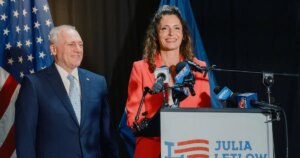
Still, Cassidy’s stance against Trump has cost him: After serving more than a decade in the Senate, Cassidy lost his campaign for renomination after Trump endorsed against him. Rep. Julia Letlow will be the Louisiana Republican Senate candidate this fall.
- The Lincoln Memorial should be green with envy: This reflecting pool stayed clear

- Anna Paulina Luna has paralyzed the House, and fellow Republicans are mystified

- Capitol agenda: House GOP agenda gets tenuous Trump lifeline

- The Lincoln Memorial should be green with envy: This reflecting pool stayed clear
- Capitol agenda: House GOP agenda gets tenuous Trump lifeline
- Iranian diplomat blasts ‘pseudo-VAR’ interventions after World Cup exit
- Rep. Julia Letlow wins Louisiana GOP Senate primary runoff
- ‘Horrifying’: Pulte’s choice for top spy aide stokes fears of Trump vote tampering

- In Springfield, Ohio, Trump’s rhetoric becomes a grim reality
- Jeffries congratulates NYC democratic socialists on their House primary wins
-

 Politics1 year ago
Former ‘Squad’ members launching ‘Bowman and Bush’ YouTube show
-

 The Dictatorship1 year ago
Luigi Mangione acknowledges public support in first official statement since arrest
-

 Politics1 year ago
Former Kentucky AG Daniel Cameron launches Senate bid
-
Uncategorized2 years ago
Bob Good to step down as Freedom Caucus chair this week
-

 The Josh Fourrier Show2 years ago
DOOMSDAY: Trump won, now what?
-

 The Dictatorship1 year ago
Pete Hegseth’s tenure at the Pentagon goes from bad to worse
-

 Politics1 year ago
Blue Light News’s Editorial Director Ryan Hutchins speaks at Blue Light News’s 2025 Governors Summit
-

 The Dictatorship10 months ago
Mike Johnson sums up the GOP’s arrogant position on military occupation with two words