
Congress
Chuck Schumer’s critics are praising how he’s handled the shutdown. For now.

Chuck Schumer ended the last shutdown standoff as a villain to Democrats outraged at his decision to surrender to Republicans. This time, the Senate minority leader has heeded the party base, sparking a showdown that has kept government agencies closed for eight days and counting.
So far, his former critics are impressed. But that doesn’t mean they trust him.
A Blue Light News survey of lawmakers and activists found Schumer has exceeded their low expectations heading into the current shutdown, but they’re still watching his every move closely amid persistent doubts that Senate Democrats will hold the line against the GOP.
“He hasn’t surrendered yet,” said Indivisible co-founder Ezra Levin, who called on Schumer to step down in March. “I call that progress, and we’re cheering him on now.”
Rep. Glenn Ivey (D-Md.), who said in March “it may be time” for Schumer to step aside, is now pleased with the top Senate leader’s coordination with top House Democrat Hakeem Jeffries — at least “at this point.”
“I think it looks great right now,” Ivey said, adding that the collaboration between the two leaders was “moving things in the right direction for both the House and the Senate Democrats.”
The guardedly positive reviews for Schumer’s leadership come as the shutdown fight enters a politically perilous new phase. Real-world impacts of the funding lapse are likely to mount in the coming days, with most federal workers set to miss a paycheck Friday and active-duty troops next Wednesday.
Air travel has been sporadically affected due to shortages in air traffic controllers, and Smithsonian museums are set to close later this week, to name a few of the mounting consequences. All but three Senate Democrats voted Wednesday for the sixth timeagainst a House-passed bill that would reopen the government.
Senior Republicans have put Schumer at the center of their shutdown blame game, asserting that it’s his fear of the Democratic base — and specifically, a possible 2028 primary challenge from Rep. Alexandria Ocasio-Cortez — that is prolonging the impasse.
House Majority Leader Steve Scalise accused Schumer Wednesday of “throwing a tantrum”, while Speaker Mike Johnson said the New York Democrat was engaged in “desperate attempts to rehabilitate his own image” by bowing to “the Marxist flank of their party.”
“They’re coming for him,” Johnson said.
There’s some truth to those charges. One House Democrat, granted anonymity to candidly discuss the shutdown dynamics, said they would publicly call for Schumer to give up his leadership post if he folds now.
An aide to a senior House Democrat agreed that the dam could break should that happen, saying a significant number of lawmakers would be inclined to push for Schumer’s ouster.
Back in March, House Democrats united against the GOP spending bill. In the Senate, however, Democrats were divided on how to proceed on legislation that had no guardrails to prevent the White House from clawing back congressionally approved spending.
As the deadline approached to avoid a funding lapse, Schumer capitulated, saying he feared a shutdown could allow President Donald Trump to unleash more havoc on federal agencies and workers. He and nine other Democrats voted to advance the Republican bill.
That prompted a handful of House Democrats to publicly call for Schumer to step aside as leader, with some even mulling whether to back a primary challenger against him. Underscoring the House frustrations, Jeffries conspicuously sidestepped questions about Schumer’s leadership at a news conference.
Now Schumer and Jeffries are in much closer coordination, arguing in lockstep that Trump is dead set on unleashing havoc, shutdown or not. They’re also saying it is imperative for Republicans to address health care as a part of any government funding package — specifically by extending enhanced health insurance subsidies that will expire on Dec. 31 unless Congress acts.
Asked Wednesday whether he was acting out of fear of his party’s left flank, Schumer insisted to reporters that was not the case.
“The bottom line is very simple: We’re fighting for the American people,” he said. “Fifty-five percent of Trump voters, hardly a flank in our party, want [the subsidies extended]. That’s why we’re doing it. We believe that’s our job. The American people are crying out for help.”
Still, there are some divides between the two leaders. Jeffries has noticeably staked out tougher demands and a harsher tone in the shutdown fight than Schumer — arguing, for instance, that any deal on the health subsidy extension needs to be written into “ironclad” legislation. Democrats in both chambers are also demanding an end to “rescissions,” or Trump administration attempts to revoke funding for programs previously enacted by Congress.
Schumer, meanwhile, has resisted drawing red lines as many of his members signal they’d be willing to open up the government for something less than a final enacted health care deal. “I’m not going to negotiate in public,” he said Wednesday. “We have to do something. We have to extend these credits.”
That split between the two leaders has made some of Schumer’s critics distrustful, with many keeping a close eye on the thus-far-infomal bipartisan talks involving some of the Senate Democrats who voted to advance the GOP bill in March.
Wary progressives believe those senators — perhaps with Schumer’s blessing — will agree to reopen the government in exchange for no more than a verbal assurance to continue negotiating an extension to the subsidies that Republicans could renege on later.
“A handshake agreement is capitulation,” Levin said. “Health care and rescission language is the demand, and it’s broadly popular. No reason to cave for less.”
Rep. Troy Carter (D-La.) told reporters last week, “The American people cannot live on promises.”
For now, however, Democrats are reveling in moments of GOP disunity this week exposed by splits on handling the expiring insurance subsidies as well as the Trump administration’s escalating threats against federal employees, including mass firings or the withholding of back pay for furloughed workers. That has only hardened Democrats’ resolve to continue the shutdown.
Sen. Chris Murphy (D-Conn.), who broke with Schumer on the March vote and called on Democrats at that time to “stand up and take some risks,” said this week that he has been pleased by the new tone set at the top.
“A lot of people wondered whether we would be bullied again, and we have not been,” he said. “So I think Sen. Schumer understands the gravity of this moment.”
“The Senate is doing exactly what we need them to do,” added purple-district Rep. Derek Tran (D-Calif.).
But Rep. Jimmy Gomez, another California Democrat, said he was content to watch Schumer manage the politics of his own chamber, saying those threatening to oust him as leader were “just all posturing.”
“It’s easy for us to say that,” he said. “If their own delegation starts turning on them — New York — that’s a different story.”
Jordain Carney contributed to this report.


Sens. Susan Collins and Patty Murray have long prided themselves on working together to advance government funding bills. That collegiality is now showing signs of decay.
The Maine Republican and Washington Democrat have been openly feuding about the path forward on spending measures this summer. It comes after their successful collaboration on bipartisan legislation during Murray’s two-year reign as chair of the Senate Appropriations Committee, which continued when Collins took the gavel last year.
Democrats attribute the clash to Collins’ pursuit of President Donald Trump’s demands for a record military budget that eclipses domestic spending, as she fights to retain her Senate seat in November. Republicans say Murray is playing midterm politics by trying to prevent Collins from landing a deal before Election Day, when Democrats hope to regain House and Senate majorities — and the upper hand in year-end funding talks.
“It’s not personal, but it is very frustrating,” Collins said last week, while insisting she and Murray are still on good terms.
All Murray would say about the state of their relationship was, “We’re talking.”
While that impasse doesn’t necessarily heighten the odds of a government shutdown this fall, it could delay any meaningful Senate appropriations action until after the elections. The outcome of congressional races — including Collins’ toss-up contest against Democrat Graham Platner — could change the power balance in government funding negotiations.
“It certainly looks to me like the Democrats don’t want to give Susan Collins a victory,” House Appropriations Chair Tom Cole (R-Okla.) said in an interview. “I really think it’s intensely political. She is a very reasonable legislator. If you can’t make a deal with Susan Collins, you don’t want to make a deal.”
Part of Collins’ campaign-trail pitch to Mainers is that she gets results in Washington, and her inability to advance the dozen annual appropriations bills through her committee undercuts that narrative.
Collins isn’t refuting the idea that Democrats might want to deprive her of legislative success as she competes against Platner in one of the closest and most-watched races in the country.
“That’s certainly a viable theory, which is pretty pathetic,” she said in an interview.
This month Collins publicly accused Murray of sending government funding offers that have “made it clear that Democrats are abandoning the appropriations process.” Murray, meanwhile, suggested Collins was at fault for the stalemate by divulging she hadn’t responded to Murray’s latest offer in more than two weeks.
It’s a major tone shift for the two lawmakers, who have earned a reputation for trying to stay out of the partisan fray since they became their party’s top leaders on the Appropriations Committee in 2023. They’ve consistently resisted broadcasting behind-the-scenes friction during tough negotiations and succeeded in reaching cross-party compromises to advance funding bills each year — even after the record government shutdown last fall.
But they’re now at loggerheads over funding totals for the military and domestic programs, along with votes on hot-button Trump policies. Senate Republicans are seeking a military funding boost more than four times larger than any increase in domestic spending, as Trump calls for a record $1.5 trillion defense budget.
“We do not have an agreement,” Murray said, because Republicans “are set on increasing defense in an increasingly huge way that we’ve never had to deal with before.”
GOP senators also want to avoid any amendment votes that could sink approval of appropriations bills, including some related to the Justice Department’s “Anti-Weaponization Fund” administration officials have promised not to pursue.
The result is that Collins has yet to hold a committee markup on a single government funding bill with just three months left before federal dollars expire. And some Republican appropriators acknowledge it’s possible the panel won’t vote on any of the spending measures this year given the deadlock.
“Obviously Susan is up this year. And Democrats, at every level and every opportunity, are playing politics with it,” Senate Majority Leader John Thune said in an interview. “The appropriations process used to be fairly bipartisan. … Murray and the Democrats have turned it into a partisan game.”
Some Democrats openly sympathize with Collins’ predicament in trying to represent politically moderate Maine while holding one of the most influential positions on Capitol Hill during Trump’s second term and unified Republican control of Congress.
“The chair of the committee is being squeezed in every direction,” Wisconsin Sen. Tammy Baldwin, a senior Democratic appropriator, said in an interview.
Many Senate Republicans don’t “give a damn” about funding domestic efforts like public education and biomedical research, Baldwin continued. “I believe that the chairwoman does care about those issues. But you know, she’s in an unenviable position.”
Since Trump was reelected, Collins has worked to negotiate funding bills that spend far more on domestic programs than the president sought. The result has been essentially flat funding for nondefense programs and a 17 percent increase in military spending, which includes the billions of dollars Republicans enacted along party lines last year.
“Chair Collins is very devoted to, or interested in, following through to help the president get more money for the Department of War and munitions, et cetera,” said West Virginia Sen. Shelley Moore Capito, a top Republican appropriator. “And I think Senator Murray is on the opposite page.”
“Rather than legislate and work these things out,” Capito added, “I think it’s been decided on the other side to just be obstinate and not participate and not negotiate.”
Trump is calling this year for boosting Pentagon spending by more than 40 percent while slashing domestic programs by 10 percent. Illinois Sen. Dick Durbin, a senior Democratic appropriator who has served in Congress for more than 40 years, calls it “a massive change” in the way government funding has been divvied up for decades — by negotiating matching dollar-for-dollar increases in both military and nondefense funding.
“We’re so far apart. We haven’t faced anything like that in recent memory,” Durbin said in an interview. “And to accept the premise of it — what’s left for nondefense is terrible.”
Collins could proceed with markups this summer without an agreement with Democrats, as the House Republican majority has done for years. But Republican senators would need to be willing to vote on controversial amendments Democrats might offer — including proposals that defy Trump.
Senate Republican appropriators faced that issue last summer, when the panel unexpectedly adopted an amendment barring the Trump administration from repurposing cash intended for relocating the FBI headquarters. That outcome prompted several GOP senators to withdraw support for the funding bill.
“The challenge is that, if you have every Democrat voting against reporting the bill out — and then they also are offering poison pills — it’s hard to move those bills,” Sen. Jerry Moran (R-Kan.), chair of the Appropriations subcommittee that funds the FBI, said in an interview.
During the two years Murray chaired the full committee, Moran recalled, “We had members who wanted to offer what would probably be considered poison pills by Democrats. And Senator Collins talked Republicans out of doing so, to move the process.”
The two sides could easily reach an agreement on amendments and policy stipulations, some Democrats contend, if only Collins and Murray could bridge the divide between the president’s military funding demands and their own domestic priorities.
“Senator Collins is carrying out the administration’s wishes,” Oregon Sen. Jeff Merkley, another senior Democratic appropriator, said in an interview. “And Senator Murray is noting that a reckless increase in defense spending is not in the best interest of Americans.”
“So they’re both advocating for their viewpoint,” Merkley added. “That’s what we do in a democracy.”
Katherine Tully-McManus contributed to this report.
The House Rules Committee advanced a procedural measure aimed at breaking an intra-Republican deadlock Monday night. But GOP leaders are still facing a major battle Tuesday to regain control of the House floor.
The panel approved on party lines a measure to set up Republicans’ $1.1 trillion defense policy bill, a government funding bill and other GOP bills for floor debate. It would then combine the Pentagon bill, once passed, with the contentious elections overhaul known as the SAVE America Act and send it to the Senate as one piece of legislation.
That maneuver, telegraphed by Speaker Mike Johnson earlier Monday, is aimed at appeasing House GOP hard-liners who have blockaded the floor, demanding the Senate pass the elections bill that has languished there for months.
However, Rep. Anna Paulina Luna of Florida, the Republican leading the blockade, said in an interview Monday before the Rules Committee acted that Johnson’s plan is not sufficient — raising the possibility she and allies could vote down the measure on the floor. Other House GOP hard-liners say there are other outstanding issues to battle over Tuesday.
Rep. James McGovern of Massachusetts, the top Rules Democrat, called the merger move “a big waste of time.” The panel voted down a motion by McGovern to remove the provision to combine the two bills in a party-line vote.
The Senate is set to debate its own version of the defense bill next month, and it is likely that the elections overhaul will be removed in negotiations between the two chambers — as McGovern acknowledged Monday and House GOP leaders privately concede.
“The Senate will just strip the SAVE Act out,” he said at the meeting. “There is a zero percent chance SAVE ends up in the [Pentagon bill] because of this rule today.”
The defense bill faces a tight vote if Republicans can pass the procedural measure. Most Democrats are expected to oppose the measure over its massive price tag, which they contend is wasteful.
The panel is set up debate on 312 amendments to the bill. The slate includes GOP measures to codify a Trump executive order to block transgender people from serving in the military, prohibit coverage of gender-affirming care, block aid to arm Ukraine and strip Democratic-backed protections for collective bargaining for Pentagon civilian workers.
The committee also voted down Democratic proposals to slash $150 billion from the bill’s topline and limit the war against Iran.
Mia McCarthy contributed to this report.
Speaker Mike Johnson said Monday he plans to deploy an unusual procedural maneuver in a bid to unfreeze the House floor this week, seeking to send the annual Pentagon policy bill and the GOP elections bill known as the SAVE America Act to the Senate in a single package.
That is likely a recipe for a continued standoff between the two chambers over the SAVE America Act, which has stalled in the Senate for months due to internal GOP divides. Under Johnson’s plan, the annual defense policy bill, which typically passes every year with large bipartisan majorities, could become a collateral victim of the impasse.
Asked in brief interview if he had talked to Senate Majority Leader John Thune about his plans, Johnson replied, “I have to do my job in the House, and they’ve got to do their job in the Senate, so we’ll see what happens.”
Johnson is seeking to placate House conservative hard-liners, led by Florida Rep. Anna Paulina Luna, who have threatened to oppose the procedural measures that give Republicans control of the floor unless they agree to tougher tactics meant to force the Senate into passing the elections bill.
House GOP leaders discussed the plan to merge the two bills over the weekend as Luna pushed to amend the defense bill directly.
She did not say in an interview Monday whether Johnson’s gambit would suffice: “We want it baked together, not able to be stripped out,” she said.
But the Senate is free to work its own will, and members of that chamber are likely to reject any defense bill that has the partisan elections bill attached. That would set the stage for GOP leaders to strip it out when the House and Senate hash out the differences between their competing Pentagon bills later this year.
Johnson, meanwhile, is pushing a separate plan to pass a slimmed-down version of the SAVE America Act through the party-line budget reconciliation process — an option hard-liners have all but rejected.
“I don’t think that that can be done,” Luna told reporters Monday.
He’s also facing another complication: The version of the SAVE America Act he is proposing to attach to the Pentagon bill doesn’t include the latest demands for the bill from President Donald Trump — including a near-total ban on mail voting that is opposed by many Republicans.
Jennifer Scholtes contributed to this report.
- The messy standoff driving a wedge between a bipartisan Senate duo
- Johnson says he will send housing bill to Trump on Monday

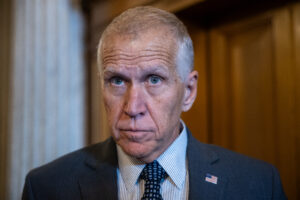
- Sen. Thom Tillis rails against Trump’s fixation on voting legislation
- Sen. Bill Cassidy on Trump: ‘Sometimes he acts as if Congress is merely an appendage’

- GOP leaders cancel Friday votes as House agenda hangs in balance

- Raskin launches discharge effort to formally block ‘Anti-Weaponization Fund’

- Johnson-backed plan to combine Pentagon and election bills advances to floor
- Johnson says he will send housing bill to Trump on Monday
- Pentagon and elections bills could be combined in bid to unfreeze House floor
- Johnson says he will send housing bill to Trump on Monday
-

 Politics1 year ago
Former ‘Squad’ members launching ‘Bowman and Bush’ YouTube show
-

 The Dictatorship1 year ago
Luigi Mangione acknowledges public support in first official statement since arrest
-

 Politics1 year ago
Former Kentucky AG Daniel Cameron launches Senate bid
-
Uncategorized2 years ago
Bob Good to step down as Freedom Caucus chair this week
-

 The Josh Fourrier Show2 years ago
DOOMSDAY: Trump won, now what?
-

 The Dictatorship1 year ago
Pete Hegseth’s tenure at the Pentagon goes from bad to worse
-

 Politics1 year ago
Blue Light News’s Editorial Director Ryan Hutchins speaks at Blue Light News’s 2025 Governors Summit
-

 The Dictatorship10 months ago
Mike Johnson sums up the GOP’s arrogant position on military occupation with two words