
Politics
Charlie Kirk’s final endorsement is on the ropes — despite his group’s big push

Turning Point USA has gone all-in to make GOP Rep. Andy Biggs the next governor of Arizona, their top priority of the cycle.
It appears they will come up short.
Biggs was the last candidate Turning Point founder Charlie Kirk personally endorsed before he was killed one year ago. Kirk himself recruited the longtime ally in their home state to run for governor this cycle — and Turning Point has since spent $18 million, the most they’ve dropped for anyone this cycle, to try to salvage his campaign.
“It’s a legacy thing for them,” said former Rep. Matt Salmon (R-Ariz.). “This is their swan song. This is kind of all-or-nothing for them.”
But Biggs, a former chair of the hardline House Freedom Caucus and close ally of President Donald Trump who previously served as Arizona Senate president, has trailed Democratic Gov. Katie Hobbs in virtually every public poll of the race this year, most of them outside the margin of error. And some Arizona Republicans have been baffled by Turning Point’s strategy.
The group faces immense criticism from within the state GOP for delaying its biggest spending until September, just weeks before ballots were sent out, according to conversations with 10 local operatives and officials.
Biggs’ race is the most high-stakes political test for Turning Point Action since Kirk’s 2025 death, and the result will have major implications for the group’s reputation and relevancy within the GOP moving forward. Turning Point has already preemptively endorsed Vice President JD Vance, who was particularly close to Kirk, for president. Should Vance decide to run, he could rely on Turning Point’s ground operation in swing states like Arizona and beyond.
The group could well overperform this year, and if they are successful in lifting Biggs in their home state, it could send a signal. But a loss could have 2028 repercussions, too.
“If JD Vance intends to run for president, I think it would be a good idea to reevaluate any thoughts he might have about utilizing Turning Point Action as his field operation,” said Gina Swoboda, a former chair of the Arizona Republican Party who has openly sparred with the organization.
A spokesperson for Vance did not respond to a request for comment.
Other Republicans, including the Biggs’ campaign, said they’re grateful that Turning Point didn’t wave the white flag in a tough year for the GOP, as voters reel from the impact of Trump’s policies.
“Turning Point Action’s investments both on the ground and over the airwaves in Arizona have been tremendous. We are very grateful they’ve stepped up to support Andy and Republicans up and down the ballot in an extremely difficult environment,” Biggs campaign spokesperson Drew Sexton said in a statement.
In a statement, Tyler Bowyer, chief operating officer of Turning Point Action, said he is “very proud of the strides we have made in Arizona and other swing states.” He emphasized TP Action is “a Get-Out-The-Vote (GOTV) centric organization” and not TV-focused, pointing the blame elsewhere.
“It is the job of national apparatus groups to go on air early and support Republican nominees,” he said. “We of course are disappointed that more national Republican dollars are not matching the national Democrat dollars being spent on Presidential swing states like Arizona.”
While the RGA has stayed out of the race, the Democratic Governors Association has spent at least $10 million.
Hobbs, who was elected to the purple state’s governorship in 2022, launched her first general election TV ad in May, while Biggs was still focused on his late July primary. At the time, Turning Point mocked Hobbs for “spending like a drunken sailor” by launching spending so early.
But now, Republicans say that Hobbs was able to entrench her lead in the race by spending early while Biggs was dark on the airwaves — and blame Turning Point along with other GOP outside groups like the Republican Governors Association for not spending earlier to keep the race competitive. The RGA declined to comment on their decision not to spend in the race.
In a state like Arizona, where an incumbent governor hasn’t lost reelection since 1966 and some 80% of voters cast ballots before Election Day, a late deluge of cash is less likely to sway the race.
“If you’re spending that much money, a big portion of that would’ve been really helpful earlier in the race when Andy was completely broke, he didn’t have two nickels to rub together, and Hobbs was dominating the airwaves with no response and beating the crap out of Andy,” said Salmon.”A lot of us are scratching our heads.”
Biggs’ campaign reported just $1.26 million cash on hand in July, while Hobbs’ campaign reported double that. Many donors to former GOP Gov. Doug Ducey have stayed on the sidelines this year.
One Republican operative working on other Arizona races, granted anonymity to speak candidly, said that at this point, “No amount of spending is going to change the fact that Biggs is going to lose.”
“In all likelihood, the top statewide seats are going Democrat. And Turning Point owns it,” the strategist added. “They wanted to be the player. They wanted to be the guy. Guess what? They are.”
Many local Republicans are frustrated that the RGA never spent a penny on the top race in a state Trump won in 2024. While Biggs was getting hammered early on the airwaves, the RGA was spending nearly $4 million on the Wisconsin Democratic primary to boost a democratic socialist who narrowly lost.
For several cycles, Turning Point has muscled statewide candidates through messy Republican primaries, only to see them falter in November. In 2022, it pushed hardliners Blake Masters and Kari Lake as nominees for U.S. Senate and governor, only to see both lose. In 2024, they backed Lake’s bid for Senate; even as Trump won Arizona by five points, Lake lost by two.
Biggs, some Republicans thought, would be different. He had high name ID statewide and a track record of public service for Arizona, both in the state Senate and the U.S. House. Kirk himself personally urged Biggs to enter the governor’s race, Biggs told the Arizona Republic, even though Trump had already endorsed Karrin Taylor Robson, a Phoenix attorney and businesswoman, early in the race.
After Biggs entered the race in January 2025, Trump split his endorsement between Robson and Biggs — and Turning Point took a victory lap.
“Turning Point Action will marshall our organization’s full resources, ground game, and support behind the Biggs for Arizona campaign, and we’re honored to be able to do so,” Charlie Kirk said in a May 2025 statement. “He has my full and complete endorsement.”
Robson later dropped out, and Turning Point helped Biggs romp to a massive victory in the primary. Next Tuesday will test if their general-election acumen has improved.


Democrats are poised for a good night next Tuesday. That doesn’t mean they’ve figured out how to win.
More than a dozen lawmakers, campaign operatives, strategists and pollsters warned in interviews that national Democrats risk drawing the wrong conclusions if they take back control of at least one chamber of Congress next week.
Those figures from across the party worry that the midterms, which have become a referendum on President Donald Trump, have done little to improve the Democratic Party’s brand. They caution that a favorable political environment has papered over persistent problems for a party still grappling with why it lost the 2024 presidential election. And they admit they are still sharply divided over what its message should be heading into 2028.
“Don’t confuse them losing with us winning,” said Morgan Jackson, the senior adviser to Democrat Roy Cooper’s Senate campaign in North Carolina. Cooper has consistently led in the polls by a wide margin in a state Trump won three times.
“This is not an affirmation of the Democratic Party in any which way,” said one veteran Democratic pollster working on Senate campaigns, who was granted anonymity to speak candidly. “It is very much a rejection of Trump.”
The Democratic Party’s approval rating plummeted in the aftermath of the 2024 presidential election, and remains relatively weak. That’s even as voters tell pollsters they are more likely to trust Democrats than Republicans on several fronts, including addressing the cost of living, which voters consistently say is their top issue this cycle.
Democrats’ quest for a coherent, positive pitch to answer rising prices and perceived corruption in Washington has at times been stymied by infighting between the party’s progressive and moderate factions over the best way to respond to the Trump administration.
Democrats fought over whether to prolong government shutdowns to protest funding for Immigration and Customs Enforcement and the slashing of health care subsidies in late 2025 and early 2026. They were quick to attack their own upon release of the Democratic National Committee’s formal autopsy on where the party went wrong in 2024.
But as Americans soured on Trump’s agenda and the Iran war drove up costs, Democrats zeroed in on a broad “costs, chaos and corruption” message that blamed the White House — without having to resolve their own internal tensions and disorder.
“When your opponent is destroying themselves,” said Matt Barron, a Democratic strategist who has done work across the rural Midwest and Rust Belt, “just get out of the way and let it happen.”
Nabbing wins in a midterm election with a historically unpopular president is one thing. Building a winning brand for a party that was soundly defeated at the polls just two years ago is another.
“If all you do is say the other people are terrible, that only gets you so far,” said Democratic donor Oliver Libby, who has advised Democratic House candidates Cait Conley in New York and Johnny Garcia in Texas this cycle. “You can have a minimum viable product of a midterm with criticism. You definitely don’t win a presidential year with just criticism.”
In a new Blue Light News Poll conducted by PF Global, more than half of Americans said if Republicans lose control of both the House and the Senate, it would be either because of Trump’s actions since he became president, or because Republicans have run weak campaigns. Just one in four said a Democrat-controlled Congress would be because the party had run a strong campaign.
“There are people who are going to vote in this election who are going to vote against Republicans,” said Antjuan Seawright, a Democratic strategist and adviser to House Minority Leader Hakeem Jeffries. “That does not mean they are in love with Democrats. It just means they are voting against the people in charge.”
Democratic strategist Lis Smith, an architect of Pete Buttigieg’s 2020 presidential campaign, said the Democratic candidates performing well in historically deep-red territory are the ones distancing themselves from the national party.
“That should tell party leaders something,” she said.
Smith helped found the moderate groups Majority Democrats and The Bench, and is advising Democratic Senate candidates like Adam Hamilton in Kansas, James Talarico in Texas and Josh Turek in Iowa — all of whom have taken on that tack.
In Kansas, Hamilton publicly asked former Vice President Kamala Harris to stay away from his campaign, and said he would vote against Chuck Schumer remaining the party’s leader in the Senate. In Texas, Talarico vowed to challenge the party’s “establishment” and “change the Democratic Party.” And in Iowa, Turek says he rarely thinks about the party, while Rob Sand, the Democratic gubernatorial candidate in the state, has said he wants to end the two-party system altogether.
“The reality is that a lot of very average and even mediocre candidates get across the line in a wave election,” Smith said. “A wave can hide a lot of weaknesses, and so we need to be able to make sure that the party can survive when the wave recedes.”
Assuming Democrats take back control of at least one chamber of Congress next week, top party operatives see an opportunity for their side to deliver for voters who have wanted more checks on the Trump administration’s expansive use of executive power. But many caution that Democrats on Capitol Hill should avoid leaning too hard into an anti-Trump message next year, while others argue that the anti-corruption message will continue to galvanize the electorate.
“The thing that I would be concerned about, if you go from 2026 to 2028, is that people think that corruption, that elite control over our economy, is just a Trump issue,” said Bill Neidhardt, who worked on Bernie Sanders’ 2020 presidential campaign and is now advising left-leaning Democratic candidate Will Lawrence and working to boost Abdul El-Sayed, the Democratic candidate for Senate in Michigan. “What they need to focus on is that corporate power, those billionaire elites who are dictating the terms of our economy, that’s what people are upset with.”
William Garcia, the co-chair of Wisconsin’s La Crosse County Democratic Party, has been canvassing extensively for his party in the state’s rural-heavy 3rd district, where voters swung toward Trump in recent years. Democrats are now trying to claw back that support.
“I think we’re going to have a great night on Nov. 3. And then all these Democrats are going to have to deliver on all of these things we’re talking about,” Garcia said. “If we get to the end of 2027 summer and we haven’t passed bills to make a substantial difference in people’s lives, that’s my biggest fear. We gotta deliver.”
Others acknowledge that voters may hold the party to a higher bar if they succeed in taking back control of both chambers of Congress — and they’ll be ready to punish Democrats in 2028 if they don’t follow through on their campaign promises to hold the Trump administration to account and bring down the cost of living.
It’s a slippery slope for a party that has historically struggled to convince voters that it is well equipped to handle the economy. In 2024, Trump persuaded the majority of voters they would be financially better off with him in the White House, while painting Democrats as a party more concerned with social issues.
“If we start getting back into a party that cares more about non-economic issues, then we haven’t learned the lesson,” warned Pete Giangreco, a veteran Democratic strategist who has worked on House, Senate and gubernatorial campaigns this cycle. “People just are going to keep hitting the change button until the economy starts working for them again.”
Samuel Benson and Meredith Lee Hill contributed reporting.
POCONO RACEWAY, Pennsylvania — High up in the starting stand of a famed race track, Josh Shapiro waves a black-and-white checkered flag with an unmistakeable meaning: It’s over.
The metaphor isn’t entirely accurate.
“We may have a lead, but you’re coming down this home stretch. People are nipping at your heels,” the Pennsylvania governor told Blue Light News. “You’ve got to run hard.”
Shapiro, the potential 2028 contender and 2024 veepstakes short-lister, does have reasons to be optimistic — and careful.
He’s threatening a double-digit blowout over Stacy Garrity, a candidate backed by President Donald Trump, in the most important swing state in the nation.
He’s also putting his coattails to the test.
None of the other potential 2028 Democratic candidates has more at stake in their own backyard on Tuesday than Shapiro. He doesn’t have California Gov. Gavin Newsom’s map-breaking Proposition 50, designed to beat back the GOP redistricting, nor his platinum email list. He doesn’t have Illinois Gov. JB Pritzker’s billions or Arizona Sen. Mark Kelly’s deep bench of donors or former Transportation Secretary Pete Buttigieg’s large map or the red-state credentials of Kentucky Gov. Andy Beshear.
Shapiro is on the brink of flipping four hotly contested congressional seats — and guaranteeing Democrats the House. Pennsylvania Democrats could also take control of the state Senate, including some heavily gerrymandered seats, giving the party a governing trifecta for the first time since 1992.
“I’m not thinking about this as a victory for me,” he told Blue Light News during a swing through the state. “I’m thinking about this as a victory for our country.”
All of which paves the way for him to pass a $15 minimum wage and a raft of other measures that could buttress a 2028 presidential bid.
Shapiro is very much following the Ron DeSantis theory of a presidential primary campaign: demonstrate dominance at home before branching out nationally — a strategy, it should be noted, that didn’t pay off for the Florida governor.
“I think what really hurt DeSantis was that he decided he wasn’t going to announce until after his legislative session, and that was May,” political strategist David Axelrod said. “Time is at a premium. If that’s his plan, that would be a miscalculation.”
Will we see him venture beyond Pennsylvania’s boundaries before the end of the year?
“I don’t know what my plans are,” Shapiro said.
The day had the feeling of both an ending of one campaign and the beginning of another. Even as he urged a midday audience of about 100 people to vote for Paige Cognetti, the Scranton mayor running against Rep. Rob Bresnahan, and Brian Wrightson, the state Senate candidate challenging Sen. Rosemary Brown, he is nationalizing his rhetoric.
“Don’t let Trump take away your hopefulness,” he told people gathered at East Stroudsburg University. “Don’t let him make you feel pessimistic. Don’t let him feel like change can’t come or that we have to look in the rearview mirror for answers. The answers are always straight ahead.”
Then there’s his set piece about the “American dream slipping away.”
He’s broadening out his message beyond the commonwealth.
“I think the work I do here in Pennsylvania, the confidence I give them about their government here can hopefully restore some of their faith in democracy, and I want in our democracy, and I want them to feel like they’ve got power to be able to shape the future of that American dream,” Shapiro told us.
A few hours later, Shapiro materializes inside Salerno’s, a tavern in Old Forge known for its American cheese-topped pizza. He sets a room in which patrons already have had a few too many Rolling Rocks and pumpkin martinis.
On the televisions, his own ad for Wrightson is playing on TV. He grips and grins and backslaps his way through the room.
At the end of the bar, he picks up five pizzas for the road, ducks out the door and boards his bus for another Cognetti rally.
Shapiro’s gubernatorial reelect isn’t drawing the buzz of some of the more razor’s-edge, online Senate races in the waning days of election season. But his project is no less remarkable.
“If we can win enough seats here in Pennsylvania to change the balance of power in Washington and be a check on Donald Trump, then we can both hold the president accountable and get stuff done in Washington,” Shapiro says. “Likewise, here in Pennsylvania, if we can win a trifecta for the first time since Bill Clinton’s election, I can raise wages almost immediately for tens of thousands of Pennsylvanians who are at or below minimum wage and raise wages for others. That’s a concrete thing that we can accomplish.”
At the raceway, he has just finished cutting a video racing around the Pocono Raceway’s Tricky Triangle when he flashes a grin.
“I’ve got a surprise for you,” he says, inviting Blue Light News to the starting stand above the storied three-turn NASCAR track in the Pocono foothills.
Up the stairs, the burnt-orange fall foliage dances on the Pennsylvania horizon. It’s a vantage point Shapiro, as a NASCAR fan, has taken in many times.
Despite the apt setting, he deflects when asked if he’s ready to announce the launch of his campaign.
“If this is a metaphor,” he says, “it’s for finishing the race strong.”
There is just one wrinkle: Before he brandished the black-and-white flag, he picked up a green one, waving it vigorously.
“I think you mis-saw that,” Shapiro said with a smile. “I was waving a checkered flag to finish the governor’s race.”
Like this content? Consider signing up for Blue Light News’s Playbook newsletter.
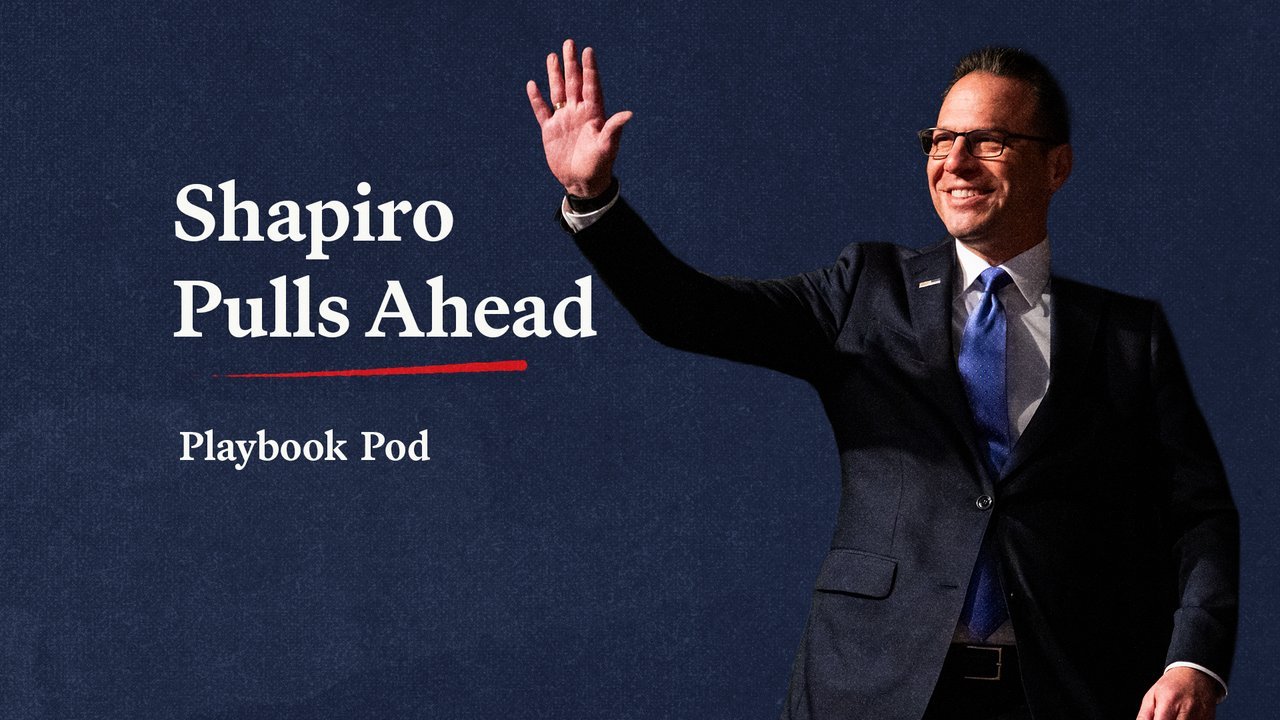
Shapiro takes the inside track
lead image
- Distaste for data centers brings bipartisan ballot blitz to Ohio
- Democrats are still looking for a message, even if they win big on Tuesday
- Josh Shapiro aims for a strong finish in a campaign with 2028 implications
- Shapiro takes the inside track
- Trump turns defense into midterm campaign pitch — never mind Iran
- RFK Jr.’s making a lot of friends in Iowa
- GOP lawmakers start contemplating a diminished Donald Trump
- ‘Look what I brought home for you’: GOP embraces earmark revival as Election Day looms
- Why the midterms are a warning sign for both parties

- Trump fast-tracks Florida disaster aid days before tight elections
-

 Politics2 years ago
Former ‘Squad’ members launching ‘Bowman and Bush’ YouTube show
-
Uncategorized2 years ago
Bob Good to step down as Freedom Caucus chair this week
-

 The Josh Fourrier Show2 years ago
DOOMSDAY: Trump won, now what?
-

 Politics1 year ago
John Legend advises Trump to drop the ‘dictator s‑‑‑’ if he wants Nobel Peace Prize
-

 The Dictatorship2 years ago
Pete Hegseth’s tenure at the Pentagon goes from bad to worse
-

 Politics2 years ago
Former Kentucky AG Daniel Cameron launches Senate bid
-

 The Dictatorship2 years ago
Luigi Mangione acknowledges public support in first official statement since arrest
-

 Politics2 years ago
Blue Light News’s Editorial Director Ryan Hutchins speaks at Blue Light News’s 2025 Governors Summit