
Congress
Capitol agenda: Senate talks sputter, White House aides prep ACA plans

Buckle up for the second week of a shutdown staredown, as the Senate tries again to pass a funding stopgap Monday evening.
All sides are showing little sign of budging. Democrats are refusing to open the government without an agreement on extending Affordable Care Act subsidies, and they’re digging in despite the Trump administration’s threat of mass layoffs. Republicans aren’t willing to negotiate until the government is open.
Most federal workers will miss their first paycheck Friday if the shutdown isn’t resolved. Another big date to watch is Oct. 15 — the day active duty military may also miss a check.
House Majority Leader Steve Scalise told members to hammer Democrats on the military pay deadline during a GOP call Saturday, after the House canceled votes this week. President Donald Trump during a Navy anniversary event on Sunday promised to get service members “every last penny.” Look for lawmakers to bat around the possibility of enacting legislation to keep paying troops, but GOP leaders think Democrats will fold before then.
“We might not even be in a shutdown at that point,” said one senior GOP leadership aide.
Congressional leaders aren’t talking, and rank-and-file attempts at bipartisan compromise appear to be sputtering. Senate Minority Leader Chuck Schumer told CBS Sunday he has encouraged Democrats to talk to Republicans but “in those conversations, the Republicans offered nothing.”
At the White House, even some of Trump’s most hard-line deputies are starting to accept the political risks of letting ACA credits expire and are preparing proposals, three people granted anonymity to discuss the plans said. One includes grandfathering current beneficiaries and cutting off boosted subsidies for new enrollees.
Democrats are feeling confident. A CBS News poll released Sunday was the latest to show a small Democratic advantage in the shutdown blame game. House Minority Leader Hakeem Jeffries told NBC on Sunday that Republicans are “losing in the court of public opinion.”
What else we’re watching:
— On the agenda: Speaker Mike Johnson will have a press conference Monday at 10 a.m. in the Rayburn Room. House Democrats will have a virtual caucus meeting at 6 p.m.
— War powers resolution: A group of senators will force a vote on a war powers resolution as soon as this week, according to a spokesperson for Sen. Adam Schiff (D-Calif.). The legislation, led by Schiff and Sen. Tim Kaine (D-Va.), would require Congress to authorize ongoing military action against cartels following Trump administration strikes on alleged drug traffickers from Venezuela.
— Bondi on Blue Light News: Attorney General Pam Bondi will testify Tuesday before Senate Judiciary as part of the panel’s oversight of the DOJ. Expect Bondi to be questioned on her handling of matters related to Jeffrey Epstein, the indictment of former FBI director James Comey and the department’s overall posture of prosecuting Trump’s perceived political enemies.
Meredith Lee Hill, Jordain Carney and Hailey Fuchs contributed to this report.


The Senate wrapped up its work late Wednesday night, and lawmakers in both chambers won’t be back until after midterm voters pass judgment.
And Chuck Schumer is growing increasingly confident they’ll hand the Senate to Democrats
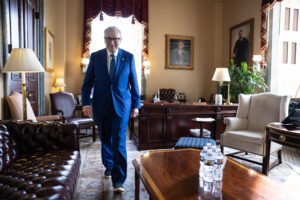
“Here’s how I’d sum up the election: Can enormous amounts of Republican money beat a Democratic enormous advantage in much better candidates and a much better political climate?” the minority leader said in an interview in his office Wednesday.
“I think we win,” he added.
Schumer’s optimism — saying Democrats’ have the “wind in their sails” — reflects his members’ growing bullishness as they head home for a final sprint to convince voters to give them back the majority. The Senate recessed Wednesday night after confirming President Donald Trump’s Labor secretary, but Democrats stayed united in a string of politically tricky votes before leaving.
“It certainly feels like it’s going to be a wave election, and not for good reasons,” Sen. Chris Murphy said. “This president’s domestic and foreign policy has gone off the rails.”
There’s division among Democratic party strategists on whether to spend these final weeks focusing on the states viewed as most likely to flip — like Alaska, Ohio or Iowa — or put resources into so-called reach states like Mississippi, South Carolina or Florida.
Schumer declined to weigh in, but said that Democrats would do “whatever it takes to win” and that he expects to spend the next five weeks fundraising.
“We have lots of different paths to victory, and we’re not going to turn any of them down,” he said.
Also hanging over the midterm elections are questions about Schumer’s future — but the New York Democrat said that he is “running for re-election for leader. Period.”
Republicans, meanwhile, are still hopeful that they can hold onto their majority even if it’s narrower. Much of the midterms map runs through states that Trump won previously.
“Of course we are,” Senate Majority Leader John Thune said about keeping control of the chamber as he left the building Wednesday. “Thank you for asking.”
What else we’re watching:
— PERMITTING DEAL FACES HOUSE BUZZSAW — The Senate’s newly announced bipartisan permitting reform package is set to hit a wall in the House, where key lawmakers aren’t rushing to endorse it. House Natural Resources ranking member Jared Huffman warned Wednesday most House Democrats will not support the Senate’s permitting legislation as written, urging lawmakers to resume negotiations after the midterm elections when they are “likely to have a far better negotiating position.” And House Energy and Commerce Chair Brett Guthrie, a key GOP negotiator, has yet to take a position on the Senate deal.
—RASKIN WANTS TRUMP AD PROBE — House Judiciary’s top Democrat is demanding federal inquiries into the amount of taxpayer money that was used by the Trump administration for a TV ad blitz endorsing the president ahead of the midterms. Rep. Jamie Raskin, who is poised to lead the panel if Democrats flip the chamber, and Rep. George Whitesides, wrote to the Government Accountability Office Wednesday asking them to investigate the “source, accounts and total amount of taxpayer funds used” to produce and distribute the ads. The pair of lawmakers also asked the Office of Special Counsel to investigate whether the ads “constitute a violation of the Hatch Act” and to “determine who should be held accountable.”
Nico Portuondo and Chris Marquette contributed to this report.
The top Democrat on the House Judiciary Committee is demanding federal inquiries into the amount of taxpayer money used to furnish a television ad blitz propping up President Donald Trump ahead of the midterms.
Rep. Jamie Raskin of Maryland, who is poised to lead the panel if Democrats win the majority in November, joined California Democratic Rep. George Whitesides in sending a letter to the Government Accountability Office and the Office of Special Counsel. It asks the GAO to investigate the “source, accounts, and total amount of taxpayer funds used by the Executive Office of the President to produce and distribute this advertisement across major television markets and official White House social media channels.”
The lawmakers also ask the Office of Special Counsel to investigate whether the ads “paid for by millions of dollars of taxpayer funds, constitute a violation of the Hatch Act, and determine who should be held accountable.”
The ads, which so far have run during NFL games and flagship Sunday news shows, depict Trump in a powerful and effective light, with glimpses of him posing for the camera, denigrating the free press and denouncing communism. Each includes the phrase, “paid for by the U.S. government.”
“These ads constitute an illegal use of taxpayer funds, perhaps best demonstrated by the fact that they are virtually identical to the ones Donald Trump used during his 2024 presidential campaign, and in fact use the same footage and the same inept ideological messaging,” Raskin and Whitesides contend.
Other congressional Democrats have also reached out to the administration in recent days to express outrage and ask basic questions about how the ads were derived and funded.
Sens. Patty Murray of Washington and Chris Murphy of Connecticut — the top Democrats on the Senate Appropriations Committee and the appropriations subcommittee on Homeland Security, respectively — have written to Homeland Security Secretary Markwayne Mullin regarding reports that the agency has redirected $20 million in funding originally intended for Customs and Border Protection to “bankroll the obscene political ads.”
A White House spokesperson called the TV spots “public service announcements” and said they are designed to remind “Americans to love their country and understand what makes it worth defending, at home, at our borders, and abroad. The ad is educational and unapologetically patriotic. We should be proud of our country.”
A spokesperson for DHS said the agency “follows all applicable rules for contracting decisions and keeps all decision makers informed” and that “all contracting decisions are made in accordance with applicable law.”
The Office of the Special Counsel confirmed it received the letter and declined comment.
A spokesperson for GAO did not respond to a request for comment.
A bipartisan Senate duo is rolling out two new data center bills one day after Democrats rejected a House-passed measure designed to shield ratepayers from costs associated with the facilities.
The measures from Sens. John Curtis (R-Utah) and Lisa Blunt Rochester (D-Del.) would aim to provide people with more information about the data centers being built in their backyards amid growing backlash against the nationwide proliferation brought on by the artificial intelligence industry boom.
One bill would establish a program within the Department of Energy to give communities access to technical expertise to better understand the costs and benefits of proposed data center developments. The other would require federal reporting on the environmental impacts of large data centers that consume at least 50 megawatts of power every day.
“Americans are rightly skeptical when a large company tells them not to worry about the impacts of a new data center in their community,” Curtis said in a statement, shared first with Blue Light News. “The answer to that distrust is transparency.”
Blunt Rochester added in a separate statement that people have “legitimate concerns” about energy and water usage coming from data centers, and that her bills with Curtis would “ensure communities have a say in how these projects affect their quality of life.”
Curtis and Blunt Rochester, who both serve on the Senate Commerce Committee, recently teamed up on a letter to Chair Ted Cruz calling for hearings and forums to discuss the perils of rapidly-advancing AI technology. They have not yet received a response.
It’s not clear what the path might be for their new data center bills in the current Congress. While support from members of both parties could bolster the effort, neither measure would contain forcing mechanisms to bring down costs passed on from data centers to consumers — a rallying cry for Democrats ahead of the midterms.
Most Senate Democrats on Wednesday blocked the Ratepayer Protection Act, legislation that passed overwhelmingly in the House earlier in September, from going to President Donald Trump’s desk because it would simply encourage tech companies to pay for data center infrastructure.
Democrats said the bill, championed in the Senate by vulnerable GOP Sen. John Husted of Ohio, was ultimately “toothless” in failing to go far enough to ensure energy prices were curbed for consumers.
- Bipartisan Senate duo drops new data center bills
- Raskin leads calls for federal investigation into Trump PSA’s
- Capitol agenda: Dems skip DC with wind in their sails
- ‘I think we win’: Schumer sets the tone as Senate Democrats grow more confident about November
- Ron Johnson blocks vote to stop Trump’s funding cancellations
- Trump says diesel export ban is still on the table
- Hegseth vows to shrink the Pentagon — and then announces plans to grow it
- Cruz kills Blackburn effort to pass AI deepfakes bill
- Sherrod Brown says Facebook ‘glitch’ cost campaign money, votes
- Key allies left out of Trump’s new in-crowd NATO group
-

 Politics2 years ago
Former ‘Squad’ members launching ‘Bowman and Bush’ YouTube show
-
Uncategorized2 years ago
Bob Good to step down as Freedom Caucus chair this week
-

 The Josh Fourrier Show2 years ago
DOOMSDAY: Trump won, now what?
-

 Politics2 years ago
Former Kentucky AG Daniel Cameron launches Senate bid
-

 The Dictatorship2 years ago
Pete Hegseth’s tenure at the Pentagon goes from bad to worse
-

 The Dictatorship2 years ago
Luigi Mangione acknowledges public support in first official statement since arrest
-

 Politics2 years ago
Blue Light News’s Editorial Director Ryan Hutchins speaks at Blue Light News’s 2025 Governors Summit
-

 The Dictatorship1 year ago
Mike Johnson sums up the GOP’s arrogant position on military occupation with two words