
The Dictatorship
America can’t afford Trump’s war with Iran for long

ByJoseph Zeballos-Roig
The U.S. economy right now is like the hero of an action movie in the last few minutes: bloodied, but resilient.
After facing everything from stubborn inflation to sweeping global tariffs to a record-breaking government shutdown, America has somehow managed to avoid a recession and soldier on. The labor market, though, is showing bruises as U.S. employers reported cutting92,000 jobs in February.
But, as in an action movie, the economy is now up against its biggest foe yet: a costly war in Iran, a regional power in the Middle East that just happens to sit next to what is arguably the world’s most critical maritime energy chokepoint.
The blows are already coming. The war is costing the U.S. an estimated $1 billion a dayaccording to two congressional sources with knowledge of the matter. Oil prices are now forecast to go higher, while gas prices have already jumped to $3.32. It’s the highest price it has reached in either of Trump’s two terms. The situation is so in flux that gas prices are poised to climb higher than that after this article is published.
The knock-on effects of increasingly expensive oil will be felt next.
The knock-on effects of increasingly expensive oil will be felt next. Higher costs for oil and gas will spread to the costs of other goods and services, particularly those relying on trucks for transportation. Higher prices for airline tickets aren’t out of the question. Grocery bills and electricity prices will also follow suit if the war drags on.
The war with Iran almost instantly wrecked forecasts for lower oil prices this year, one of the only slices of the U.S. economy that had been getting cheaper for consumers. Analysts had previously expected Brent crude to trade at about $60 per barrel in 2026. Instead, Brent crude rocketed to $93 per barrel as of Friday due to the conflict.
On Wednesday, Goldman Sachs published a worst-case scenario in which $100 per barrel of oil becomes a reality in five weeks. That was based on whether Iran managed to choke off oil shipments in the Strait of Hormuz, the Persian Gulf waterway near Iran that accounts for one-fifth of global oil and natural gas shipping. It did, and Goldman quickly updated its forecast for oil prices to cross into dreaded triple-digit territory as soon as next week.
Mark Zandi, chief economist at Moody’s Analytics, recently said“a good rule of thumb” is to assume that for every $10 per barrel increase in oil prices, the cost of a gallon of regular unleaded will rise by 25 cents. Prices at the pump usually move in tandem with crude oil, which quickly climbed after the first wave of U.S.-Israeli airstrikes that killed Iran’s supreme leader, Ayatollah Ali Khamenei.
The country’s clerical regime does have incentives to drive up global oil prices as high as possible in a last-ditch effort to ensure its survival. The Iranian military has already targetedpower plants and oil refineries in the Gulf, and the financial fallout of the war stands to get worse if nothing changes. Qatar warned on Fridayoil prices may reach $150 per barrel within three weeks if the war shuts down commercial traffic in the Strait of Hormuz.
So far, this latest war has only intensified across the Middle East. Trump has statedhe believes the U.S. will keep up its air-and-sea offensive against Iran for four or five weeks, adding, “we have capability to go far longer than that.” Indeed, Defense Secretary Pete Hegseth raised a scenario in which the war lasts eight weeks.
Trump has railed against “affordability” and even called it “a hoax”during an economic speech late last year. So it wasn’t surprising to hear him downplaya possible long-term spike in gas prices this week.
“I don’t have any concern about it. They’ll drop very rapidly when this is over, and if they rise, they rise,” the president told Reutersin a Thursday interview. Yes and no.

Even if the U.S. and Israel call off their military campaign in the next two or three weeks, gasoline prices could remain elevated for a while. Economists have named this tendency “rockets and feathers.” Gas prices shoot up like a rocket overnight. But those same prices fall delicately like a feather over many weeks.
Still, the U.S. is better able to withstand an oil shock than in the past. It enjoys a privileged position as the world’s top oil drillerso it’s not as dependent on foreign oil supplies as it was two decades ago when it launched the second Iraq War. Still, that doesn’t mean the U.S. economy is completely inoculated.
Sugar prices rosethis week with the expectation of Brazilian mills stepping up production of ethanol instead of sugar as a cheaper fuel alternative.
The Strait of Hormuz is associated with oil, but it’s also a vital arteryfor fertilizer transport. Fertilizer prices were already elevated prior to the Iran conflict, dealing a blow to American farmers coping with dwindling markets and lower crop prices.
Now their spring planting budgets face more strain due to rising prices for urea, a version of nitrogen fertilizer often used for corn. Farmers facing fresh hardship could take it out on Republicans in the November midterms.
Many companies spent the past year reshuffling supply chains to avert Trump’s double-digit tariffs. The war is jolting them anew. The top five largest container shipping firms, including Maersk, suspended their operations in the Persian Gulf, per trade analystJacob Jensen at the American Action Forum.
Instead of traveling through the Suez Canal, the companies are sending their cargo fleets around the Cape of Good Hope at the tip of South Africa. The fraught, dangerous environment caused them to add surcharges ranging from $1,500 to $3,500 per container.
The building blocks of prolonged uncertainty are all falling into place.
The building blocks of prolonged uncertainty are all falling into place. Trump remains devoted to his tariffs, which affect just about everyone in the U.S. The White House is scrambling to rebuild a 15% universal tariff regime that the Supreme Court knocked down. If the war in Iran stretches on for months, it will magnify the expected price increasesfor food, furniture and much more.
Trump continues lashing out at long-standing allies, particularly in Europe. Recently, Spain caught the brunt of his fury when the government refused to allow U.S. warplanes to use their bases for the Iran war. Trump then threatened to cut off trade with Spain, a member of NATO and the European Union. No one knows which country will land in hot water with the president next.
Still, don’t count out the U.S. economy just yet. Reports of its demise have been greatly exaggerated before. Famously, it defied a 100% probability call for a recession in 2023 made by Bloomberg Economics models.
Only time will tell if the economy keeps going despite sustaining so many body blows, or if it’s knocked down by another war in the Middle East. The longer the war goes on, though, the harder it will be to stay standing.

Joseph Zeballos-Roig
Joseph Zeballos-Roig is a reporter who has covered economic policy and politics for Semafor, Business Insider and Quartz, among other publications.



NEW YORK (AP) — United States President Donald Trump signed an executive order Thursday that could impose tariffs of up to 100% on some patented medicines from companies that do not reach agreements with his government in the coming months.
Companies that have signed a “most favored nation” pricing agreement and are actively building facilities in the United States to move production of patented drugs and their ingredients there will have a 0% tariff. For those that do not have a price agreement but are building projects of this type in the United States, a 20% tariff will apply, although it will increase to 100% in four years.
A senior government official told reporters on a conference call that companies still have months to negotiate before the 100% tariffs take effect: 120 days for the largest companies and 180 days for everyone else. The official, who spoke on condition of anonymity to preview the executive order before it was issued, did not identify any companies or drugs that were at risk of receiving the tariff increase, but noted that the government had already reached 17 pricing agreements with big pharma, 13 of which have already been signed.
In the order, Trump wrote that he considered these measures necessary “to address the potential deterioration of national security posed by imports of pharmaceutical products and pharmaceutical ingredients.” The order was announced on the first anniversary of Trump’s so-called “Liberation Day,” when the president unveiled new tariff rates on imports on nearly every country in the world, rocking the stock market. Those tariffs were among the levies that the Supreme Court struck down in February.
Some warned of the consequences of the tariffs announced Thursday. Stephen J. Ubl, chief executive of the pharmaceutical industry trade group PhRMA, said taxes “on cutting-edge drugs will increase costs and could put billions in U.S. investments at risk.” He noted the already extensive presence of the United States in biopharmaceutical production and noted that drugs obtained from other countries “the vast majority come from reliable allies of the United States.”
Trump has launched a barrage of new tariffs on America’s trading partners since the start of his second term, and has repeatedly promised sky-high levies on medicines made abroad. But the government has also used the threat of new tariffs to strike deals with big companies — such as Pfizer, Eli Lilly and Bristol Myers Squibb — over the past year, with promises of lower prices for new drugs.
Beyond company-specific rates, a handful of countries have reached trade frameworks with the United States to further limit tariffs on medicines. The United States will apply a 15% tariff on patented drugs to the European Union, Japan, South Korea and Switzerland, matching previously agreed rates for most goods, and will impose a 10% tariff rate on the United Kingdom, which, Thursday’s order noted, “will then be reduced to zero” under future trade agreements. The United Kingdom had previously said it had secured a 0% tariff rate on all medicines exported to the United States for at least three years.
Trump also presents an update on metal tariffs
Also on Thursday, Trump released an update on his 50% tariffs on steel, aluminum and copper. Starting Monday, tariff rates on those metals will be calculated based on the “full customs value” of what customers in the United States pay when purchasing foreign metal, according to the latest order, which government officials said will prevent importers from other countries from avoiding higher payments.
Products made entirely of steel, aluminum and copper will continue to be subject to a 50% tariff for most countries. But the government will also change the way it calculates tariffs for derived metals — or finished goods that contain some of these metals, but are not made entirely of them.
For a product whose metal makes up less than 15% of its total weight (such as the lid of a perfume bottle), only country-specific tariffs will now apply, officials told reporters Thursday. But for products with more metal, such as a mostly steel washing machine, they indicated that a tariff of 25% will be applied to the total value.
More sectoral taxes accumulate
Thursday’s orders are another example of Trump’s use of sectoral levies. The president used Section 232 of the Trade Expansion Act of 1962 to impose the tariffs, the same authority he cited to impose taxes on imports of automobiles, lumber and even kitchen cabinets. And many expect to see more product-specific tariffs later.
That’s because a Supreme Court ruling struck down blanket tariffs that Trump imposed using the International Emergency Economic Powers Act of 1977.
Although the February 20 court decision represented a significant blow to Trump’s economic agenda, the president still has many options to continue taxing imports aggressively. In addition to the sectoral levies, Trump also imposed a 10% tariff on all imports under another legal authority, just hours after the Supreme Court ruling, but that levy can only last 150 days. About two dozen states have already challenged the new tariffs.
Trump has maintained that his new taxes on imports are necessary to recover the wealth that was “stolen” from the United States. He claims they will reduce the decades-long U.S. trade deficit and bring manufacturing back to the country. But Trump has also resorted to tariffs over personal grudges or in response to political critics. And disrupting the global supply chain has proven costly for businesses and households already under pressure from rising prices.
___
This story was translated from English by an AP editor with the help of a generative artificial intelligence tool.

A federal judge on Friday denied the Trump administration’s bid to revive the defunct subpoenas targeting Federal Reserve Chair Jerome Powell, another blow to the Justice Department’s ability to execute President Donald Trump’s demands.
The subpoenas sought records from a $2.5 billion renovation project at the Fed’s headquarters in Washington. The investigation alleged Powell knowingly misled Congress about the project’s cost. The accusation became central to Trump’s public smear campaign against Powellwhom he appointed to the top Fed position in his first term.
Powell’s lawyers fought the subpoenas, and the Fed chief publicly argued the investigation was motivated by his refusal to succumb to Trump’s pressure campaign on the central bank to slash interest rates, which the president said will boost the U.S. economy.
In his orderChief Judge James E. Boasberg of U.S. District Court for the District of Columbia wrote, “The Government’s arguments do not come close to convincing the Court that a different outcome is warranted.” He rejected the DOJ’s motion to reconsider his March 13 decision to quash the investigation.
Boasberg wrote in his March 13 decision that “a mountain of evidence” suggested that “the Government served these subpoenas on the [Federal Reserve] Board to pressure its Chair into voting for lower interest rates or resigning.” The judge threw out the subpoenas, but the DOJ quickly filed a motion to reconsider.
On Friday, Boasberg ruled the DOJ’s motion “ignores the fact that its total lack of a good-faith basis to suspect a crime is relevant to the second, separate question of the subpoenas’ true purpose.”
The federal government can formally appeal Boasberg’s decision, which could complicate the confirmation process for Kevin WarshTrump’s pick to lead the central bank after Powell’s term as Fed chair ends next month.
Powell was joined by every living former Fed chair in denouncing the probe as an act of partisanship against the leader of an institution designed to be insulated from political pressure.
Two Republicans on the Senate Banking Committee, Sens. Thom Tillis of North Carolina and Kevin Cramer of North Dakota, expressed deep concern over the investigation. Sen. Lisa Murkowski, R-Ala., called the probe “an attempt at coercion,” in a post on X in January.
Tillis is a key vote on the banking committee, which handles confirmation hearings for Fed appointees and has a narrow 13-11 Republican majority. He has vowed not to support Trump’s pick for Fed chair as long as Powell is under criminal investigation.
Sydney Carruth is a breaking news reporter covering national politics and policy for MS NOW. You can send her tips from a non-work device on Signal at SydneyCarruth.46 or follow her work on X and Bluesky.
Fallon Gallagher is a legal affairs reporter for MS NOW.
Today’s edition of quick hits.
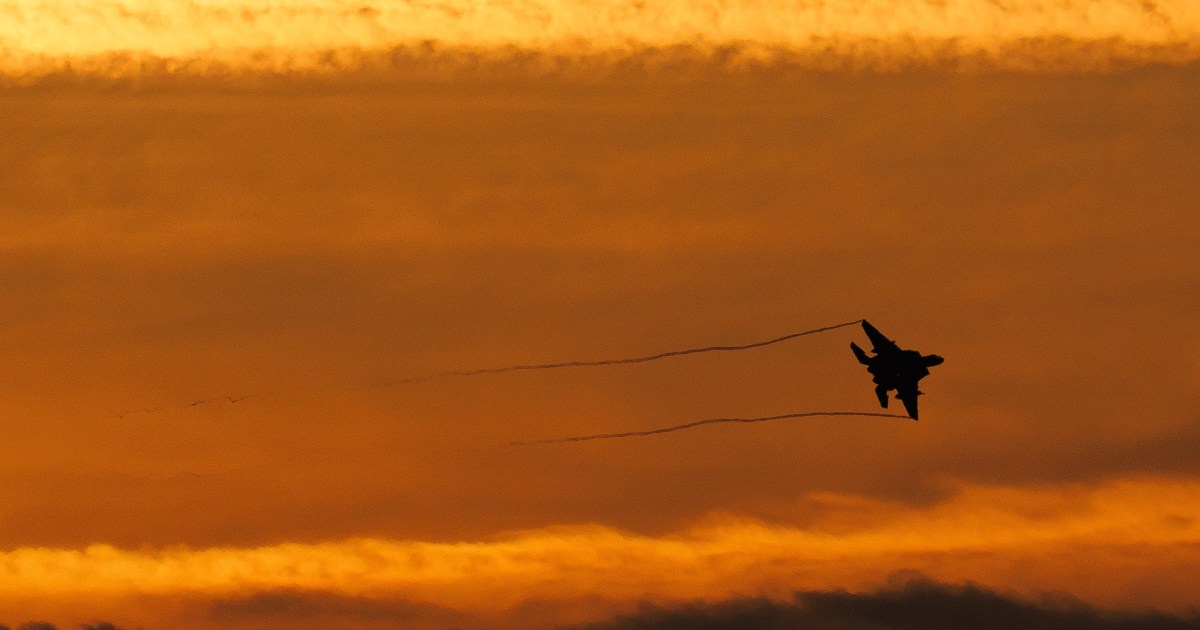
* Iran’s military assets still matter: “An American fighter jet carrying two crew members was shot down today by Iranian forces, a U.S. official told MS NOW. The military has rescued a pilot of the F-15E, and a search is underway for the second crew member, two officials said.”
* In related news: “A second U.S. military plane involved in the U.S. war with Iran crashed on Friday, a U.S. official with knowledge of the matter told MS NOW. The plane’s pilot was safely rescued by American forces after it went down near the Strait of Hormuz. The crash was first reported by The New York Times. It was not clear if the plane, an A-10 Warthog, was shot down or crashed due to mechanical failure, the U.S. official said.”
* Crisis conditions in Lebanon: “The U.S. Embassy in Lebanon issued an alert Friday to U.S. citizens to ‘Leave Lebanon NOW,’ urging them to depart ‘while commercial flight options remain available.’ The alert said if people choose not to leave, they should ‘prepare contingency plans’ in case ‘the situation deteriorate further.’”
* A probe worth watching: “An expansive inquiry by the Department of Homeland Security’s inspector general into the handling of contracts under the agency’s former secretary, Kristi Noem, is scrutinizing her senior adviser Corey Lewandowski’s interactions with companies seeking federal business, according to multiple people familiar with the investigation.”
* The obvious call: “A federal judge on Friday reaffirmed his decision to block subpoenas from the Justice Department to the Federal Reserve on the grounds that the probe appears to be driven by a political vendetta, setting the stage for an appeal by the Trump administration.”
* Hegseth ice”https://apnews.com/article/pentagon-policy-guns-military-bases-hegseth-09cdd079f8ac28aa72b2349859e2f54e”>full of ideas: “Defense Secretary Pete Hegseth said Thursday that he will allow service members to carry personal weapons onto military installations, citing the Second Amendment and recent shootings at bases across the country.”
* In light of the occasional rumors about his possible retirement, this seems notable: “Supreme Court Justice Samuel Alito became ill during an event in Philadelphia on the evening of March 20, a spokesperson for the high court said Friday. … Alito, 76, underwent an examination and received fluids for dehydration, the spokesperson said, adding he returned home that night, which was previously planned.”
Have a safe weekend.
Steve Benen is a producer for “The Rachel Maddow Show,” the editor of MaddowBlog and an MS NOW political contributor. He’s also the bestselling author of “Ministry of Truth: Democracy, Reality, and the Republicans’ War on the Recent Past.”
- Artemis II astronauts are more than halfway to the moon as they seek to break Apollo 13’s record
- ‘Paradigm shift:’ How Trump’s budget request will keep everyone guessing
- Trump announces 100% tariff on some patented drugs
- ‘Bad idea’: Party-line plan for ICE funding has some fearing a slippery slope
- Bondi isn’t off the hook yet for Epstein testimony

- What to know about US fighter jets hit in Iran war

- Susan Collins knocks funding cuts in White House budget proposal

- 2 US helicopters hit during recovery efforts in Iran

- What to know about Trump’s defense budget proposal
- GOP senator calls to end Iran operations without formal declaration of war

-

 Politics1 year ago
Former ‘Squad’ members launching ‘Bowman and Bush’ YouTube show
-

 The Dictatorship1 year ago
Luigi Mangione acknowledges public support in first official statement since arrest
-

 Politics1 year ago
Former Kentucky AG Daniel Cameron launches Senate bid
-

 Politics1 year ago
Blue Light News’s Editorial Director Ryan Hutchins speaks at Blue Light News’s 2025 Governors Summit
-

 The Dictatorship7 months ago
Mike Johnson sums up the GOP’s arrogant position on military occupation with two words
-

 The Dictatorship1 year ago
Pete Hegseth’s tenure at the Pentagon goes from bad to worse
-
Uncategorized1 year ago
Bob Good to step down as Freedom Caucus chair this week
-

 Politics12 months ago
Democrat challenging Joni Ernst: I want to ‘tear down’ party, ‘build it back up’