
Politics
A longstanding belief in Democratic circles has completely collapsed


Crucial to President-elect Donald Trump’s first victory in the popular vote were his gains with nonwhite voters. According to exit polls, Trump received 45% of the Latino vote — including a majority of Latino men — in what was a record high for a Republican presidential candidate. He doubled the share of young Black men he got in 2020. He made a 5-point gain with Asian Americans. In the heavily Arab American city of Dearborn, Michigan, where Democrats usually dominate, Trump easily won.
Exit poll numbers don’t tell the full story, and the details could change as more sophisticated voter data comes out in the coming months. But combined with pre-election polling and trends from earlier electionsthe emerging picture is clear: Trump’s coalition is becoming more racially diverse even as he leans into bigotedhateful rhetoric more than ever before.
Many liberals forget that those groups are never a monolith, and their members also have other identities that shape how they view the world.
Trump’s victory is shattering a common slogan and guiding principle in Democratic circles that “demographics is destiny.” There has long been a belief in the party that Democrats were destined to hold a long-term majority in the country as the nation became more diverse. That belief was predicated on the idea that the party won ethnic minorities because it presented itself as the multicultural and socially inclusive party, and because it treated minorities as interest groups to cater to based on priorities specific to their ethnicity. That belief has always been problematic, and now it is collapsing.
Trump’s playbook has thrown a grenade into the Democratic worldview, and the fallout among the left hasn’t been pretty. Where I expected to see introspection and sadness there have instead been expressions of spite. Sen. John Fetterman of Pennsylvania told Semafor“Dearborn delivered for Trump? OK, congratulations. You’re going to love the next Muslim ban.” Some progressive commentators have pitted ethnic minorities against each other and described the ones who appeared “loyal” to the party more favorably. “Black people did their job. Trump’s gains with Latinos were real. Trump is their guy,” declared one liberal commentator. There were even cruel viral jokes circulating on social media about how liberals now considered themselves indifferent to Trump’s promised “bloody” deportation operation because they felt betrayed by the Latino swing to the GOP.
This anger is reductive and retrograde — and it helps illuminate why the Democratic Party is in this predicament. Yes, people from the same ethnic group do often share common experiences and exhibit trends in their values and priorities. But many liberals forget that those groups are never a monolith, and their members also have other identities that shape how they view the world, including class, gender, age and the countless subcultures they choose to associate with. New York Times’ political correspondent Astead Herndon, who has long flagged Black men voters’ changing political attitudes, has rightly called it a “racist assumption” that people from racial minorities will automatically support the Democratic Party.
Setting aside the finger-pointing, I do understand why it is shocking for some that Trump could win over racial minorities even while saying or implying bigoted things about them. Some wonder how could Trump win over huge swaths of Latinos even as he demonizes Latino migrants with degrading, fascist language? How could Trump win over Muslim voters even after promising to re-institute a ban on migration from Muslim majority countries?
There are a lot of explanatory factors. First, people who are part of racial minorities are strategic voters just like white voters. Given the choice between only two options in an election, a voter of color can simultaneously object to Trump’s language, but still prefer the GOP’s right-wing policy positions on issues such as abortion. The economy is a particularly big example. Thomas Wood, a political scientist at Ohio State University, told The Atlantic that the breadth of the swing to the right across countless demographic groups since 2020 suggested a “really simple story … that secular dissatisfaction with Biden’s economic stewardship affected most demographic groups in a fairly homogeneous way.” The Austin American Statesman found a number of undocumented immigrants — arguably the most vulnerable demographic group in the country now — were “optimistic” about Trump’s victory because they thought it would be good for business and worth the increased risk of deportation.
In the case of the Dearborn switch, one big reason is obvious: Many Arab Americans switched sides out of disgust at the Biden administration’s support for Israel’s military operation in Gaza. These voters made a (misguided, in my opinion) bet that there is some chance that Trump will take a different course of action.
Of course, racial minorities can also share Trump’s worldview about race. People of color can and regularly do hold bigoted attitudes toward other minorities. What’s to say that conservative voters of color don’t just tune out or laugh off Trump’s remarks when they’re trained on their specific community, but nod along as he calls out every other marginalized group under the sun? Or what’s to say they don’t endorse his offensive language but agree with the policy outcomes they help support, such as being “tough” on immigration, crime, or China?
Democrats cling to their old “demographics are destiny” worldview at their own peril. Not only is anti-bigoted messaging inadequate to hold onto voters of color, it can sometimes put them at odds with their lived experience. A good example of this is how Democrats have controversially incorporated the term “Latinx” into some of their messaging to Latino voters, in an attempt to be gender inclusive. A recent study by scholars from Harvard University and Georgetown University found that the term actually drives Latino voters away. While that backlash effect is driven by conservative attitudes, according to the study, the broader takeaway is that Democrats should not assume maximizing the vocabulary of inclusivity is always in the party’s interest.
This is not an argument that the Democrats ought to mimic the GOP’s right-wing nationalism or discard its commitment to multiculturalism. Rather, the point is Democrats ought not to take racial minorities for granted as meek loyalists who have to choose them because the alternative is assumed to be worse, or see them as an interest group that can be pandered to based on a race-specific lens. They ought to treat voters of color the way they would white voters — as complicated, ideologically flexible people who care about kitchen table issues. And they need to excite them the same way too — by making a compelling case for the future.
So far, Trump’s dark vision for that future is winning. But there is one obvious way to keep anti-bigotry at the center of the Democratic Party — and the broader left — while staying laser focused on economic liberation: hammering home that prejudice and culture wars are used to divide us us distract us from the class war at the heart of American unfreedom.

Zeeshan Aleem is a writer and editor for BLN Daily. Previously, he worked at Vox, HuffPost and Blue Light News, and he has also been published in, among other places, The New York Times, The Atlantic, The Nation, and The Intercept. You can sign up for his free politics newsletter here.


Politics
Political operatives with Trump ties raked in millions of dollars in commissions from DHS ad campaign
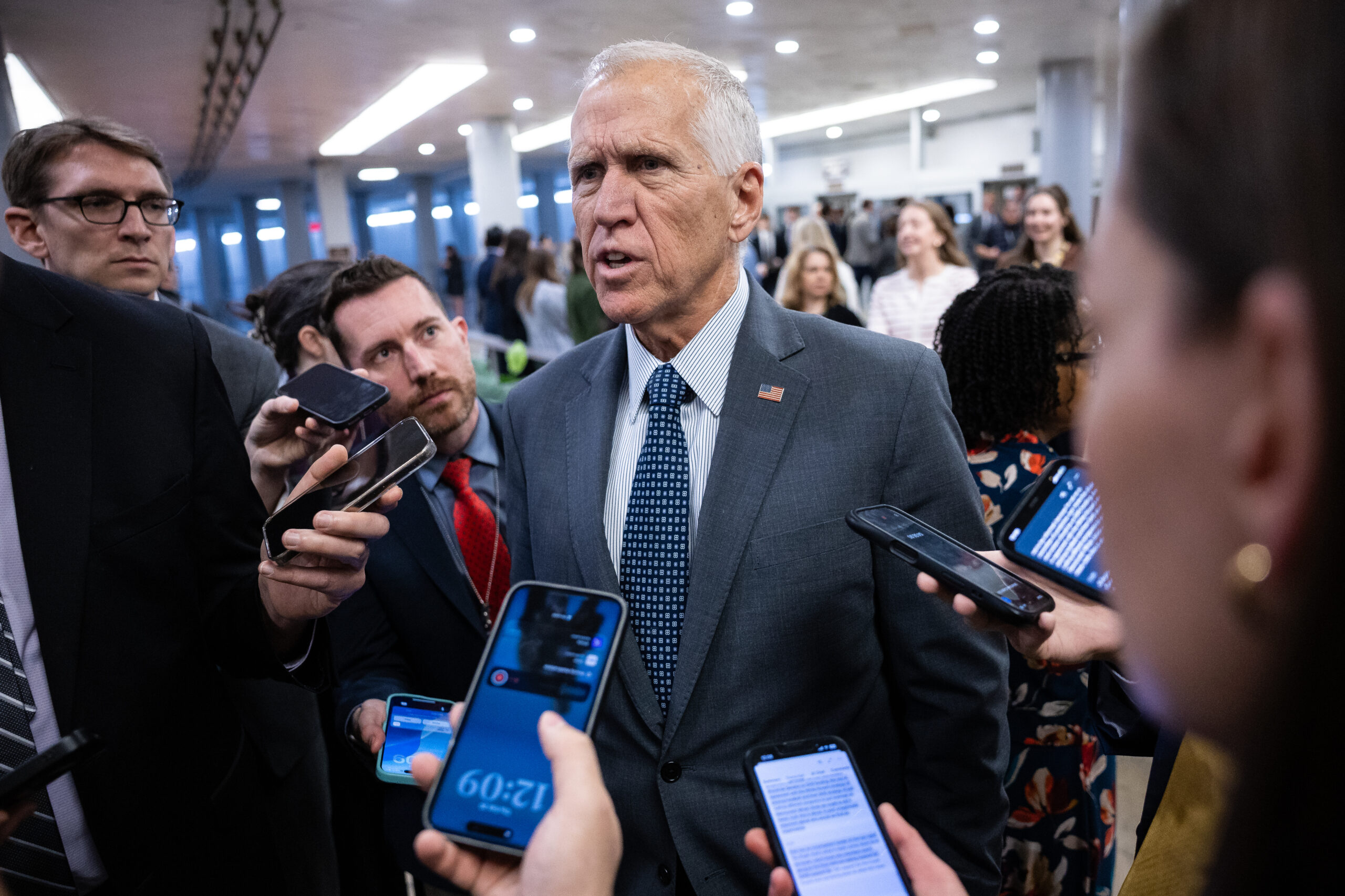
Two companies with ties to veteran political operatives received at least $23 million in commissions for their role in the controversial Department of Homeland Security ad campaign that helped lead to Secretary Kristi Noem’s ouster.
One of the firms, Safe America Media, received at least $15.2 million and was formed last February just a few days before it was awarded the limited-bid contract to work on the overall $220 million, taxpayer-funded ad campaign, according to an internal DHS memo and three people familiar with the contracts who were granted anonymity because they weren’t authorized to speak publicly about the contracts. Safe America Media was run by Republican operatives Mike McElwain and Patrick McCarthy, who have ties to a firm that did extensive media buying on President Donald Trump’s 2024 campaign.
The second firm, People Who Think, received at least $7.7 million from its 10 percent commission on a portion of the $220 million, according to the memo, which was written by DHS Deputy Under Secretary for Management Paul Stackhouse, and reviewed by Blue Light News. People Who Think was co-founded by Jay Connaughton, who did work for Trump’s 2016 campaign and has reportedly worked for other conservative politicians and causes.
The March 3 DHS memo noted there was only a “limited competition” for the awarded contracts because of the “urgent and compelling need” for the ad campaign. It also stated that People Who Think’s 10 percent commission for international advertising and Safe America Media’s 12 percent commission for domestic advertising was below the industry norm of 15 percent.
Besides military recruiting efforts and Covid-19-related campaigns, the DHS ads were the most expensive U.S. government marketing campaign in the last 10 years, Bloomberg reported.
The information about the contracts add new details to the ongoing fallout over DHS’s $220 million ad campaign, which included a video of a cowboy-hat clad Noem riding a horse at Mount Rushmore. It also highlights how political operatives were awarded contracts worth millions of dollars with seemingly little oversight or guardrails — including from President Donald Trump, who White House officials have said did not sign off on the ad campaign.
The ads became a sore spot within the White House, including with Trump, because they fed into a perception that Noem used her position to set herself up for a future political run.
“Safe America Media submitted a proposal for and was awarded a contract to support DHS’s nationwide public awareness campaign, and committed substantial resources to meet an accelerated timeline on budget,” Safe America Media lawyer Joseph Folio said in a statement to Blue Light News. “We look forward to providing additional information to address inaccuracies in the public reporting and ensure the record accurately reflects the scope and context of that work.” It’s unclear what he is referring to and a spokesperson didn’t respond to a follow-up question.
McCarthy, McElwain and Connaughton didn’t respond to requests for comment and People Who Think could not be reached for comment. A spokesperson for DHS declined to comment.
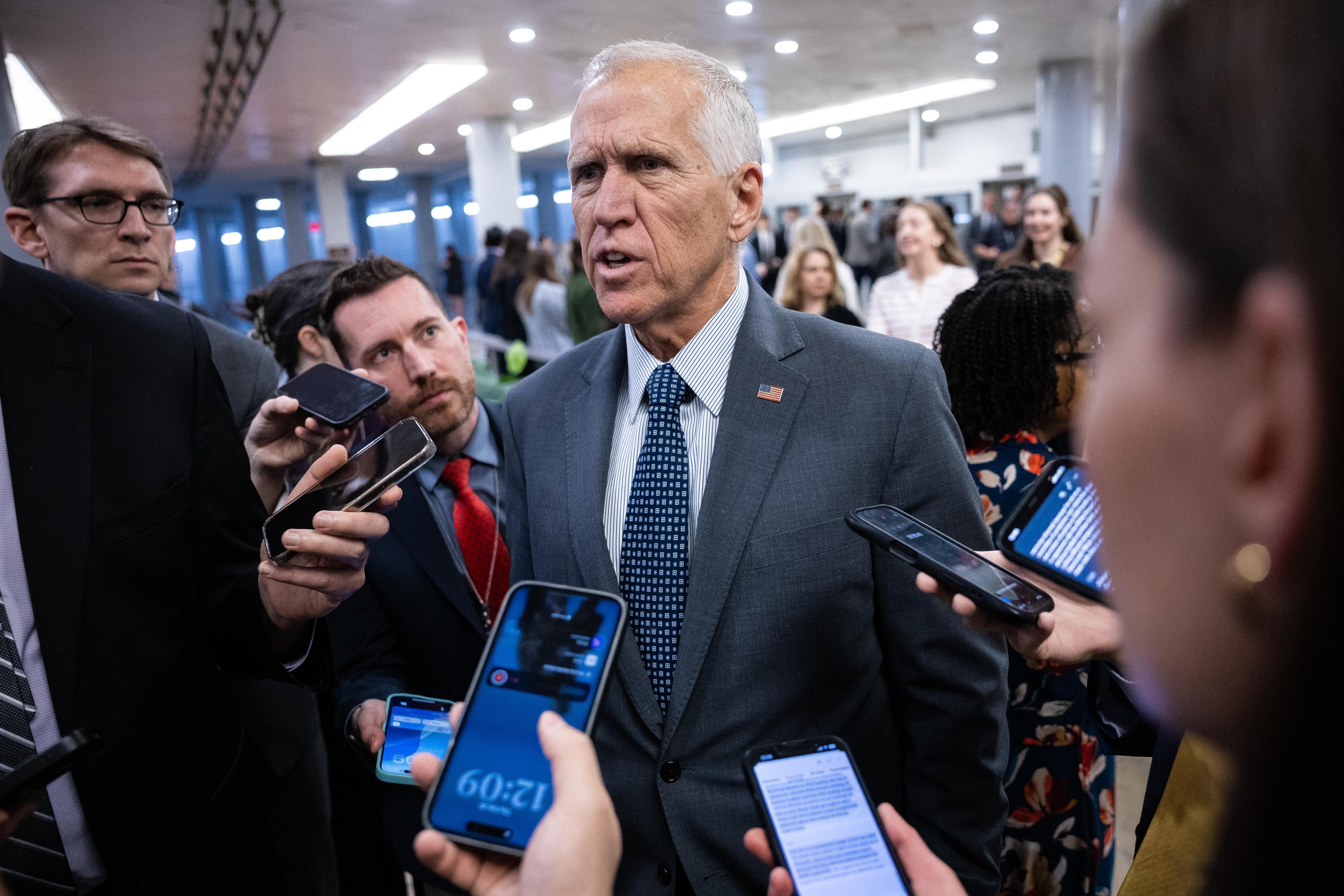
Republican Sens. Thom Tillis of North Carolina and John Kennedy of Louisiana, along with Democrats, grilled Noem when she testified before Congress in early March about the DHS ad campaign. At one point during the hearing, a clearly frustrated Tillis threatened to halt all Senate business if Noem refused to provide information about immigration enforcement in his home state, while Kennedy probed Noem about the ads and derided them for only being “effective in your name recognition.”
Noem has defended the campaign by saying the ads helped encourage two million immigrants to self-deport and thus saved billions of dollars.
Noem was also asked during the hearing about the Strategy Group,which worked to make some of the ads for Safe America Media. The Strategy Group is run by Ben Yoho, the husband of Noem’s former right-hand communications aide Tricia McLaughlin. McLaughlin has said she recused herself from the campaign, and DHS general counsel James Percival has backed her up publicly on questions about the matter and said she was not involved in selecting subcontractors.
In a response to inquiries from Sens. Richard Blumenthal (D-Conn.) and Peter Welch (D-Vt.), both members of the Senate Homeland Security Committee, Yoho said his company was only hired as a subcontractor by Safe America Media for ad production worth $226,000.
Asked about his role in this ad campaign, Yoho referred Blue Light News to the letter.
Welch’s office told Blue Light News that they have talked with legal representatives for People Who Think and Safe America Media but have not yet received responses to their questions. They said they expect to hear from them soon.
Safe America Media LLC placed some of the DHS ads through Strategic Media Services Inc., which received more than $269 million from Trump’s campaign in 2024, according to FEC records. SMS used the same office address on corporate registrations between 2013 and 2021 as Designated Market Media Inc., which McElwain is the president of.
SMS didn’t respond to a request for comment.
Congressional Black Caucus members, after a stinging loss in the Illinois Democratic Senate primary, are training their ire on Gov. JB Pritzker — and saying it’s on him to rehabilitate the relationship.
After Pritzker’s outsized financial support for Lt. Gov. Juliana Stratton helped lift her to victory, lawmakers vented frustrations that his money unfairly tilted the race in her favor and away from their candidate, Rep. Robin Kelly, a CBC member who finished a distant third. And as Pritzker eyes a 2028 presidential bid, some members, cognizant that the path to winning the Democratic Party’s nomination will run through the caucus, signaled they won’t forget that he crossed them this round.
“He has to justify what he did,” said Rep. Bennie Thompson (D-Miss.). “I’m sure at some point if he decides to run, he’ll have to come with that justification. As to whether or not it has merit or not, remains to be seen.”
Pritzker’s money helped put Stratton on the path to becoming just the sixth Black senator in U.S. history. But by boxing out Kelly, he frayed his relationship with the caucus, which holds significant sway over which candidates break through with Black voters — a large and powerful voting bloc the billionaire governor will need if he chooses to run for the White House.
“Keep in mind, the Democratic candidate for president that prevails has to go through [the CBC],” said Rep. Joyce Beatty (D-Ohio). “The CBC is very strategic and so if there is an issue … we will lay out our framework for what it will take” to get our endorsement, she added.
Many top CBC officials are in no rush to make the first move to mend fences.
“We don’t need to reach out to the governor,” said Rep. Gregory Meeks (D-N.Y.) who chairs the Congressional Black Caucus PAC, adding that the group is focused on midterm races and delivering House Minority Leader Hakeem Jeffries the speaker’s gavel.
“Others are going to have to reach out to us,” he said of Pritzker. “Those conversations happen when those conversations happen.”
Pritzker’s political arm issued a statement in response saying he was “proud” to support Stratton, Illinois’ first Black lieutenant governor: “With only six black women having served in the U.S. Senate throughout its history, Gov. Pritzker supported his partner in governance because he’s worked side by side with her for almost a decade and knows she will deliver for the people of Illinois,” Jordan Abudayyeh, Pritzker’s spokesperson, said.
His team did not address questions about CBC members’ concerns, but did point to Rep. Jim Clyburn, the powerful South Carolina Democrat, saying ahead of the election that Pritzker was “free to support” anyone.
Clyburn on Wednesday told Blue Light News he would “expect” for Pritzker to support his No. 2 and that he was not focused on 2028.
Still, lawmakers’ veiled threats lay bare the difficulties Pritzker could face beyond Tuesday’s primary. And they underscore the duality the CBC is navigating as high-profile defeats of their members in Illinois and Texas raise questions about their political influence — even as they celebrate Stratton’s victory.
In interviews with more than a dozen CBC members on Wednesday, they made clear their irritation is not with Stratton, who many said will be welcomed into the caucus if she wins as expected in November. Their indignation rests solely with Pritzker, who they accused of playing kingmaker by pouring millions of dollars into propping up Stratton.
Tensions flared between the powerful legislative voting bloc and the billionaire governor in early March. CBC Chair Yvette Clarke lashed out at Pritzker, saying she was “beyond frustrated” with the governor for “tipping the scales” a nod to his funneling of $5 million from his super PAC to help catapult Stratton into contention with Rep. Raja Krishnamoorthi, who for much of the primary was leading in the polls and started with a massive cash advantage.
Many CBC members, and Clarke specifically, took Pritzker’s presence in the race as a snub to Kelly, who had a long-standing beef with Pritzker after he worked to oust her as chair of the Illinois Democratic Party in 2022. While both Kelly and Pritzker were said to have moved beyond it, the Senate campaign reopened old wounds.
Clarke issued a statement — some 12 hours after the Illinois Senate primary was called — to congratulate Stratton on her victory, calling it “a significant moment for Illinois and the nation that calls for unity” before pivoting to praise Kelly.
The CBC chair on Wednesday said she and Pritzker had not spoken.
“I’m sure there’ll be a moment where we’ll have a conversation,” Clarke said. When asked if she felt like she needed to initiate a conversation with the governor, she responded tersely. “No, I don’t.”
Former Illinois Sen. Carol Moseley Braun, the first Black woman elected to the body in U.S. history, endorsed Stratton in the race. She took issue with CBC members’ intense focus on the governor’s role in the process instead of the historic outcome, and said the group seemed more focused on backing its own than expanding Black representation.
“To weigh in on this race was just backwards,” she told Blue Light News. “[Kelly] was a member of the caucus and so it’s understandable on that level. But at the same time, Juliana deserved at least something from that group.”
Many current CBC members refrained from attacking Pritzker directly, however — another sign of the complex politics at play. Congressional Democrats want Pritzker’s billions to help bankroll their bid to retake control of the House and make Jeffries, the minority leader and New York Democrat, the first Black speaker. They’ve already been working him behind the scenes.
“I’ve already reached out to Governor Pritzker,” said Rep. Steven Horsford (D-Nev.), a former CBC chair. “I’ve talked to him this morning, in fact, and I’ll talk to him in the weeks and months to come, because I have one objective: to win this House, to help win the Senate, and to make sure we end the chaos that’s coming out of this administration.”
Others took pains to separate their evaluation of Pritzker’s role in propelling Stratton to victory from any campaign he may run in 2028, suggesting they were willing to reset the relationship.
“You will still have to show your bona fides, and you still will have to make your case as to why the CBC and Black people should take you into consideration. So we have reset it,” Rep. Sydney Kamlager-Dove (D-Calif.) said. “Good for him, for her, but that has no bearing on the 2028 race.”
Shia Kapos contributed to this report.

NEW YORK (AP) — A federal judge on Tuesday ordered the Trump administration to restore the government-run Voice of America’s operations after it had effectively been shut down a year ago, putting hundreds of employees who have been on administrative leave back to work.
U.S. District Court Judge Royce C. Lamberth gave the U.S. Agency for Global Media a week to put together a plan for putting Voice of America on the air. It has been operating with a skeleton staff since President Donald Trump issued an executive order to shut it down.
A week ago, Lamberth said Kari Lake, who had been Trump’s choice to lead the agency, did not have the legal authority to do what she had done at Voice of America. In Tuesday’s decision, Lamberth ruled on the actions she had taken to respond to Trump’s order, essentially shelving 1,042 of VOA’s 1,147 employees.
“Defendants have provided nothing approaching a principled basis for their decision,” Lamberth wrote.
There was no immediate comment on the decision by the agency overseeing Voice of America. Lake had denounced Lamberth’s March 7 ruling, saying it would be appealed. Since then, Trump nominated Sarah Rogers, the undersecretary of state for public diplomacy, to run USAGM. That requires Senate approval, a step that was not taken with Lake.
Patsy Widakuswara, Voice of America’s White House bureau chief and a plaintiff in the lawsuit to restore it, said she is deeply grateful for the decision.
“We are eager to begin repairing the damage Kari Lake has inflicted on our agency and our colleagues, to return to our congressional mandate, and to rebuild the trust of the global audience we have been unable to serve for the past year,” she said.
“We know the road to restoring VOA’s operations and reputation will be long and difficult,” she said. “We hope the American people will continue to support our mission to produce journalism, not propaganda.”
Voice of America has transmitted news coverage to countries around the world since its formation in World War II, often in countries with no tradition of a free press. Before Trump’s executive order, VOA had operated in 49 different languages, broadcasting to 362 million people.
- Congress must ‘adequately’ fund defense, Johnson says, amid talk of $200 billion war request
- Thune, Tim Scott endorse Hern for open Oklahoma Senate seat
- Why targeting Kharg Island could backfire on Trump
- Mullin’s nomination to be DHS chief advances out of committee
- Sexual assault allegations roil bills honoring César Chávez
- Bernie Sanders to force disapproval votes over U.S. arms sales to Israel
- Capitol agenda: Markwayne Mullin’s rockier-than-expected road
- Political operatives with Trump ties raked in millions of dollars in commissions from DHS ad campaign
- Pritzker helped a Black woman become senator. Some Black leaders are still mad at him.
- Judge orders restoration of Voice of America
-

 The Dictatorship1 year ago
Luigi Mangione acknowledges public support in first official statement since arrest
-

 Politics1 year ago
Former ‘Squad’ members launching ‘Bowman and Bush’ YouTube show
-

 Politics1 year ago
Blue Light News’s Editorial Director Ryan Hutchins speaks at Blue Light News’s 2025 Governors Summit
-

 Politics1 year ago
Former Kentucky AG Daniel Cameron launches Senate bid
-

 The Dictatorship6 months ago
Mike Johnson sums up the GOP’s arrogant position on military occupation with two words
-

 The Dictatorship1 year ago
Pete Hegseth’s tenure at the Pentagon goes from bad to worse
-

 Politics11 months ago
Democrat challenging Joni Ernst: I want to ‘tear down’ party, ‘build it back up’
-
Uncategorized1 year ago
Bob Good to step down as Freedom Caucus chair this week