
Politics
Supreme Court could save ‘Cowboys for Trump’ leader after D.C. panel rejects him

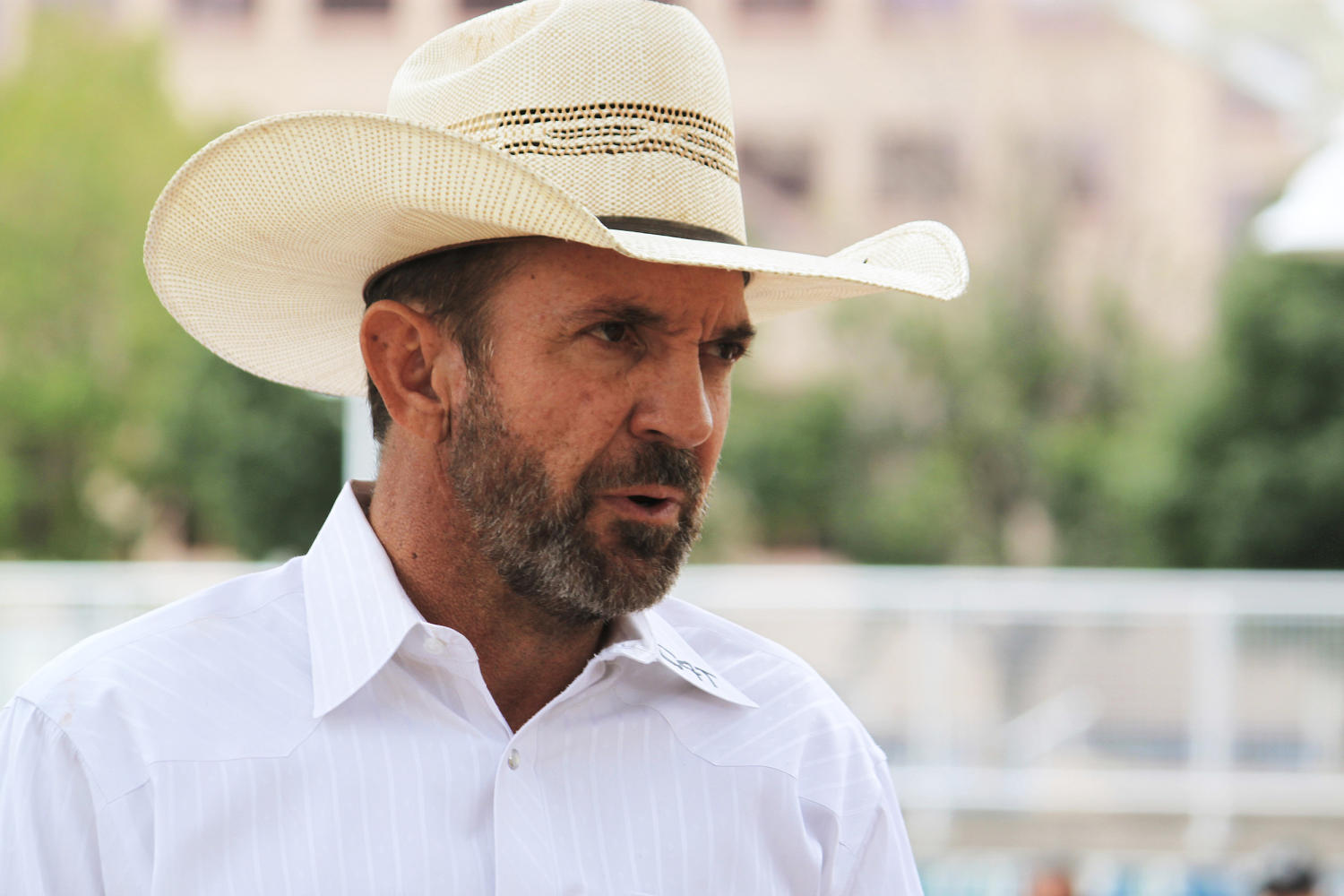

Earlier this year in Fischer v. United States, the Supreme Court narrowed a federal obstruction law used against Jan. 6 defendants, overturning a ruling from the federal appeals court in Washington. That same appeals court just upheld a Jan. 6 defendant’s federal trespass conviction, setting up a potential appeal for the justices to curb that law, too.
Tuesday’s decision came in the case of Cowboys for Trump leader Couy Griffin, who was convicted in 2022 under the trespass law that bars people from knowingly entering or remaining in “any restricted building or grounds” without lawful authority. Such an area is defined under the law as “any posted, cordoned off, or otherwise restricted area” where a Secret Service protectee “is or will be temporarily visiting.”
Griffin, who in January 2021 was an elected county commissioner in New Mexico, argued that people can only be convicted under that law if they know the basis for restricting the area is to safeguard a Secret Service protectee.
But a divided three-judge appellate panel held Tuesday that “knowingly breaching the restricted area suffices, even without knowing the basis of the restriction — here, the presence of Vice President Pence at the Capitol on January 6 — which merely confirms that such trespasses are within Congress’s legislative authority.”
The two judges in the majority, Barack Obama appointee Cornelia Pillard and Bill Clinton appointee Judith Rogers, noted that a different reading “would impair the Secret Service’s ability to protect its charges.” They concluded that “[n]either the text nor the context of the statute supports that reading.”
Dissenting, Donald Trump appointee Gregory Katsas argued that the law puts a greater burden on the government than the majority thinks. He said that on top of proving Griffin’s knowledge that the Capitol grounds “were posted, cordoned off, or otherwise restricted,” prosecutors also had to prove that he knew Pence was present “when he entered or remained in those restricted grounds.”
Ultimately, Katsas’ opinion could carry the day — or at least help Griffin get his case to the justices. Indeed, in the Fischer case that narrowed Jan. 6 obstruction charges, Katsas dissented from the majority panel ruling that the Supreme Court overturned in June.
And in Griffin’s case, Katsas noted that federal prosecutors had secured over 470 convictions under the law and that, in all of them, “criminal liability may turn on whether the defendant had to know that Vice President Pence was present at the time of the trespass.” Katsas added that the trial judges in Washington “are deeply divided on that question; six have answered yes, while ten have answered no.”
Both the broad impact of an issue and division over it can lead to the Supreme Court stepping in.
The justices declined to take up a separate appeal from Griffin in March. That appeal related to him being barred from office after Jan. 6. He was barred from state office as opposed to federal office in the case of Trump, whom the high court cleared to run for president again despite the insurrection. But Griffin may have a better outcome if he petitions the justices to review his trespass conviction.
Subscribe to the Deadline: Legal Newsletter for expert analysis on the top legal stories of the week, including updates from the Supreme Court and developments in Donald Trump’s legal cases.
Jordan Rubin is the Deadline: Legal Blog writer. He was a prosecutor for the New York County District Attorney’s Office in Manhattan and is the author of “Bizarro,” a book about the secret war on synthetic drugs. Before he joined BLN, he was a legal reporter for Bloomberg Law.


Republican Senate candidates are hurting for cash.
Nearly every Democratic candidate in battleground Senate races outraised their GOP opponent from July through September. And in some cases, the disparities were stark.
- In Texas, Democrat James Talarico trounced Republican Ken Paxton $60.2 million to $10.2 million in their main campaign accounts.
- In Georgia, Democratic Sen. Jon Ossoff raised $33.1 million to Rep. Mike Collins’ nearly $2.8 million.
- In North Carolina, Democrat Roy Cooper raised $12.2 million to Michael Whatley’s $2.1 million.
- In Michigan, Democrat Abdul El-Sayed hauled in roughly $33 million to former Rep. Mike Rogers’ nearly $10 million.
- In Maine, Democrat Troy Jackson raised $20.5 million to GOP Sen. Susan Collins’ $5.2 million.
- In Ohio, Democratic former Sen. Sherrod Brown hauled in $23.1 million to GOP Sen. Jon Husted’s $4.8 million.
- In Iowa, Josh Turek raised $13.9 million to Republican Rep. Ashley Hinson’s nearly $3.3 million.
- In Alaska, Democratic former Rep. Mary Peltola raked in $17 million to GOP Sen. Dan Sullivan’s nearly $2.7 million.
- In New Hampshire, Democratic Rep. Chris Pappas brought in $8.1 million to Republican former Sen. John E. Sununu’s $1.5 million.
- And in Kansas, Democrat Adam Hamilton raised nearly $9.9 million to GOP Sen. Roger Marshall’s just $866,000.
Across those 10 Senate races, the Democratic campaigns raised more than five times as much as the Republican ones. Put another way: Talarico alone raised more than all those Republicans combined.
Marshall and Whatley each started October with less than $1 million left in the bank. Mike Collins wasn’t much better-positioned, entering the final weeks of the election with just over $1 million cash on hand.
These numbers do not include joint fundraising committees, which allow candidates to raise money and may have some more cash that has not yet been transferred to the campaigns.
Democrats have consistently outraised Republicans on the candidate level this cycle. But the yawning gaps heading into the midterm’s home stretch stand as the latest example of the deteriorating environment for the GOP.
And while GOP outside groups have significantly more money than Democrats, this candidate cash advantage matters because candidates get TV ads for much cheaper rates, letting their dollars stretch much farther.
To underscore how lopsided some of these figures are: At least half a dozen House Democratic challengers raised over $3 million in the third quarter — a sum higher than several GOP Senate incumbents.
There are some silver linings for the GOP.
In Minnesota, Republican Michele Tafoya raised $4.9 million to Democratic Lt. Gov. Peggy Flanagan’s $4.3 million. Tafoya started the month with $2.1 million to Flanagan’s $1.5 million.
Sullivan, Husted, Hinson, Rogers and Susan Collins all entered October with millions more in cash on hand than their Democratic opponents.
And Republicans are getting air cover from GOP super PACs bankrolled by billionaire Elon Musk and President Donald Trump’s MAGA Inc. that have pumped hundreds of millions of dollars into the midterms in recent weeks.
Musk was revealed on Thursday as the primary funder of Texas PAC, which has spent $131 million so far boosting Paxton and attacking Talarico. Musk gave $158 million to Senate Republicans’ super PAC arm last quarter, the filings showed, with the group in turn transferring the funds to the pro-Paxton PAC.
Republicans are also benefitting from a recent Supreme Court ruling that allows party committees to spend unlimited sums in coordination with candidates, allowing the National Republican Senatorial Committee to offset at least some of the differences.
Since the tranche of reports filed Thursday only cover until Sept. 30, the full scope of each candidates’ coffers is unknown.
But there are other signs that some are strapped for cash in the final sprint: Whatley has gone dark on television, a clear indication of him running low on funds even as his campaign insists it’s a temporary pause.
Inside the democratic socialists’ plan to shake up Congress
lead image
President Donald Trump is blaming fellow Republicans as his endorsed candidate, Ken Paxton, appears to be in a fierce struggle for a Senate seat in Texas with Democratic challenger James Talarico in a state the GOP has long taken for granted.
Trump, in a lengthy post to Truth Social Thursday, singled out longtime Republican strategist Karl Rove and Sen. John Cornyn, the incumbent who failed to secure the president’s endorsement in a heated primary.
Rove and Cornyn, Trump said, are doing “everything possible” to make it harder for Paxton to defeat Talarico, a state lawmaker and Presbyterian seminarian who is making a suprisingly strong run for Senate in deep red Texas.
“They are hurting Texas and, more importantly, hurting the United States of America!” Trump wrote. “If Ken Paxton loses, it will be because of WEAK and INEFFECTIVE Political Hacks like John Cornyn and Karl Rove, who have ineffectively opposed me for my entire political career.”
Cornyn, a longtime fixture in Texas politics, lost his bid for reelection in a contentious Republican primary in which he and his supporters portrayed Paxton as a deeply flawed candidate. As Election Day approaches, public polling over the past two months has shown Talarico with a narrow edge against Paxton, the state’s attorney general.
Trump urged his supporters to back Paxton.
“Your favorite President (ME!) is asking all of those who supported Senator John Cornyn to UNITE, and immediately switch your support to Ken Paxton,” Trump said. “He will be a Great Senator, just like he is a Great Attorney General. “
The race has also become one of the most expensive non-presidential battles. Talarico raised $64 million this summer — the largest third-quarter haul of any Senate candidate in history. He has raised more than $134 million since launching his campaign last year.
Paxton raised $18 million in the third quarter of 2026 and last month announced a new $20 million ad buy. Earlier this month, though, a Trump operative told POLITICO that MAGA Inc. and its affiliates are could spend nearly $45 million on direct mail, TV and digital advertising in Texas through Oct. 12.
Already, $235 million has been spent by outside conservative groups and party committees against Talarico as national Republicans scramble to boost Paxton.
Some Republicans have grown concerned that the cost of the Texas race is diverting money needed in other states and have expressed frustrations with Paxton after leaked audio showed him blaming Trump for his woes.
Trump easily won Texas in 2024, winning just over 56% of the vote. But concerns about Republicans’ chances this November have surged as the president’s approval rating plummets.
- Senate Republicans are getting smoked in fundraising
- Inside the democratic socialists’ plan to shake up Congress

- Trump lashes out at Republicans as Ken Paxton struggles in Texas
- Trump’s defense dreams are on life support
- Mitch Daniels rebukes JD Vance over free-market retreat
- Groups supporting RFK Jr. are spending nearly $2M in Iowa governor, House races
- 2 women accuse Matt Gaetz of sex trafficking in new lawsuit
- Bernie Moreno says GOP needs to prep for ‘Last Supper’ reconciliation bill
- Authorities investigate ‘suspicious substances’ mailed to congressional offices
- Bipartisan House group urges Trump to enforce Russia sanctions, scrap diesel deal
-

 Politics2 years ago
Former ‘Squad’ members launching ‘Bowman and Bush’ YouTube show
-
Uncategorized2 years ago
Bob Good to step down as Freedom Caucus chair this week
-

 The Josh Fourrier Show2 years ago
DOOMSDAY: Trump won, now what?
-

 The Dictatorship2 years ago
Pete Hegseth’s tenure at the Pentagon goes from bad to worse
-

 Politics2 years ago
Former Kentucky AG Daniel Cameron launches Senate bid
-

 The Dictatorship2 years ago
Luigi Mangione acknowledges public support in first official statement since arrest
-

 Politics2 years ago
Blue Light News’s Editorial Director Ryan Hutchins speaks at Blue Light News’s 2025 Governors Summit
-

 The Dictatorship1 year ago
Mike Johnson sums up the GOP’s arrogant position on military occupation with two words