
Congress
Big Ten, SEC are on the clock as new college athletics bill is circulated

The bipartisan leaders of the Senate Commerce Committee are making changes to their big college sports overhaul in a bid to garner support from the nation’s two most powerful athletic conferences as they look to build Republican support ahead of a potential vote on the Senate floor.
Chair Ted Cruz (R-Texas) and Sen. Maria Cantwell (D-Wash.), the ranking member, made several concessions to the Big Ten and Southeastern Conferences in the latest draft of their Protect College Sports Act. They include protections against certain legal challenges and a new $20 million pool of funds that schools can use for retaining athletes, according to three people close to the negotiations.
It’s unclear whether the changes will be good enough to win over the two conferences. A senior Commerce Committee staffer asked the conferences to schedule a call with their general counsels and staff “ASAP” to discuss the text and gave them a 9 a.m. Wednesday deadline to decide whether they support the latest version of the bill, according to an email reviewed by Blue Light News.
Two lobbyists directly engaged on the bill said Tuesday that weeks of negotiations had not meaningfully addressed a litany of concerns the SEC and the Big Ten had with earlier versions of the bill.
The conferences demanded, for instance, that a provision allowing universities to jointly negotiate their media rights make clear that schools cannot be coerced into participating. The updated text includes a provision shielding schools who do not participate in media pooling from potential litigation, according to a copy of the draft obtained by Blue Light News.
The bill, however, leaves out another key demand of the conferences: a provision clarifying that postseason tournaments and contests would be excluded from media pooling.
It also retains a prohibition on conferences with over $700 million in revenue participating in mergers and acquisitions, which would impact both power conferences along with the Atlantic Coast Conference. That threshold was brought down from an earlier $1 billion limit, but the SEC and the Big Ten had hoped to see it stripped from the bill altogether.
The new text also includes a newly added section titled the “Ignite HBCUs Sports and Media Act.”
That section, which is still in flux, deals with “extraneous topics of broadband,” per the email sent to the conferences on Tuesday. The $20 million athlete retention pool also remains subject to change “as we discuss how to align the proper incentive for spending on women’s NIL,” according to the email.
Cruz remains determined to get the bill onto the floor before the Senate heads out of town for a scheduled recess next week. But time is running short, and he and Cantwell still need to win over wary senators on both sides of the aisle.


The Department of Homeland Security still has not shared the findings from its investigations into the January killings of Alex Pretti and Renee Good in Minneapolis, despite continued requests from the top Republican on the Homeland Security and Governmental Affairs Committee.
Sen. Rand Paul (R-Ky.), the chair of the panel, said during a brief hallway interview that DHS has not yet given the committee any information from internal probes into any shootings involving immigration officers.
Asked if that included the two January shootings in Minneapolis, where immigration officers shot and killed two American citizens, Paul said: “We’ve asked for information. We’re still asking.”
DHS did not immediately respond to a request for comment.
Paul’s comments come as DHS faces continued bipartisan scrutiny following several incidents where ICE or Border Patrol agents used deadly force against individuals they were trying to apprehend. Several of those individuals were U.S. citizens.
Most recently, ICE agents Saturday shot an unauthorized immigrant who faced deportation. The man, 28-year-old Wilber Rafael Garcés Pérez, survived. His lawyers claim he has been transferred into ICE custody despite still having a bullet lodged in his back.
Paul had asked DHS earlier this year to share more information about its reviews of the shootings, and did not schedule a confirmation hearing for the administration’s ICE director nominee as he awaited those findings. The White House ultimately pulled that nomination last week as the nomination stalled.
Senate Armed Services Chair Roger Wicker lambasted the White House decision to invite Chinese leader Xi Jinping for a state dinner this week, calling the foreign head of state “a brutal, unelected and oppressive dictator” who cannot be trusted.
Wicker, typically a staunch defender of President Donald Trump and Republican loyalist, targeted most of his criticism at Xi and Chinese policy during a Senate floor speech Tuesday. But the comments were nonetheless a surprise rebuke of the president’s courting of Beijing amid broader concerns, such as the durability of U.S. security commitments to the Indo-Pacific, including in deterring a potential invasion of Taiwan from the Chinese mainland.
The Mississippi Republican urged Trump to press the Chinese premier on a variety of sensitive topics — including purported support for Iran, its military buildup and human rights abuses.
“Had the White House asked me for advice, I would have suggested the president not invite Xi Jinping to Washington for such a lavish welcome here in the United States, based on all of the troubling issues we have with President Xi and the Chinese Communist Party,” he said.
“I know the president tends to discuss trade and artificial intelligence with the Chinese leadership, and rightfully so,” he said. “Perhaps some progress will be made. But … during every minute of dialog, our commander in chief should keep in mind that his guest is a brutal, unelected and oppressive dictator who seeks to dominate his neighbors and whose massive military arsenal is aimed directly at the United States of America.”
The senior Republican’s comments on the Senate floor were delivered just a few hours before Xi’s expected arrival in Washington. Trump has scheduled a formal welcome ceremony for Xi and his wife at the White House on Thursday, along with talks between the two leaders throughout his three-day visit.
Trump is facing bipartisan criticism over the state visit by Xi. Wicker’s comments followed similar attacks on Chinese leadership from Sen. Dick Durbin (D-Ill.) and Ted Budd (R-N.C.).
“President Trump has been clear that under his leadership, the United States must engage with China, given the reality of our economic relationship,” Budd said. “But we can’t forget that China is also a competitor and an adversary.”
A federal appeals court ruling Tuesday on demonstrators’ access to the steps of the Capitol could bode poorly for President Donald Trump’s attempt to ban three media organizations from the White House.
The majority opinion, written by Trump appointee Neomi Rao, concluded that the East Steps of the Capitol are a “nonpublic forum” — just like most areas of the White House grounds, including the press facilities. While the government may impose restrictions on access to those nonpublic areas, the limits must be “viewpoint neutral,” apply “objective, workable standards” and not permit officials to exercise “unbridled discretion over a forum’s use,” the D.C. Circuit Court of Appeals panel concluded.
“A regulation that grants the government arbitrary control over who may speak invites the suppression of disfavored viewpoints and undermines the First Amendment’s core protections,” wrote Rao, who was joined in the majority by Judge Karen Henderson, a George H.W. Bush appointee.
The ruling, on the eve of a hearing over restoring White House accessfor Blue Light News, BLN and MS NOW, reaffirms the D.C. Circuit’s longstanding First Amendment precedents at an inopportune time for Trump. The president has explicitly described his ban on the three outlets as a punishment for publishing what he calls “fake news.”
“Fake News people and publications that only write negatively, and who violate our National Security by writing false and defamatory stories with unknown ‘sources,’ shouldn’t be allowed access to the most important Office anywhere in the World,” Trump said on social media Monday.
The outlets have said their access was revoked because the White House objected to their reporting and that the ban “threatens press freedom and the public’s right to independent journalism free from government interference.”
The D.C. Circuit would hear any appeals in the litigation over Trump’s media ban, and Trump has in fact already said he anticipates filing an appeal, presuming that he will be dealt a defeat in district court.
The White House did not immediately respond to a request for comment.
The D.C. Circuit’s Tuesday ruling stemmed from a lawsuit brought by Patrick Mahoney, a clergyman who sought to hold prayer vigils and demonstrations on the East Steps of the Capitol several months after the Jan. 6, 2021 attack, which resulted in new access restrictions. His permit was denied in part based on Capitol Police regulations that prohibit public demonstrations on the steps unless they are sponsored by a member of Congress.
Though the case has inched through the courts for years, Tuesday’s ruling resolves a key question, labeling the Capitol’s East Steps a “nonpublic forum” for which congressional authorities may restrict public access — in part because lawmakers use those steps to enter and exit the building.
But allowing members of Congress to sponsor gatherings on the steps creates an arbitrary system, the majority concluded.
“Because the protection of unpopular speech and advocacy is central to the First Amendment, we cannot leave it to the selective enforcement of members,” Rao wrote.
Notably, Rao’s opinion cites a D.C. Circuit ruling last year that concluded “it would be unreasonable to control access to White House press facilities through standardless discretion.”
The third judge on the panel, Clinton appointee Judith Rogers, dissented, but her opinion was even more protective of free-speech rights.
Rogers said she agreed with her colleagues that the “selective exception” for demonstrations sponsored by lawmakers was unconstitutional. However, she said she would have held that the lower portion of the Capitol steps was a public forum where the government was obligated to permit protest activity.
- Paul: ICE hasn’t shared information about Minneapolis shooting probes
- GOP Armed Services chair blasts White House welcome of Chinese leader
- Sen. Jon Husted: Iran war ‘needs to come to an end as quickly as possible’
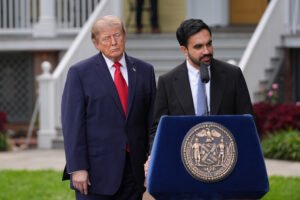
- Mamdani and Trump face frosty reception in Queens over Sunnyside Yard plan
- Trump says decision on possible diesel export ban to come ‘fast’
- Appeals court’s Capitol steps ruling may signal trouble for Trump on media ban
- Ohio stations ignore Max Miller’s legal threat, run Democratic challenger’s ad
- GOP Senator wants to subpoena Donald Trump Jr. over Russian-funded wedding
- Capitol agenda: Senate GOP eyes exit plan as trail calls
- ‘We need to stop the contagion’: GOP ramps up midterms defense in Trump states
-

 Politics2 years ago
Former ‘Squad’ members launching ‘Bowman and Bush’ YouTube show
-
Uncategorized2 years ago
Bob Good to step down as Freedom Caucus chair this week
-

 The Josh Fourrier Show2 years ago
DOOMSDAY: Trump won, now what?
-

 Politics2 years ago
Former Kentucky AG Daniel Cameron launches Senate bid
-

 The Dictatorship2 years ago
Luigi Mangione acknowledges public support in first official statement since arrest
-

 The Dictatorship2 years ago
Pete Hegseth’s tenure at the Pentagon goes from bad to worse
-

 Politics2 years ago
Blue Light News’s Editorial Director Ryan Hutchins speaks at Blue Light News’s 2025 Governors Summit
-

 The Dictatorship1 year ago
Mike Johnson sums up the GOP’s arrogant position on military occupation with two words