
Politics
Poll: Americans uneasy with AI, crypto even as they spend big on midterms

Deep-pocketed political groups tied to artificial intelligence and cryptocurrency are rapidly reshaping the midterm money landscape — but many Americans are uneasy with the industries behind the spending.
New results from The POLITICO Poll find broad public skepticism about crypto and AI, creating a possible conflict for candidates benefitting from an influx of contributions from the two industries. These groups are pouring millions of dollars into competitive 2026 races to elevate politicians who they believe will support their agendas in Washington.
Meanwhile, Americans have been slow to embrace either technology.
A 45 percent plurality of Americans say investing in cryptocurrency is not worth the risk, even if it can yield high returns, and a 44 percent plurality say AI is developing too quickly, according to the April survey conducted by independent firm Public First.
Nearly half of Americans say they trust a traditional bank with their money more than a cryptocurrency platform, while just 17 percent say the opposite. And two-thirds support lawmakers either imposing strict regulations or setting broad principles for the AI industry.
The results raise an emerging challenge for the industries as their aligned super PACs seek to translate financial might into political influence. Several of these groups are already becoming the most dominant players on the political battlefield, spending heavily for candidates on both sides of the aisle and in some cases rivaling the fundraising of long-established party groups.
It’s too early to say how candidates associated with these groups will fare in November — and the two industries could draw different reactions from voters. Still, in hypothetical head-to-head matchups, poll respondents were much less likely to choose candidates backed by a campaign group seeking looser regulations on artificial intelligence than candidates backed by a group advocating for more stringent rules on AI and tech companies. Those polled were also more likely to support a group advocating for policies to protect the environment and prevent climate change.
Skepticism of the industries, those results suggest, could turn into voter backlash if Americans grow fed up with the heavy spending.
“Democrats’ best approach is to make their spending an issue,” said Sen. Chris Murphy (D-Conn.), who has been outspoken about the need for AI regulation. “People do not want AI companies to run them over culturally and economically. They don’t trust crypto.”
Some of the resistance to the AI and crypto groups may reflect broader American dissatisfaction with special interest groups’ spending. A 41 percent plurality say special interest groups have too much influence over politics in the U.S., while 23 percent say they have the right amount. Just 12 percent say they have too little influence.
But the AI and crypto super PACs are on a new level, and the rise of these groups is creating shockwaves throughout politics. These groups could easily become the biggest spender in any House or Senate race that they choose — or several.
Leading the Future, a pro-AI super PAC founded in August, has already raised more than $75 million since its launch, according to recent filings with the Federal Election Commission. Through a network of PACs, it has deployed money on primaries in North Carolina, Texas, Illinois and New York for Democratic and Republican candidates. Fairshake, a pro-crypto group primarily funded by Coinbase, Andreessen Horowitz and Ripple Labs, is expected to back candidates in both parties and has already spent $28 million across several competitive primaries through its network of PACs.
Both industries are also spending big on Washington lobbyists to ensure their influence continues past Election Day. The AI lobby in particular has ballooned in recent years; OpenAI and Anthropic spent record amounts of money on lobbyists in the first quarter of 2026. The crypto industry has also poured millions into lobbying efforts in recent years to push Congress to enact a sweeping overhaul of how digital assets are regulated.
“The universal thread, from their perspective, is, I think an attempt to maintain a degree of bipartisanship and identify people whom they think will be champions on these issues,” said Jason Thielman, former executive director of the National Republican Senatorial Committee, of the crypto-aligned groups.
For the crypto industry, the super PAC spending is aimed at pushing through a market structure bill called the CLARITY Act that is pending in the Senate. Industry executives and lobbyists hope the proposed law would give the industry a stamp of legitimacy from Washington and deliver long-term certainty about how digital tokens will be overseen by market regulators.
The super PAC money acts as both carrot and stick: It could benefit lawmakers facing competitive reelection campaigns in 2026 who back the industry’s goals — and threaten those who stand in the way.
In 2024, a Fairshake-affiliated super PAC spent more than $40 million to help defeat then-incumbent Democratic Sen. Sherrod Brown in Ohio. Brown, a longtime crypto critic, is running again and could again be a major target for the crypto PAC network.
“Crypto groups are absolutely becoming a disruptive force in political spending, including in Ohio,” said former Ohio Republican Rep. Jim Renacci, who unsuccessfully challenged Brown in 2018. “But let’s face it, they’re not unique. It’s just the latest version of outside money.”
Fairshake declined to comment.
The AI groups spending big in elections want to ensure their nascent industry is regulated by one set of federal rules, not a state-by-state patchwork, as state legislators rapidly pass new laws regulating the technology. The White House and congressional Republicans have generally supported that goal, but have so far floated light-touch regulations that most Democrats believe don’t go far enough. While the tech sector leans toward the GOP’s deregulatory approach, some lobbyists are open to strong federal rules on AI in exchange for a ban on state laws.
“A national framework will prevent a patchwork of conflicting state laws from harming our ability to win the global AI race against China,” Leading the Future spokesperson Jesse Hunt said in a statement.
But the polling suggests these industries’ efforts may run into broader public skepticism.
More than half of Americans say they have never and would not consider buying or trading cryptocurrency. On artificial intelligence, nearly half of respondents say it is likely to eliminate more jobs than it creates, and a 43 percent plurality say the risks of the technology outweigh the benefits.
“There is a lot of work that needs to be done to help the voting public fully appreciate the national security threat that we face if we are not first in [the AI] race,” Thielman said of AI-affiliated groups. “It’s essential that [the] industry continue to invest very aggressively here, both to increasingly educate the public, educate policy makers because the issue is somewhat mixed from a public opinion perspective.”
The skepticism cuts across partisan lines, with pluralities of voters for both Trump and former Vice President Kamala Harris in 2024 saying that investing in crypto is not a risk worth taking, even if it gives high returns. A near majority of both groups — 49 percent of Harris voters and 46 percent of Trump voters — say AI is developing too quickly.
For now, many of the super PACs tied to the AI and crypto industries remain relatively unknown to many voters, allowing them to fly under the radar.
Americans associate political spending with more established industries, with a 29 percent plurality incorrectly identifying groups representing the oil and natural gas industry as the highest spenders in the midterms — ahead of AI and tech groups or crypto-backed organizations.
Just nine percent of Americans say they have heard of Leading the Future, the pro-AI super PAC, and only three percent have heard of Fairshake, the pro-crypto PAC. Meanwhile, 48 percent of Americans say they have heard of the National Rifle Association and 36 percent say they’ve heard of Planned Parenthood Action Fund.
“Until people realize where the money’s coming in from, a lot of people don’t judge it,” Renacci said. “But I do think if they see somebody is backed by crypto, that’s always going to be a problem, because, let’s face it, the people that I talk to in Ohio, they don’t understand crypto, and most say they’re not comfortable with [it].”


DALLAS — Top Republican lawmakers had no idea President Donald Trump was going to promise $5,000 checks to every adult American so long as his party keeps control of Congress. Now, they’re grappling with how to handle the fallout.
GOP leaders have privately pushed back on similar Trump promises of giving money to Americans in the past year, according to four people granted anonymity to share details of closed-door meetings. Senior Republicans on Capitol Hill were blindsided by Trump’s Wednesday night announcement in Dallas, and are trying to manage lawmakers’ and voters’ expectations about a trillion-dollar-plus proposal they cannot deliver.
“The only thing that I knew of was that he has this concept of a dividend of all Americans being able to share in the success of America,” House Majority Whip Tom Emmer, who appeared supportive of the idea, said in an interview on the sidelines of the party’s midterm convention. “But last night, no, I was just like you and everybody else when I went, ‘Oh, that’s interesting. Okay.’”
NRCC Chair Richard Hudson added in an interview: “First, I’d heard of it, so I want to talk to him and get some details before I comment.” Hudson said the idea was “exciting,” but he didn’t indicate the House GOP campaign arm would start touting the idea in ads for battleground candidates.
As for the chances of the measure passing Congress, Hudson responded: “Not this Congress. Because Democrats in the Senate will never go through with it.”
Republican leaders, indeed, don’t have the votes to pass such an offer this year, with some in the party questioning the legality of Trump effectively declaring he would pay for votes. GOP fiscal hawks and others also quickly shot it down.
And some Republicans worry Trump’s last-ditch move steps on their carefully laid messaging about the economic benefits of their major tax cuts package — benefits which have largely been erased by the Iran war and tariffs, according to five senior Republicans, who were also granted anonymity to speak candidly.
“It seems incredibly desperate,” said one of the House Republicans.
“I see zero chance of this happening,” said another House Republican at the convention.
The scramble to figure out their position — and how serious Trump is — comes at a critical final stretch of the midterms and as many voters grow increasingly skeptical of the GOP’s record on the economy.
Democrats were quick to slam Trump’s announcement as a way to bribe Americans and distract from an unpopular trade agenda and war in the Middle East. And as Republicans gathered in Dallas for their splashy midterm convention, the emerging splits over the dividends were on full display.
GOP lawmakers have privately noted a clear divide in the messaging around Trump’s promise of $5,000 checks: The White House and Trump’s campaign social media accounts are wholeheartedly touting the idea. GOP House and Senate campaign arms, meanwhile, are not. The NRSC declined to comment on the proposal.
Vice President JD Vance defended Trump’s offer on Fox News shortly after the president announced it Wednesday night, saying it was intended to boost “the American middle class.” But Vance did not mention the Trump proposal during a closed-door breakfast with GOP lawmakers, state party officials and activists from key battleground states on Thursday morning, instead touting a string of GOP economic achievements like Trump’s executive action that aims to lower prescription drug costs and the GOP tax cuts package.
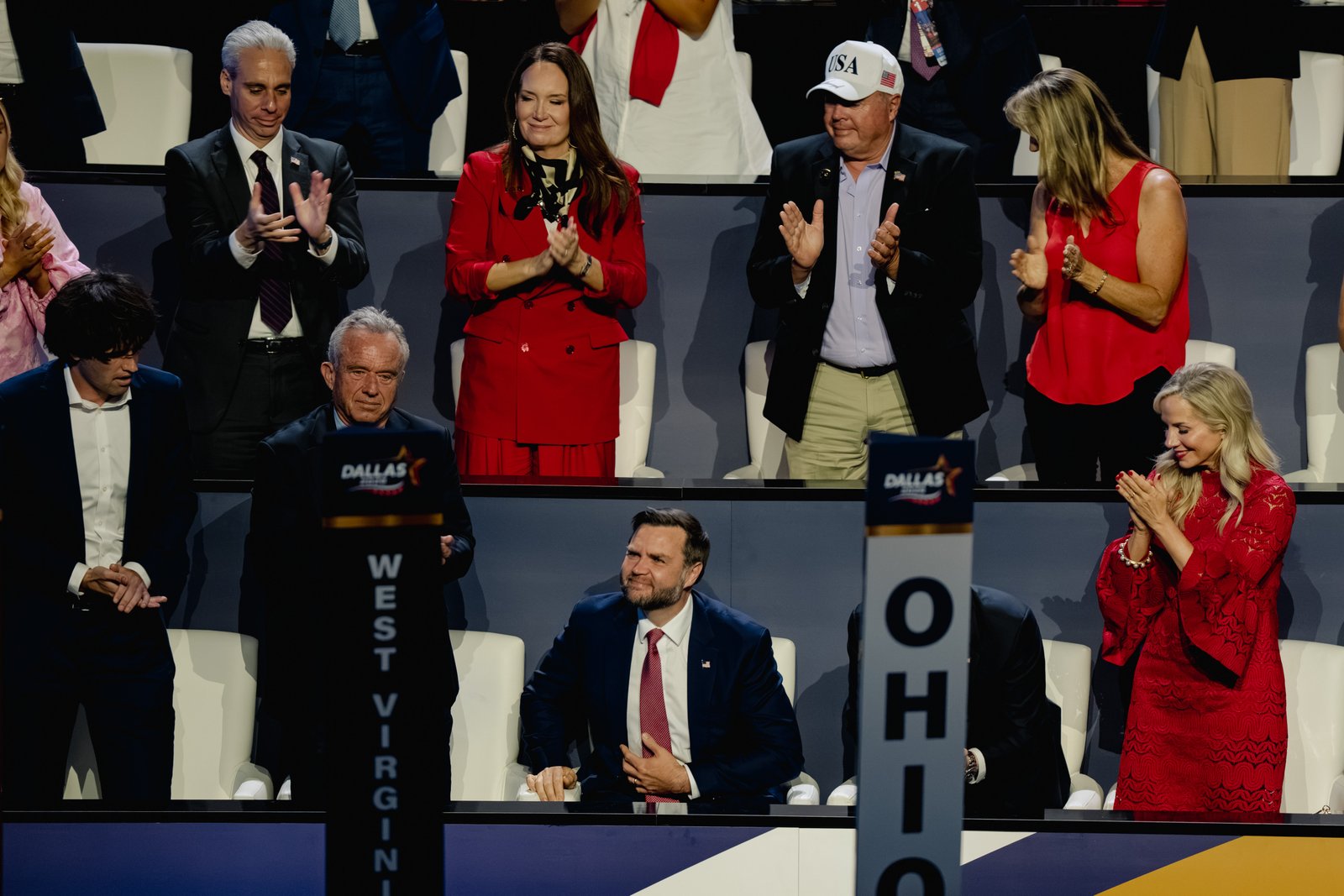
“I think we’re all looking forward to learning more,” said Rep. Bryan Steil (R-Wis.) as he left the closed-door breakfast with Vance.
Asked if he would support Trump’s proposal, Steil repeated, “I think we’re all looking forward to learning more.”
While Republicans scramble to figure out how to position themselves on the “dividend” pledge, Trump told CBS on Thursday he doesn’t think he needs Congress to approve his plan to send out payments.
Amy Natoce, a spokesperson for Ohio GOP Sen. Jon Husted, who faces a tough battle for reelection this fall, said his team “has reached out to the White House to learn more about the proposal and how it would work.” Natoce noted that “putting money directly back into the pockets of hardworking Ohioans is in line with Jon Husted’s priorities.”
Some Republicans were willing to more fully embrace the idea.
Texas Sen. Ted Cruz said Wednesday that it was “an incentive for work” — even though the money will go to all Americans regardless of employment status. Ohio Sen. Bernie Moreno pledged to draft up a bill on the checks “so that we can get the Trump Dividend passed immediately after the November 3rd election.” Kansas Sen. Roger Marshall, who’s facing a surprisingly competitive race, eagerly asked his social media followers to “comment how you will spend your $5,000 Trump Dividend when Republicans win in November.”

Fiscal hawks say they are eager for information. Rep. Glenn Grothman (R-Wis.), who serves on the House Budget Committee, declined to say whether he would support the president’s proposal which could cost more than $1 trillion.
“I would like to know how they would plan to pay for … back of envelope … well over $1 trillion,” Rep. Chip Roy (R-Texas) said in an interview Wednesday night shortly after Trump announced the proposal.
Trump has promised a litany of dividends and checks to Americans in recent years that have never materialized.
He raised the idea of direct checks to Americans in private meetings with GOP leaders before, often with money he says are from tariffs or the DOGE cuts. It’s an idea that Trump and some close White House advisers have discussed on and off for extended periods of time, particularly during his second term.
Each time, GOP leaders on Capitol Hill have argued that such an idea wouldn’t have the votes among Republicans given the price tag — and that it would likely require Congress to codify Trump’s controversial tariffs into law.
In December, Trump sent a $1,776 check to all members of the military, a move he referred back to while unveiling the dividend plan Wednesday. And he quickly followed up on Thursday with a separate offer to send money to Americans: $500 rebate checks to about 1 million Obamacare enrollees in 30 states.
Democrats immediately pounced on the latest proposal, including several candidates locked in competitive November races.
“Is this some kind of sick joke? Donald Trump’s policies are costing us more than [$5,000] — from his illegal war in Iran and his trade wars — and this dividend is nothing but a lie that wouldn’t even begin to make up for what he’s costing us,” Michigan Democratic Senate candidate Abdul El-Sayed said in a statement to Blue Light News.
A spokesperson for El-Sayed’s opponent, Mike Rogers, did not respond to a request for comment on the proposal. He also declined questions from reporters at the Dallas convention Thursday.
So far Democratic leaders have been dismissive of the idea.
Senate Minority Leader Chuck Schumer called the dividends a “bribe” to Americans and said they demonstrate Trump’s weak political position.
“Trump just talks out of who knows what,” he told reporters Thursday in New York City.
The Democratic Congressional Campaign Committee and House Majority PAC did not indicate that they planned to include the dividends in messaging to voters.

Emmer dismissed the criticism that the checks were a bribe, saying Trump wanted Americans “to share in the success” of the country.
He acknowledged it’s unlikely the House takes up such a bill before the midterms, given there is no proposal drafted yet and only one week of session scheduled before November, but expressed confidence the GOP could deliver on Trump’s promise after the election.
“Let the policy guys draft it. Let them debate it. Let them move it through committee,” Emmer said. “You get it to the whip’s office. We’ll pass it.”
Kamala Harris will campaign with Sen. Jon Ossoff in Georgia and headline a fundraising dinner hosted by Fulton County Democrats next month, marking her latest involvement in the midterm elections.
Harris is also slated to join Nevada attorney general and gubernatorial candidate Aaron Ford next month in Las Vegas and campaign with Democratic challengers in two competitive House races in her home state.
“It is critical for Democrats to win this November so we can fight the Trump administration’s corruption and work to lower costs for the American people,” a Harris spokesperson said in a statement. “Vice President Harris will continue to do whatever is needed to support candidates in races where she can be helpful.”
The events in Georgia were first reported by CNN. Harris will also be the keynote speaker at the fundraising dinner on Oct. 30 in Atlanta. An Ossoff campaign spokesperson confirmed his plan to campaign with Harris. Ossoff’s campaign previously told Blue Light News that it would welcome Harris to Georgia to stump with or on behalf of the senator.
Still, the announcements come as some Democrats have been keeping distance from the party’s last presidential nominee.
In Iowa, where Democrats are hoping to flip a Senate seat and retake the governor’s mansion in a state where Harris lost by 13 points in 2024, the two candidates both declined to have Harris’ help. So did Mary Peltola, the Democratic Senate candidate in Alaska who “isn’t seeking endorsements from anyone from the Lower 48,” and House candidates in some red states and rural districts.
For her part, Harris has skirted the question of whether she will run again in 2028 and said she is focusing on the midterm elections.
“Right now midterms [are] full-time occupying my thoughts, my mind and my work,” Harris said in a recent podcast episode with Megan Rapinoe on Vox Media. “I’m spending full time working on doing everything I can to help people restore some balance in our government, which is through the midterms, winning back Congress, the House and the Senate.”
“I haven’t decided. But honestly, from my perspective, ’28 doesn’t matter if we don’t win ’26,” she said to a question on another presidential bid.
It’s been a bad year to be an incumbent.
Rhode Island Gov. Dan McKee’s ouster on Wednesday, the first primary defeat for an incumbent governor in eight years, caps off a primary season that’s seen longtime leaders fall across the map and politicians across both parties struggle to make the leap to higher office.
Thirteen members of Congress have lost their reelection bids: seven Democrats and six Republicans, including two GOP senators. At least 16 more who were trying to move from the House to the Senate or take on statewide office have lost primaries: nine Republicans and seven Democrats, including Colorado Sen. Michael Bennet who unsuccessfully ran for governor.
The upheaval has been driven by a confluence of factors that will continue to dog incumbents through November. Voters are frustrated with both parties’ leadership in Washington. President Donald Trump has targeted some GOP foes as he looks to cement his legacy; Democrats are in the midst of pitched generational and ideological battles. Some members in both parties faced daunting new district lines. Others faced scandals that sank them.
In some races, those factors converged. Rep. Haley Stevens (D-Mich.) didn’t benefit much from her years in Washington in her Senate bid — and lost her primary to a left-flank rival who yoked her to the party establishment.
Caitlin Legacki, who advised Stevens’ bid, said incumbents’ losses this year show voters are simply fed up.
“It speaks to the high level of dissatisfaction that voters have with everyone,” said Legacki, who noted the anti-incumbent climate contributed to Stevens’ loss. “It’s a major ‘throw the bums out’ moment.”
DEMS KICK INCUMBENTS TO THE CURB
Democrats disillusioned with their leadership in Washington are taking it out on the party’s rank and file.
Progressives picked off more-moderate House members from New York to Colorado. Younger challengers ousted older incumbents from Texas to Connecticut. Local elected officials outran Washington incumbents. And voters have spurned lawmakers seeking higher office from Michigan to Minnesota.
Sometimes age was the biggest factor, sometimes it was ideology and sometimes both played a role. Democratic socialists defeated decades-older Reps. Diana DeGette of Colorado and Rep. Adriano Espaillat of New York. Former Hartford Mayor Luke Bronin relied on generational change to topple longtime Rep. John Larson in Connecticut.
THE TRUMP FACTOR
For Republicans, Trump played a major role in directing voters against his longstanding Washington foes.
Trump-backed challengers wiped MAGA irritants Sen. Bill Cassidy (R-Louisiana) and Rep. Thomas Massie (R-Ky.) off the map. And the president’s late-stage endorsement of Texas Attorney General Ken Paxton in the Senate runoff helped sink Sen. John Cornyn (R-Texas).
REDISTRICTING RIPPLE EFFECTS
The unusual mid-decade gerrymandering war took out members of both parties, who lost competitive races in less favorable districts, ran for other offices or switched parties to avoid similar fates.
Texas Democratic Rep. Al Green was ousted by Rep. Christian Menefee in a member-on-member primary forced by gerrymandering that played on their generational divide.
Democratic Rep. Julie Johnson lost her redrawn Dallas-area district to former Rep. Colin Allred, while Rep. Dan Crenshaw’s right-flank challenger leveraged the redraw (as well as some of Crenshaw’s breaks with Trump) to oust the Republican.
Others chose to retire rather than keep fighting uphill battles. Democratic Reps. Steve Cohen of Tennessee (who had already been facing a generational primary challenge before the redraw), Lloyd Doggett of Texas and Cleo Fields of Louisiana hung it up after Republicans dismantled their districts. So did GOP Reps. Darrell Issa of California and Burgess Owens of Utah after their districts were redrawn. California Rep. Kevin Kiley, who opposed the mid-decade gerrymanders and switched from GOP to independent after his district was redrawn, said the new maps have unleashed “chaos” on the House and “reduced the quality of representation in Congress.”
SWEPT OUT BY SCANDAL
Call it the midterms of controversy: Incumbents in both parties have succumbed to the political pressures of their scandals this year.
Democratic Rep. Eric Swalwell ended his run for California governor and exited Congress amid sexual assault and misconduct allegations. Rep. Tony Gonzales (R-Texas) dropped his reelection bid and resigned after admitting to having an affair with a staffer who later killed herself.
Tennessee GOP Rep. Andy Ogles, despite his Trump endorsement, couldn’t overcome his past controversies, a newly redrawn district and outside spending. Republican Florida Rep. Cory Mills faced attacks over probes of his conduct from primary winner Ryan Elijah. Elijah told Blue Light News this week that he believed Mills’ controversies collided with voters’ anti-incumbent angst.
“We ran on our merits, but trust was a factor,” Elijah said. “I think trust was the biggest factor.”
HIGHER OFFICE FLAMEOUTS
Several congressional Democrats struggled to outmatch opponents without Washington ties in Senate primaries. Bennet, Stevens and Reps. Angie Craig (D-Minn.), Jasmine Crockett (D-Texas), Raja Krishnamoorthi (D-Ill.) and Robin Kelly (D-Ill.) all lost statewide primaries to rivals who hadn’t served in D.C.
Voters haven’t been kind to GOP representatives seeking higher office either. Reps. Randy Feenstra of Iowa, Dusty Johnson of South Dakota and Nancy Mace and Ralph Norman of South Carolina all lost their gubernatorial bids. Voters rejected Norman twice: He also lost the snap primary for Lindsey Graham’s seat to the late senator’s sister — a total political newcomer. Texas Rep. Chip Roy also lost a runoff for state attorney general.
-

 Politics2 years ago
Former ‘Squad’ members launching ‘Bowman and Bush’ YouTube show
-
Uncategorized2 years ago
Bob Good to step down as Freedom Caucus chair this week
-

 Politics2 years ago
Former Kentucky AG Daniel Cameron launches Senate bid
-

 The Josh Fourrier Show2 years ago
DOOMSDAY: Trump won, now what?
-

 The Dictatorship2 years ago
Luigi Mangione acknowledges public support in first official statement since arrest
-

 The Dictatorship2 years ago
Pete Hegseth’s tenure at the Pentagon goes from bad to worse
-

 Politics2 years ago
Blue Light News’s Editorial Director Ryan Hutchins speaks at Blue Light News’s 2025 Governors Summit
-

 The Dictatorship1 year ago
Mike Johnson sums up the GOP’s arrogant position on military occupation with two words