
The Dictatorship
SECRET POLICE: Federal appeals court blocks California law requiring federal agents to wear identification…

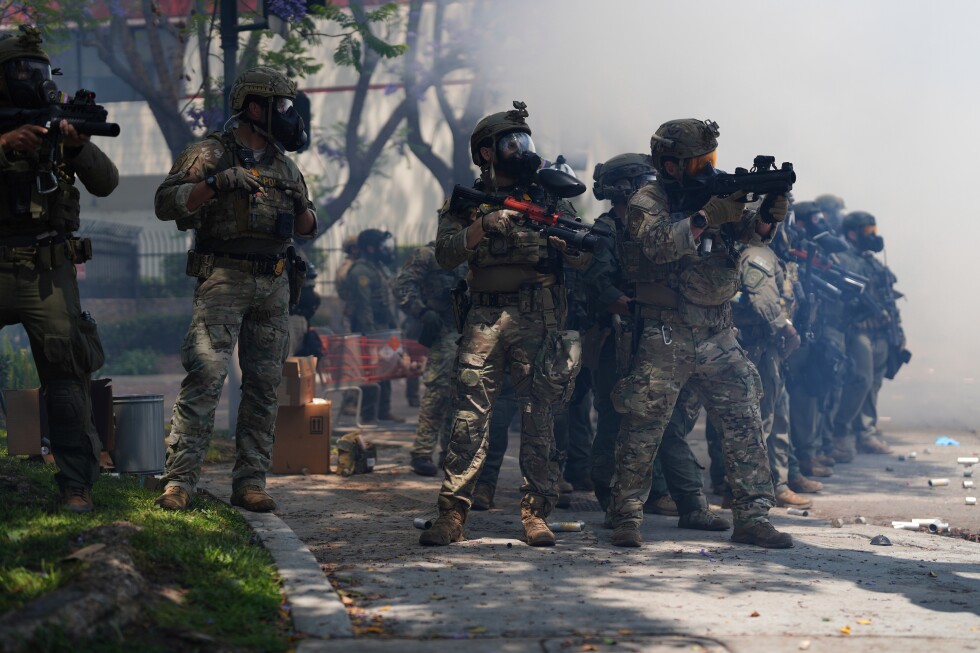
LOS ANGELES (AP) — A federal appeals court issued an order Wednesday blocking a California law requiring federal immigration agents to wear identification, another blow to the state’s attempts to limit the Trump administration’s aggressive enforcement tactics.
The Trump administration argued that it would threaten the safety of officers who are facing harassment, doxing, and violence and that it violated the constitution because the state was directly seeking to regulate the federal government.
A three-judge panel of the 9th U.S. Circuit Court of Appeals issued an injunction pending appeal. It had earlier blocked the law from taking effect.
The decision could have implications nationwide for other states that have pursued their own measures to place restrictions on immigration agents.
The measure was one of two major pieces of legislation enacted last fall aimed at reining in federal immigration agents after a sweeping crackdown on illegal immigration in Southern California in June. The other law would have banned most law enforcement officers from wearing masks, neck gaiters, and other facial coverings. Advocates have raised concerns about masked agents conducting workplace raids or arresting people on the street, often without showing identification.
The Trump administration sued over both in November.
A federal judge blocked the mask ban in Februaryruling that it discriminated against the federal government because it did not apply to state troopers. The law made exceptions for undercover agents, protective equipment like N95 respirators or tactical gear, and other situations where not wearing a mask would jeopardize the operation. That judge let the ID law stand.
At an appeal hearing March 3, Justice Department lawyers argued that the California identification requirement law sought to regulate the federal government, violating the Supremacy Clause of the Constitution.
The appeals court agreed unanimously, saying the law “attempts to directly regulate the United States in its performance of governmental functions,” in an opinion written by Judge Mark J. Bennett. The panel was composed of two Trump appointees, Bennett and Daniel P. Collins, and Obama appointee Jacqueline H. Nguyen.
California lawyers argued that the law applied equally to all law enforcement officers without discriminating against the U.S. government, and that states could apply “generally applicable” laws federal agents. They also argued that the law was important to address public safety concerns.
People are more likely to attack officers in self-defense if there’s no visible identification letting the public know they are law enforcement, California lawyers said in a brief.
“This confusion has resulted in federal law enforcement officials being mistaken for criminals and vice versa, creating serious risk of harm to peace officers and members of the public,” they wrote.
In October 2025, the Federal Bureau of Investigation issued a report warning that the increase in U.S. Immigration and Customs Enforcement activity had spurred “criminal actors impersonating ICE agents to commit violent crime,” California attorneys noted.
The appeals court judges said they did not consider the public safety factors because the federal government has demonstrated its constitutional rights would be violated by the legislation, and “all citizens have a stake in upholding the Constitution.”
When a lower court struck down California’s mask ban, it left open another way of achieving the same goal. The judges in that case had indicated they would be more open to a law that banned masks for all law enforcement officers, not just federal ones. A new California bill attempts to revive the mask restrictions by also applying them to state troopers.
But the appeals court’s opinion signals a stricter view on the state government’s ability to regulate federal officers.
“The Supremacy Clause prohibits States from enacting a law that directly regulates federal operations even if the law regulates state operations in the same manner,” the judges wrote.
First Assistant U.S. Attorney Bill Essayli called it a “huge legal victory” in a post on X.
California Attorney General Rob Bonta’s office said they are reviewing the order.
“The Trump Administration has stepped well outside the boundaries of normal practice, deploying masked and unidentified agents to carry out immigration enforcement, despite the risks these tactics pose to public safety and basic civil liberties,” Bonta’s office said in a statement.


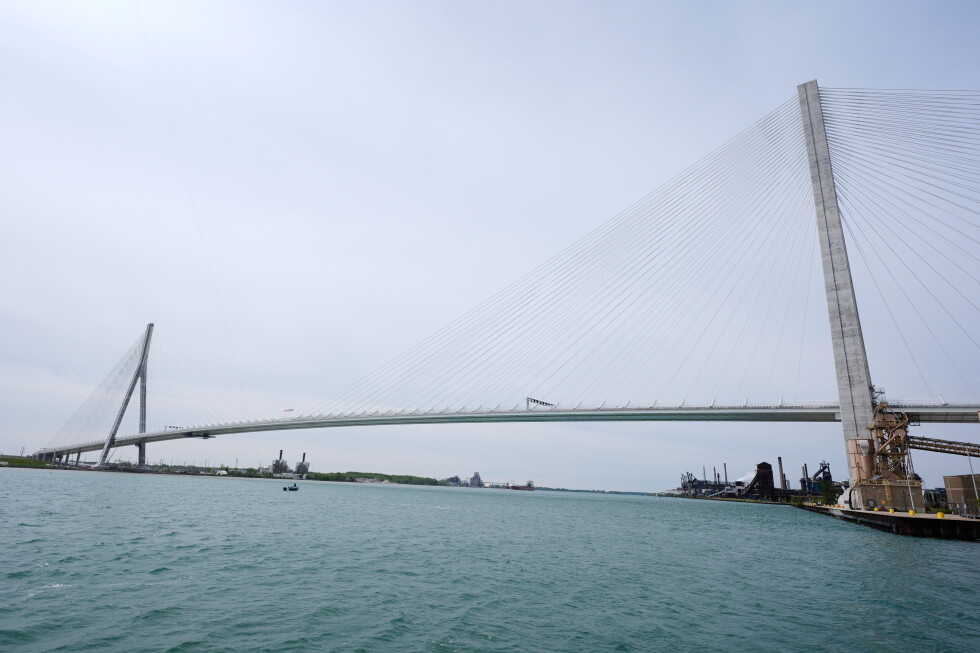
DETROIT (AP) — The opening of a Canadian-U.S. bridge across the Detroit River, which President Donald Trump had previously threatened to block, was delayed Thursday due to unresolved issues.
In a statement released before a scheduled Friday ribbon-cutting ceremony at the bridge, the Windsor-Detroit Bridge Authority said that “Canada and the United States have agreed to delay the opening of the bridge, taking the necessary time to resolve any outstanding issues.” It didn’t elaborate on what those issues are or how long the delay would last.
The 1.5-mile-long (2.4-kilometer-long) Gordie Howe International Bridge spans the Detroit River and connects the Motor City with Windsor, Ontario. The bridge is jointly owned by Canada and Michigan and was expected to open to traffic later this month.
But the opening had been thrown into question after Trump in February demanded in a social media post that Canada turn over at least half of the bridge’s ownership to the U.S. federal government and agree to other unspecified demands in one of the Republican president’s many salvos over cross-border trade issues.
Michigan officials and the White House had been in contact for months about the bridge following Trump’s post, with the understanding that the opening would move forward Friday. Invitations for the bridge’s opening went out this week following a conversation between Michigan Gov. Gretchen Whitmer, a Democrat, and White House chief of staff Susie Wiles.
“This project is a powerful example of bipartisan and international cooperation, and the governor looks forward to attending the ribbon-cutting ceremony when it happens,” a statement from Whitmer spokesperson Bobby Leddy said.
New bridge a “long-term play”
Internal disagreements within the Trump administration threw those plans into question, as Commerce Secretary Howard Lutnick pushed back on the opening, according to two people with knowledge of the matter who insisted on anonymity to discuss the private talks.
The White House did not immediately return a request for comment Thursday.
Canadian Prime Minister Mark Carney said Thursday evening, “At the request of the United States we agreed to delay the opening and take the necessary time to resolve outstanding issues.”
He added, “There are some things that have been raised, a series of technical aspects, which we will work through with the United States.”
Even with the delay, officials remained optimistic that the bridge — a roughly $4.4 billion project — is still expected to open.
“We need to keep this very much in perspective,” said Sandy Baruah, president of the Detroit Regional Chamber and former U.S. assistant secretary of commerce. “Our organization, the state of Michigan and others have been working on this bridge for 20 years. If it opens July 1, Aug. 1 or Sept. 1, I’m not going to get overly agitated about it. This is a long-term play.”
Named after the late Canadian Hockey great Gordie Howe, who spent 25 seasons leading the Detroit Red Wings, the bridge is expected to be another vital economic artery between Canada and the United States.
The construction project was negotiated by Rick Snyder, the former Republican governor of Michigan, and paid for by Canada to help ease congestion at the existing Ambassador Bridge and the Detroit-Windsor tunnel. Work has been underway since 2018.
U.S. Sen. Elissa Slotkin, a Michigan Democrat, said she’s taking people at their word that the holdup is “a minor hiccup.”
“This is probably the most bipartisan issue in the state of Michigan, so it’s ridiculous that we can’t just seal the deal,” Slotkin said.
Commerce and border crossings
Detroit and Windsor have been neighborly for generations, with residents in both countries frequently crossing the shared river border for entertainment and shopping. Windsor’s population in 2021 was about 230,000. Like Detroit, the Canadian city’s economy has a strong focus on manufacturing and the auto industry.
Commercial trade between the two cities primarily has been across the nearly century-old and privately-owned Ambassador Bridge, which is closer to downtown Detroit than the Gordie Howe Bridge.
The Ambassador Bridge had been the busiest commercial border crossing between the United States and Canada until last year, when truck traffic along the Blue Water Bridge connecting Port Huron, Michigan, to Sarnia, Ontario, surpassed the Ambassador Bridge’s numbers, according to the Bridge and Tunnel Operators Association.
In 2025, about 2.1 million trucks crossed the Blue Water Bridge compared to just over 1.8 million that used the Ambassador Bridge. About 3.5 million passenger vehicles used the Ambassador Bridge last year, while 1.6 million crossed via the Blue Water Bridge.
Combined, more than 9.2 million vehicles crossed the border on those two bridges in 2025, according to the U.S. Bureau of Transportation Statistics.
More than 3.7 million cars and SUVs also traveled between the United States and Canada last year via the Detroit-Windsor Tunnel.
Both bridges and the tunnel are working at full capacity, and the new bridge will help improve the efficiency of commercial and personal traffic between the two countries, Baruah said.
“This is what government is supposed to do, make it easier for business to conduct commerce,” he said.
___
Cappelletti reported from Washington.
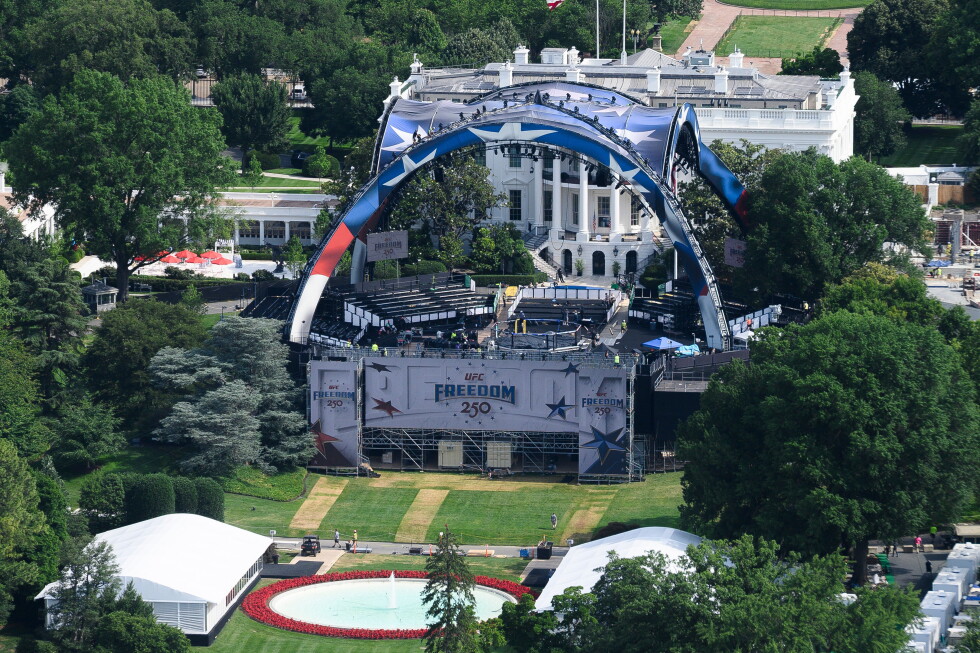

President Donald Trump’s planned UFC fight on the White House’s South Lawn has required a monumental effort from more than seven federal agencies, hundreds of staff working onsite daily and at least $60 million, according to a legal filing that offers a glimpse into the preparations.
The event is part of the 250th anniversary of America’s founding, and is scheduled for the weekend with the main attraction — seven mixed martial arts matches — on Sunday.
That is, if a judge doesn’t halt the proceedings, which is sought by two Virginia residents in a federal lawsuit against the National Park Service, which oversees the South Lawn.
The agency filed a rebuff of the request Tuesday in court, and, in it, laid out the operations for the event.
“Well over $60 million and tens of thousands of hours of labor have been expended,” the document read, adding that the money came from the UFC and groups affiliated with it.
The Octagon
It’s the eight-sided cage that surrounds the sometimes bloodied combatants and sits at the center of the constructed arena on the South Lawn.
The arena is expected to hold 4,000 spectators, with another 120,000 visitors — who swung tickets from an online lottery — anticipated to watch from the nearby Ellipse.
The installation began May 20, and the Secret Service worked with the UFC to screen between 20 and 30 trucks of equipment — as well as between “700 and 900” staff — that came in daily for the installation.
The document did not specify the extent of government resources spent on the project, but said seven agencies, including Homeland Security and the Federal Aviation Administration, have “allocated significant resources and manpower.”
The schedule
It’ll kick off Saturday with a ceremonial weigh-in at the Ellipse, followed by a concert by country musicians The Zac Brown Band.
A UFC Freedom 250 Fan Fest will be ongoing through the weekend, with “interactive experiences,” live shows, celebrity appearances, “exclusive on-stage moments,” meet and greets, live music and interviews with the athletes.
Sunday night is when the seven bouts kick off. At the close, Trump is scheduled to fly to France for the G7 summit.
Disassembly of the installations will begin the next day, and they are expected to be entirely removed by June 23.
The athletes’ Epsom salt baths
There are 14 athletes competing, and their training is rigorous.
Preparations start months in advance, working toward more intense weight cutting and diet alteration in the final week that can include fasting, extreme sauna use and hot Epsom salt baths.
They could be shaving as many as 20 pounds before weigh-ins, which are designed to keep the competition fair between similarly weighted combatants.
Lawsuit calls it ‘corrupt’
It was filed Saturday by the Public Integrity Project on behalf of the two Virginia residents and argues that Trump’s authorization of the event violated National Park Service regulations prohibiting sporting events on federal parklands.
One of the attorneys, Brendan Ballou, characterized it as a “corrupt use of our most sacred national monuments for private gain.”
The National Park Service pushed back on that claim, but also detailed the event’s preparations to make a point.
“All these hopes could be dashed at the very last moment,” it read, “by the whim of two people who believe they have superior taste and want to spoil the event for everyone else.”
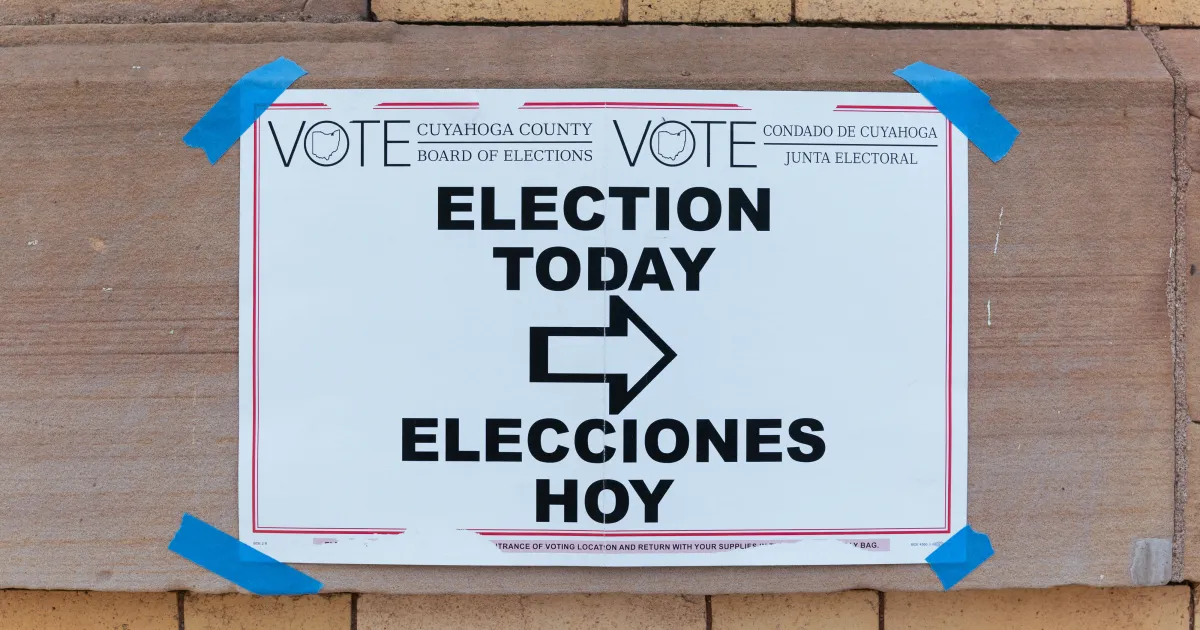
FBI agents on Thursday raided the Cleveland offices of the Ohio Organizing Collaborative, a pro-democracy organization that helps register voters in that state, according to three people briefed on the search.
Agents also fanned out across the state, showing up at the homes of the group’s leaders and staff members, carrying some subpoenas and seeking information and electronic devices, according to the people, two of whom spoke on the condition of anonymity to discuss a sensitive ongoing investigation. Members of the group had made contact with lawyers on Thursday to determine their legal options, the people said.
Prentiss Haney, a board member for Ohio Organizing Collaborative, told MS NOW Thursday night that agents approached people with connections to Ohio Organizing Collaborative, including some who had performed basic canvassing and volunteer work for the group, and began pressing them for information.
Agents were “basically trying to fish for information,” said Haney.
“They had agents all across the state going to civil rights leaders and community leaders’ doors intimidating them, coming and demanding that they talk about literally anything they would ask,” Haney said, adding that agents “asked them if they’re committing voter fraud, just on their doors, in front of their houses with their children, and just following them to work and school.”
Haney said some of the people said the agents approached without warrants.
“Just straight-up intimidation tactics,” he said.
Spokespeople for the FBI and the Justice Department did not immediately respond to requests for comment late Thursday night.
Those sources familiar with the investigation said they are concerned this new effort in Ohio is part of the Trump administration’s efforts to sow doubt and distrust in voting integrity in key swing states ahead of the midterm elections.
Federal agents have in recent months launched inquiries and investigations into voting protocols in Georgia and Wisconsin, have subpoenaed voting records in Arizona and sought reviews of voting machines in Puerto Rico.
According to its website, the Ohio Organizing Collaborative facilitates statewide voter registration through grassroots, community-led programs, including its “Democracy Builders” initiative. This collaborative works in Ohio’s major metropolitan areas, such as Cleveland, Columbus and Cincinnati, to help underrepresented communities register to vote and provides other support.
The group has also joined lawsuits challenging redistricting efforts that it argues reduce Black voters of representation. These lawsuits also “stand your ground” laws that allow a person to shoot someone if they feel threatened.
Haney said the Cleveland raid and harassment of staff are unjustified and that investigators lack any evidence of wrongdoing.
“How can they distract and intimidate civil rights leaders and voters and community leaders who are helping people get registered to vote and create a national spectacle about it?” he said.
“That is the only reason why they would choose to do that, do it now, in the middle of a contested political election in the state. There’s no other reason. They have no evidence of that.”
Carol Leonnig is a senior investigative reporter with MS NOW.
Will McDuffie is a reporter for MS NOW.
Alex Tabet is a reporter for MS NOW.
Laura Barrón-López covers the White House for MS NOW.
- Freedom 250’s fair on National Mall highlights conservative groups
- Trump keeps extending the Iran war. Republicans are losing patience.
- Trump believes that we will win
- Trump’s massive arch could snarl traffic for years
- How I failed to make it to my first World Cup match
- Algae resurfaces in reflecting pool after multimillion-dollar fixes
- House Oversight requests Alan Dershowitz testify in Epstein probe
- The Epic Story of How Trump Seized the World Cup
- Rick Scott lifts holds on Coast Guard promotions
- Senate panel approves Department of War name change
-

 Politics1 year ago
Former ‘Squad’ members launching ‘Bowman and Bush’ YouTube show
-

 The Dictatorship1 year ago
Luigi Mangione acknowledges public support in first official statement since arrest
-
Uncategorized2 years ago
Bob Good to step down as Freedom Caucus chair this week
-

 Politics1 year ago
Former Kentucky AG Daniel Cameron launches Senate bid
-

 The Dictatorship1 year ago
Pete Hegseth’s tenure at the Pentagon goes from bad to worse
-

 The Josh Fourrier Show2 years ago
DOOMSDAY: Trump won, now what?
-

 Politics1 year ago
Blue Light News’s Editorial Director Ryan Hutchins speaks at Blue Light News’s 2025 Governors Summit
-

 The Dictatorship9 months ago
Mike Johnson sums up the GOP’s arrogant position on military occupation with two words