
Politics
‘Just get in and stir sh-t up’ — Lawler as chaos agent

DAYS THE BUDGET IS LATE: 13
OPERATIVES GONNA OPERATE: Republican Rep. Mike Lawler isn’t facing a primary challenge for his seat — but he’s got his hands full with the one across the aisle anyway.
The GOP member of Congress spent the last few days meddling in the crowded Democratic primary for his seat — sending covert text messages that some say were designed to look like they’re from Democrats and deploying his campaign manager to challenge the signatures of a lefty Democratic candidate.
In the meantime, Lawler — who also serves as the Rockland County Republican Chair — held a rally Sunday to launch his own campaign.
“This is him. This is his deviousness,” Putnam County Democratic Chair Jennifer Colamonico said of Lawler’s strategy. “Just get in and stir shit up.”
Last week, a blast text message reached dozens of Democratic voters in NY-17 highlighting how one Democrat in the race was allegedly attacking the other by challenging their signatures to get on the ballot.
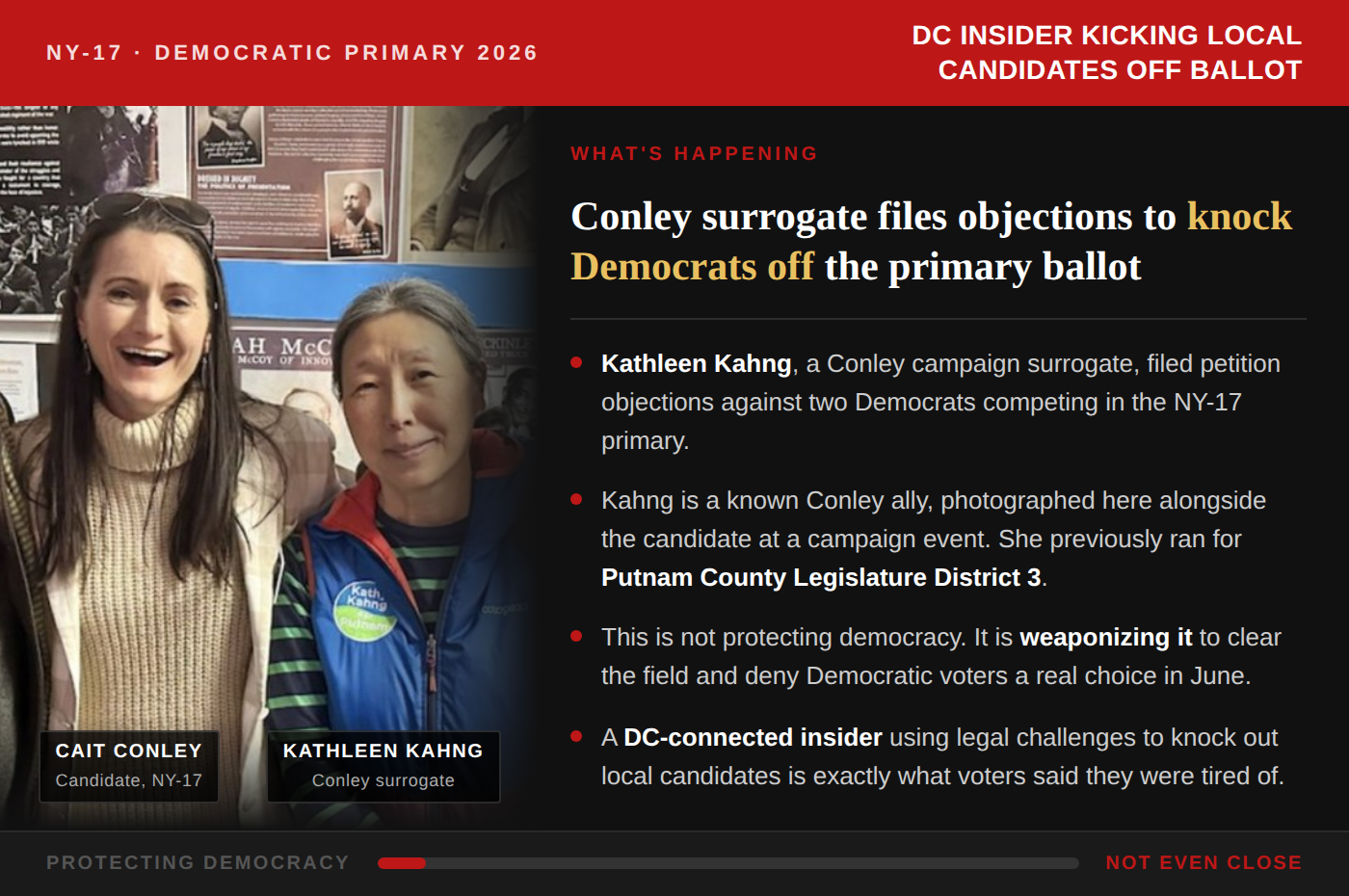
“Kathleen Kahng, a Conley campaign surrogate and former Putnam County legislative candidate, filed objections to the petitions of two Democrats competing in the June primary,” the message read, referencing Army vet Cait Conley, who is running for Lawler’s seat as a Democrat. “Not a concerned voter. A Conley insider. This isn’t democracy. It’s field-clearing.”
The text — which was sent out on the night of the Democratic debate in the district — included a picture of Conley and Kahng and the words “DC INSIDER KICKING LOCAL CANDIDATES OFF BALLOT.”
It didn’t say who it was from, but when recipients texted back “help,” a second text popped up: “Mike Lawler: For help, reach out to mike@lawlerforcongress.com. To opt-out, reply STOP.”
Lawler’s campaign declined to comment on the blast text. But it’s his latest barrage into the competitive Democratic primary as he’s likely looking at tougher odds at reelection than in 2024, after the Cook Political Report moved its rating of the district from “Leans Republican” to “toss-up.”
Lawler, a former campaign manager, lobbyist and political strategy firm founder, has long been recognized by Republicans and Democrats alike for his shrewd political abilities and tireless campaigning. Two years ago, he was one of the only House Republicans to win reelection in a district that voted for Kamala Harris for president by less than a one-point margin.
In that election, he was also accused by the Working Families Party of being the mastermind who encouraged a “ghost candidate” to run on the lefty third-party’s ballot line. The candidate — who was almost never seen in public — was running in an apparent attempt to siphon votes from former Democratic Rep. Mondaire Jones. Last year, on Lawler’s home turf, a similar strategy appears to have played out in races for town council.
This year, no mysterious candidates will be on the ballot for Congress in NY-17 from the Working Families Party, filings show. However, board of elections filings show Lawler’s campaign manager, Ciro Riccardi, filed preliminary paperwork to contest Democratic Rep. Effie Phillips-Staley’s ballot access signatures.
“Lawler is wasting everyone’s time with frivolous political games that will go nowhere,” Phillips-Staley spokesperson John Tomlin said in a statement. “Clearly Effie’s momentum is making him nervous and he’s terrified to face her in November.”
Riccardi responded in a statement saying that Phillips-Staley’s signatures were “rife with fraud and errors” but did not identify what those errors were. Team Lawler plans to file a “specific objection” by tomorrow, which will reveal more details.
He also said that Lawler “will be happy to face whoever survives this clown show in November.”
“Democrats whining about our campaign defining our opponents are the same ones trying to rig their own primary,” Riccardi said. “We’re not hiding anything.”
In the meantime, Lawler’s mass text about Democrats filing preliminary challenges to other candidates’ petitions appears to have successfully struck a nerve.
When Playbook reached out to Putnam County Democratic Vice Chair Kathleen Kahng — the person who objected to Democratic candidate Mike Sacks and John Cappello’s petitions — she referred Colamonico, the Putnam County chair, back to us for comment.
Colamonico told us her party won’t follow through with its initial objections to the two Democratic candidates’ petitions and dismissed the move as “regular order committee business, that’s all.”
Conley’s campaign refused to answer questions about whether Kahng was acting on their behalf to challenge her opponents’ petitions. And Suzanne Berger, the Westchester Democratic chair, told Playbook she and the other Democratic county chairs talked to each other about “doing our due diligence” in advance of Colamonico making the challenge.
“The more candidates there are in a race, the less ability there is to focus on the candidates that are more likely to win the primary,” Berger said.
Sacks, whose petitions were challenged, didn’t like that.
“I find that deeply anti-Democratic,” Sacks said. “It goes further to the deep dissatisfaction that everyday Democratic voters have here with our party leadership. — Jason Beeferman
From the Capitol
SHED A TIER: The labor-led drive to overhaul the Tier 6 pension category is steamrolling through the state Capitol — with few officials disagreeing with powerful unions seeking to lower the retirement age and reduce employee contributions.
It’s a disheartening development for Republican Assemblymember Michael Fitzpatrick, a Long Island lawmaker who is perhaps the most vocal and rare opponent to changing the pension.
“You now, in a sense, have a professional Legislature,” Fitzpatrick said in an interview. “That’s right where the unions want us. You’re asking the legislators to vote against their own financial best interest. So who is going to say no to the alphabet soup of unions when, if I lose, I’m out of the pension system.”
Read more from Blue Light News Pro’s Nick Reisman.
TRAVELING SEPARATELY: New York lawmakers passed a third temporary stopgap spending bill Monday afternoon as deadlock sets in over Gov. Kathy Hochul’s push to overhaul the state’s car insurance laws.
The state budget is now more than two weeks late as the governor and Democratic-led Legislature remain at odds over a host of issues, including her push to weaken a 2019 climate law and opposition to raising taxes.
But the Hochul-backed car insurance proposals have emerged as a major sticking point — with lawmakers beginning to publicly grumble that the governor is not willing to negotiate on the subject.
“It’s a one-way street on the auto insurance issue,” Senate Deputy Leader Mike Gianaris said.
Read more from Blue Light News Pro’s Bill Mahoney and Nick Reisman.
FROM CITY HALL

MAMDANI AND ZUCMAN’S TAX DAY: The deadline to file income taxes is Wednesday, and to commemorate the occasion, Mayor Zohran Mamdani, top French economist Gabriel Zucman and Nobel prize laureate Joseph Stiglitz will host a joint conference on “confronting global inequality” at the CUNY Graduate Center in New York.
Mamdani and Zucman are both advocating for a 2 percent tax on the ultra-rich, but with some major differences. While Mamdani is calling for a 2 percent tax increase on New Yorkers earning more $1 million per year, Zucman wants rich households to pay at least 2 percent of the value of all their assets in taxes every year.
In 2024, during the Brazilian G20 presidency, Zucman pitched a global version of his tax, targeting the world’s billionaires. A national version of the “Zucman tax” dominated the French political debate last year, but it has not been implemented. Zucman, though, remains confident that sooner or later his dream will come true. Mamdani, Zucman and Stiglitz are expected to also spell out their ideas in a joint op-ed. — Giorgio Leali and Anthony Lattier
PRIDE FLAG FLIES: The Trump administration is agreeing to fly a pride flag at Stonewall National Monument in Manhattan’s Greenwich Village after civil rights groups sued the federal government following the flag’s sudden removal in February.
“We fought the Trump administration — and we won,” Manhattan Borough President Brad Hoylman-Sigal said in a statement. “The Trump administration has blinked and backed down from its contemptuous attempt to erase American history.”
Earlier this year, the Trump administration quietly removed the flag after it issued a memo mandating that “only the U.S. Flag, flags of the [Department of the Interior], and the POW/MIA flag will be flown” by the National Park Service. Groups like The Gilbert Baker Foundation, Village Preservation and EQNY Fund Inc. sued to say the flag’s removal was an “arbitrary and capricious action.”
Today’s agreement settles that suit. — Jason Beeferman
IN OTHER NEWS
— MISS DIRECTION: Council Member Farrah Louis directed $450,000 to BHRAGS Home Care, a Brooklyn nonprofit currently under a federal corruption investigation. (Gothamist)
— PARK, MEET PLAZA: Mamdani is proposing to shut down a hazardous roadway at Brooklyn’s Grand Army Plaza in the hopes of restoring the Soldiers’ and Sailors’ Memorial Arch as a direct gateway to Prospect Park. (The New York Times)
— TOUGH CROWD: Republican Rep. Mike Lawler faced a hostile audience at his latest town hall in Putnam County, where residents pressed him on his support of the Trump administration and the ongoing war in Iran. (Lohud)
Missed this morning’s New York Playbook? We forgive you. Read it here


Prominent Texas Republicans are denouncing Bo French, a Republican nominee to join the state’s railroad commission, after he made a xenophobic post describing a group of Asian American students attending a University of Texas football game as a “problem.”
French posted a photo on X of UT students celebrating in the crowd and wrote: “I heard UT graduation this year looked like this. I didn’t believe it. The problem is now obviously far worse than anyone imagined.”
Sen. John Cornyn immediately condemned the post as racist and called on other Republican officials to speak out.
“This is the Republican nominee for statewide office,” Cornyn wrote on X. “Are other Republican elected officials going to condemn the intolerance and racism, or look the other way while it becomes normalized. This is how great political parties self-destruct. Sad.”
Texas Gov. Greg Abbott also rejected French’s message in a statement shared with Blue Light News, saying the picture instead showed Texans united behind their college football team, which had just defeated top-ranked Ohio State.
“That is not my message,” Abbott said. “A selective picture of Longhorn fans celebrating our biggest home victory-ever-actually shows a way that Texans unite. We all support our college football teams.”
“The way we win the state is the same way we win football games,” Abbott added. “We unite under the brand of Texas.”
Abbott also defended Texas’ hard-line immigration policies, saying unity “doesn’t mean that Texas cannot also lead in having the toughest immigration laws of any state in America and freezing H1B visas at our universities.”
Several Republican members of the Texas House also joined in the backlash. State Rep. Lacey Hull urged French to remove the post, writing: “This post breaks my heart. I see college kids cheering on their football team. I see Texans.”
State Rep. Jared Patterson called the post “racist” and said it demeaned students because of their race or ethnicity.
“There is absolutely nothing Christian or conservative about looking at a crowd of young Texans at a college football game, seeing the color of their skin, and declaring that they are a ‘problem,’” Patterson wrote on X. “These are 20-year-old kids cheering for their university — not political props and not targets for racial attacks.”
Texas House Speaker Dustin Burrows similarly wrote that opposing immigration policy does not justify “demeaning people because of their race or ethnicity,” adding that French’s post has “crossed the line” and should be deleted. State Rep. Jeff Leach offered a more succinct request: “Delete this, Bo.”
But French also drew support from some Republicans who attacked Cornyn for condemning him. Former Texas GOP Chair Matt Rinaldi accused Cornyn and other Republicans of mortgaging “our children’s future for government handouts and cheap labor,” while state Rep. Andy Hopper called Cornyn a “smug globalist” who had brought the policies at issue to Texas.
French has repeatedly engaged in inflammatory rhetoric. Earlier this year, he suggested Republicans should fear Islam and advocated for deporting 100 million people.
Representatives for French and Lt. Gov. Dan Patrick did not immediately respond to requests for comment.
Former President Barack Obama is urging Democrats — including 2028 presidential candidates and congressional leaders — to more aggressively focus on a comprehensive AI agenda, warning in a closed-door fundraiser that the technology is at an inflection point.
“This is something that is moving very fast in private hands, and if we don’t get on top of it, I think can be dangerous,” Obama said at the fundraiser Thursday, according to a partial transcript of his remarks provided by his office. “If we do get on top of it, I do think it’s beneficial.”
Speaking alongside House Minority Leader Hakeem Jeffries at the New-York Historical Society in Manhattan, Obama said he is neither a “doomer” nor an “accelerationist.” His remarks come amid increasing alarm over the technology’s advance, with executives at two of the country’s leading AI labs joining Elon Musk in calling for slowing its development, following months and years of cries from within the industry for government to act.
Obama said AI development would be “one of my central agendas” if he were running for president, throwing down a gauntlet as the shadow 2028 Democratic primary debate responded to the AI leaders’ calls.
“I would have a very clear plan, and I would talk about this, and I would say, here’s our plan for safety, here’s our plan for making sure our kids are not corrupted by this,” Obama said, according to excerpts of his remarks shared with Blue Light News by his office and first reportedby The New York Times.
Among the top concerns, Obama said: “I would be thinking about the economic impacts in very concrete ways and understanding what does it mean if there’s going to be job displacement. Where is that going to hit? How are we going to respond? Are there going to be limits to the amount of displacement that can take place? What is that going to mean for our social safety net? If it turns out that you’ve got a lot more people who can’t find full-time work because they’ve been rendered redundant, how are we going to respond?”
He also called for Congress to take action, telling Jeffries that Democrats should “put together a framework for a very public conversation” centered on the biggest issues.
Obama’s remarks mark a larger shift for both himself and the Democratic Party writ large: He governed as a tech-friendly Democrat, who broke POTUS tech barriers by having a laptop and iPad while in office and whose 2011 town hall at Facebook headquarters was widely seen as typifying the administration’s friendliness with Silicon Valley.
The Obama era was also known for Washington’s failure to confront the growing monopolization of power in the tech industry, most famously in the Federal Trade Commission’s 2013 decision not to file an antitrust lawsuit against Google. (The first Trump Justice Department later filed such a suit seven years later.)
Already on Sunday, at least two potential 2028 Democratic presidential candidates addressed the issue of slowing the pace of cutting-edge AI development, or otherwise keeping their products from launching pandemics or cyberattacks.
Speaking on NBC’s “Meet the Press,” former Transportation Secretary Pete Buttigieg said Democrats need to “address it head on.”
“There needs to be safeguards. There need to be rules. There need to be limits. There needs to be a kill switch on rogue AI,” Buttigieg said, criticizing congressional Republicans and the White House for not moving quicker to rein in AI development.
Pennsylvania Gov. Josh Shapiro, who has gone from courting AI investment to pumping the brakes on data center development, posted to X Sunday that it’s “long past time for our federal government to step up, take this seriously, and put up some guardrails — both here at home and on the global stage.”
The calls for “some guardrails” are still much milder than the proposals coming from the far left of the Democratic caucus, including the proposal by Sen. Bernie Sanders (I-Vt.) and Rep. Greg Casar (D-Texas) to pause the development of advanced AI models and permanently ban “artificial superintelligence.” And Obama’s remarks underscore the leadership vacuum in a Democratic Party that remains in the wilderness after brutal 2024 losses and continues to struggle to unify around a policy agenda.
In a portion of his remarks, Obama acknowledged the lack of high-level leadership on the AI issue, saying that “part of the job for us is to give people a reason to believe again in the idea of the democratic project, the American project, the economy that works for everyone, opportunity for every kid, to reassure people that if we work together, we can deliver those things. That’s hard to do without somebody in the White House to lead the charge, but I do think that people are ready for that message.”
President Donald Trump, meanwhile, has dismissed any worries about AI posing an existential threat, telling reporters last week that he’s mainly worried about beating China to dominate the technology.
Obama compared AI to other “dangerous technologies like nuclear power,” but added that it did not have the same “natural” and “physical constraints” on it that is not “under state control.”
In Congress, House and Senate lawmakers have sought to advance legislation to slow down or impose limits on AI development, so far without success. One key Senate proposal, led by Sen. Amy Klobuchar (D-Minn.) and Senate Majority Leader John Thune, faces an uncertain future because of differences over how to impose a legal duty on Silicon Valley companies that would hold them liable for harms their models cause. Another contentious issue is whether the legislation should preempt state from imposing their own AI laws.
House Speaker Mike Johnson said Sunday morning he would support talks with tech leaders on AI but insisted that developers — not Congress — are primarily responsible for ensuring their products are safe.
As lawmakers campaign in their districts ahead of the midterm elections, they are fighting to own the messaging as voters sour on data centers and the impact of AI systems on jobs and education, among other key areas.
DALLAS — Republicans are increasingly worried that North Carolina’s Senate race is slipping out of contention.
For months, they had argued that a post-Labor Day infusion of cash could jolt new energy into the largely stagnant but critical Senate race. But as Republican nominee Michael Whatley struggles to meaningfully close the gap against Democrat Roy Cooper in the polls, some in the party fear they’re running out of time.
Republicans’ concerns were apparent in side conversations, closed-door meetings and even on-stage speeches at their splashy midterm convention in Dallas.
Sen. Rick Scott of Florida, a former National Republican Senatorial Committee chair, told Blue Light News that North Carolina was “probably one of the hardest” states on the map.
“You’re running against an existing governor,” Scott said of Cooper. “So that makes it harder in an open seat.”
One person, granted anonymity to discuss a private lunch they attended with Senate Majority Leader John Thune and the Senate Leadership Fund on the second day of the convention, similarly described the North Carolina race as “tough.” The lunch was focused on the party’s battleground Senate map, and Thune zeroed in on Alaska, Maine and Michigan as top targets.
“North Carolina and Georgia are seen by most as off the map at this point, and with Michigan and New Hampshire becoming real flip opportunities as we get closer to November, it’s becoming even more challenging to justify spending in North Carolina and Georgia,” said one GOP pollster who was in Dallas for the convention and, like others in this article, was granted anonymity to speak candidly.
Public polling has consistently shown Cooper ahead, including a survey released Thursday that found the Democrat leading Whatley by 11 points among likely voters.
Even President Donald Trump appeared to acknowledge the challenge: “Now in North Carolina, you have a little more difficult case, because people don’t quite get it, but they’re going to find out,” he said during his speech on the first night of the convention, while reiterating his support for Whatley, his former handpicked Republican National Committee chair.
The White House later announced that he will travel to Gastonia, North Carolina, for a campaign rally with Whatley next week. “The president’s first visit in the coming week is going to be helpful,” said a person close to the Whatley campaign. “Roy Cooper has maxed out his support and can’t grow anymore. But voters in NC, especially on the right, tune in late and break late. The Trump visit will be a good motivator for our voters.”
North Carolina’s Senate contest has been one of the more subdued races of the cycle, especially for a perennial battleground that could play a pivotal role in determining control of the upper chamber. That could change as more money pours in during the final stretch — and if Whatley can pick up more steam.
“Some in D.C. — [Republicans] and [Democrats] — have viewed North Carolina as typically a slam dunk for Republicans,” Doug Heye, a longtime GOP strategist who is from North Carolina. “But that just isn’t true, as tight presidential and senatorial margins have shown us time and again.”
SLF, the top Senate super PAC, has pledged an initial $71 million in North Carolina through Election Day, including an initial $17 million summer advertising campaign supporting Whatley. No Going Back PAC, which is affiliated with the president’s MAGA Inc. super PAC, dropped roughly $5 million into North Carolina earlier this week. But in a state that has some of the country’s most expensive media markets, both parties may ultimately need to spend substantially more.
Whatley was at the Dallas convention, where he attended an event hosted jointly by SLF and the NRSC discussing the battleground map. He also had a speaking slot.
Whatley told Blue Light News that he was confident his campaign was “going to have the resources that we need to get our message out and talk to the voters about the issues that they care about.” Asked about the prospect of an influx of support from MAGA Inc., Whatley said he would “wait and see how that entire universe is going to come.”
But some Republicans are questioning whether additional money is enough to change the race’s trajectory at this point.
“There is still time, but even with at least $100 million, [Whatley] would need a campaign team capable of turning that money into actual points,” said one North Carolina-based Republican operative.
And Whatley could run up against the overall difficult environment for the GOP, as the party needs to shore up Republicans in other expensive states — like Texas — that historically have not needed attention.
“We can’t allocate a limited amount of resources and energy to 10 Senate races and expect to do well. We should be over-indexing where we think we have an edge,” the GOP pollster told Blue Light News in Dallas.
The NRSC isn’t worried about Whatley’s current standing.
“Summer polling has flattered North Carolina Senate Democratic candidates before only to be proven wrong in November,” Bernadette Breslin, NRSC national press secretary, said in a statement. In 2020, polling at this point in the cycle showed GOP Sen. Thom Tillis trailing Cal Cunningham, the Democrat, before Tillis ultimately won by roughly two percentage points. Cunningham was also caught in a late-cycle scandal.
Democrats haven’t won a Senate race or carried North Carolina at the presidential level since 2008, though they’ve come close a few times. But it’s undeniable that Republicans’ struggle to address high costs of living — voters’ top concern heading into November — and Trump’s sagging approval ratings are putting Democrats in a strong position, both in North Carolina and other key battleground states.
“When you look at Republicans who won close races in the past, the setting and political environment aren’t the same,” said a national GOP operative who was also in Dallas for the convention.
“Sen. Tillis was elected in 2014, a wave year for Republicans,” the operative said. “Tillis won reelection in 2020 with Trump at the top of the ticket, and his opponent had a huge scandal. 2022 was an open seat [and] Ted Budd was a congressman. Dems gave up on the seat and didn’t put the money needed into the race to win.”
For their part, North Carolina Democrats aren’t relying on Cooper’s current wide polling advantage to hold. The Cooper campaign noted that the former governor’s lead is already narrowing.
The political dynamics of the state also make Democrats uneasy: North Carolina has backed the Republican presidential nominee in each of the last four elections, and Whatley could still benefit from an enormous influx of outside spending.
“A Democrat has not won statewide federal office here in nearly two decades — and Whatley’s elite D.C. connections mean Republicans are going to spend whatever it takes to keep this seat,” Jeff Allen, Cooper’s North Carolina campaign manager, said in a statement. “North Carolina is a 50-50 state and this will be a margin-of-error race, which is why we’re building a campaign to earn every vote and make sure North Carolinians know that Roy Cooper will fight for them, while Michael Whatley will continue to enrich himself at their expense.”
Still, for Republicans, the challenge goes beyond money. Motivating lower-propensity Republican voters — who are loyal to Trump but who may otherwise ignore a midterm election — is central to the party’s strategy. It was an overarching goal of the midterm convention as GOP lawmakers and Trump officials repeatedly warned of a democratic socialist takeover and focused on bread-and-butter issues for their base.
Paul Shumaker, a longtime North Carolina GOP operative and top consultant for Tillis, said Whatley is running up against two key hurdles that threaten to dog Republicans this cycle: GOP voters’ low enthusiasm and Trump’s sinking standing with unaffiliated voters.
“The President is underwater with unaffiliated voters, and Michael Whatley has to win a majority of those unaffiliated who turn out this election year,” said Shumaker, who is unaffiliated in the race. “Given North Carolina’s registration number and the fact that there is little to no crossover voting between the two major parties, fixing both problems is the only path to victory.”
Meredith Lee Hill contributed to this report.
- Chris Murphy gives $525K to party, state committees
- Capitol agenda: Congress isn’t rushing after AI alarms
- Texas Republicans denounce GOP statewide candidate over xenophobic post
- Trade wars are going electric. The planet could pay the price.
- Chip Roy is leaving Congress — but not before warning his colleagues to take the threat of AI seriously
- Obama calls for Dems to focus on AI
- GOP anxiety grows over North Carolina Senate race
- Convention puts GOP’s reality on display: Midterm policy agenda is skimpy
- At 9/11 ceremony, Giuliani and Mamdani … shake hands?

- Court deals first blow to Trump’s coal rescue campaign
-

 Politics2 years ago
Former ‘Squad’ members launching ‘Bowman and Bush’ YouTube show
-
Uncategorized2 years ago
Bob Good to step down as Freedom Caucus chair this week
-

 Politics2 years ago
Former Kentucky AG Daniel Cameron launches Senate bid
-

 The Dictatorship2 years ago
Luigi Mangione acknowledges public support in first official statement since arrest
-

 The Josh Fourrier Show2 years ago
DOOMSDAY: Trump won, now what?
-

 The Dictatorship2 years ago
Pete Hegseth’s tenure at the Pentagon goes from bad to worse
-

 Politics2 years ago
Blue Light News’s Editorial Director Ryan Hutchins speaks at Blue Light News’s 2025 Governors Summit
-

 The Dictatorship1 year ago
Mike Johnson sums up the GOP’s arrogant position on military occupation with two words