Politics
Trump’s family is betting big on crypto — and it’s not difficult to see why
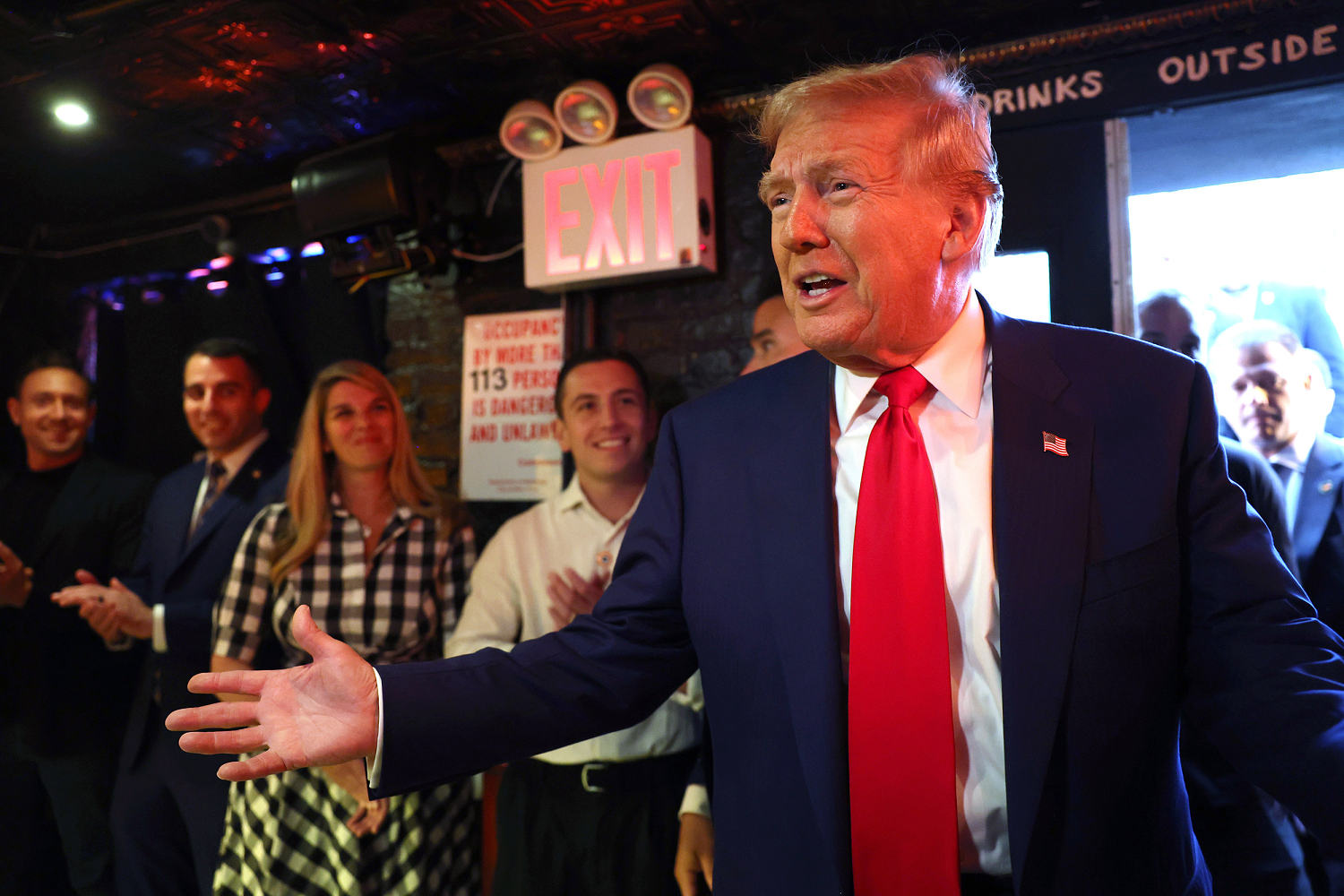
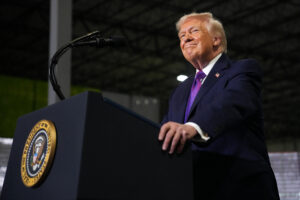
Former President Donald Trump in a livestream on X this past Monday announced his family’s latest project: World Liberty Financial, which intends to function as something of a crypto stock exchange.
Trump’s embrace of this emergent, often scandal-plagued sector isn’t a particularly novel development. In fact, it’s highly predictable, as for roughly a decade crypto’s underlying premises have relied, to a surprisingly heavy degree, on right-wing political thought.
The relationship between crypto and the right stems in large part from how crypto seeks to shift financial transactions beyond the purview of centralized, democratic systems. The right-wing nature of this pivot has been noted by everyone from left-leaning scholars and academics to right-leaning venture capitalists like Marc Andreessen, who has observed that crypto is “quite literally right-wing tech that is far more aggressively decentralized and far more comfortable with entrepreneurialism and free voluntary exchange.”
For roughly a decade crypto’s underlying premises have relied, to a surprisingly heavy degree, on right-wing political thought.
I came around slowly to acknowledging this political alignment. I graduated college directly into the housing crisis, when distrust in banks and the politics surrounding them reached a critical mass thanks to movements like Occupy Wall Street. Cryptocurrencies — Bitcoin specifically — arrived at this moment, too. Like countless others of all political affiliations, I was curious about cryptocurrencies, eager to entertain philosophies and technologies that promised better answers for how to distribute wealth and, by extension, money itself.
Intriguing projects would pop up in sectors like journalism and health care, often more related to the blockchain than crypto. And yet, the crypto critiques from this initial era have outlasted the majority of these projects themselves. When these projects failed, the autopsies did not reveal oh-co-close brushes with new liberating financial processes but, rather, predatory practices that sought to get marginalized groups “drinking the crypto Kool-Aid.”
If Trump’s embrace of crypto seems like some novel development, consider the very title of the late, brilliant David Golumbia’s book, published weeks before the 2016 presidential election, “The Politics of Bitcoin: Software as Right Wing Extremism.” For the remaining years of his life, Golumbia would argue that, messy and unsexy as democratic and financial processes may be, they were more trustworthy than cryptocurrencies, which sought to sidestep such regulatory processes entirely. Moreover, Golumbia regularly argued that “The economic framework on which cryptocurrencies depend emerges from right-wing and often antisemitic conspiracy theories about the nature of central banking.”
I found simpler, less technical perspectives from writers like Stefan Eich, a political theorist and author of what for me was a crucial article“Old Utopias, New Tax Havens: The Politics of Bitcoin in Historical Perspective.” Eich’s basic argument is convincing and plainly stated, “The attempt to remove money from political control is itself a supremely political act that raises profound questions of legitimacy.”
What a surprise, then, that an entity founded upon removing one’s assets and actions from political scrutiny would wind up in the Trump universe. What a surprise that Trump would eventually come around to a sector full of political acts that raise, in Eich’s words, “profound questions of legitimacy.”
Since the World Liberty Financial announcement, there has been a rush to compare the Trump family’s new crypto venture to the various steaks and universities that dot the ex-president’s resume of shady financial pursuits. The juxtaposition is apt, and it is not difficult to see how World Liberty Mutual could be yet one more way to funnel MAGA cash into Trump’s pocket. As noted crypto critic Molly White wrote ironically on X: “equitable access to finance is when we screw you all over equally.”
Personally, I think the Supreme Court’s immunity ruling from July is a more apt comparison than his roster of tacky ripoff products. The court essentially said presidents are immune from prosecution, and crypto has almost no regulatory oversight. Voila!
Many scholars saw this coming. For a while, cryptocurrencies have been called a solution in search of a problemand they now seem to have been useful in answering this question: what sector has a rabid base and a right-wing lean that could help grant an authority figure the ability to “remove money from political control?”
Problem solved.
Patrick McGinty
Patrick McGinty’s novel about crypto, Town College City Road, will be published in the fall of 2025 by The University of Wisconsin Press.
Politics
Pritzker helped a Black woman become senator. Some Black leaders are still mad at him.
Congressional Black Caucus members, after a stinging loss in the Illinois Democratic Senate primary, are training their ire on Gov. JB Pritzker — and saying it’s on him to rehabilitate the relationship.
After Pritzker’s outsized financial support for Lt. Gov. Juliana Stratton helped lift her to victory, lawmakers vented frustrations that his money unfairly tilted the race in her favor and away from their candidate, Rep. Robin Kelly, a CBC member who finished a distant third. And as Pritzker eyes a 2028 presidential bid, some members, cognizant that the path to winning the Democratic Party’s nomination will run through the caucus, signaled they won’t forget that he crossed them this round.
“He has to justify what he did,” said Rep. Bennie Thompson (D-Miss.). “I’m sure at some point if he decides to run, he’ll have to come with that justification. As to whether or not it has merit or not, remains to be seen.”
Pritzker’s money helped put Stratton on the path to becoming just the sixth Black senator in U.S. history. But by boxing out Kelly, he frayed his relationship with the caucus, which holds significant sway over which candidates break through with Black voters — a large and powerful voting bloc the billionaire governor will need if he chooses to run for the White House.
“Keep in mind, the Democratic candidate for president that prevails has to go through [the CBC],” said Rep. Joyce Beatty (D-Ohio). “The CBC is very strategic and so if there is an issue … we will lay out our framework for what it will take” to get our endorsement, she added.
Many top CBC officials are in no rush to make the first move to mend fences.
“We don’t need to reach out to the governor,” said Rep. Gregory Meeks (D-N.Y.) who chairs the Congressional Black Caucus PAC, adding that the group is focused on midterm races and delivering House Minority Leader Hakeem Jeffries the speaker’s gavel.
“Others are going to have to reach out to us,” he said of Pritzker. “Those conversations happen when those conversations happen.”
Pritzker’s political arm issued a statement in response saying he was “proud” to support Stratton, Illinois’ first Black lieutenant governor: “With only six black women having served in the U.S. Senate throughout its history, Gov. Pritzker supported his partner in governance because he’s worked side by side with her for almost a decade and knows she will deliver for the people of Illinois,” Jordan Abudayyeh, Pritzker’s spokesperson, said.
His team did not address questions about CBC members’ concerns, but did point to Rep. Jim Clyburn, the powerful South Carolina Democrat, saying ahead of the election that Pritzker was “free to support” anyone.
Clyburn on Wednesday told Blue Light News he would “expect” for Pritzker to support his No. 2 and that he was not focused on 2028.
Still, lawmakers’ veiled threats lay bare the difficulties Pritzker could face beyond Tuesday’s primary. And they underscore the duality the CBC is navigating as high-profile defeats of their members in Illinois and Texas raise questions about their political influence — even as they celebrate Stratton’s victory.
In interviews with more than a dozen CBC members on Wednesday, they made clear their irritation is not with Stratton, who many said will be welcomed into the caucus if she wins as expected in November. Their indignation rests solely with Pritzker, who they accused of playing kingmaker by pouring millions of dollars into propping up Stratton.
Tensions flared between the powerful legislative voting bloc and the billionaire governor in early March. CBC Chair Yvette Clarke lashed out at Pritzker, saying she was “beyond frustrated” with the governor for “tipping the scales” a nod to his funneling of $5 million from his super PAC to help catapult Stratton into contention with Rep. Raja Krishnamoorthi, who for much of the primary was leading in the polls and started with a massive cash advantage.
Many CBC members, and Clarke specifically, took Pritzker’s presence in the race as a snub to Kelly, who had a long-standing beef with Pritzker after he worked to oust her as chair of the Illinois Democratic Party in 2022. While both Kelly and Pritzker were said to have moved beyond it, the Senate campaign reopened old wounds.
Clarke issued a statement — some 12 hours after the Illinois Senate primary was called — to congratulate Stratton on her victory, calling it “a significant moment for Illinois and the nation that calls for unity” before pivoting to praise Kelly.
The CBC chair on Wednesday said she and Pritzker had not spoken.
“I’m sure there’ll be a moment where we’ll have a conversation,” Clarke said. When asked if she felt like she needed to initiate a conversation with the governor, she responded tersely. “No, I don’t.”
Former Illinois Sen. Carol Moseley Braun, the first Black woman elected to the body in U.S. history, endorsed Stratton in the race. She took issue with CBC members’ intense focus on the governor’s role in the process instead of the historic outcome, and said the group seemed more focused on backing its own than expanding Black representation.
“To weigh in on this race was just backwards,” she told Blue Light News. “[Kelly] was a member of the caucus and so it’s understandable on that level. But at the same time, Juliana deserved at least something from that group.”
Many current CBC members refrained from attacking Pritzker directly, however — another sign of the complex politics at play. Congressional Democrats want Pritzker’s billions to help bankroll their bid to retake control of the House and make Jeffries, the minority leader and New York Democrat, the first Black speaker. They’ve already been working him behind the scenes.
“I’ve already reached out to Governor Pritzker,” said Rep. Steven Horsford (D-Nev.), a former CBC chair. “I’ve talked to him this morning, in fact, and I’ll talk to him in the weeks and months to come, because I have one objective: to win this House, to help win the Senate, and to make sure we end the chaos that’s coming out of this administration.”
Others took pains to separate their evaluation of Pritzker’s role in propelling Stratton to victory from any campaign he may run in 2028, suggesting they were willing to reset the relationship.
“You will still have to show your bona fides, and you still will have to make your case as to why the CBC and Black people should take you into consideration. So we have reset it,” Rep. Sydney Kamlager-Dove (D-Calif.) said. “Good for him, for her, but that has no bearing on the 2028 race.”
Shia Kapos contributed to this report.
Politics
Judge orders restoration of Voice of America
NEW YORK (AP) — A federal judge on Tuesday ordered the Trump administration to restore the government-run Voice of America’s operations after it had effectively been shut down a year ago, putting hundreds of employees who have been on administrative leave back to work.
U.S. District Court Judge Royce C. Lamberth gave the U.S. Agency for Global Media a week to put together a plan for putting Voice of America on the air. It has been operating with a skeleton staff since President Donald Trump issued an executive order to shut it down.
A week ago, Lamberth said Kari Lake, who had been Trump’s choice to lead the agency, did not have the legal authority to do what she had done at Voice of America. In Tuesday’s decision, Lamberth ruled on the actions she had taken to respond to Trump’s order, essentially shelving 1,042 of VOA’s 1,147 employees.
“Defendants have provided nothing approaching a principled basis for their decision,” Lamberth wrote.
There was no immediate comment on the decision by the agency overseeing Voice of America. Lake had denounced Lamberth’s March 7 ruling, saying it would be appealed. Since then, Trump nominated Sarah Rogers, the undersecretary of state for public diplomacy, to run USAGM. That requires Senate approval, a step that was not taken with Lake.
Patsy Widakuswara, Voice of America’s White House bureau chief and a plaintiff in the lawsuit to restore it, said she is deeply grateful for the decision.
“We are eager to begin repairing the damage Kari Lake has inflicted on our agency and our colleagues, to return to our congressional mandate, and to rebuild the trust of the global audience we have been unable to serve for the past year,” she said.
“We know the road to restoring VOA’s operations and reputation will be long and difficult,” she said. “We hope the American people will continue to support our mission to produce journalism, not propaganda.”
Voice of America has transmitted news coverage to countries around the world since its formation in World War II, often in countries with no tradition of a free press. Before Trump’s executive order, VOA had operated in 49 different languages, broadcasting to 362 million people.
Politics
Judge orders restoration of Voice of America
NEW YORK (AP) — A federal judge on Tuesday ordered the Trump administration to restore the government-run Voice of America’s operations after it had effectively been shut down a year ago, putting hundreds of employees who have been on administrative leave back to work.
U.S. District Court Judge Royce C. Lamberth gave the U.S. Agency for Global Media a week to put together a plan for putting Voice of America on the air. It has been operating with a skeleton staff since President Donald Trump issued an executive order to shut it down.
A week ago, Lamberth said Kari Lake, who had been Trump’s choice to lead the agency, did not have the legal authority to do what she had done at Voice of America. In Tuesday’s decision, Lamberth ruled on the actions she had taken to respond to Trump’s order, essentially shelving 1,042 of VOA’s 1,147 employees.
“Defendants have provided nothing approaching a principled basis for their decision,” Lamberth wrote.
There was no immediate comment on the decision by the agency overseeing Voice of America. Lake had denounced Lamberth’s March 7 ruling, saying it would be appealed. Since then, Trump nominated Sarah Rogers, the undersecretary of state for public diplomacy, to run USAGM. That requires Senate approval, a step that was not taken with Lake.
Patsy Widakuswara, Voice of America’s White House bureau chief and a plaintiff in the lawsuit to restore it, said she is deeply grateful for the decision.
“We are eager to begin repairing the damage Kari Lake has inflicted on our agency and our colleagues, to return to our congressional mandate, and to rebuild the trust of the global audience we have been unable to serve for the past year,” she said.
“We know the road to restoring VOA’s operations and reputation will be long and difficult,” she said. “We hope the American people will continue to support our mission to produce journalism, not propaganda.”
Voice of America has transmitted news coverage to countries around the world since its formation in World War II, often in countries with no tradition of a free press. Before Trump’s executive order, VOA had operated in 49 different languages, broadcasting to 362 million people.
-
The Dictatorship1 year agoLuigi Mangione acknowledges public support in first official statement since arrest
-
Politics1 year agoFormer ‘Squad’ members launching ‘Bowman and Bush’ YouTube show
-

Politics1 year agoBlue Light News’s Editorial Director Ryan Hutchins speaks at Blue Light News’s 2025 Governors Summit
-
Politics1 year agoFormer Kentucky AG Daniel Cameron launches Senate bid
-
The Dictatorship6 months agoMike Johnson sums up the GOP’s arrogant position on military occupation with two words
-
The Dictatorship1 year agoPete Hegseth’s tenure at the Pentagon goes from bad to worse
-

Politics11 months agoDemocrat challenging Joni Ernst: I want to ‘tear down’ party, ‘build it back up’
-
Uncategorized1 year ago
Bob Good to step down as Freedom Caucus chair this week