
Politics
I know how Hurricane Helene survivors feel. And what they don’t want to hear.

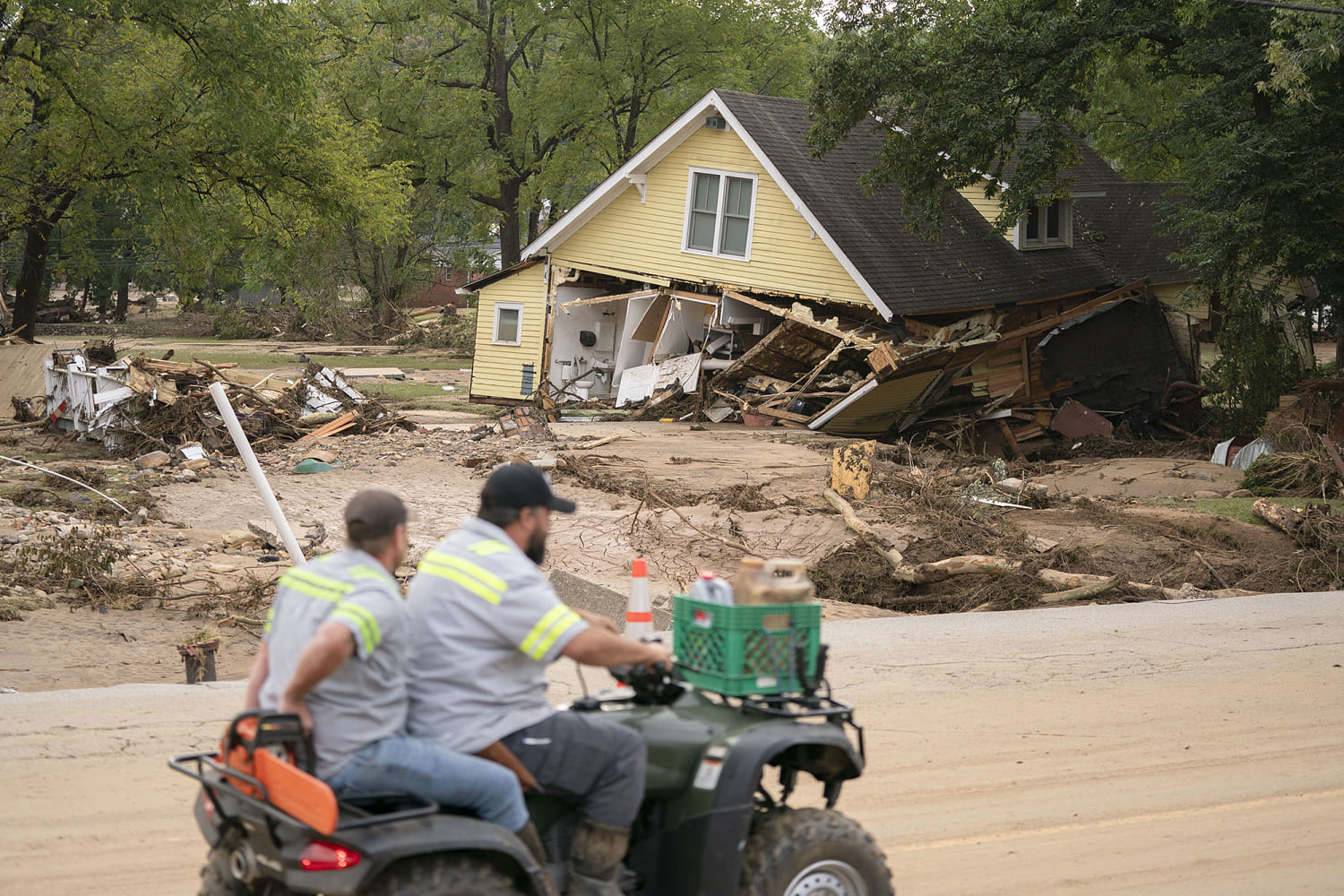
My heart breaks for the people of western North Carolina and eastern Tennesseewhose experience of Hurricane Helene was a flood of biblical proportions. That’s not an empty expression of sympathy. It emerges from remembering the first time I walked through my house in New Orleans, which took on 8 feet of water, after the city’s floodwalls broke during Hurricane Katrina in 2005.
One of the more awful things about flooding is hearing other people’s opinions about what it all means politically.
The stench of the water and food rotting in refrigerators and freezers. The squishiness of wet drywall and warped, waterlogged floors. The shock at the sight of all types of fungi and mold growing on the walls — and somehow even on the ceiling fans. The sting of finding a lifetime’s worth of books and snapshots and family heirlooms in a sodden heap on the floor.
While not as bad as seeing the totality of one’s life possessions moldering on the curb, one of the more awful things about flooding is hearing other people’s opinions about why you flooded or what it all means politically. You lived in a place that’s too low. You lived in a place controlled by the GOP. Or, from the other side: You should have picked a place more conservatively Christian that God wouldn’t strike with a storm.
Such simple-minded arguments proliferated on social media this weekend and are depressingly easy to find. Comments ran the gamut: from people saying residents in North Carolina, for example, got what they had coming because the state typically votes for Republicans for president, to people saying Asheville got what it had coming because it’s far more liberal than the rest of the state.
Regardless of the political persuasion making the argument, it’s borne of the idea that some people are deserving of disaster and some people are smart enough to avoid such disaster, while others aren’t.
It’s also based on an argument — contradicted by the reality that flooding is the most common disaster in the U.S. — that floods are to be expected only in certain places, places easily avoided by people with sense.
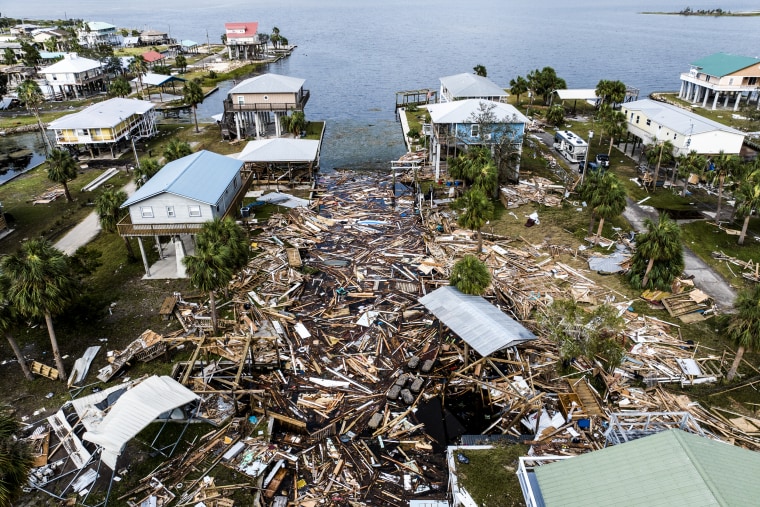
According to the Department of Homeland Security, “Ninety percent of natural disasters within the United States involve flooding. Consequently, floods inflict more economic damage and loss of life and property than any other natural hazard.” Pew reported in 2022: “Since 2000, at least one flood occurred in the U.S. on nearly 300 days per yearon average. The NOAA[
In January 2014, more than a year after Hurricane Sandy had struck New Jersey and New York and more than eight years after Hurricane Katrina, I appeared on a stage with Tom Ashbrook, then the host of NPR’s show “On Point,” who was recording his show in front of a live audience in New Orleans.
When I noted that the subsidized National Flood Insurance Program had problems and argued instead for a kind of catastrophic insurance plan that would spread the risk and pull in people at risk of disasters from all over the country, the host posed an argument on behalf of people who might balk at such a proposition. He said, “If you’re sitting up on a mountaintop and thinking about that coast and thinking just how serious the threat of sea-level rise is and what it may cost to back that up, you might not want to pay for that.”
According to the Department of Homeland Security, “Ninety percent of natural disasters within the United States involve flooding.”
“It flooded in Colorado last summer,” I said. “It flooded in NashvilleTennessee, just a few years ago. Flooding is the most common natural disaster in the United States, and I would hope that people would stop seeing it as just a Louisiana problem.”
Even though I was already aware that a place as hilly as Asheville could flood, it was still shocking that a hurricane that first struck the Gulf Coast would be a cause of it. (I say “a” cause because a so-called 1,000-year storm had already dumped as much as 8 inches of water in Asheville ahead of Helene’s arrival.)
I’d spent a lot of time thinking about how frightening it is that storms have been exploding in strength before they make landfall. But I hadn’t stopped to consider that stronger storms’ hitting the coasts could mean stronger storms and scarier rainmakers far inland.
KD Minor, an organizer who created a relief effort for people in her native Lake Charles, Louisiana, after that area of southwest Louisiana was hit by two hurricanes (Laura and Delta) in a six-week span in 2020, wrote Sunday on X, “The climate catastrophe doesn’t have an address on it.”
Nor does the climate catastrophe care whom you’re voting for in November or whether you’re gay or whether you live at sea level or whether you’re high above it. It affects us all.
If that’s not a reason to try to heal the climate, I don’t know what is.



Around a hundred Samurai Blue superfans crowded the Old Ambassador’s Residence at the Japanese embassy in Washington, on Sunday for a watch party marking its World Cup opener against the Netherlands.
The supporters — a motley group including erstwhile English teachers in Japan, state department workers and embassy staffers — lounged around a projector set in the building’s front room, plates piled high with nigiri. Drinking Kirin Ichiban lager and Asahi Super Dry, they winced when the Dutch team had the ball in the opposing third and burst into cheers and sang “Vamos Nippon” when Daichi Kamada’s header tied the game in the 89th minute.
“The World Cup itself is a competition,” said Masatsugu Odaira, the embassy’s minister of public affairs, at the watch party. “But from the perspective of policy and diplomacy, it’s a very good chance to connect people across borders.”
At the event, Blue Light News spoke to soccer fans who are already excited about Japan’s growing diplomatic footprint and soft power projection. And they hope the World Cup will buoy that cultural momentum, stimulating tourism — one of the nation’s most lucrative sectors — and drawing eyes to Japan.
The World Cup is “just a visceral way to connect people who have not yet had the opportunity to travel to Japan to be swept up in the enthusiasm of an international competition,” said Andrew Wylegala, president of the National Association of Japan-America Societies.
Japan is already “at the top of its game” in terms of soft power projection, Wylegala added — and “soccer now fits in with that.”
Embassy staff wore pink shirts with the American and Japanese flags on the back. “Together We Bloom,” they read.
The end result, a 2-2 draw against the Dutch, the world’s eighth ranked international side, only added to their enthusiasm.
The women’s team has a far more prolific record. Fans still hark back to their 2011 World Cup final victory over the U.S., months after a massive earthquake and tsunami slammed the country.
But the men’s team has won just seven World Cup games in its history. Japan’s best-ever finish: The round of 16, where they’ve fallen four separate times.
But there’s hope that, this year, the underdogs could pull off an upset. From Ajax’s Takehiro Tomiyasu to Kamada, a Crystal Palace midfielder, the Samurai Blue have more than enough talent to compete with the sport’s upper crust.
Odaira’s hope for this year? “Oh, becoming a champion,” he said.
No European country has infuriated Donald Trump more than Spain. Now it’s desperate to win his World Cup.
Teenage superstar Lamine Yamal, Rodri and co. enter the tournament as joint favorites alongside France. With the U.S. president apparently intent on making this a World Cup that projects his personal influence and America’s soft power, victory would be sweet for Spanish soccer fans — but especially so for their prime minister.
Outspoken socialist leader Pedro Sánchez, a supporter of Atlético Madrid, has clashed spectacularly with Trump over the Iran war, but also regarding NATO spending and Israel’s assault in Gaza. Meanwhile their policies on issues from energy to immigration could hardly be further apart.
Read the full story about the failing Washington-Madrid relationship here.
LOS ANGELES — In many World Cup host cities, competing teams also find themselves jostling for soft-power supremacy around their matches. But before its first match tomorrow in Los Angeles, New Zealand has had the diplomatic landscape all to itself.
New Zealand is scheduled to face Iran, which has not had formal diplomatic relations with the United States since 1980. Even as President Donald Trump claims an end to the countries’ monthslong war is at hand, Iran will be competing in the World Cup under severe travel restrictions. The team has been forced from its original Tucson training camp to Tijuana, and is being forced to effectively commute to its matches in the U.S. without a full government delegation.
That has left New Zealand alone in pressing its off-field agenda in Los Angeles. On Sunday evening, New Zealand consul-general Katja Ackerley opened her Brentwood mansion to a “New Zealand on the World Stage” networking reception sponsored by the government agencies overseeing the country’s trade, sport and foreign-investment portfolios.
“It’s all about soft power, it’s all about person-to-person,” said Peter Miskimmin, the government’s head of sports diplomacy. “We are building relations through sport rather than bringing up arms against one another.”
The country’s Los Angeles diplomatic outpost typically focuses on promoting exports of wine and lamb, expediting visas for Hollywood personnel traveling for location shoots and addressing the perpetual crisis of “Kiwis losing their passports in Las Vegas,” as one previous inhabitant of the office put it.
A delegation of New Zealand officials was preparing for their first World Cup appearance since 2010 uncertain whether any of their opposite numbers from Iran would attend, and how that might affect the standard match-day pageantry.
“This is our first World Cup in 16 years so we can’t tell what’s different,” said James Wear, a general manager of the New Zealand Football Association. “We don’t have anything to compare.”
-

 Politics1 year ago
Former ‘Squad’ members launching ‘Bowman and Bush’ YouTube show
-

 The Dictatorship1 year ago
Luigi Mangione acknowledges public support in first official statement since arrest
-

 Politics1 year ago
Former Kentucky AG Daniel Cameron launches Senate bid
-
Uncategorized2 years ago
Bob Good to step down as Freedom Caucus chair this week
-

 The Dictatorship1 year ago
Pete Hegseth’s tenure at the Pentagon goes from bad to worse
-

 The Josh Fourrier Show2 years ago
DOOMSDAY: Trump won, now what?
-

 Politics1 year ago
Blue Light News’s Editorial Director Ryan Hutchins speaks at Blue Light News’s 2025 Governors Summit
-

 The Dictatorship9 months ago
Mike Johnson sums up the GOP’s arrogant position on military occupation with two words