
Politics
Why the Olympics won’t have a Balogate

President Donald Trump’s call to FIFA President Gianni Infantino urging him to review U.S. striker Folarin Balogun’s red card has thrust the politics of global sport back in the spotlight — and it’s raising questions about how the Olympic movement plans to navigate a White House that has an interventionist approach toward the world’s biggest sporting events.
Trump’s involvement — along with that of other senior administration officials — with the global governing body for soccer highlighted just how deeply FIFA has cultivated its relationship with the White House.
But with Los Angeles set to host the 2028 Summer Olympics, Olympic officials have charted a markedly different course. So far, newly elected IOC President Kirsty Coventry has yet to appear publicly alongside Trump.
While FIFA has been the primary organizer of the 2026 World Cup, the International Olympic Committee will rely on LA28 — the independent local organizing committee — to execute the games.
That structure has allowed the IOC to keep more distance from Washington. Asked in January whether she could learn from Infantino’s approach to courting Trump, Coventry suggested the Olympic movement would take a more measured path.
“If we weren’t seeing good relations six months before the World Cup I would get worried,” she said. “As we get closer to the Olympics you will see the relations continue … and only get stronger.”
For now, the personal relationship with Trump has largely been managed through Casey Wasserman, the chair of LA28, who has emerged as the Olympic movement’s chief interlocutor with the White House.
Wasserman appeared alongside Trump in the Oval Office last year when the president signed an executive order establishing a White House task force focused on the 2028 Games. But it’s a sharp contrast with Infantino’s regular presence at the president’s side, his proclivity for praising the president in public and catering to his ego. After supporting the effort to have the Nobel Peace Prize awarded to Trump, Infantino created FIFA’s first-ever Peace Prize and awarded it to the president.
“My understanding of the Casey way is keep your head down, do the work, have your leaders lead the day-to-day, and worry about the most important things to make sure the event is successful, right?” said one person who has worked closely with Wasserman. “It’s not grandstanding and placating the way Gianni has done. It’s just a different approach. Look, maybe it’s just too soon, but he’s not a peace prize-giving kind of guy.”
Behind the scenes, however, cooperation between LA28 and the administration has already begun.
According to people familiar with the discussions, organizers have been working closely with the White House Olympic Task Force on a range of logistical issues, including plans for a pro-am golf tournament at Trump’s Los Angeles-area golf course before the Games.
At the State Department’s request, LA28 has also helped develop a dedicated visa processing portal for Olympic athletes and officials. The system has already been used to facilitate the entry of a small number of LA28 support staff into the United States, according to people familiar with the effort.
As the World Cup has unfolded this month, Trump’s interest in the Olympics has hardly diminished — they are the two events taking place during his second term that he takes credit for bringing to the U.S., based on decisions that were made during his first term.
“The beautiful thing about what I did is I ran [for president again]. I never thought of it, and then all of a sudden I realized, you know, I just got the Olympics, and I totally got that myself, and I just got FIFA,” Trump said on Monday. “I got that myself.”


WICHITA, Kansas — Roger Marshall was running behind.
The bus Kansas Republicans booked for a five-day barnstorming tour sat idling Tuesday morning, with other statewide candidates onboard. The tour was already a few minutes delayed as state party chair Danedri Herbert awaited word from the senator who some Republicans grumble isn’t campaigning hard enough as polls show him tied or trailing.
Finally, she got word: Marshall would ride separately.
As the bus reached its first stop in rural Newton, Marshall crept aboard — and was spotted by reporters doing so. He then joined the other candidates exiting to greet the crowd like he’d been there the whole time.
Marshall is playing catch-up as he races to avoid becoming the first person to lose a Senate contest to a Democrat in the state in nearly a century. He faces the most serious challenger for a Kansas senator in over a decade as his party stares down a grim environment under President Donald Trump’s second term.
National Republicans are pouring millions into the state to prop him up; national Democrats are responding in kind, and Democrat Adam Hamilton, a well-known United Methodist pastor, is suddenly flush with cash for the campaign’s homestretch.
But some Republicans think it’s already too late for Marshall.
“He took it way too much for granted,” said former Kansas Gov. Mike Hayden, a Republican who supported Marshall’s previous campaigns but is now publicly backing Hamilton. “He’s been almost invisible, except on national television. And there’s not a lot of love in Kansas for Washington D.C.”
National Republicans have privately urged Marshall to take his race more seriously on numerous occasions, according to a person familiar with the conversations who was granted anonymity to discuss them. Marshall, this person said, never appeared too worried about the race. Marshall’s latest Federal Election Commission report indicates this may be true. He raised just $866,000 for the third quarter to $9.9 million for Hamilton, and that filing did not appear to include any full-time payments to campaign staff.
Marshall’s team did not respond to requests for comment on this article.
One Republican strategist close to the White House, granted anonymity to speak candidly, acknowledged the race is an “uphill battle,” comparing Marshall to an “old athlete who, it takes them a lot longer to warm up to get ready for the game time, and they didn’t start that early enough.”
That strategist said that the remaining undecided voters are overwhelmingly Trump voters, and predicted they’d come home. Kansans “are mad at Republicans, but they just hate Democrats more,” the strategist said. “As much as DC Republicans are bedwetting, the ones actually working on the races are cognizant of this.”
As the race nears the homestretch, a deluge of bad press has dogged the senator: His campaign used pictures of a Kansas campground without permission and had to edit the ad; his team faces accusations of blurring the line between his official and campaign offices; his campaign reportedly didn’t pay a bill to a local bakery for six years until after the unpaid debt was made public (he apologized).
Two other stories landed the hardest.
The first focuses on a Florida property that he owns, raising questions about how much time he actually spends in Kansas. The second stems from a New York Times report that Marshall, an obstetrician-gynecologist who served two terms in the U.S. House, had allegedly taken legal action against hundreds of medical patients who didn’t pay their bills. Marshall has said he spends the bulk of his time in Washington or Kansas, calling the claims “bologna.” He called the Times’ report a “hit job by left media” and told Fox News he had “nothing else to do to with the process” after patients’ accounts went to collections.
At a Monday rally in the liberal college town of Lawrence, Hamilton told supporters that Kansans deserve a senator who isn’t just “showing up for photo ops” between “time with your family in Florida.”
“I want to know from Roger Marshall: What’s your plan when people … show up and they don’t have health insurance?” Hamilton said, standing on a hay bale in a shady park. “Is the plan we’re going to sue them? Then we’re going to have some of them arrested, and maybe a few of them put in jail?”
Hamilton’s campaign cut a face-to-camera ad with one of Marshall’s former patients, who said she was arrested when she was eight months pregnant because she missed a $50 payment to Marshall’s office. The Marshall campaign sent a cease-and-desist letter in response, saying the ad’s “message is false in every material respect,” and went up this week with its own ad of a former patient singing his praises.
National Republicans have swooped in to prop up Marshall with $11 million in planned spending in recent days. And he’s getting other reinforcements: Chris Grant, the stalwart Trump-world operative and veteran of previous Marshall campaigns, will take an expanded role on the senator’s team through Election Day, Axios first reported.
Marshall’s struggles are drawing unfavorable comparisons to the last Republican who needed to be bailed out to win a Senate race in the state.
“This race reminds me of Sen. Pat Roberts’ last race [in 2014], when he was accused of not maintaining a Kansas residence and campaigning poorly,” said one Kansas state GOP lawmaker, who was granted anonymity to speak openly.
But Republicans had a strong wind at their backs in 2014, sweeping nearly every Senate race that year; Roberts managed a 10-point win, similar to Marshall’s 11-point win in 2020. This time around, the national climate is blowing hard the other direction.
Kansas has been especially hard-hit by some of Trump’s policies. His tariffs and spiking fuel prices left the state’s row crop farmers struggling. A plan to import cheap foreign beef infuriated ranchers in a state that produces the second-most cattle annually. And his threats to cut off U.S. sales of Bombardier planes — a Canadian company whose U.S. headquarters are in Wichita — rattled the state’s robust aviation industry.
Marshall has recently shown signs he knows he’s in a fight. The normally strident MAGA backer broke with the president on the beef import plan and on a recent local immigration enforcement action, after ICE activity rattled some of his state’s agricultural towns.
He’s banking on the conservative nature of the state, working hard to paint Hamilton as a progressive who will fall in line behind Washington Democrats. “This guy is the most radical liberal Democrat in the history of Kansas to get through a primary,” Marshall said in an interview in Garden City. “He is this wolf in sheep’s clothing.”
At rallies in Newton, Hutchinson, Dodge City and Garden City, he warned that his election could decide which party controls the upper chamber. “If my opponent were elected, it would give Chuck Schumer and AOC control of the Senate,” he repeated. Recent Republican ads hit Hamilton as “woke” and “radical,” pointing to his past praise of the Black Lives Matter movement.
But as Marshall tagged along with the other GOP candidates for their barnstorming tour, holding mini-rallies across central and western Kansas on Tuesday, he was reminded how deep the anger at Washington runs right now — even in ruby-red Kansas.
In Dodge City, the self-described “cattle capital” of the country, some Republicans in the crowd grumbled about spiking fuel prices. In Newton, protesters screamed through Marshall’s speech, calling Republicans “fascists.” (“Quiet, Satan!” a disgruntled attendee retorted.) In Garden City, where ICE activity sent shockwaves last month, Marshall got an earful in a private meeting with local lawmakers over their frustration that immigration officers barged into town without coordinating with local law enforcement.
”I think the frustration is still there,” state Rep. Jason Goetz, a Republican who represents some of the cities affected by ICE enforcement.
There’s a belief among some Kansas Republicans that Marshall has thrown together so poor a campaign that if he wins, it won’t be of his own accord — it will be because of Ty Masterson, the Republican state Senate president running for governor who joined him on the bus tour and has polled a few points ahead of Marshall in most surveys.
Rep. Tim Huelskamp, a Kansas Republican who lost a U.S. House primary to Marshall in 2016, said Masterson is “going to pull everybody across the line,” a list that “absolutely” includes Marshall.
Patricia Woods, a Hutchinson resident, said at a rally that she is “100% behind Masterson.” When asked about Marshall, she said she is “kind of on the fence.”
Masterson, when asked about Marshall’s race, simply chuckled. “It’s more complicated than mine,” he said.
Adam Wren and Andrew Howard contributed reporting.
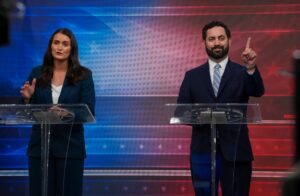
Haley Stevens is highly visible in the wake of her Senate primary loss: Meeting with the Dalai Lama, crashing “TMZ Live” with her new fiancee, getting spoofed on The Tonight Show with Jimmy Fallon.
One place she hasn’t been spotted: alongside her former rival Abdul El-Sayed.
Even though the representative quickly endorsed El-Sayed after their bruising Aug. 4 primary, she’s done little to help him since. That absence is becoming more conspicuous in the closing weeks of a crucial Senate contest, as some of her old supporters continue to vocally resist backing him.
In an interview, Stevens said El-Sayed is building a “new coalition” in the race against GOP former Rep. Mike Rogers — and suggested it’s not her place to push some of her more skeptical supporters into joining it.
When asked if she was encouraging her former donors to help El-Sayed, she said she believes her role this election is to “be part of the coordinated campaign, support where I can,” mentioning Michigan House races. When asked again if she would push donors to back him, she responded: “That’s Elissa’s thing,” referring to Sen. Elissa Slotkin (D-Mich.), who has been fundraising for El-Sayed. “I didn’t win a Senate primary,” she continued. “It’s not like a salty grapes deal or anything.”
Stevens said she’d checked in with El-Sayed’s team, but hadn’t met with the candidate himself recently because she’d been traveling.
“There’s changing dynamics, and there’s a new coalition that Abdul has built, and some people are a die-hard part of it, and some people are not. We’re seeing some constituent community pain coming out,” Stevens said, referencing resistance to El-Sayed among some Black and Jewish voters who backed her in the primary.
“Rogers is working the Black community harder and more successfully than we have ever seen a Republican do or at least that I can remember — ever,” Stevens said.
“But we’re also seeing Abdul go up to the UP [Upper Peninsula] and we’re seeing him fill venues in rural Michigan and it’s very real in terms of this coalition he’s built,” she added.
El-Sayed ran particularly strongly during the primary with young voters and in the state’s large Arab-American community, as well as in some rural, more populist parts of the state, and is working hard to expand that coalition in the general election.
Stevens’ remarks come as some of her former backers and financial boosters continue to publicly withhold support from El-Sayed and in some cases openly embrace his Republican rival. The ruptures are most visible among the Jewish and Black communities that largely broke for Stevens, and point to enduring friction within Michigan Democrats’ traditional coalition after a bitter primary that she could be in a unique position to mend.
Debbie Rosenman, the chair of Birmingham-Bloomfield Area Democratic Party Club in Stevens’ backyard and an El-Sayed supporter, said Stevens has been “absent” on the trail and said she was “very concerned” her coalition is not coalescing around El-Sayed.
“I feel that that could change with more of her public support,” Rosenman said.
El-Sayed’s campaign said the former rivals’ teams keep in close touch and noted several Stevens staffers joined the nominee’s team after the primary.
“The Abdul campaign is grateful for Congresswoman Stevens’ immediate and sustained support,” El-Sayed campaign spokesperson Roxie Richner said in a statement.
El-Sayed has worked to repair relationships with Black and Jewish leaders. He has endorsements from several of them and is campaigning with prominent Democrats from both communities, including former President Barack Obama and former Vice President Kamala Harris and Slotkin, who is Jewish. He has made more than two dozen visits to Black churches and participated in more than 100 events and meetings with Black leaders, according to his campaign. He has hired a liaison to the Jewish community, keeps in regular contact with Jewish leaders and has apologized for his controversial remark after a synagogue attack in West Bloomfield in the spring that “hurt people hurt people.”
“I take very seriously that I’m going to represent a large community of Jewish Michiganders, and I want them to know that I’m committed to their safety and their well being, even if there are points in foreign policy on which we might disagree,” El-Sayed said in an interview.
Not everyone has come around.
David Kramer, Stevens’ primary campaign chair and a vice chair of the Michigan Democratic Jewish Caucus who introduced Stevens to her fiance, is now working with Nonnegotiable Michigan, a group of Jewish leaders who have pledged to withhold their support from El-Sayed unless he adjusts his approach to Israel.
Kramer, a prominent Democratic fundraiser in the state who has also previously worked with Slotkin and Gov. Gretchen Whitmer, told Blue Light News he’s not tapping his donor network for the general election and estimated he’s left upward of seven figures on the table that he could have raised to boost El-Sayed.
Brian Hermelin, a normally Democratic donor who backed Stevens in the primary and leads the Jewish Federation of Detroit, co-hosted a fundraiser for Republican nominee Mike Rogers shortly after the primary that raised roughly $200,000.
Rogers’ campaign has attempted to capitalize on those cracks by launching a “Democrats for Mike Rogers” group and making overtures to Jewish and Black voters. Bobby Schostak, a former Michigan GOP chair who is serving as Rogers’ finance chair, estimated the Republican’s campaign has brought in roughly $3 million to $4 million since the primary from “nontraditional Republican donors” across the country, including Democrats.
“The Democratic Party is still divided,” said Democrat Mary Waters, a Black Detroit city councilor who’s met with both El-Sayed and Rogers but remains undecided. “People are still so torn about what it is that they want to do.”
Joe Tate, a Black state representative from Detroit who supported Stevens, acknowledged there has been some lingering apprehension around El-Sayed. But he said Stevens’ endorsement of El-Sayed helped convince him to back the candidate and predicted Democratic voters would largely stand by their party, too.
El-Sayed’s donor network may look different from Stevens’, but he’s still posted big numbers. He raised nearly $33 million from July through September, which included some raised before the Aug. 4 primary, compared to Rogers’ nearly $10 million, and has been outspending Rogers on the airwaves.
Some of El-Sayed’s prominent surrogates have also taken steps to court apprehensive Democrats. Jewish leaders like former Rep. Andy Levin, a former synagogue president who Stevens defeated in a 2022 primary, are holding house parties with voters coordinated by the grassroots group Michigan Jews for Democracy. Slotkin has privately pressed senators and donors to boost El-Sayed’s bid.
That includes hosting a fundraiser for El-Sayed in Washington, D.C., in late September with donors who she described as initially “skeptical” of the nominee.
“I talked to them about why I thought it was important and how I don’t agree with Abdul on everything … but we agree on the really important things, and that’s putting a check and balance on this president,” Slotkin told Blue Light News in a brief hallway interview on Capitol Hill the next day. “And they donated.”
Republican Senate candidates are hurting for cash.
Nearly every Democratic candidate in battleground Senate races outraised their GOP opponent from July through September. And in some cases, the disparities were stark.
- In Texas, Democrat James Talarico trounced Republican Ken Paxton $60.2 million to $10.2 million in their main campaign accounts.
- In Georgia, Democratic Sen. Jon Ossoff raised $33.1 million to Rep. Mike Collins’ nearly $2.8 million.
- In North Carolina, Democrat Roy Cooper raised $12.2 million to Michael Whatley’s $2.1 million.
- In Michigan, Democrat Abdul El-Sayed hauled in roughly $33 million to former Rep. Mike Rogers’ nearly $10 million.
- In Maine, Democrat Troy Jackson raised $20.5 million to GOP Sen. Susan Collins’ $5.2 million.
- In Ohio, Democratic former Sen. Sherrod Brown hauled in $23.1 million to GOP Sen. Jon Husted’s $4.8 million.
- In Iowa, Josh Turek raised $13.9 million to Republican Rep. Ashley Hinson’s nearly $3.3 million.
- In Alaska, Democratic former Rep. Mary Peltola raked in $17 million to GOP Sen. Dan Sullivan’s nearly $2.7 million.
- In New Hampshire, Democratic Rep. Chris Pappas brought in $8.1 million to Republican former Sen. John E. Sununu’s $1.5 million.
- And in Kansas, Democrat Adam Hamilton raised nearly $9.9 million to GOP Sen. Roger Marshall’s just $866,000.
Across those 10 Senate races, the Democratic campaigns raised more than five times as much as the Republican ones. Put another way: Talarico alone raised more than all those Republicans combined.
Marshall and Whatley each started October with less than $1 million left in the bank. Mike Collins wasn’t much better-positioned, entering the final weeks of the election with just over $1 million cash on hand.
These numbers do not include joint fundraising committees, which allow candidates to raise money and may have some more cash that has not yet been transferred to the campaigns.
Democrats have consistently outraised Republicans on the candidate level this cycle. But the yawning gaps heading into the midterm’s home stretch stand as the latest example of the deteriorating environment for the GOP.
And while GOP outside groups have significantly more money than Democrats, this candidate cash advantage matters because candidates get TV ads for much cheaper rates, letting their dollars stretch much farther.
To underscore how lopsided some of these figures are: At least half a dozen House Democratic challengers raised over $3 million in the third quarter — a sum higher than several GOP Senate incumbents.
There are some silver linings for the GOP.
In Minnesota, Republican Michele Tafoya raised $4.9 million to Democratic Lt. Gov. Peggy Flanagan’s $4.3 million. Tafoya started the month with $2.1 million to Flanagan’s $1.5 million.
Sullivan, Husted, Hinson, Rogers and Susan Collins all entered October with millions more in cash on hand than their Democratic opponents.
And Republicans are getting air cover from GOP super PACs bankrolled by billionaire Elon Musk and President Donald Trump’s MAGA Inc. that have pumped hundreds of millions of dollars into the midterms in recent weeks.
Musk was revealed on Thursday as the primary funder of Texas PAC, which has spent $131 million so far boosting Paxton and attacking Talarico. Musk gave $158 million to Senate Republicans’ super PAC arm last quarter, the filings showed, with the group in turn transferring the funds to the pro-Paxton PAC.
Republicans are also benefitting from a recent Supreme Court ruling that allows party committees to spend unlimited sums in coordination with candidates, allowing the National Republican Senatorial Committee to offset at least some of the differences.
Since the tranche of reports filed Thursday only cover until Sept. 30, the full scope of each candidates’ coffers is unknown.
But there are other signs that some are strapped for cash in the final sprint: Whatley has gone dark on television, a clear indication of him running low on funds even as his campaign insists it’s a temporary pause.
- Kansas Republicans fear Roger Marshall may be running out of time
- Internal FEMA memo reveals plans to curb states’ reliance on federal aid
- House Democrat introduces bipartisan bill to block Trump’s Russian diesel deal
- A vulnerable Republican takes on both parties over immigration
- RFK Jr. and his allies are standing by Russell Brand as the comedian’s rape trial begins
- Haley Stevens is everywhere — except on the trail for El-Sayed
- No one wants to be on the Senate Ethics Committee
- Senate Republicans are getting smoked in fundraising
- Inside the democratic socialists’ plan to shake up Congress

- Trump lashes out at Republicans as Ken Paxton struggles in Texas
-

 Politics2 years ago
Former ‘Squad’ members launching ‘Bowman and Bush’ YouTube show
-
Uncategorized2 years ago
Bob Good to step down as Freedom Caucus chair this week
-

 The Josh Fourrier Show2 years ago
DOOMSDAY: Trump won, now what?
-

 The Dictatorship2 years ago
Pete Hegseth’s tenure at the Pentagon goes from bad to worse
-

 Politics2 years ago
Former Kentucky AG Daniel Cameron launches Senate bid
-

 The Dictatorship2 years ago
Luigi Mangione acknowledges public support in first official statement since arrest
-

 Politics2 years ago
Blue Light News’s Editorial Director Ryan Hutchins speaks at Blue Light News’s 2025 Governors Summit
-

 The Dictatorship1 year ago
Mike Johnson sums up the GOP’s arrogant position on military occupation with two words