
Congress
Why MAHA isn’t breaking through on Capitol Hill

The MAHA assault on junk food is not catching on in Congress, even as President Donald Trump and his legions of supporters use the populist health movement to take shots at the deep-pocketed industry.
In the name of “Make America Healthy Again,” the Trump administration is goading food makers to voluntarily swear off synthetic dyes and forgo marketing to kids. It’s blocking candy and soda from being purchased with federal food assistance in dozens of states, while cutting off SNAP dollars for retailers that don’t stock a wider variety of food than previously required.
But the campaign isn’t resonating on Capitol Hill, where both Republicans and Democrats in recent weeks have continued to side with processed food companies on key votes to rein in the industry — driven by long-entrenched political beliefs and reinforced by a barrage of lobbying cash reminiscent of the tobacco industry’s century-old playbook for controlling policy.
The food and beverage industry has spent a record $113 million in lobbying since Trump returned to office last January, reflecting a more than 30 percent increase from 2024 to 2025.
“They have a stranglehold,” Rep. Debbie Wasserman Schultz (D-Fla.) said in a recent interview of the food industry’s influence over Congress. “I don’t want to be dramatic, but that was the case with the tobacco industry.”
Before the House defeated a farm bill amendment last month that would have blocked SNAP food assistance from being used to buy soda, the Appropriations Committee voted against the release of a federal report on junk food marketing to kids. Meanwhile, neither chamber has taken action on any of the dozens of bills lawmakers have crafted to ban synthetic food colors, overhaul product labeling or encourage schools to serve healthier meals.
“The truth is, the amount of money and political heft that the food industry exerts on our political leaders right now is far more than tobacco — and maybe more than tobacco ever has,” Lawrence Gostin, a Georgetown University law professor focused on global health, said in an interview. “And while the MAHA movement talks a big game, it doesn’t do much.”
“This is killing our children,” he added, “and Congress should be ashamed of itself.”
Mars and Hershey spent a total of $430,000 on lobbying in the first quarter of this year, with the National Confectioners Association shelling out another quarter-million dollars.
Ahead of the House soda vote last month, the American Beverage Association spent nearly $1 million on lobbying in the first three months of this year, in addition to more than $2 million from Coca-Cola and another $1.8 million from PepsiCo.
Only the Confectioners Association responded to requests for comment, arguing in a statement that SNAP restrictions aren’t needed for candy and chocolate because they make up about 2 percent of SNAP purchases — “significantly less” than other junk food. The group also said that it’s difficult to “create a bright-line definition for candy” that doesn’t also block purchase of granola bars, trail mix and energy bars.
The amendment to ban soda purchases ultimately went down on a 238-186 vote, with 55 Republicans joining 183 Democrats in opposing it.
Trump administration officials were not pleased.
“It is absolutely astounding that anyone with a straight face can say that they are OK using taxpayer dollars to buy sugary drinks to be even more unhealthy, to then go on the government health care program,” Agriculture Secretary Brooke Rollins said on Newsmax last week.
Congress also continues to withhold a Federal Trade Commission report on how the food industry markets unhealthy products to children. Lawmakers have used the congressional funding process to stave off the report’s release since 2014, with proponents arguing that it includes outdated nutritional guidance and that the FTC should first reduce “regulatory burdens” and do a cost-benefit analysis.
Wasserman Schultz made an attempt in the Appropriations Committee last month to compel the Trump administration to divulge its research through an amendment to the measure that funds the FTC, the Treasury Department and other agencies. It failed.
As House lawmakers prepare to debate a slew of other government spending bills on the floor in the coming weeks, Wasserman Schultz is now working with Rep. Andy Harris (R-Md.) — chair of the hard-right House Freedom Caucus and the appropriations panel that funds USDA — on tweaking the FTC funding measure to secure the release of the research once and for all.
Harris, who for years has tried to get Congress to block SNAP dollars from being used to buy unhealthy food, said in an interview he believes the food industry’s grip on U.S. policy is slipping.
“It’s moving in our direction,” he said. “And I think the food manufacturers — I think they’re realizing that.”
That shift isn’t yet reflected in vote outcomes, however. Ahead of the failed House vote on banning soda purchases with SNAP dollars, opponents argued it would be overly confusing for consumers and grocers if changes were made to the list of foods allowed to be purchased with federal benefits.
While dozens of Republicans voted against that amendment, Democrats were the most vocal about their reasons for opposing new restrictions, arguing the GOP only wants to use nutrition policy to castigate low-income Americans, not help them.
“The people to blame are not poor people,” Rep. Jim McGovern (D-Mass.), a leader on food assistance policy in Congress, said in an interview. “The people to blame are the big corporations that are pushing junk food.”
McGovern notes that Republicans enacted $187 billion in cuts to SNAP food assistance in the tax-cuts-focused megabill they enacted last summer, while axing nutrition initiatives including programs that gave schools and food banks money to buy food from local farms and ranchers.
At the same time, some advocates contend that the Trump administration, for all its MAHA bluster, isn’t actually interested in imposing restrictions on the industry as it seeks voluntary commitments — not federal mandates — to get rid of synthetic colors and limit the marketing of junk food to kids.
This means food companies are now looking to Congress to preempt the growing labyrinth of state regulations on ingredients, in hopes that lawmakers will create new federal food standards that set a lower bar for labeling additives or banning ultraprocessed food in schools.
Last month, Health and Human Services Secretary Robert F. Kennedy Jr. told lawmakers that while he would support a ban on TV ads for junk food, he would try encouraging industry cooperation first.
That tack could resonate with small-government conservatives, including Harris, who suggested “it’s one thing not to spend federal dollars” on promoting junk food and another to curb advertising by private companies.
But consumer advocates bristle at the suggestion that an antiregulatory approach to junk food is a wise idea and are questioning how big of a stomach even Congress’ self-described MAHA supporters have for taking on powerful business interests.
“They don’t want to go out on a limb for their buddies in the industry,” Thomas Gremillion, director of food policy at the Consumer Federation of America, said in an interview. “But are they going to actually rock the boat to help reduce food marketing to kids, for example? No, I’d be very surprised.”


Former Speaker Kevin McCarthy predicted Republicans will lose the House in two weeks, citing historical midterm trends while also criticizing the sitting GOP leadership for how they’ve managed the chamber.
“In the last 100 years, all off-year elections, whoever is the party in power has the White House, has lost seats, and it’s only a few seats for the majority,” McCarthy said in an interview with Bloomberg TV Thursday.
Democrats, he added, will “get a majority” in the House: “I’m not quite sure how big it is, but they will probably win the majority.”
The former speaker, who ushered in the current GOP House majority in 2022 but only led the conference for less than a year before being booted from the speakership, went on to fault his own party for giving the election away.
“It’s not that the Democrats are going to win this election,” he said. “Republicans are going to lose it.”
He pointed to the skimpy House legislative calendar as a factor. Speaker Mike Johnson and his deputies have routinely canceled scheduled session days amid member revolts that have undermined his grip on the razor-thin majority.
“You’re only given 24 months in a majority to manage it. They were in the fewest amount of days. They let the Democrats dictate,” McCarthy said. “You have to give a reason why to win. What are the three things Republicans will do if they win the majority? I can’t tell you what that is.”
Still, McCarthy cautioned that if Democrats win the House, it won’t be because they have laid out their own agenda and warned that he believes that Democrats will face their own hurdles.
“Democrats are not popular. They haven’t laid out an agenda on what they’ll do,” McCarthy said. “So they’ll have a really hard time governing in the next Congress.”
North Dakota Sen. Kevin Cramer said Thursday that he had concerns about Elon Musk’s influence over national security matters after Ukraine was blindsided by a disruption of a satellite communications service developed by Musk’s SpaceX.
“We’re putting too many eggs in one company’s basket when it comes to our space assets,” the Republican member of the Armed Services Committee said. He added about Musk that he was concerned about the power of “one individual and one company over America’s ability to protect the domain of space, which is a war-fighting domain.”
Cramer received a briefing Thursday from Air Force Secretary Troy Meink that he said focused on getting an update on Starshield — a military product based on SpaceX’s Starlink technology. Cramer told reporters before the briefing that he wanted Congress and the Pentagon to “pour a lot of resources … into making sure there’s lots of competition both for satellite production and satellite launch.” “I’m uncomfortable with the potential vendor lock in space, and I think the events of the last couple of weeks have demonstrated greater concern, even than just simply cost,” Cramer said.
Musk has been under days of scrutiny — including fresh pledges by Democrats to investigate him next year — after the Wall Street Journal reported that he ordered the recent slowdown in Starshield capabilities over the Russia-Ukraine war theater.
Cramer, asked about the Journal reporting after the closed-door briefing, said that he wasn’t sure if Musk ordered the slowdown and that the “culpability of multiple people … was left somewhat loose.”
“By that I mean, discussions with the president before, discussions with the president after. … Obviously I don’t think it could have possibly happened without Elon Musk’s knowledge, whether or not you know how supportive he was one way or the other,” Cramer said.
Cramer added that he believed there could have been a broad misunderstanding within the U.S. government and within SpaceX about how reliant Ukraine was on the satellite technology. But he said it was incumbent that the operation of satellite technology like Starshield must “be exclusively with the authority of the United States government.”
“There are certain things the government has to do that can’t be so dependent on others,” Cramer said. “And fighting wars is one of those things.”
The top Democrat on the Senate Finance Committee wants to revive a clean energy tax credit program he argues was a booming success — and says he has the receipts to prove it.
Sen. Ron Wyden of Oregon is releasing a new report of IRS data, shared first with Blue Light News, showing that, in the first two years of the Democrats’ 2022 climate law, nearly $2.5 billion in direct payments went directly to schools and other tax-exempt entities to cover electric school buses, rooftop solar, electric vehicles and more.
Wyden said in a press release the numbers prove there is “massive demand” for “any and all” programs that lower energy costs and rebuild aging infrastructure, after Republicans gutted many of these wind and solar tax credits in their tax and spending megalaw last summer.
“When Democrats have a trifecta of power, reinstating the wind and solar tax credits and bolstering the Direct Pay Program will be a top priority to help bring an end to Trump’s energy crisis,” said Wyden, who is poised to take back the Finance gavel if control of the Senate flips in the midterms.
The report, prepared by Democratic staff for the committee, argues the current “energy crisis,” where Americans’ utility bills are rising, was manufactured by Republicans and the direct result of the Trump administration’s clean energy incentive rollbacks.
Wyden said he would revive the solar and wind tax credits if given the chance to chair the Finance Committee again, plus boost what’s known as the Direct Pay Program, which schools and tax exempt entities can use on rooftop solar, electric vehicle purchases, heat pumps and more.
“If we’re back in the majority — and I think we will — I will be introducing that bill [to restore] the clean energy tax credits that had billions of dollars in the market in the first couple of years,” Wyden said in an interview last month regarding his plans. “I’ll be introducing that right away.”
Wyden, who has led his party on the Finance Committee since 2015, wrote the bulk of the 2022 Inflation Reduction Act’s climate and clean energy provisions.
- Kevin McCarthy predicts GOP will lose House majority
- Trump plans to fast-track arch despite legal challenge
- GOP senator questions Elon Musk’s influence over military assets
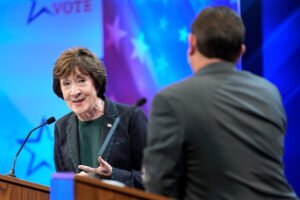
- The good, the bad and the unruly from over two dozen candidate debates
- How a fake pollster may have moved some 2026 elections
- Top Senate Finance Democrat maps out clean energy plan
- Australian treasurer says opponents want higher inflation for political gain
- Rising bond yields will add billions to budget pressure: Australian treasurer
- Capitol agenda: Some Republicans get bipartisan curious
- America’s Heartland sows doubt in the GOP

-

 Politics2 years ago
Former ‘Squad’ members launching ‘Bowman and Bush’ YouTube show
-
Uncategorized2 years ago
Bob Good to step down as Freedom Caucus chair this week
-

 The Josh Fourrier Show2 years ago
DOOMSDAY: Trump won, now what?
-

 The Dictatorship2 years ago
Pete Hegseth’s tenure at the Pentagon goes from bad to worse
-

 Politics2 years ago
Former Kentucky AG Daniel Cameron launches Senate bid
-

 The Dictatorship2 years ago
Luigi Mangione acknowledges public support in first official statement since arrest
-

 Politics2 years ago
Blue Light News’s Editorial Director Ryan Hutchins speaks at Blue Light News’s 2025 Governors Summit
-

 Politics1 year ago
John Legend advises Trump to drop the ‘dictator s‑‑‑’ if he wants Nobel Peace Prize