
Politics
Warren Davidson is a rare hard-line Republican questioning the Middle East war



Haley Stevens caps a bizarre midterm cycle
lead image
Republicans are already privately blaming President Donald Trump as they brace for losses on Tuesday.
Even as they race to distance themselves from his actions on tariffs, the unpopular Iran war and his mass deportation agenda, few have been willing to criticize him publicly — a clear sign of just how powerful Trump’s grip remains on the GOP. But interviews with roughly a dozen candidates, campaign officials and lawmakers reveal they’re acutely aware of who, exactly, put them on the back foot this entire cycle.
“There was a point earlier this year where we really felt like we could defy history,” said one House Republican, who, like others in this article, was granted anonymity to candidly discuss midterms dynamics. “And then Trump bombed Iran. And it was just one thing after another.”
Republicans are tied or trailing in polls in numerous critical battlegrounds and expecting to lose some once-secure red seats. And Trump’s unfocused closing message — including repeated comments about male candidates’ physical appearances — has further frustrated an already on-edge party.
“I think Jon Husted’s ass and Nicki Minaj’s is a great closing message,” T.W. Arrighi, a Republican strategist working on the South Carolina Senate race and others, said sarcastically in an interview on The Conversation with Dasha Burns. “You’ve got to take the good with the bad with Trump, unless you want to drive yourself crazy every day.”
“People are gonna go after the president. The buck stops with him. His approval ratings aren’t great,” he added.
Privately, some Republicans are even harsher. “At least when Barack Obama was president, he only screwed his enemies, never his friends,” said a second House Republican.
The White House defended its involvement in the war with Iran, tariff regime and approach to immigration enforcement. Davis Ingle, a White House spokesperson, said in a statement that Trump “is the unequivocal leader, best messenger, and unmatched motivator for the Republican Party, and he is committed to maintaining Republican majorities in Congress.”
One White House official, granted anonymity to speak candidly, called the blame game “an asinine adventure” and said Trump “has obviously left it all on the field.”
If the bottom falls out for the GOP on Tuesday, the quiet calls assigning him blame may turn into a public shanking as Trump nears the lame-duck stage of his presidency, Republicans refocus on how to win voters back for 2028 and jostle for their own spots in the party’s future.
“I’m not sure what the Republican Party looks like in six months. Look, a lot of Republicans have held their tongues. A lot of Republicans who have real problems with the way things have gone the last two years have been good soldiers,” said a Republican strategist involved in competitive midterm races across the country. “But what happens if we lose 35 House seats and six Senate seats?”
“We all know who the problem is. It’s Trump. And do we continue down a path of losing?” the strategist added.
In Georgia, some Republicans have already warned that low early voting turnout in rural parts of the state could drag down their entire ticket. “If you live in rural Georgia, you’re going to be disproportionately hurt by higher — especially diesel — prices,” said Jason Shepherd, the former GOP chair of suburban Cobb County. “The promise of the great Trump economy has not materialized.”
Top Hill Republicans have worked behind the scenes for months to try to alleviate some of the political fallout from Trump’s election year policy moves, including arguing to White House officials that Maine Sen. Susan Collins and Michigan Senate nominee Mike Rogers could lose their races if the administration didn’t reach an off-ramp from the trade war with Canada, according to three Republicans with direct knowledge of the matter. Eventually, Trump agreed to roll back some tariffs and add new ones in a boost to Collins.
Republicans also pressed for the White House to undo some of Trump’s other controversial moves, like his executive order to import more foreign beef that has riled ranchers and farmers in red states like Kansas, Iowa and Texas. But that relief never came.
“Republicans have always been aware of the historical midterm precedent, and that’s why we’re barnstorming the country to tout the president’s achievements on cutting taxes, securing the border, and lowering drug costs,” said Natalie Baldassarre, a spokesperson for the Republican National Committee. “Any anonymous strategist who says the president is not helpful in turning out Republican voters has no idea what they’re talking about, and their candidates should request a refund for their shoddy consulting services.”
But Trump’s actions, Republicans say, are hitting different parts of the country hard. The Iran war, they argue, was a significant blunder from Trump that has multiplied Democrats’ paths to power in both the House and Senate by driving fuel and fertilizer costs up — most notably impacting races across the Midwest.
The White House’s tariffs regime has been a major concern in battlegrounds on the Canadian border like Maine and Michigan.
Hardline immigration enforcement that has resulted in the deportation of thousands has hurt especially in heavily Latino border states like Arizona and Texas, and the cancelling of Temporary Protected Status for Haitians and Venezuelans has enraged South Florida voters. Rep. Maria Elvira Salazar, a Miami Republican, warned the president in a campaign ad earlier this year that his immigration tactics had gone too far.
“Trump won Miami, and yet he went to the place that gave him the biggest support, and kind of just fucked everybody over if we’re being honest.” said one Florida-based Republican operative.
New results from The Blue Light News Poll show that Republican midterm voters are split over who they would blame if the GOP performs worse than it did in 2024: A sizable 29% blame Trump for making the GOP less popular, while 30% said it is because Trump himself is not on the ballot. Fourteen percent said it would be because the Democratic Party has become more popular, while roughly one in four said they don’t know.
Some in the party question whether Trump’s last-minute campaign travel across the country and the millions of dollars his political operation has poured into battleground states will even be enough. They see him as more absorbed in protecting his legacy than making actionable policy changes to help his party stay in power.
“He cares more about the ballroom than he cares about Republicans winning the midterms,” said a third Republican strategist working in battleground races. “He wants the Nobel Peace Prize, these big legacy-defining things seem to be taking up more of his attention than actually being president.”
A fourth GOP operative working on midterms races has a curt message if Republicans lose big: “Thank you, Donald Trump.”
Dasha Burns contributed reporting.
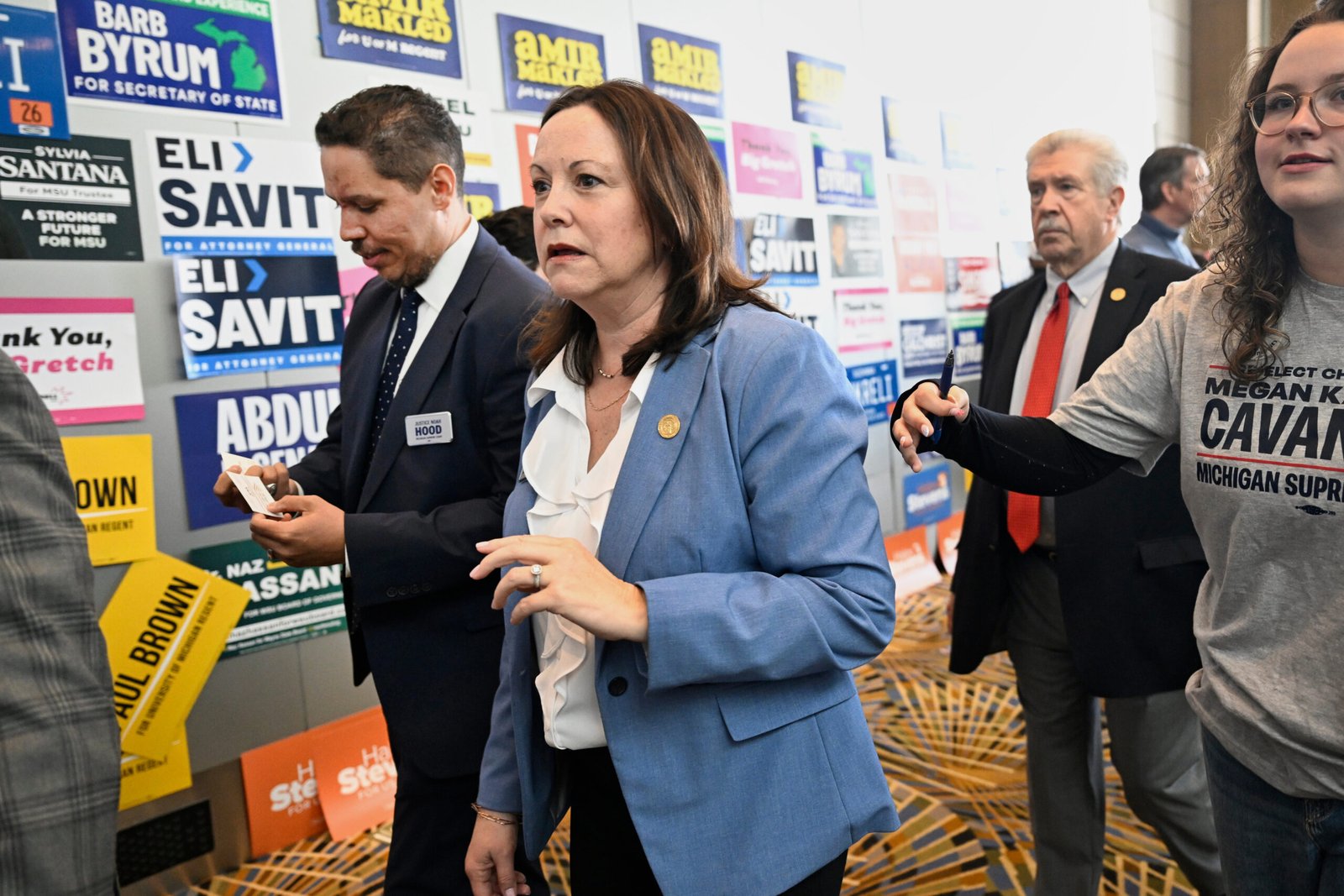
Liberal groups have spent millions in a handful of battleground state supreme court races ahead of Tuesday’s elections, looking to lay the groundwork for Democrats to win control of more courts ahead of a crucial redistricting cycle.
At the center of the fight are races for Republican-majority state supreme courts in North Carolina and Ohio, where this year’s results could set the stage for Democrats to flip the makeup of the benches in 2028. National groups are also spending to defend the liberal majority on Michigan’s court and on an open seat in Montana, where voters will also decide whether judicial elections remain nonpartisan.
The investments are yet another reflection of how state supreme court elections have become national political battlegrounds. The high court justices have become arbiters of major disputes, from abortion rights to election integrity and redistricting. Those who win in the coming cycles will likely preside over challenges to congressional and legislative maps that are drawn in a handful of states after the midterm election — and then nationwide after the 2030 census.
Nowhere are the contests more heated than in North Carolina.
Democrats’ defense of a seat currently held by Anita Earls is “step No. 2” to flip the North Carolina Supreme Court, said Anderson Clayton, the state’s Democratic Party chair. “In 2028, we’re looking at being able to take three Republican seats on that court.”
Democrats lost four seats on the state supreme court in the 2020 and 2022 elections, and the Republican majority cleared the way for a Republican-led gerrymandering in 2023.
Clayton said her group has spent more than $1 million on the state supreme court race. Earls has also drawn support from national Democrats like Pete Buttigieg and Maryland Gov. Wes Moore.
“If we had won a state Supreme Court race then in 2020 in our state, Hakeem Jeffries would be speaker of the House right now,” said Clayton, adding that her group is trying to build the foundation for congressional majorities “in 2032 and beyond.”
The ACLU is among the groups making long-term investments in state supreme court races. It has poured $8 million into state supreme court races in North Carolina, Michigan and Montana this year, in addition to Georgia and Wisconsin races earlier this year, said Deirdre Schifeling, the group’s chief political and advocacy officer, making it one of the top spenders in these contests.
The ACLU’s multi-cycle strategy to build “pro-civil rights, civil liberties majorities” is also targeting Arizona, Pennsylvania, Kentucky and Ohio, Schifeling said. The group already set aside resources for supreme court races in Wisconsin and Pennsylvania in 2027 and will begin fundraising for the 2028 races early next year.
More than $14 million has been spent on television ads in North Carolina, Michigan, Ohio and Montana, most of it benefiting Democratic and liberal-leaning candidates, according to estimates from the liberal-leaning Brennan Center for Justice. Most of the liberal candidates have also outraised their conservative competitors.
By contrast, the electoral headwinds have forced Republicans to defend statewide offices and state legislatures they currently control, leaving fewer resources for the judicial races.
Republican-aligned groups like the Republican State Leadership Committee — the party’s chief downballot campaign organization — have largely stayed on the sidelines this cycle after warning for months they were being swamped by Democrats. The organization’s judicial affiliate reported more than $5 million in expenditures across 2024 and 2025.
“Democrats understand what is at stake, and have dumped massive amounts of resources into these contests,” said RSLC President Edith Jorge-Tuñón in a statement. “The RSLC is fighting back with smart and targeted spending because the investments we make today will determine whether we are positioned to protect our majorities, compete in the next redistricting cycle, and secure Republican victories for years to come.”
The National Democratic Redistricting Committee — the party’s main redistricting-focused group — declined to discuss this year’s total spending in judicial races this year, but NDRC President John Bisognano said in a statement that “the upcoming 2026 and 2028 state supreme court elections are critical to the long-term fight to protect democracy.”
And those involved in supreme court fights said they believed spending will only increase down the road, particularly from major industry players.
“I think that the money flowing into those races from external interests tells the tale of what big money, big pharma, big data recognize about the next areas that they can seek to leverage and control to their benefit,” said Tish Gotell Faulks, the state courts director at the liberal Alliance for Justice Action. “Those interests are now turning to the state courts and seeking to capture those courts as well.”
- Enviro lawyers say the permitting bill could aid Trump’s DC renovations
- Crypto billionaire’s climate pivot earns him new foes
- Haley Stevens caps a bizarre midterm cycle
- Geothermal energy looks to ride the AI wave
- Republicans are privately blaming Trump, even if they won’t say it out loud
- Data centers are galvanizing the midterms. Here are the key races.
- Chuck Schumer’s leadership hopes run through the midterms
- What Hakeem Jeffries’ Albany years reveal about how he’d lead the House
- Democrats eye state supreme court races — this year and beyond

- The trust-busters going after CVS are Republicans
-

 Politics2 years ago
Former ‘Squad’ members launching ‘Bowman and Bush’ YouTube show
-

 Politics1 year ago
John Legend advises Trump to drop the ‘dictator s‑‑‑’ if he wants Nobel Peace Prize
-
Uncategorized2 years ago
Bob Good to step down as Freedom Caucus chair this week
-

 The Josh Fourrier Show2 years ago
DOOMSDAY: Trump won, now what?
-

 The Dictatorship2 years ago
Pete Hegseth’s tenure at the Pentagon goes from bad to worse
-

 Politics2 years ago
Former Kentucky AG Daniel Cameron launches Senate bid
-

 The Dictatorship2 years ago
Luigi Mangione acknowledges public support in first official statement since arrest
-

 Politics2 years ago
Blue Light News’s Editorial Director Ryan Hutchins speaks at Blue Light News’s 2025 Governors Summit