
Congress
Vulnerable House Republicans press Johnson on Obamacare subsidies

Thirteen vulnerable Republicans are urging Speaker Mike Johnson to “immediately turn our focus” to extending Obamacare subsidies after the government reopens.
The group, led by GOP Reps. Jen Kiggans of Virginia and Jeff Van Drew of New Jersey, laid out its case Tuesday in a new letter to Johnson, reminding him that millions of Americans face skyrocketing health insurance premiums as a result of the expiration of the subsidies at the end of the year.
While the moderate members acknowledge Republicans must not cede to Democratic demands that the subsidies be extended during the shutdown, they also emphasize that Johnson must help the party “chart a conservative path” forward on the credits immediately after the shutdown ends.
“Allowing these tax credits to lapse without a clear path forward would risk real harm to those we represent,” wrote the lawmakers. “Our Conference and President Trump have been clear that we will not take healthcare away from families who depend on it.”
Conversations have already started around pairing an extension of the enhanced Affordable Care Act tax credits with conservative health care policy priorities. There are discussions about making changes to the structure of the tax credits themselves, for instance instituting new minimum out-of-pocket premiums for all enrollees and imposing an income cap for eligibility.
House GOP leaders are engaged in early, informal conversations with White House officials about potential changes, too. Still, many hard-liners remain dug in against any extension, which Republicans across the political spectrum caution would be a political mistake heading into the midterms.
The Republicans said in their letter that they agree with their conservative colleagues that changes are needed: “Let us be clear: significant reforms are needed to make these credits more fiscally responsible and ensure they are going to the Americans who need them most.”
But with no resolution in sight to the 21-day government funding standoff between the two parties, the letter signals mounting GOP anxiety about the issue as Nov. 1 fast approaches. That’s the date for open enrollment in plans under the Affordable Care Act, at which point it might be too late to avoid massive premium hikes.
State insurance officials have warned that an expectation that the enhanced tax credits will expire has already been baked into updated insurance rates, and it will be difficult to update those rates if Congress passes an extension in November or December.
Kiggans introduced a bill in September that would extend the subsidies for a year, which currently has the support of 28 co-sponsors, equally divided between the two parties. Twelve of the signers of the Johnson letter are supporters of the Kiggans measure.


A federal appeals court ruling Tuesday on demonstrators’ access to the steps of the Capitol could bode poorly for President Donald Trump’s attempt to ban three media organizations from the White House.
The majority opinion, written by Trump appointee Neomi Rao, concluded that the East Steps of the Capitol are a “nonpublic forum” — just like most areas of the White House grounds, including the press facilities. While the government may impose restrictions on access to those nonpublic areas, the limits must be “viewpoint neutral,” apply “objective, workable standards” and not permit officials to exercise “unbridled discretion over a forum’s use,” the D.C. Circuit Court of Appeals panel concluded.
“A regulation that grants the government arbitrary control over who may speak invites the suppression of disfavored viewpoints and undermines the First Amendment’s core protections,” wrote Rao, who was joined in the majority by Judge Karen Henderson, a George H.W. Bush appointee.
The ruling, on the eve of a hearing over restoring White House accessfor Blue Light News, BLN and MS NOW, reaffirms the D.C. Circuit’s longstanding First Amendment precedents at an inopportune time for Trump. The president has explicitly described his ban on the three outlets as a punishment for publishing what he calls “fake news.”
“Fake News people and publications that only write negatively, and who violate our National Security by writing false and defamatory stories with unknown ‘sources,’ shouldn’t be allowed access to the most important Office anywhere in the World,” Trump said on social media Monday.
The outlets have said their access was revoked because the White House objected to their reporting and that the ban “threatens press freedom and the public’s right to independent journalism free from government interference.”
The D.C. Circuit would hear any appeals in the litigation over Trump’s media ban, and Trump has in fact already said he anticipates filing an appeal, presuming that he will be dealt a defeat in district court.
The White House did not immediately respond to a request for comment.
The D.C. Circuit’s Tuesday ruling stemmed from a lawsuit brought by Patrick Mahoney, a clergyman who sought to hold prayer vigils and demonstrations on the East Steps of the Capitol several months after the Jan. 6, 2021 attack, which resulted in new access restrictions. His permit was denied in part based on Capitol Police regulations that prohibit public demonstrations on the steps unless they are sponsored by a member of Congress.
Though the case has inched through the courts for years, Tuesday’s ruling resolves a key question, labeling the Capitol’s East Steps a “nonpublic forum” for which congressional authorities may restrict public access — in part because lawmakers use those steps to enter and exit the building.
But allowing members of Congress to sponsor gatherings on the steps creates an arbitrary system, the majority concluded.
“Because the protection of unpopular speech and advocacy is central to the First Amendment, we cannot leave it to the selective enforcement of members,” Rao wrote.
Notably, Rao’s opinion cites a D.C. Circuit ruling last year that concluded “it would be unreasonable to control access to White House press facilities through standardless discretion.”
The third judge on the panel, Clinton appointee Judith Rogers, dissented, but her opinion was even more protective of free-speech rights.
Rogers said she agreed with her colleagues that the “selective exception” for demonstrations sponsored by lawmakers was unconstitutional. However, she said she would have held that the lower portion of the Capitol steps was a public forum where the government was obligated to permit protest activity.
Ohio television stations are so far choosing to ignore a legal threat from GOP Rep. Max Miller and broadcast an ad from his Democratic challenger centered on the allegations of domestic abuse Miller faces from his ex-wife.
A lawyer for Miller demanded that Cleveland-area television station WKYC not publish “false, malicious, and defamatory statements” in a Thursday cease-and-desist letter first reported by Blue Light News.
WKYC ran the ad Tuesday morning, according to ad-tracking firm AdImpact, as did two other Cleveland stations, WEWS and WOIO.
The 30-second ad from the Poindexter campaign and Democratic Congressional Campaign Committee depicts a local sheriff listing the accusations levied against Miller levied by Emily Moreno, his ex-wife and the daughter of Sen. Bernie Moreno (R-Ohio). Miller has repeatedly denied the abuse allegations.
“The ad mentioned is filled with lies,” Miller spokesperson Abigail Angelos said in a statement. “Each of the statements in the advertisement are entirely unsubstantiated and contradicted by evidence.”
Representatives for the three TV stations did not immediately respond to requests for comment. Poindexter responded to the legal threat by tearing up the cease-and-desist letter in a campaign video.
Before the ad, Poindexter had focused his campaign on his working-class background and cost-of-living issues. Now the campaign has gotten intensely personal: The Democrat is on air publicizing Miller’s family dispute, while Miller’s campaign is lobbing accusations about Poindexter’s past run-ins with law enforcement in an ad paid for by the NRCC.
NRCC spokesperson Zach Bannon said in a statement that Poindexter is “completely out of touch with Northeast Ohio” and is a “life-long criminal” who is “fully embracing the radical far-left socialist agenda.”
Aaron Pellish contributed to this report.
A Senate Republican from Utah is asking the Senate Judiciary Committee to subpoena Donald Trump Jr. following reports that the president’s son had parts of his wedding paid for by a Russian oligarch with ties to Russian President Vladimir Putin.
Sen. John Curtis’ request, which comes following a news story by ProPublica, marks a significant break with President Donald Trump from a member of his own party.
“Questions have arisen about the relationships of President Trump’s eldest son, Donald Trump Jr., with foreign business figures and the acceptance of significant gifts. These include a lavish wedding afterparty, on a private island, provided by Russian oligarch Umar Kremlev, who reportedly traveled to China as part of a delegation accompanying Vladimir Putin shortly before giving the gift,” Curtis wrote in a letter dated Sept. 21 to Senate Judiciary Chair Chuck Grassley (R-Iowa) and the panel’s top Democrat, Sen. Dick Durbin of Illinois.
“These concerns are compounded by Donald Trump Jr.’s active promotion of family-backed cryptocurrency ventures, his continued pursuit of international real estate deals involving direct meetings with foreign heads of state, and his reported investments in defense contracting,” Curtis added.
Curtis, also noting the profits the Trump family has made through cryptocurrency deals, indicated this incident is part of a broader pattern where the relatives of U.S. presidents can improperly leverage their proximity to power.
In addition to probing Trump Jr., Curtis asked the Senate Judiciary Committee to subpoena President Joe Biden’s son, Hunter Biden, who over the years found himself enveloped in numerous self-dealing scandals. Both men, he said, should testify “regarding their past business dealings, relationships with foreign individuals and entities, gifts, or other benefits they have received, and any instances in which their relationship to the President was invoked or understood to provide value.”
“The country should not have to accept one standard for the family of a Republican president and another for the family of a Democratic president. Nor should congressional oversight begin and end when control of the White House changes hands,” Curtis said.
The White House did not immediately return a request for comment Wednesday, but it’s unlikely that Trump, who demands loyalty from the GOP, will consider the bipartisan nature of Curtis’ request to be anything other than a personal affront.
Trump said in a statement he has “no idea who Umar is” and that he has “never heard of him, and he didn’t pay for Don and Bettina’s wedding, which took place at a totally different location, and on a different day from the wedding.”
Kremlev is president of the International Boxing Association and received an Order of Friendship medal from Putin for his “contribution to international sport and his commitment to the global boxing family.” He’s also been sanctioned by the Ukrainian government for his ties to Putin.
A spokesperson for Judiciary Committee Republicans confirmed Grassley was in receipt of the letter but could not commit to investigating the matter. The spokesperson noted that hearing dates are extremely limited through the end of 2026 and investigative hearings usually take months of background work before they can be scheduled.
It’s sure to be an issue Democrats pursue if they win the majority in either chamber next year. Rep. Robert Garcia (D-Calif.), the ranking member of the House Oversight and Government Reform Committee, wrote to the White House and Donald Trump Jr. last week demanding information about the president’s son’s ties to Kremlev.
Cheyanne M. Daniels contributed to this report.
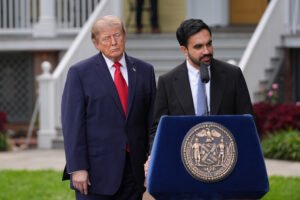
- Mamdani and Trump face frosty reception in Queens over Sunnyside Yard plan
- Trump says decision on possible diesel export ban to come ‘fast’
- Appeals court’s Capitol steps ruling may signal trouble for Trump on media ban
- Ohio stations ignore Max Miller’s legal threat, run Democratic challenger’s ad
- GOP Senator wants to subpoena Donald Trump Jr. over Russian-funded wedding
- Capitol agenda: Senate GOP eyes exit plan as trail calls
- ‘We need to stop the contagion’: GOP ramps up midterms defense in Trump states
- Abbott slaps halt on Texas data center permits
- Top House Oversight Dem demands answers to Trump’s media ban
- Mike Rogers says Iran war needs to “end quickly” amid rising prices
-

 Politics2 years ago
Former ‘Squad’ members launching ‘Bowman and Bush’ YouTube show
-
Uncategorized2 years ago
Bob Good to step down as Freedom Caucus chair this week
-

 The Josh Fourrier Show2 years ago
DOOMSDAY: Trump won, now what?
-

 Politics2 years ago
Former Kentucky AG Daniel Cameron launches Senate bid
-

 The Dictatorship2 years ago
Luigi Mangione acknowledges public support in first official statement since arrest
-

 The Dictatorship2 years ago
Pete Hegseth’s tenure at the Pentagon goes from bad to worse
-

 Politics2 years ago
Blue Light News’s Editorial Director Ryan Hutchins speaks at Blue Light News’s 2025 Governors Summit
-

 The Dictatorship1 year ago
Mike Johnson sums up the GOP’s arrogant position on military occupation with two words