
Congress
Under Mike Johnson, a rarely used House tool has gone mainstream


Over the course of decades, House lawmakers had succeeded only a few times in triggering votes on bills the chamber’s leaders refused to call up.
Then Mike Johnson became speaker.
On the Louisiana Republican’s watch, the “discharge petition” has caught fire. Rank-and-file lawmakers have managed five times since he won his gavel two years ago to circumvent Johnson’s wishes by getting the 218 signatures needed to force votes on legislation he had blocked — more than in the prior 30 years combined.
Most recently, a bipartisan group used the maneuver to advance a long-stalled bill requiring President Donald Trump’s administration to release information about the late convicted sex offender Jeffrey Epstein.
It’s members of Johnson’s own party who have most effectively wielded the tool in recent years. Rep. Thomas Massie (R-Ky.) masterminded the Epstein push, while Rep. Anna Paulina Luna (R-Fla.) engineered an effort to seek voting accommodations for House members with newborn babies. Before that, then-Rep. Garret Graves (R-La.) used the gambit to enact a bill to expand Social Security payments for millions of public sector workers.
“They try to say that discharge petitions are a tool of the minority, but that’s actually only the perspective of people that want to consolidate power within leadership,” Luna said in an interview, adding that she would protect the maneuver “with every bone in my body.”
The upshot for Johnson is that the arcane legislative mechanism once known only to Capitol Hill obsessives is now a routine part of life in the Republican House majority. Beyond Epstein, Johnson is now facing several new drumbeats for action, with lawmakers looking to force votes on banning member stock trading, sanctioning Russia and extending health care subsidies that are set to expire at year’s end.
The GOP’s slim majority is an obvious contributor to the burgeoning popularity of the maneuver. The discharge process is set into motion when 218 members sign on to a petition, meaning only a handful of Republicans need to cross leadership if Democrats are united in support.
But the recent spate of successful discharges also reflects careful groundwork Democrats laid to quickly seize on the procedure, along with a sentiment among many Republicans that Johnson is stifling the will of the House to appease Trump and small GOP factions — including hard-liners who successfully ousted Johnson’s predecessor, Kevin McCarthy.
“I would encourage you to ask Mike Johnson why he repeatedly refused to bring my bill to the floor,” Rep. Greg Steube (R-Fla.) said in an interview.
‘Toxic political environment’
Steube is still bitter about how Johnson hindered passage last year of his legislation to provide tax relief to disaster survivors, even after the measure was unanimously approved in committee. Once Steube got the signatures he needed to compel floor action, the measure passed the House in a 382-7 vote before clearing the Senate and earning then-President Joe Biden’s signature.
That first victory — seven months into Johnson’s tenure as speaker — showed how the maneuver can be successful “in a toxic political environment,” said Steube, a MAGA-hat-wearing, fourth-term member who has consistently won his southwest Florida district by a landslide. “It’s got to be something that is very bipartisan and is important enough that the body says, Yeah, this warrants overriding the speaker.”

The discharge petition dates back to 1910, when it was created in response to the “overreaching, overbearing, overcontrolling” style of then-Speaker Joseph Cannon — aka “Czar Cannon” — according to Sarah Binder, a George Washington University professor who focuses on legislative politics.
Now, she said, it serves as a “pressure valve” for a chamber designed to reflect the majority’s will.
In some cases, discharge petitions can help solve thorny political problems for the speaker. Philip Wallach, who studies the roots of congressional dysfunction at the right-leaning American Enterprise Institute, said Johnson is “using this idea of getting forced” as a way to keep his job.
“He’s actually kind of deft at the coalition management problem and at staying on side with Trump,” Wallach said. “If he acted some other way, I really do think there’s a good chance that he would find himself on the wrong side of Trump and get thrown out.”
That was certainly the case with the Epstein vote, though Johnson protested mightily against the bill Massie and his ally Rep. Ro Khanna (D-Calif.) sought to discharge, arguing until the moment Trump signed it that it did not do enough to protect Epstein’s victims from invasions of privacy.
But as the 427-1 vote demonstrated, there was a deep groundswell for transparency that Johnson had been holding off at Trump’s behest.
‘The fuse in the fuse box’
Massie said members of both parties are now “brainstorming” other bills they might be able to catapult to the floor.
“It’s the fuse in the fuse box when everything gets jammed up and the wires get crossed and nothing can get done,” he told reporters last week.
In discouraging Republicans from signing on to discharge petitions, House GOP leaders argue that the tactic undermines the party in power and circumvents Congress’ “regular order” system of debate, where legislation is meant to advance through committees with special expertise.
“Typically it’s when somebody either doesn’t want to go through the committee process or doesn’t get what they want out of the committee process,” House Majority Leader Steve Scalise (R-La.) said in an interview.
But it’s not just committee calendars and floor scheduling that has chafed many House Republicans. GOP leaders have taken more overt steps this year to thwart the chamber’s ability to work the majority’s will — including by preemptively blocking efforts to force votes on canceling some of Trump’s tariffs.

Even before Johnson’s tenure, House leaders of both parties have chipped away at the “open rule” practice of allowing lawmakers to debate any amendments they wanted on the floor. Now they nearly always pick and choose the amendments allowed — if they allow them at all.
On the Epstein bill, the House’s top Republicans characterized the decision to sign Massie’s petition as a loyalty test.
“They made it pretty clear that if you get on the discharge petition, you’ve declared war on the president, in so many words,” Rep. Don Bacon (R-Neb.) said in an interview, adding that he sympathized with Johnson’s need to keep Trump and “prima donnas” in the House GOP happy.
“He tries his best,” Bacon said.
But Bacon, who is retiring after his term ends, has signed on to several discharge petitions, including one to sanction Russia and aid Ukraine, which is just a few signatures shy of 218. Bacon reasons that gesture is a way to show Trump that there’s rising support for helping Ukraine while affording Johnson some political cover.
“I feel like I’m helping him out by doing the discharge on Ukraine, in a way,” Bacon said of Johnson. “Because I’m trying to force the hand. He’s going to say, ‘I didn’t have any choice on this.’”
‘Zombie’ legislation
Democrats, to be sure, have done their share to contribute to the dizzying pace of discharges. Just last week, another petition succeeded, setting up a vote on a measure sponsored by Rep. Jared Golden (D-Maine) that would nullify an executive order Trump issued in March scrapping the collective bargaining rights of more than 1 million federal employees.
The party’s leaders, in fact, have quietly plotted for months to take full advantage of the tool. Under House rules, it typically takes well over a month to force a vote once a petition gets the requisite 218 signatures. So Massachusetts Rep. Jim McGovern, the top Democrat on the House Rules Committee, coordinated the filing of “zombie” measures containing placeholder language allowing members to jump-start the procedural countdown before they finalize the substance of the legislation they want to propel to the floor.
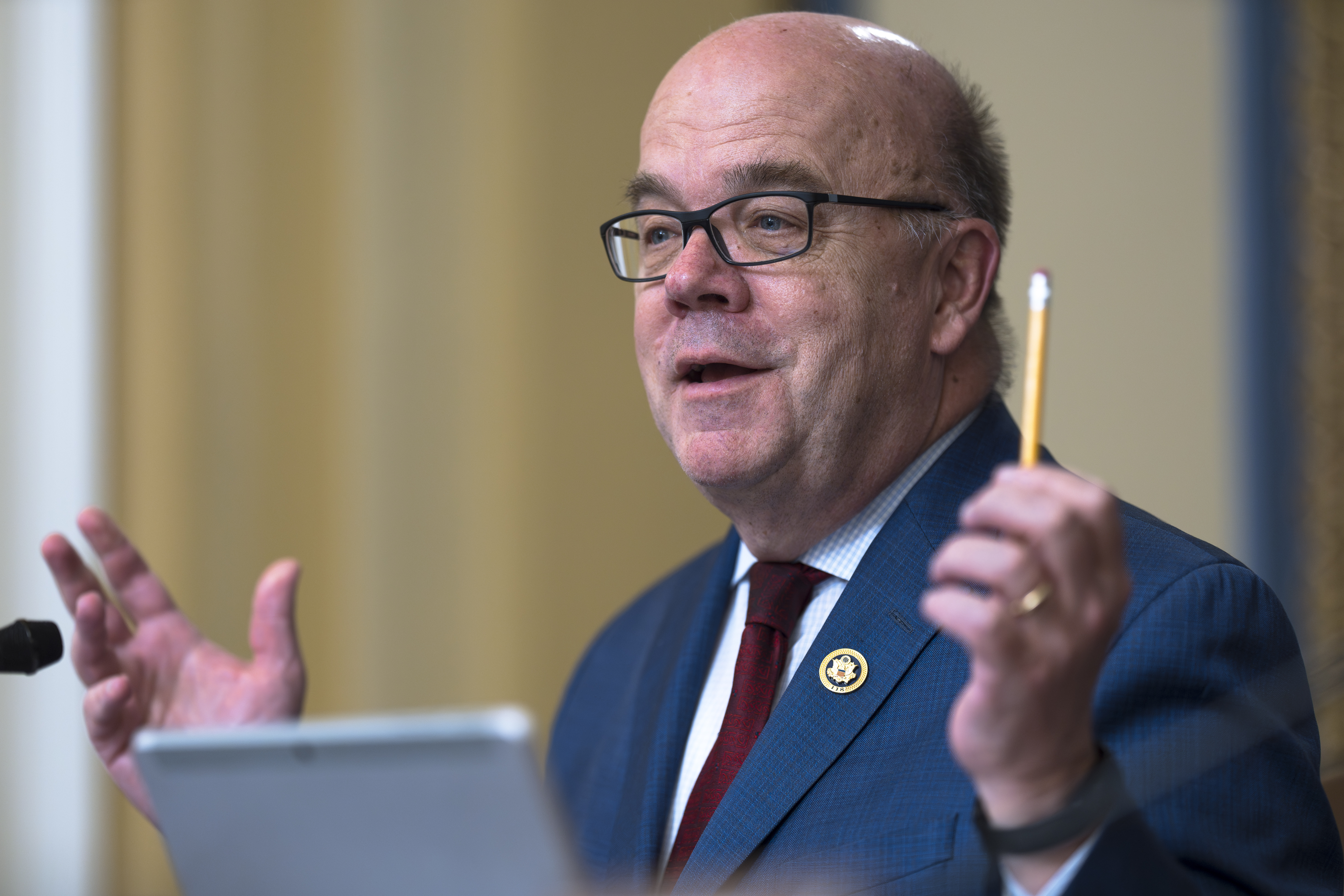
McGovern acknowledged in an interview that none of that spade work pays off unless at least a few members of the majority are disgruntled enough to buck their leaders.
“It takes a lot of courage for Republicans to sign on to a discharge petition when they’re in charge,” he said. “But I think it’s a reflection of their frustration with their own leadership.”
Off Blue Light News, congressional observers who know the history of the seldom-used gambit are stunned, if not necessarily surprised, by its recent success.
“Despite the fact that it doesn’t succeed very often, it’s out there for an ambitious, organized minority — and, in this case, also disgruntled or concerned majority members, who feel their leadership’s not on the right side of the issue,” Binder said. “So beware the discharge.”
Cassandra Dumay contributed to this report.


Rep. Max Miller issued a subpoena to his former father-in-law and fellow Ohio Republican, Sen. Bernie Moreno, in the latest escalation of a long-running family legal drama.
Pamela MacAdams, an attorney for Miller, reported to the Cuyahoga County Domestic Relations Court Monday that three subpoenas were served in Miller’s divorce case, according to court records. A person with knowledge of the subpoenas granted anonymity to comment on them said that two were sent to Moreno and his wife, Bridget.
Their daughter, Emily Moreno, was married to Miller, and the two remain embroiled in a nasty legal battle.
Spokespeople for Miller, Emily Moreno and Bernie Moreno did not immediately return requests for comment. TMZ first reported on the subpoenas.
Miller is seeking reelection in a competitive district, and his campaign has been marred by accusations of domestic abuse against Emily Moreno and their daughter. Miller has repeatedly denied the allegations and chose to remain in the race despite other Republican lawmakers pressuring him to withdraw his campaign.
The House Ethics Committee, which began an inquiry into Miller after Miller asked to be investigated, is currently in a preelection blackout period. During that period, which will continue through the midterms, the Ethics Committee doesn’t take any action against sitting members who could return next Congress.
Congress
Trump declares $1B canceled in ‘pocket rescission’ in another affront to Congress’ funding power
President Donald Trump informed congressional leaders Friday that he has unilaterally canceled almost $1 billion without Congress’ consent — employing a budget maneuver many lawmakers consider illegal.
In a move that will almost certainly set up an ugly government funding battle after the midterms, Trump has again claimed the power to execute a so-called “pocket rescission” to nix money Congress has already enacted. The money his administration will claw back is for for immigration services, support to foreign countries, education programs, health research efforts and assistance for businesses owned by minorities.
By law, the president is allowed to send Congress a request to rescind federal funding, then withhold that money for 45 days while lawmakers consider whether to approve, reject or ignore it. Trump administration officials also argue they have the power to cancel funding without any congressional action by sending Congress a rescission request with less than 45 days left in the fiscal year. The argument is that the money automatically gets canceled on Sept. 30, when funding lapses at the end of the fiscal year.
Last year, Trump canceled $4.9 billion in foreign aid.
The Senate’s top Republican appropriator, Sen. Susan Collins of Maine, immediately blasted the move as illegal, saying in a statement Friday night that “any effort to rescind appropriated funds without congressional approval is a clear violation of the law.”
“This move shows that OMB intentionally withheld these funds for months to execute this unlawful cancellation of appropriations that were approved on a bipartisan basis and signed into law,” Collins added, pledging to work with other lawmakers “to address these illegal actions.”
Collins and other appropriators have already been on high alert in recent days, pressing multiple agencies about funding officials have yet to spend ahead of the expiration date.
Democrats are finally catching on to how to talk to young male voters in the lead-up to the midterms, but the party can still up its game, one battleground senator and potential 2028er said Friday.
Sen. Ruben Gallego (D-Ariz.) has been one of his party’s most outspoken critics on its handling of outreach to young men, who swung right and helped deliver the White House and both chambers of Congress to Republicans in 2024.
The party is now “definitely moving in the right direction,” Gallego said Friday.
“Like back in the day, I was like the only one,” putting out positions on men, Gallego said at a Washington event on young American men. “Now, like, it seems like everyone every week is coming out with a new position, new idea, which is great.”
Gallego has criticized Democrat’s failure to highlight mens’ struggles and their tendency to over-police mens’ ideas. But there are signs the political winds have shifted in his party’s favor.
A new Cygnal poll released with the event of men ages 18-30 who say they’re the most determined to vote revealed Democrats’ generic ballot lead over Republicans at 57%-40%, Blue Light News reported. The poll also said nearly 40 percent of respondents said they feel their lives are off track.
“We need to take the opportunity to invest in that portion of this country, to say that we care about them and actually try to change the trajectory of what’s happening with men in this country,” Gallego said at the symposium.
Still, the path for specific legislation targeting the needs of this demographic faces an incredibly tight calendar this Congress and is uncertain in the political landscape of next year.
A proposal from Gallego and Sen. Roger Marshall (R-Kan.) to establish a men’s health office within the Department of Health and Human Services, for example, has not advanced. Nor has bipartisan legislation from Sen. Bill Cassidy (R-La.), who also spoke at the event, targeting education outcomes, college investment transparency and dyslexic student support.
-

 Politics2 years ago
Former ‘Squad’ members launching ‘Bowman and Bush’ YouTube show
-
Uncategorized2 years ago
Bob Good to step down as Freedom Caucus chair this week
-

 The Josh Fourrier Show2 years ago
DOOMSDAY: Trump won, now what?
-

 Politics2 years ago
Former Kentucky AG Daniel Cameron launches Senate bid
-

 The Dictatorship2 years ago
Luigi Mangione acknowledges public support in first official statement since arrest
-

 The Dictatorship2 years ago
Pete Hegseth’s tenure at the Pentagon goes from bad to worse
-

 Politics2 years ago
Blue Light News’s Editorial Director Ryan Hutchins speaks at Blue Light News’s 2025 Governors Summit
-

 The Dictatorship1 year ago
Mike Johnson sums up the GOP’s arrogant position on military occupation with two words