
Congress
Under Mike Johnson, a rarely used House tool has gone mainstream


Over the course of decades, House lawmakers had succeeded only a few times in triggering votes on bills the chamber’s leaders refused to call up.
Then Mike Johnson became speaker.
On the Louisiana Republican’s watch, the “discharge petition” has caught fire. Rank-and-file lawmakers have managed five times since he won his gavel two years ago to circumvent Johnson’s wishes by getting the 218 signatures needed to force votes on legislation he had blocked — more than in the prior 30 years combined.
Most recently, a bipartisan group used the maneuver to advance a long-stalled bill requiring President Donald Trump’s administration to release information about the late convicted sex offender Jeffrey Epstein.
It’s members of Johnson’s own party who have most effectively wielded the tool in recent years. Rep. Thomas Massie (R-Ky.) masterminded the Epstein push, while Rep. Anna Paulina Luna (R-Fla.) engineered an effort to seek voting accommodations for House members with newborn babies. Before that, then-Rep. Garret Graves (R-La.) used the gambit to enact a bill to expand Social Security payments for millions of public sector workers.
“They try to say that discharge petitions are a tool of the minority, but that’s actually only the perspective of people that want to consolidate power within leadership,” Luna said in an interview, adding that she would protect the maneuver “with every bone in my body.”
The upshot for Johnson is that the arcane legislative mechanism once known only to Capitol Hill obsessives is now a routine part of life in the Republican House majority. Beyond Epstein, Johnson is now facing several new drumbeats for action, with lawmakers looking to force votes on banning member stock trading, sanctioning Russia and extending health care subsidies that are set to expire at year’s end.
The GOP’s slim majority is an obvious contributor to the burgeoning popularity of the maneuver. The discharge process is set into motion when 218 members sign on to a petition, meaning only a handful of Republicans need to cross leadership if Democrats are united in support.
But the recent spate of successful discharges also reflects careful groundwork Democrats laid to quickly seize on the procedure, along with a sentiment among many Republicans that Johnson is stifling the will of the House to appease Trump and small GOP factions — including hard-liners who successfully ousted Johnson’s predecessor, Kevin McCarthy.
“I would encourage you to ask Mike Johnson why he repeatedly refused to bring my bill to the floor,” Rep. Greg Steube (R-Fla.) said in an interview.
‘Toxic political environment’
Steube is still bitter about how Johnson hindered passage last year of his legislation to provide tax relief to disaster survivors, even after the measure was unanimously approved in committee. Once Steube got the signatures he needed to compel floor action, the measure passed the House in a 382-7 vote before clearing the Senate and earning then-President Joe Biden’s signature.
That first victory — seven months into Johnson’s tenure as speaker — showed how the maneuver can be successful “in a toxic political environment,” said Steube, a MAGA-hat-wearing, fourth-term member who has consistently won his southwest Florida district by a landslide. “It’s got to be something that is very bipartisan and is important enough that the body says, Yeah, this warrants overriding the speaker.”

The discharge petition dates back to 1910, when it was created in response to the “overreaching, overbearing, overcontrolling” style of then-Speaker Joseph Cannon — aka “Czar Cannon” — according to Sarah Binder, a George Washington University professor who focuses on legislative politics.
Now, she said, it serves as a “pressure valve” for a chamber designed to reflect the majority’s will.
In some cases, discharge petitions can help solve thorny political problems for the speaker. Philip Wallach, who studies the roots of congressional dysfunction at the right-leaning American Enterprise Institute, said Johnson is “using this idea of getting forced” as a way to keep his job.
“He’s actually kind of deft at the coalition management problem and at staying on side with Trump,” Wallach said. “If he acted some other way, I really do think there’s a good chance that he would find himself on the wrong side of Trump and get thrown out.”
That was certainly the case with the Epstein vote, though Johnson protested mightily against the bill Massie and his ally Rep. Ro Khanna (D-Calif.) sought to discharge, arguing until the moment Trump signed it that it did not do enough to protect Epstein’s victims from invasions of privacy.
But as the 427-1 vote demonstrated, there was a deep groundswell for transparency that Johnson had been holding off at Trump’s behest.
‘The fuse in the fuse box’
Massie said members of both parties are now “brainstorming” other bills they might be able to catapult to the floor.
“It’s the fuse in the fuse box when everything gets jammed up and the wires get crossed and nothing can get done,” he told reporters last week.
In discouraging Republicans from signing on to discharge petitions, House GOP leaders argue that the tactic undermines the party in power and circumvents Congress’ “regular order” system of debate, where legislation is meant to advance through committees with special expertise.
“Typically it’s when somebody either doesn’t want to go through the committee process or doesn’t get what they want out of the committee process,” House Majority Leader Steve Scalise (R-La.) said in an interview.
But it’s not just committee calendars and floor scheduling that has chafed many House Republicans. GOP leaders have taken more overt steps this year to thwart the chamber’s ability to work the majority’s will — including by preemptively blocking efforts to force votes on canceling some of Trump’s tariffs.

Even before Johnson’s tenure, House leaders of both parties have chipped away at the “open rule” practice of allowing lawmakers to debate any amendments they wanted on the floor. Now they nearly always pick and choose the amendments allowed — if they allow them at all.
On the Epstein bill, the House’s top Republicans characterized the decision to sign Massie’s petition as a loyalty test.
“They made it pretty clear that if you get on the discharge petition, you’ve declared war on the president, in so many words,” Rep. Don Bacon (R-Neb.) said in an interview, adding that he sympathized with Johnson’s need to keep Trump and “prima donnas” in the House GOP happy.
“He tries his best,” Bacon said.
But Bacon, who is retiring after his term ends, has signed on to several discharge petitions, including one to sanction Russia and aid Ukraine, which is just a few signatures shy of 218. Bacon reasons that gesture is a way to show Trump that there’s rising support for helping Ukraine while affording Johnson some political cover.
“I feel like I’m helping him out by doing the discharge on Ukraine, in a way,” Bacon said of Johnson. “Because I’m trying to force the hand. He’s going to say, ‘I didn’t have any choice on this.’”
‘Zombie’ legislation
Democrats, to be sure, have done their share to contribute to the dizzying pace of discharges. Just last week, another petition succeeded, setting up a vote on a measure sponsored by Rep. Jared Golden (D-Maine) that would nullify an executive order Trump issued in March scrapping the collective bargaining rights of more than 1 million federal employees.
The party’s leaders, in fact, have quietly plotted for months to take full advantage of the tool. Under House rules, it typically takes well over a month to force a vote once a petition gets the requisite 218 signatures. So Massachusetts Rep. Jim McGovern, the top Democrat on the House Rules Committee, coordinated the filing of “zombie” measures containing placeholder language allowing members to jump-start the procedural countdown before they finalize the substance of the legislation they want to propel to the floor.
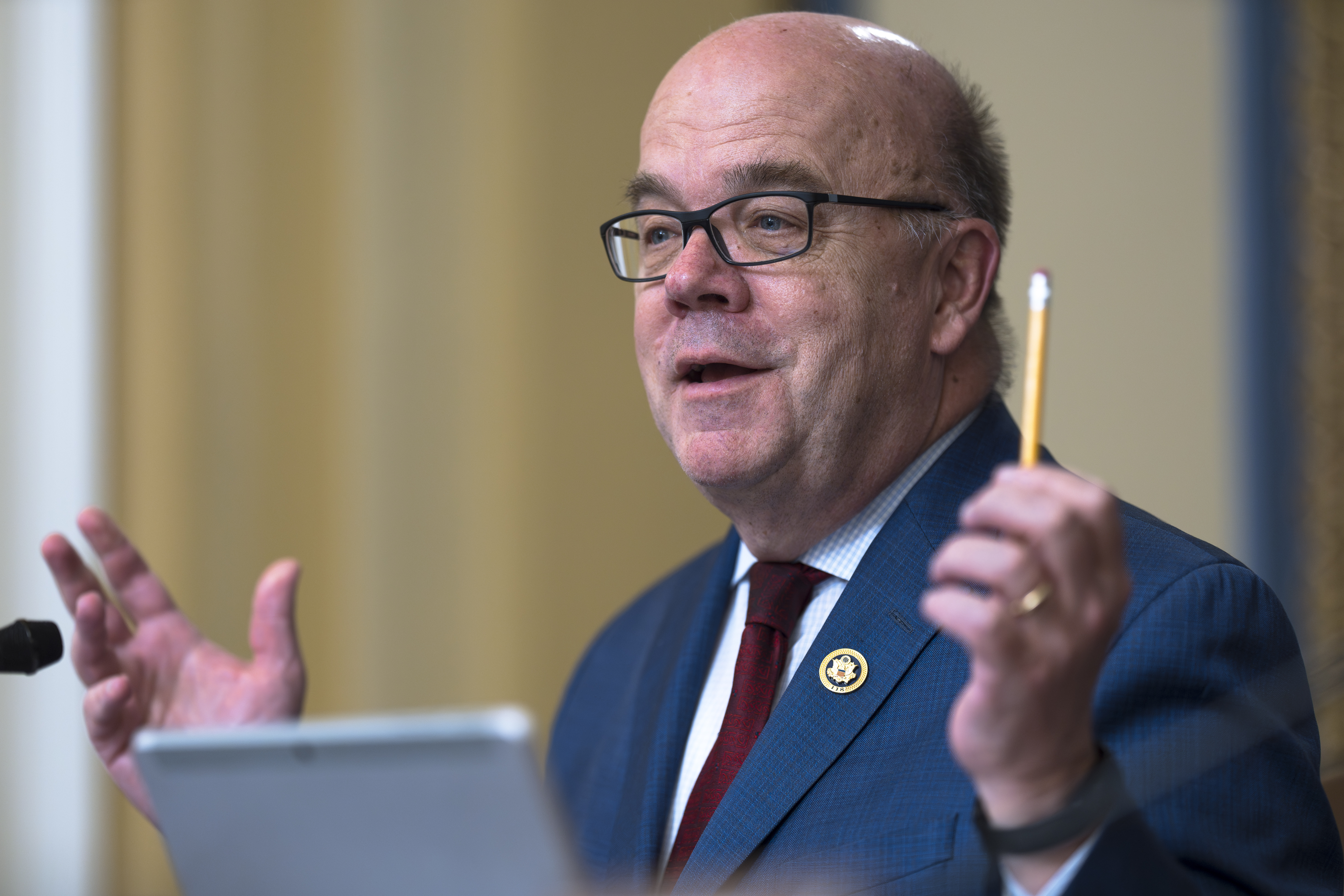
McGovern acknowledged in an interview that none of that spade work pays off unless at least a few members of the majority are disgruntled enough to buck their leaders.
“It takes a lot of courage for Republicans to sign on to a discharge petition when they’re in charge,” he said. “But I think it’s a reflection of their frustration with their own leadership.”
Off Blue Light News, congressional observers who know the history of the seldom-used gambit are stunned, if not necessarily surprised, by its recent success.
“Despite the fact that it doesn’t succeed very often, it’s out there for an ambitious, organized minority — and, in this case, also disgruntled or concerned majority members, who feel their leadership’s not on the right side of the issue,” Binder said. “So beware the discharge.”
Cassandra Dumay contributed to this report.


Texas Rep. Tony Gonzales has admitted for the first time that he had a sexual relationship with his former staff member who killed herself last year.
Gonzales, who faces a May runoff in the Republican primary to hold his seat, insisted in a radio interview that he is not responsible for her death.
“I made a mistake, and I had a lapse in judgment, and there was a lack of faith, and I take full responsibility for those actions,” Gonzales told radio host Joe Pagliarulo.
Gonzales, who is married, made the comments hours after congressional investigators recommended the House Ethics committee probe the lawmaker for the relationship, which would be a violation of House rules. The Texas lawmaker said he plans to cooperate with the committee’s investigation.
The acknowledgment comes a day after Gonzales was forced into a runoff election in his west Texas congressional seat against Brandon Herrera, a media personality who owns a gun business and calls himself “the AK Guy.”
Several of his Republican colleagues have called for Gonzales to step down after new details about the relationship came to light in the weeks before Tuesday’s election. Gonzales had previously denied the affair and refused to resign.
Gonzales is alleged to have tried to coerce Regina Santos-Aviles into sending explicit photos, according to text messages published by the San Antonio Express-News and other publications. Blue Light News has not independently reviewed the messages.
An attorney for Gonzales declined to comment.
In the interview, Gonzales spoke about Santos-Aviles’ time working in his office before her death, which he said came as “a shock to everyone.” She died by suicide after setting herself on fire at her home in 2025 – about a year after the exchange of messages with the lawmaker.
“Some of the reports are saying that she was not thriving at work. It’s exact opposite. She was thriving at work,” he said.
Gonzales said that Santos-Aviles’ suicide had “absolutely nothing to do with” their relationship.
Some Democrats aren’t ruling out voting for a multibillion-dollar military infusion, setting up a potential internal clash in the weeks ahead for a party whose political base is aghast at President Donald Trump’s aggression against Iran.
The Trump administration’s top defense and intelligence officials told lawmakers this week that the Pentagon could soon send an emergency supplemental funding request to Capitol Hill. They didn’t offer a timeline or dollar value, but the White House is reportedly mulling a $50 billion ask.
That’s a massive sum on top of the more than $990 billion Congress has shelled out for defense capabilities in recent months between the GOP’s “big, beautiful bill” and the latest government funding package.
To pass any new military funding measure through the Senate, the support of at least seven Democrats will be needed to overcome the filibuster. It’s far from certain the votes are there.
“Good luck. What Democrat is going to vote to fund an illegal war?” Sen. Chris Murphy (D-Conn.) said Wednesday. “I don’t think — with the exception of one Democrat — there will be any votes for it.”
He appeared to be referring to Pennsylvania Sen. John Fetterman, who was the only Democrat to oppose a separate Iran war powers resolution and has routinely broken with his colleagues on government funding votes.
Democrats also want to stay disciplined around their campaign message heading into the midterms, arguing that Trump has abandoned his central campaign promises to keep the country out of prolonged wars and bring down costs for Americans.
“I mean, you lie to us, don’t consult us and then expect us to send more taxpayer money to a war that we shouldn’t have started with no plan and no answers,” said Rep. Pat Ryan (D-N.Y.), a combat veteran of the Iraq War, in an interview. He called reports of the $50 billion request “outrageous.”
But this is not the universal position inside the party. Several Democrats on the Senate Armed Services Committee aren’t ruling out supporting more Pentagon funding. That includes the panel’s top Democrat, Sen. Jack Reed of Rhode Island, as well as Sens. Gary Peters of Michigan, Tim Kaine of Virginia and Elissa Slotkin of Michigan.
A White House emergency funding request could force Democrats to choose between rebuffing the president and turning their backs on legislation the administration deems necessary for replenishing key defensive munition stocks designed to keep U.S. troops and civilians safe.
There’s awareness among many Democrats that Trump has thrust the country into a conflict, and now Congress has no choice but to help keep things on track.
“I need to know the goals and the plan. … I don’t rule anything out,” said Slotkin. “I mean, we’re in it.”
Lawmakers in both parties are also concerned that the bombing campaign and effort to defend U.S. personnel in the Middle East could quickly deplete stockpiles of precision-guided missiles and air defense interceptors that are critical for national security priorities elsewhere around the globe. The Pentagon and defense industry have struggled to speed up production of the expensive munitions, which are in high demand in the Middle East, Ukraine and in the Pacific.
“We have to look at what they need,” said Reed, the ranking member on the Senate Armed Services Committee. “Some of it might be to fill in critical issues and other theaters of war they’ve taken things from.”
There’s a possibility a spending package for the Iran conflict could be tied to other priorities, which could make it more palatable to some Democrats. Lawmakers were talking Wednesday about attaching Ukraine aid. Others are eyeing relief for farmers — a key priority for Republicans in agriculture-heavy states — as well as wildfire disaster aid Democrats have long sought.
“I think it comes down to, you’re going to have to have a number of things in there to get a critical mass,” Sen. John Hoeven (R-N.D.) said Wednesday.
That doesn’t mean all Democrats are prepared to give Trump a blank check for military action in Iran. Many who left the door open to voting for a supplemental funding package said the administration would first have to provide Congress with more information about the offensive. That includes the rationale for striking Iran, a commitment to avoid putting boots on the ground and a plan for ending the conflict.
“Clearly, there’s going to be a cost to this war that we haven’t budgeted for. So there is going to be a need for funding, and we need some answers before we provide it,” Sen. Jeanne Shaheen of New Hampshire, the top Democrat on the Senate Foreign Relations Committee, said in an interview.
Sen. Chris Coons (D-Del.), the top Democrat on the appropriations panel overseeing Pentagon spending, is also keeping open the option of supporting an emergency military funding package but said like Shaheen that administration officials need to testify publicly about “the failures in planning” in the conflict so far.
Republican Sen. Lisa Murkowski of Alaska cautioned Wednesday that Democrats could decide to take a stand on funding — a vote where they have real leverage. That is in contrast to the doomed efforts on Blue Light News this week to put guardrails on the president’s ability to take unilateral military action, which Trump would certainly veto in any case.
“There’s a lot of people who have said, ‘Well, if you want to express your position on the war, the way to do it is … through appropriations,” she said in an interview. “We get that. So the administration should not be taking anything for granted.”
Across the Capitol, California Rep. Pete Aguilar, the No. 3 Democrat in the House and a member of the Defense appropriations funding panel, told reporters Wednesday that he’s “incredibly skeptical” of any emergency military funding request from Trump — but also that he has “a duty and a responsibility to help protect this country.”
At the same time, said Aguilar, “It’s going to be pretty hard to move me off of a ‘no.’”
Mia McCarthy, Jordain Carney, Connor O’Brien and Calen Razor contributed to this report.
Rep. Burgess Owens (R-Utah) announced Wednesday he will retire from Congress at the end of his current term after the state redrew its congressional maps ahead of the midterms.
Owens announced on social media he will not seek reelection and will instead take on “the next chapter of my mission … outside of elected office” while committing to serving out the remainder of his term.
“I will finish this term fully committed and fully accountable. My final political sprint will be here in Utah and across the country, helping my colleagues expand our Republican majority,” Owens said. “Though this chapter closes, my commitment to advancing opportunity, advocating for our children, and strengthening families will continue in new ways.”
Owens’ retirement helps Utah Republicans avoid a possible member-on-member primary after a Utah judge implemented a new congressional map that created a new Democratic-leaning seat and drew Rep. Mike Kennedy (R-Utah) and Rep. Celeste Maloy (R-Utah) into the same district. Utah’s 4th congressional district, which Owens represents, will remain a strongly Republican seat under the new map.
Owens’ decision to serve out the remainder of his term helps House Republican leadership preserve their narrow majority for the remainder of the cycle. Republicans’ four-seat House majority means they can only afford to lose one Republican on a party-line vote.
In addition to Owens leaving Congress, Reps. John James (R-Mich.) and Byron Donalds (R-Fla.) are running for governor, and Rep. Wesley Hunt (R-Tex.) launched a failed bid for Texas’ Senate seat, meaning there will likely be no Black members of the House Republican conference next year.
Owens is the latest in a wave of House Republicans looking to leave the lower chamber this cycle. Since the beginning of 2025, 35 other House Republicans have resigned, announced their retirements or launched campaigns seeking other elected positions.
Before entering politics, the former NFL player won a Super Bowl with the Oakland Raiders in 1981.
-

 The Dictatorship1 year ago
Luigi Mangione acknowledges public support in first official statement since arrest
-

 Politics1 year ago
Former ‘Squad’ members launching ‘Bowman and Bush’ YouTube show
-

 Politics1 year ago
Blue Light News’s Editorial Director Ryan Hutchins speaks at Blue Light News’s 2025 Governors Summit
-

 The Dictatorship6 months ago
Mike Johnson sums up the GOP’s arrogant position on military occupation with two words
-

 Politics1 year ago
Former Kentucky AG Daniel Cameron launches Senate bid
-

 The Dictatorship1 year ago
Pete Hegseth’s tenure at the Pentagon goes from bad to worse
-
Uncategorized1 year ago
Bob Good to step down as Freedom Caucus chair this week
-

 Politics11 months ago
Democrat challenging Joni Ernst: I want to ‘tear down’ party, ‘build it back up’